If you’ve ever shopped online for sneakers, you probably know the drill.
You find a pair you love—maybe a sleek running shoe or a classic lifestyle sneaker—only to realize your size is out of stock. So you check another site. Different price. Different availability. Maybe even a different color variation.
That’s when it hits you: the same product behaves completely differently across platforms.
Now imagine tracking that across hundreds—or thousands—of products.
That’s exactly what businesses do when they analyze SKU-level data from brands like Adidas.
Behind every product page lies a structured system of SKUs (Stock Keeping Units) that define variations like size, color, and style. When extracted and analyzed, SKU data becomes a powerful source of eCommerce intelligence.
In this guide, we’ll break down what Adidas SKU data includes, how businesses collect it, and how it’s used to drive smarter decisions.
What Is SKU Data (And Why It Matters)
Let’s start simple.
A SKU (Stock Keeping Unit) is a unique identifier assigned to a specific product variation.
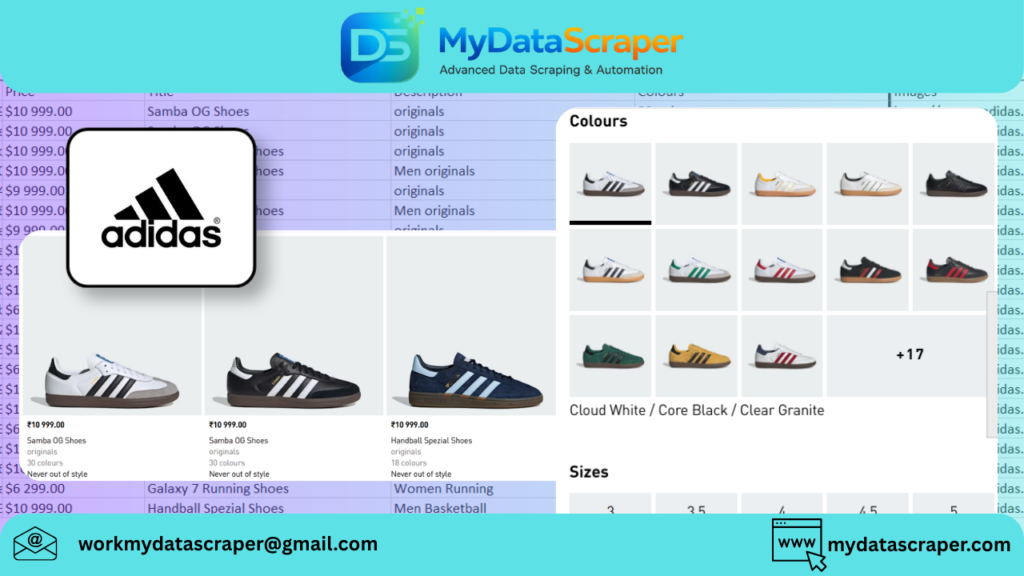
For example, a single Adidas sneaker model might have multiple SKUs based on:
- Size (UK 6, 7, 8, etc.)
- Color (black, white, red)
- Gender (men, women, unisex)
- Region (US, EU, India variants)
So while a product might look like “one shoe,” it actually exists as multiple SKUs in the system.
Why does this matter?
Because SKU-level data reveals what’s really happening in the market.
A Relatable Shopping Moment
I remember helping someone track down a specific pair of Adidas running shoes.
The product was available online—but only in certain sizes.
Size 9? Out of stock everywhere.
Size 7? Available on multiple platforms with discounts.
At first glance, it seemed like the product was “available.”
But at the SKU level, the reality was completely different.
That’s the power of SKU data—it shows true availability and demand.
What Adidas SKU Data Includes
When businesses extract SKU-level data from Adidas product listings, they typically collect several key data points.
1. Product Information
Basic product-level data includes:
- Product name
- Category (running, lifestyle, training)
- Description
- Product ID or model number
This helps identify the overall product group.
2. SKU Variations
This is where things get interesting.
SKU-level data includes:
- Size variants
- Color options
- Style variations
Each combination represents a unique SKU.
For example:
- Black / Size 8
- White / Size 9
- Red / Size 7
Each of these may have different availability and pricing.
3. Pricing Data
Pricing often varies at the SKU level.
You might see:
- Discounts on specific sizes
- Premium pricing on popular variants
- Regional price differences
Tracking SKU-level pricing helps businesses understand which variants drive revenue.
4. Stock Availability
Availability is one of the most valuable insights.
SKU data can show:
- In-stock vs out-of-stock status
- Low inventory signals
- Restocking patterns
For example:
If a specific size consistently goes out of stock, it may indicate high demand.
5. Product Ratings and Reviews
While reviews are usually product-level, they still provide context.
High ratings combined with frequent stockouts often signal strong-performing products.
Where SKU Data Comes From
Businesses collect Adidas SKU data from multiple sources, including:
- Brand websites
- Online marketplaces
- Retail partner sites
- Mobile apps
Each platform may display slightly different data, which makes cross-platform analysis even more valuable.
Why Businesses Scrape SKU Data
Now let’s talk about the “why.”
Why go through the effort of collecting SKU-level data?
Because it unlocks insights that product-level data simply can’t provide.
1. Demand Analysis
SKU data helps identify which variants are most popular.
For example:
- Which sizes sell out fastest
- Which colors are most in demand
- Which styles perform best in specific regions
This helps brands and retailers align inventory with demand.
2. Inventory Optimization
Retailers can use SKU insights to improve stock planning.
Instead of overstocking slow-moving variants, they can focus on high-demand SKUs.
This reduces:
- Dead stock
- Storage costs
- Lost sales opportunities
3. Competitive Pricing Intelligence
By tracking SKU-level pricing across platforms, businesses can:
- Compare discounts
- Identify pricing strategies
- Monitor competitor behavior
For example:
One retailer may discount only certain sizes to clear inventory.
Another may offer uniform discounts across all SKUs.
These patterns reveal pricing tactics.
4. Market Trend Identification
SKU data helps identify broader trends.
For example:
- Growing demand for neutral colors
- Increasing popularity of certain shoe categories
- Seasonal spikes in specific products
These insights help brands stay ahead of market shifts.
A Practical Example
Let’s say you’re analyzing Adidas sneakers across multiple eCommerce platforms.
You notice:
- Black color variants sell out quickly
- Bright colors remain in stock longer
- Mid-range sizes (8–10) have the highest demand
With this insight, a retailer can:
- Increase stock for black variants
- Reduce inventory for slow-moving colors
- Focus marketing on popular sizes
This is how SKU data drives real business decisions.
Challenges in SKU Data Extraction
While SKU data is valuable, collecting it isn’t always easy.
Some common challenges include:
Dynamic Content
Many eCommerce sites load SKU data dynamically.
This means traditional scraping methods may not capture all variations.
Frequent Updates
Prices and availability can change multiple times a day.
This requires continuous monitoring.
Regional Differences
SKU availability may vary by location.
A product available in one region may not appear in another.
Data Standardization
Different platforms may structure SKU data differently.
Businesses must normalize this data for accurate analysis.
The Role of Automation
Given these challenges, automation plays a key role in SKU data extraction.
Automated systems can:
- Collect data at scale
- Update datasets regularly
- Track changes over time
- Ensure consistency
This allows businesses to build reliable and up-to-date datasets.
The Future of SKU-Level Intelligence
As eCommerce continues to grow, SKU-level data will become even more important.
Future trends may include:
- AI-driven demand forecasting
- Real-time inventory optimization
- Personalized product recommendations
- Dynamic pricing at the SKU level
Brands that leverage SKU intelligence effectively will have a strong competitive advantage.
Final Thoughts
At first glance, a product page might seem simple.
But beneath the surface lies a complex system of SKUs, each telling a different story about demand, pricing, and availability.
By scraping and analyzing SKU data from Adidas, businesses can unlock insights that drive smarter decisions across inventory, pricing, and marketing.
And once you start thinking at the SKU level, you’ll never look at online shopping the same way again.
Join the Conversation
Have you ever struggled to find your size or preferred color while shopping online?
Did you notice price differences for different variants of the same product?
Share your experiences in the comments—we’d love to hear your thoughts!
Need Help Extracting SKU Data?
If you’re looking to collect and analyze SKU-level data from Adidas or other eCommerce platforms, we can help you turn raw product data into actionable insights.
👉 Visit our contact page to get started:
https://www.mydatascraper.com/contact-us/
Let’s transform product data into powerful eCommerce intelligence.