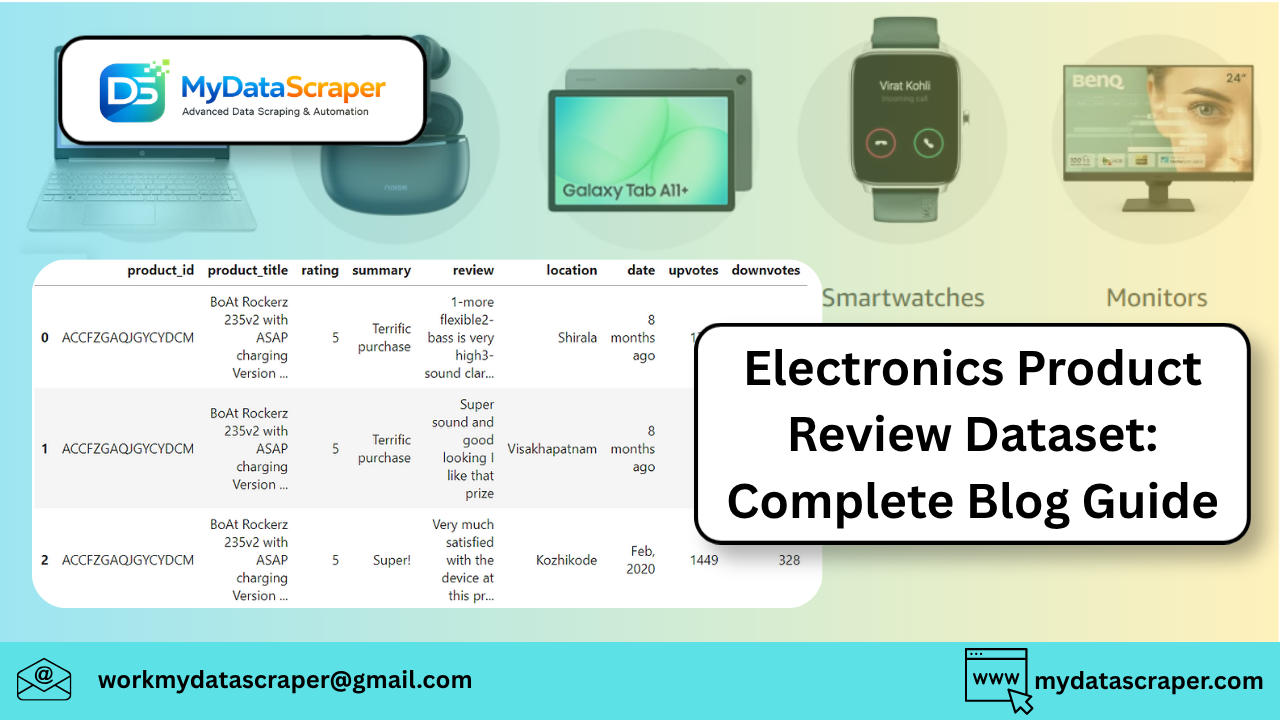
If you’re looking for an electronics product review dataset, you’re stepping into one of the most valuable data sources for understanding customer behavior, sentiment, and product performance in eCommerce.
Let’s break this down in a practical, no-fluff way—what datasets exist, what they contain, and how you can actually use them.
What Is an Electronics Product Review Dataset?
An electronics product review dataset typically includes customer feedback and ratings for products like:
- Smartphones
- Laptops
- Headphones
- TVs
- Smart home devices
These datasets combine structured data (ratings, product IDs) with unstructured data (review text)—making them perfect for analytics and AI use cases.
What Data Fields Are Included?
Most high-quality datasets contain:
Basic Fields
- Product ID / SKU
- Product name
- Brand
Review Data
- Review text
- Review title
- Rating (e.g., 1–5 stars)
- Review date
User Data
- Reviewer ID
- Verified purchase flag
Engagement Signals
- Helpful votes
- Review replies
Popular Electronics Review Datasets
Here are some widely used datasets you can start with:
1. Amazon Electronics Review Dataset
One of the most popular datasets for product reviews.
What it includes:
- Millions of reviews
- Star ratings
- Product metadata
- Time-based review data
Why it’s useful:
- Ideal for sentiment analysis
- Great for recommendation systems
- Covers a wide range of electronics products
2. Best Buy Product Reviews Dataset
Focused specifically on electronics retail.
Key features:
- Product-specific reviews
- Ratings and feedback
- Brand-level insights
3. Walmart Electronics Reviews
Includes customer feedback on electronics sold via Walmart.
Useful for:
- Price vs satisfaction analysis
- Competitive benchmarking
4. Flipkart Electronics Reviews
Especially useful for Indian market insights.
Includes:
- Regional preferences
- Budget vs premium product reviews
- High-volume mobile device feedback
A Simple Real-Life Use Case
Let’s say you’re launching a new pair of wireless earbuds.
By analyzing an electronics review dataset, you might discover:
- Customers complain about battery life
- Positive reviews mention comfort and fit
- Negative reviews focus on connectivity issues
With this insight, you can:
- Improve product design
- Adjust marketing messaging
- Highlight strengths in product listings
That’s the power of review data.
Key Use Cases of Electronics Review Data
1. Sentiment Analysis
You can classify reviews into:
- Positive
- Negative
- Neutral
This helps understand overall customer satisfaction.
2. Product Improvement
Identify common complaints such as:
- Poor battery
- Low durability
- Overheating
These insights directly guide product development.
3. Competitor Analysis
Compare reviews across brands to see:
- What competitors do better
- Where they fail
- What customers prefer
4. Recommendation Systems
Use review data to build:
- “Customers also liked” systems
- Personalized recommendations
5. Feature Extraction
Extract key product features from reviews like:
- Sound quality
- Display performance
- Build quality
How to Get an Electronics Review Dataset
You have three main options:
1. Public Datasets
Best for quick access.
Sources include:
- Kaggle
- Academic repositories
- Open data platforms
2. APIs
Some platforms provide structured access to review data.
Good for:
- Real-time data
- Scalable collection
3. Web Scraping (Most Powerful)
This is where things get interesting.
With product data scraping, you can collect:
- Reviews from multiple platforms
- Real-time updates
- Competitor insights
You’re not limited to pre-built datasets—you create your own.
Challenges in Working with Review Data
Unstructured Text
Reviews are messy.
Example:
“Battery is okay but not great, expected better tbh”
You’ll need NLP techniques to process this.
Fake Reviews
Not all reviews are genuine.
Filtering is important for accuracy.
Language Variations
Different regions = different languages and slang.
Data Volume
Large datasets require proper storage and processing.
Best Practices
Clean Your Data
- Remove duplicates
- Normalize text
- Handle missing values
Use NLP Tools
Apply techniques like:
- Tokenization
- Sentiment scoring
- Keyword extraction
Combine with Other Data
Review data becomes more powerful when combined with:
- Pricing data
- Sales data
- Product specs
Advanced Insights You Can Unlock
Once you go deeper, you can extract:
- Feature-level sentiment (e.g., battery vs camera)
- Trend shifts over time
- Regional preference differences
- Brand perception analysis
Future of Review Data Analytics
Review datasets are becoming even more powerful with AI.
Future trends include:
- AI-generated summaries
- Voice review analysis
- Real-time sentiment tracking
- Predictive product success models
Final Thoughts
An electronics product review dataset isn’t just a collection of feedback—it’s a direct line into the customer’s mind.
It tells you:
- What people love
- What frustrates them
- What they expect next
Whether you’re building an AI model, improving products, or tracking competitors, this data can give you a serious edge.
Want a Custom Electronics Review Dataset?
If you’re looking to build a custom, real-time electronics product review dataset using scraping across multiple platforms, we can help.
👉 Get in touch here:
https://www.mydatascraper.com/contact-us/
Let’s turn raw customer reviews into actionable insights 🚀