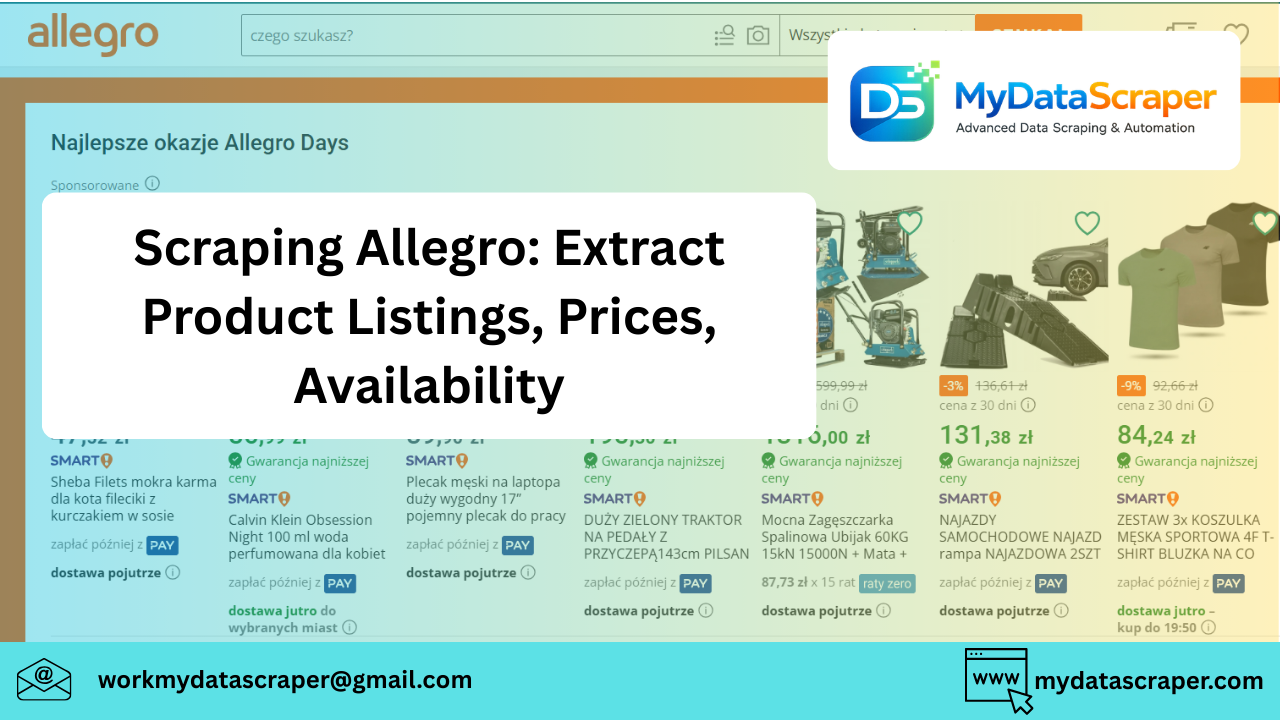
If you’ve ever gone down a rabbit hole while online shopping, you’ll relate to this.
You search for a product—say wireless earbuds—and suddenly you’re comparing 10 different listings. One has a better price, another has faster delivery, and a third offers a bundle deal. You bookmark a few options, come back later… and the prices have already changed.
Now imagine doing that not for one product—but for thousands of listings every day.
That’s exactly what businesses do when they extract data from platforms like Allegro.
Behind every listing lies valuable information about pricing, availability, competition, and demand. When collected at scale, this data becomes a powerful asset for eCommerce intelligence.
In this blog, we’ll walk you through how web scraping Allegro product listings, prices, and availability works—and how businesses use this data to gain a competitive edge.
Why Allegro Data Matters
Allegro is one of the largest eCommerce platforms in Europe, especially dominant in Poland.
It hosts millions of listings across categories like:
- Electronics
- Fashion
- Home & kitchen
- Automotive
- Beauty products
For brands and sellers targeting European markets, Allegro provides a real-time snapshot of market activity.
Analyzing this data helps answer questions like:
- What products are trending?
- How are competitors pricing similar items?
- Which products go out of stock frequently?
What Data Can You Extract from Allegro?
Let’s break down the most valuable data points businesses typically collect.
1. Product Listings
At the core of any scraping process is the product listing data.
This includes:
- Product title
- Category
- Brand
- Product description
- Images
- Listing URL
This data helps build a structured catalog of products available on the platform.
2. Pricing Data
Pricing is one of the most critical elements in eCommerce.
From Allegro listings, you can extract:
- Current price
- Original price (if discounted)
- Discount percentage
- Shipping cost
- Bundle pricing
Tracking this data over time allows businesses to perform advanced price monitoring.
3. Availability and Stock Status
Availability data reveals real demand patterns.
You can track:
- In-stock vs out-of-stock products
- Limited stock indicators
- Restocking frequency
For example:
If a product frequently goes out of stock, it likely indicates high demand.
4. Seller Information
Unlike single-brand stores, marketplaces like Allegro include multiple sellers.
Data points include:
- Seller name
- Seller ratings
- Number of reviews
- Seller location
This helps identify top-performing sellers and trusted vendors.
5. Ratings and Reviews
Customer feedback provides insight into product performance.
Extractable data includes:
- Average rating
- Review count
- Customer comments
This helps businesses understand what customers like—or dislike.
A Simple Real-World Example
Let’s say you’re selling smartwatches in Europe.
By analyzing Allegro data, you might discover:
- One competitor consistently undercuts prices
- Another offers free shipping to attract buyers
- A specific model frequently goes out of stock
With these insights, you can:
- Adjust pricing
- Improve offers
- Stock high-demand products
This is how raw data turns into strategy.
How Web Scraping Works for Allegro
While the technical side can vary, the process generally follows a structured approach.
Step 1: Define Target Data
Start by identifying what you need:
- Product listings
- Pricing data
- Availability
- Seller details
Clear goals ensure efficient scraping.
Step 2: Collect Data from Listings
Scraping tools navigate through:
- Category pages
- Search results
- Product detail pages
They extract structured data fields from each listing.
Step 3: Handle Dynamic Content
Modern eCommerce platforms often load data dynamically.
This means scraping systems must handle:
- JavaScript-rendered pages
- Pagination
- Filters and sorting
Step 4: Clean and Structure Data
Raw data is rarely perfect.
It must be:
- Standardized
- Organized
- De-duplicated
This ensures accurate analysis.
Step 5: Store and Analyze
Once cleaned, data is stored in databases or spreadsheets.
From there, businesses can:
- Track price trends
- Monitor stock changes
- Analyze competitors
Key Use Cases of Allegro Data Scraping
Let’s explore how businesses actually use this data.
1. Price Monitoring
This is one of the most common use cases.
Businesses track competitor prices to:
- Stay competitive
- Identify discount trends
- Adjust pricing dynamically
Even small price differences can impact sales significantly.
2. Competitor Analysis
Scraping Allegro allows businesses to:
- Track competitor listings
- Monitor new product launches
- Analyze seller performance
This helps companies stay ahead in the market.
3. Demand Analysis
Availability data reveals demand patterns.
For example:
- Frequent stockouts → high demand
- Slow-moving inventory → low demand
This helps businesses optimize inventory planning.
4. Product Research
Companies use product data to identify:
- Trending items
- High-performing categories
- Market gaps
This is especially useful for launching new products.
5. Marketplace Intelligence
Allegro data provides insights into:
- Seller competition
- Pricing strategies
- Customer preferences
This helps businesses understand the overall ecosystem.
Challenges in Scraping Allegro Data
While powerful, scraping comes with challenges.
Frequent Data Changes
Prices and availability can change multiple times a day.
Continuous monitoring is required.
Large Data Volume
Marketplace data can be massive.
Handling and analyzing it requires scalable systems.
Data Consistency
Different sellers may list the same product differently.
Standardizing this data is essential for accurate insights.
Platform Complexity
Modern platforms use advanced technologies that require sophisticated scraping tools.
Best Practices for Effective Data Extraction
To get the most value from Allegro scraping, follow these best practices.
Focus on Key Metrics
Prioritize:
- Price
- Availability
- Product details
Avoid unnecessary data overload.
Automate Data Collection
Automation ensures:
- Real-time updates
- Consistent data
- Scalability
Monitor Regularly
Daily or hourly tracking helps capture:
- Price fluctuations
- Stock changes
- New listings
Normalize Data
Standardize formats for:
- Prices
- Product categories
- Seller information
This improves analysis accuracy.
The Future of Marketplace Data Intelligence
As eCommerce grows, platforms like Allegro will continue generating massive amounts of data.
Future trends include:
- AI-driven price optimization
- Real-time competitor tracking
- Predictive demand analysis
- Automated inventory management
Businesses that leverage this data effectively will gain a significant advantage.
Final Thoughts
Online marketplaces are more than just shopping platforms—they’re data ecosystems.
By extracting product listings, prices, and availability from Allegro, businesses can uncover insights that drive smarter decisions.
From price monitoring to demand analysis, data scraping transforms raw information into actionable intelligence.
And once you start using data strategically, you’ll never look at eCommerce the same way again.
Join the Conversation
Have you ever noticed price differences for the same product across different sellers?
Do you compare multiple listings before making a purchase?
Share your thoughts in the comments—we’d love to hear your shopping strategies!
Need Help Extracting Allegro Data?
If you’re looking to scrape product listings, monitor prices, or analyze marketplace trends from Allegro, we can help you turn raw data into meaningful insights.
👉 Visit our contact page:
https://www.mydatascraper.com/contact-us/
Let’s unlock the full potential of eCommerce data together 🚀