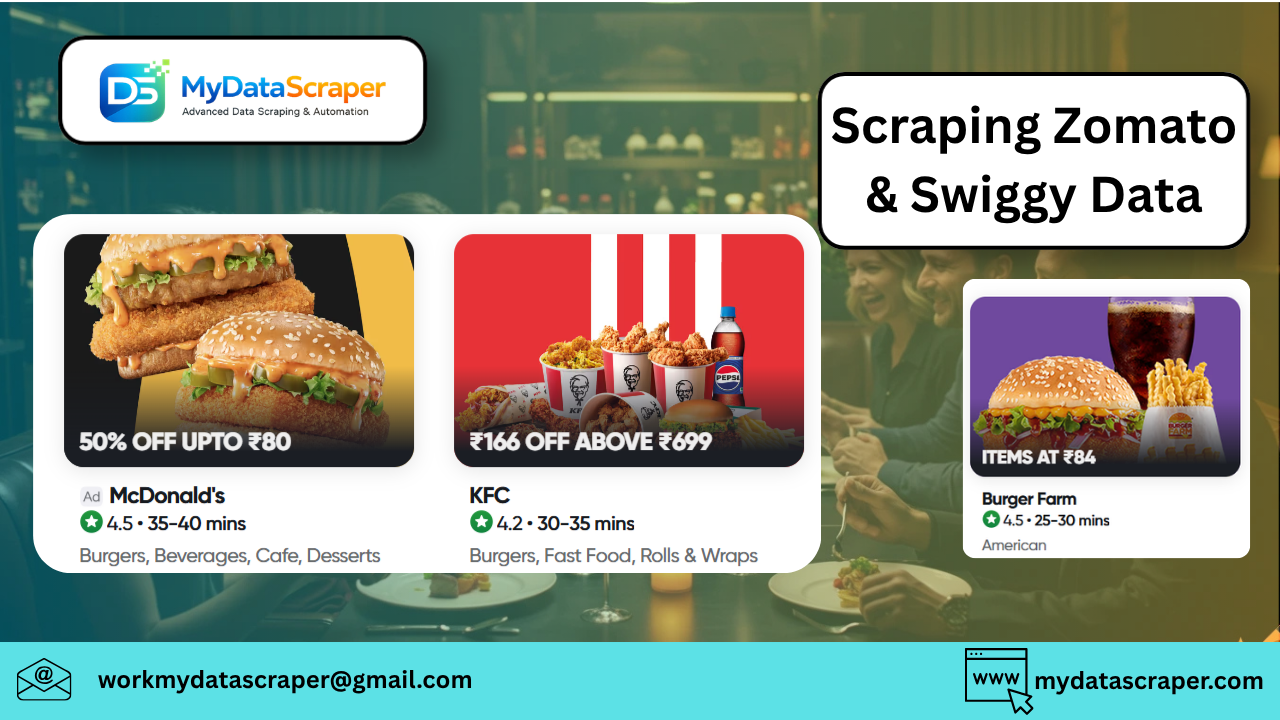
If you’ve ever opened a food delivery app on a busy evening, you already know how dynamic these platforms are. A restaurant that showed a 25-minute delivery time yesterday might show 40 minutes today. The same dish might be ₹20 cheaper on one platform and bundled with an offer on another.
Behind this everyday convenience lies a rich, constantly evolving data ecosystem.
Platforms like Zomato and Swiggy generate enormous volumes of real-time data—menus, pricing, delivery estimates, customer feedback, and promotional strategies. When analyzed properly, this data becomes a powerful asset for restaurants, cloud kitchens, aggregators, and market analysts.
In this blog, we’ll take a professional yet practical look at how Zomato and Swiggy data can be extracted, the methods involved, and the real-world use cases that make this data so valuable.
Why This Data Matters More Than You Think
Food delivery platforms are not static catalogs—they are live marketplaces.
Every few minutes, something changes:
- Prices adjust based on demand
- Discounts are activated or removed
- Delivery times fluctuate
- Menu items go out of stock
For businesses, these changes are not random—they reflect customer demand, operational efficiency, and competitive strategy.
A Simple Observation
A while ago, I compared the same restaurant across Zomato and Swiggy during peak dinner hours.
What stood out wasn’t just the pricing difference—it was the strategy:
- One platform showed a discount but higher delivery charges
- The other offered faster delivery but no discount
- Menu visibility also differed slightly
That’s when it becomes clear: each platform optimizes differently—and that’s where insights live.
What Data Can You Extract?
To make sense of these platforms, you need to look at the right data layers.
Restaurant-Level Data
- Restaurant name
- Location and service area
- Cuisine categories
- Ratings and review counts
This helps understand market positioning and popularity.
Menu Data
- Item names and categories
- Descriptions and images
- Variants (half/full, combo meals)
Menu data reveals what customers are actually being offered.
Pricing Data
- Item price
- Discounted price
- Combo pricing
- Platform-specific pricing differences
This is essential for price benchmarking and strategy analysis.
Delivery Intelligence
- Estimated delivery time
- Delivery fees
- Distance-based variations
These factors directly impact customer decisions.
Offers & Promotions
- Coupons and promo codes
- Bank or wallet offers
- Limited-time deals
Understanding promotions helps decode customer acquisition tactics.
Availability Signals
- Open/closed status
- Item availability
- Time-based menu changes
These signals often reflect operational efficiency and demand.
Methods to Extract Zomato & Swiggy Data
Extracting data from modern platforms requires a thoughtful, layered approach.
1. HTML-Based Scraping
This is the most straightforward method.
It involves extracting data directly from page structures using parsing tools.
Best suited for:
- Basic listings
- Static restaurant information
However, this method has limitations because most modern content is dynamically loaded.
2. API-Based Extraction
Both Zomato and Swiggy rely heavily on backend APIs.
When accessible, APIs provide:
- Clean, structured data
- Faster extraction
- More reliable datasets
Best suited for:
- Menu details
- Pricing
- Restaurant listings
3. Browser Automation
Since much of the content is rendered via JavaScript, browser automation tools simulate real user interactions.
This approach allows you to:
- Load dynamic content
- Handle infinite scrolling
- Extract location-specific data
Best suited for:
- Full-page scraping
- Complex interactions
- Real-time data extraction
4. Location-Based Data Simulation
One of the most critical aspects of food delivery data is location dependency.
The same restaurant can show:
- Different prices
- Different menus
- Different delivery times
depending on the user’s location.
Advanced scraping setups simulate multiple locations to capture these variations.
Key Challenges You’ll Encounter
While the opportunity is significant, the process isn’t without challenges.
Dynamic and Real-Time Data
Menus, prices, and delivery times change frequently, requiring continuous data collection.
Anti-Bot Mechanisms
Both platforms use safeguards such as:
- Rate limiting
- IP blocking
- Behavioral detection
This requires careful request handling and realistic interaction patterns.
Data Consistency Issues
The same dish might be listed differently across restaurants or platforms.
Standardizing this data is essential for meaningful analysis.
Scale and Complexity
Scraping a handful of restaurants is simple. Scaling to hundreds or thousands requires:
- Automation
- Infrastructure
- Data pipelines
Real-World Use Cases
This is where things get interesting—how businesses actually use this data.
1. Competitive Pricing Intelligence
Restaurants and cloud kitchens track:
- Dish-level pricing across competitors
- Discount strategies
- Platform-specific pricing differences
This helps them position their offerings effectively.
2. Menu Optimization
By analyzing menu data, businesses can identify:
- High-performing dishes
- Popular cuisines
- Optimal pricing ranges
This leads to better menu design and higher conversions.
3. Delivery Performance Insights
Delivery time plays a crucial role in customer satisfaction.
Businesses analyze:
- Delivery speed vs ratings
- Peak-hour delays
- Area-wise performance
4. Customer Sentiment Analysis
Reviews and ratings provide direct insight into:
- Food quality
- Packaging
- Delivery experience
This helps improve operations and customer experience.
5. Market Expansion Strategy
For anyone launching a new restaurant or cloud kitchen, this data answers critical questions:
- Which cuisines are in demand?
- What price range works best?
- Which areas have less competition?
A Practical Scenario
Imagine you’re planning to launch a cloud kitchen in Ahmedabad.
By analyzing data from Zomato and Swiggy, you might discover:
- Biryani, North Indian, and fast food dominate orders
- The average order value sits between ₹150–₹300
- Combo meals outperform individual items
- Faster delivery correlates with better ratings
With this insight, you can:
- Design a focused menu
- Price strategically
- Optimize delivery operations
Best Practices for Reliable Data Extraction
To ensure accuracy and sustainability:
Be Thoughtful with Requests
Avoid overwhelming platforms—space out requests and mimic human behavior.
Focus on Relevant Data
Collect only what you need to avoid unnecessary complexity.
Normalize Your Dataset
Standardize:
- Price formats
- Dish categories
- Restaurant naming
Automate Smartly
Schedule regular updates to keep your data fresh and actionable.
Legal & Ethical Considerations
Data extraction should always be approached responsibly.
- Review platform terms of service
- Avoid scraping personal or sensitive user data
- Use data for analytical and business purposes only
- Ensure compliance with local regulations
The Road Ahead: Food Data Intelligence
The food delivery ecosystem is becoming increasingly data-driven.
We’re moving toward:
- Real-time pricing optimization
- AI-driven menu recommendations
- Hyperlocal demand prediction
- Personalized user experiences
In this landscape, data from Zomato and Swiggy will play a central role in shaping smarter business decisions.
Final Thoughts
Scraping Zomato and Swiggy data isn’t just about collecting information—it’s about understanding the story behind the data.
Every price change, every menu update, every delivery estimate reflects a deeper layer of strategy and demand.
When you connect those dots, you move from raw data to actionable intelligence.
Let’s Continue the Conversation
When you order food online, what matters most to you?
- Price?
- Delivery time?
- Ratings?
- Offers?
Share your thoughts—I’d love to hear how you make your decisions.
Need Help Extracting Food Delivery Data?
If you’re looking to build a reliable system for extracting and analyzing data from Zomato and Swiggy, we can help.
👉 Get started here:
https://www.mydatascraper.com/contact-us/
Let’s turn food delivery data into meaningful business insights 🍽️🚀