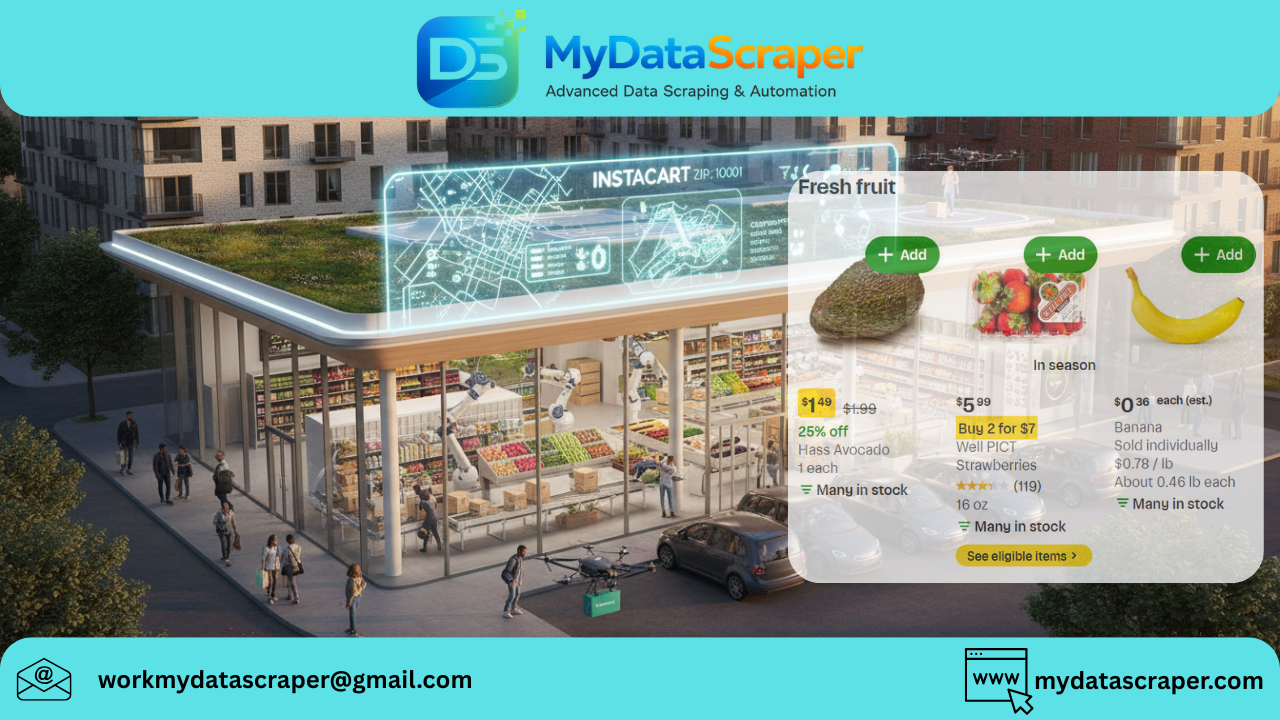
Imagine this: it’s a rainy Sunday evening. You’ve just realized you’re out of milk, eggs, and that one snack you absolutely can’t watch a movie without. Instead of putting on a jacket and driving to the store, you open a grocery delivery app. Within seconds, you’re browsing products from nearby stores, seeing prices, availability, and delivery options that are tailored specifically to your neighborhood.
That seamless experience isn’t magic—it’s powered by something called ZIP code-based product mapping, one of the most exciting innovations shaping the future of hyperlocal e-commerce. Platforms like Instacart rely heavily on location intelligence to show you the right products, from the right stores, at the right price.
In this blog post, we’ll explore how ZIP code-based product mapping works, why it’s transforming online grocery shopping, and how businesses can leverage hyperlocal data to stay competitive in the evolving e-commerce landscape.
The Rise of Hyperlocal E-Commerce
Not long ago, e-commerce operated on a fairly simple model: you ordered something online, and it shipped from a central warehouse. Delivery took a few days, and inventory was largely the same for everyone regardless of where they lived.
Today, things are very different.
Consumers expect:
- Same-day delivery
- Real-time product availability
- Location-specific pricing
- Personalized recommendations
This shift has led to the rise of hyperlocal e-commerce, where products and services are delivered from nearby stores rather than distant warehouses.
Instacart is a perfect example of this model in action. Instead of stocking inventory itself, the platform connects users with grocery stores in their area. When a customer enters their ZIP code, Instacart loads a catalog of stores and products available within that delivery zone.
In other words, the grocery options you see online are determined largely by where you live.
What Is ZIP Code-Based Product Mapping?
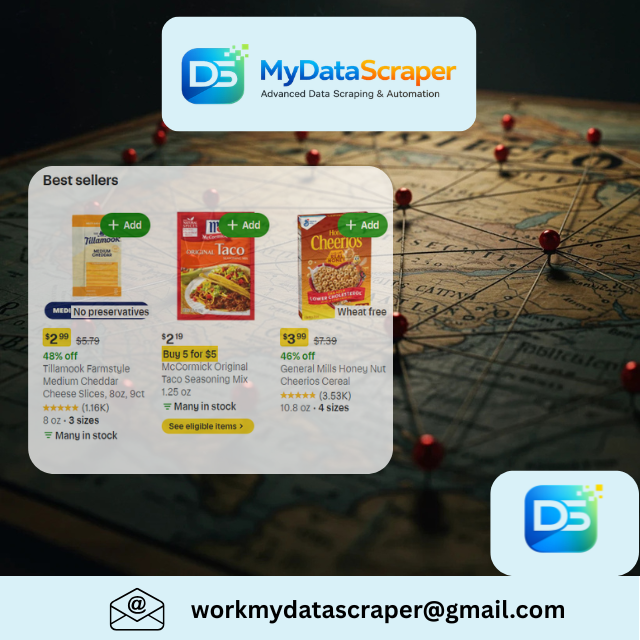
ZIP code-based product mapping is the process of linking products, prices, and inventory to specific geographic locations.
When a customer enters a ZIP code in an app like Instacart, several things happen behind the scenes:
- The platform identifies stores that deliver to that location.
- It loads the product catalogs for those stores.
- It displays prices, promotions, and availability specific to that area.
This means two customers browsing the same product might see completely different results.
For example:
- A shopper in one neighborhood might see five grocery stores offering organic strawberries.
- Someone a few miles away might only see two stores with the same product.
Even prices can vary. Studies show the same product may differ by $0.40 to $0.80 between ZIP codes, depending on the store and local market conditions.
This is the essence of hyperlocal commerce: location defines the shopping experience.
A Personal Story: The “Wrong ZIP Code” Moment
A friend of mine once told me a story that perfectly illustrates this concept.
She was ordering groceries online while visiting her sister across town. Out of habit, she entered her own home ZIP code instead of her sister’s address.
Immediately, the app showed a completely different set of stores and products.
The funny part?
One of her favorite local bakeries disappeared from the results. It turned out that the bakery only partnered with the platform in certain delivery zones.
The moment she switched the ZIP code, the bakery magically reappeared.
It was a simple mistake—but it revealed how deeply location influences the digital grocery experience.
How Instacart Uses Location Data
Instacart’s system is built around the idea that every order is local.
Once a user enters their delivery address, the platform identifies stores within a specific delivery radius—often within about a 30-minute travel time.
From there, the system dynamically adjusts:
- Available products
- Store selection
- Delivery times
- Pricing
If multiple stores carry the same item, the platform can choose the one closest to the customer or the one most likely to have the item in stock.
Behind the scenes, Instacart also tracks detailed product location data inside stores, such as aisle numbers, shelves, and departments.
This helps shoppers pick items faster and improves delivery efficiency.
Why ZIP Code-Based Product Mapping Matters
At first glance, this might sound like a simple technical feature.
But in reality, it’s transforming the entire grocery ecosystem.
Let’s break down why.
1. Personalized Shopping Experiences
One of the biggest benefits of hyperlocal mapping is personalization.
Instead of browsing a generic catalog, shoppers see products that actually exist in nearby stores.
This means:
- Accurate availability
- Faster delivery
- Relevant recommendations
Imagine searching for “fresh bread.”
In one ZIP code, the results might highlight a local bakery. In another, it might show supermarket brands.
That level of relevance makes online grocery shopping feel more natural and local.
2. Real-Time Competitive Pricing
Hyperlocal data also enables dynamic pricing insights.
Research shows that identical products can have price differences of up to 22% between nearby stores, even within the same city.
Why?
Because each store operates independently, with different:
- Promotions
- Inventory levels
- Supplier costs
- Local demand
ZIP code-based product mapping allows platforms to display those variations transparently.
For shoppers, that means better deals.
For brands, it means new opportunities for competitive analysis.
3. Improved Delivery Efficiency
Speed is everything in modern e-commerce.
Customers expect groceries in hours—not days.
Hyperlocal mapping helps platforms choose the best store for each order by considering factors such as:
- Distance from the customer
- Item availability
- Shopper proximity
This reduces delivery time and increases order accuracy.
Think about it like a smart logistics system constantly optimizing itself.
4. Smarter Retail Strategy
For retailers and brands, ZIP code-level insights are incredibly valuable.
They reveal patterns like:
- Which neighborhoods buy organic products
- Where certain brands sell faster
- Which stores run out of stock more often
Businesses can use this data to improve:
- Inventory planning
- Product placement
- Pricing strategies
- Promotional campaigns
In short, hyperlocal data turns guesswork into strategy.
5. Better Demand Forecasting
Hyperlocal product mapping also enables powerful demand forecasting.
By analyzing product availability and sales across ZIP codes, companies can identify emerging trends faster.
For example:
- Plant-based milk might trend first in urban ZIP codes.
- Family-sized snacks might dominate suburban areas.
These insights help brands stay ahead of consumer behavior.
The Data Behind the Scenes
Behind every Instacart search result lies a complex data pipeline.
Retailers provide inventory data, product descriptions, and store details. Instacart then combines that information with additional data sources to maintain accurate product listings.
The system constantly updates:
- Product catalogs
- Inventory status
- Store coverage areas
- Delivery availability
All of this ensures customers see the most relevant options for their location.
Why Data Scraping Is Becoming Essential
As hyperlocal e-commerce grows, businesses need reliable ways to collect and analyze location-specific data.
That’s where ZIP code-based data extraction becomes incredibly valuable.
With the right tools, companies can gather information such as:
- Product listings per ZIP code
- Store availability
- Local price variations
- Category trends
- Inventory distribution
For example, businesses can track how a product performs across multiple neighborhoods or compare pricing between retailers.
These insights help brands make smarter decisions about:
- Market expansion
- Pricing strategies
- Product launches
- Competitive positioning
The Future of Hyperlocal E-Commerce
Looking ahead, hyperlocal commerce will only become more advanced.
Here are a few trends likely to shape the future:
AI-Driven Product Recommendations
Machine learning models are already improving search and recommendations in grocery apps.
Advanced AI systems can analyze search behavior and shopping patterns to deliver better results and increase cart additions.
In the future, these systems will become even more personalized.
Predictive Inventory
Imagine opening an app and seeing items suggested based on what’s currently in stock at nearby stores.
Predictive systems will soon anticipate demand and adjust product recommendations accordingly.
Neighborhood-Level Marketing
Brands may soon run campaigns targeting specific ZIP codes.
For example:
- A beverage brand might promote summer drinks in hot regions.
- A bakery might advertise breakfast deals in commuter neighborhoods.
Hyperlocal data will make these strategies possible.
Faster Delivery Models
With better location mapping, delivery windows will shrink.
What used to take hours could soon take minutes.
Why This Matters for Businesses
If your business sells products online—especially in grocery, retail, or delivery services—hyperlocal data is no longer optional.
It’s essential.
Companies that understand location-based product availability will gain a major advantage in:
- Market intelligence
- Competitive pricing
- Customer personalization
- Operational efficiency
In the coming years, the companies that win in e-commerce won’t just understand products.
They’ll understand places.
Final Thoughts
The future of e-commerce isn’t just digital—it’s hyperlocal.
ZIP code-based product mapping is transforming how platforms like Instacart connect shoppers with nearby stores, creating a shopping experience that feels personal, relevant, and incredibly convenient.
For consumers, this means faster deliveries and better choices.
For businesses, it means powerful insights into local markets and customer behavior.
And honestly, once you start noticing how much your location influences what you see online, it’s hard to unsee it.
Next time you open a grocery delivery app, try changing your ZIP code for fun.
You might be surprised at how much the digital grocery aisle changes.
What Do You Think?
Have you ever noticed different products or prices appearing when you change your delivery location in an app like Instacart?
Do you think hyperlocal e-commerce will eventually replace traditional retail shopping?
I’d love to hear your thoughts—feel free to share your experiences or opinions in the comments!
Need Help With Hyperlocal Data?
If you’re looking to collect ZIP code-based product data, analyze Instacart listings, or build powerful location-driven insights for your business, we’re here to help.
👉 Visit our contact page to learn more or discuss your project:
https://www.mydatascraper.com/contact-us/
Our team would be happy to assist you with the tools and expertise needed to unlock the full potential of hyperlocal e-commerce data.