If you’ve ever run a scraper that worked perfectly… but took hours to finish, you’ve already hit the wall most data teams eventually face:
👉 Speed becomes the bottleneck.
At small scale, sequential scraping works fine. But as soon as you need to extract thousands—or millions—of pages, things change. Latency adds up. Requests pile up. And suddenly, your “simple script” becomes painfully slow.
That’s where modern Python tools like httpx and the asyncio framework come in.
In this guide, we’ll walk through how to build high-speed, concurrent scraping pipelines using async techniques—without turning your codebase into a mess.
Why Traditional Scraping Slows Down
Let’s start with a quick reality check.
A typical synchronous scraper looks like this:
- Send request
- Wait for response
- Parse data
- Repeat
That “wait” is the problem.
Even if each request takes just 1 second:
- 1,000 pages = ~16 minutes
- 10,000 pages = ~2.7 hours
And that’s assuming everything runs smoothly.
The Insight
👉 Most scraping time is spent waiting for network responses, not processing data.
So the obvious question becomes:
👉 What if we didn’t wait?
Enter Asynchronous Scraping
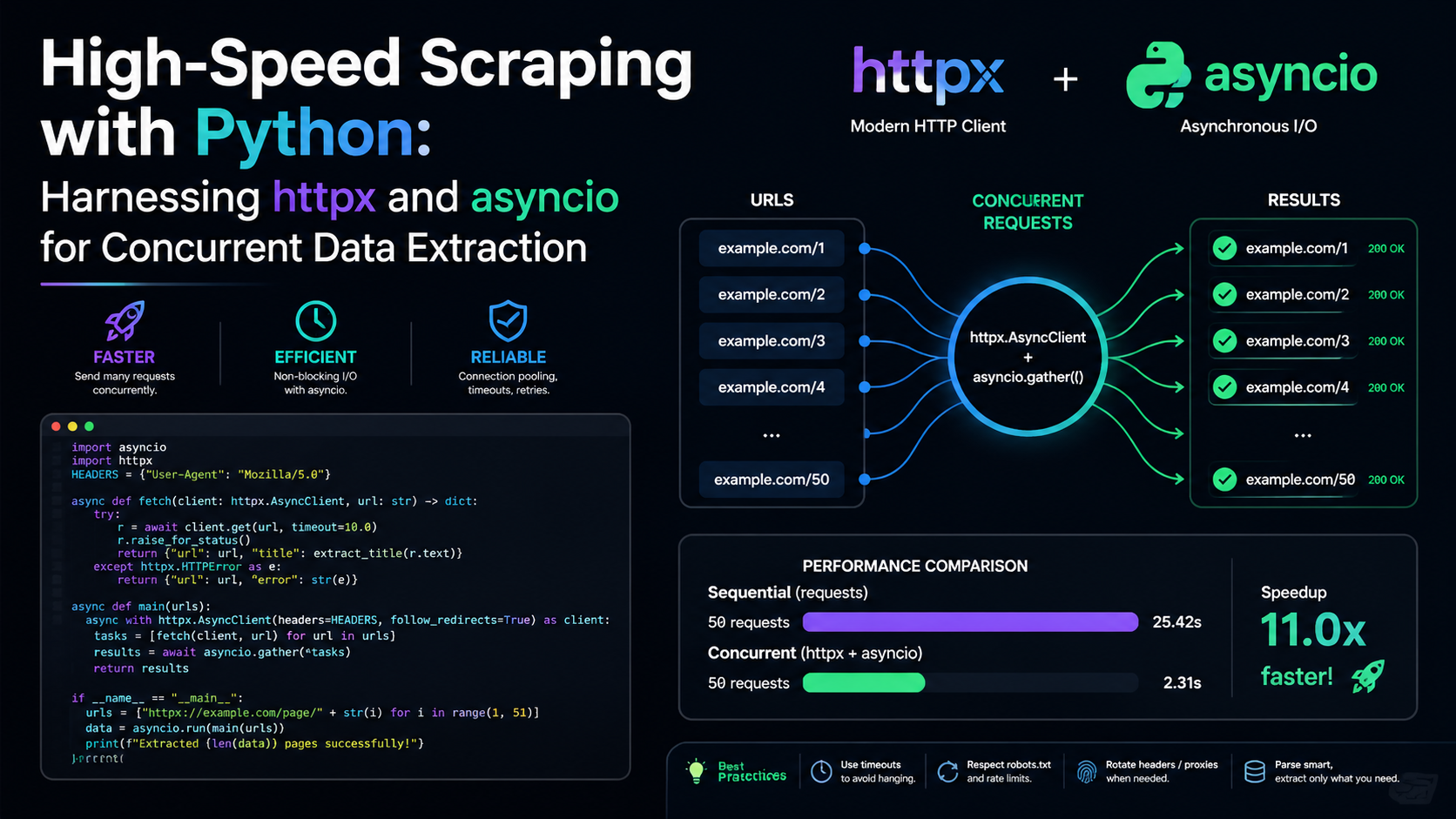
With asyncio, you can send multiple requests at the same time.
Instead of:
👉 Request → Wait → Request → Wait
You get:
👉 Request → Request → Request → Process responses as they arrive
This dramatically improves speed.
Why Use httpx Instead of requests?
While requests is great, it’s synchronous.
httpx is designed for modern workflows.
Key Advantages of httpx
- Supports both sync and async
- HTTP/2 support (faster connections)
- Better timeout handling
- Cleaner API for async workflows
👉 In short: it’s built for performance.
Building a High-Speed Scraper (Step-by-Step)
Let’s walk through a practical setup.
Step 1: Install Dependencies
pip install httpx
Step 2: Basic Async Request
import httpx
import asyncioasync def fetch(url):
    async with httpx.AsyncClient() as client:
        response = await client.get(url)
        return response.textasync def main():
    html = await fetch("https://example.com")
    print(html)asyncio.run(main())
What’s happening here?
async defdefines asynchronous functionsawaitallows non-blocking execution- The event loop (
asyncio.run) manages everything
Step 3: Concurrent Requests
Now let’s scale it.
import httpx
import asynciourls = [
    "https://example.com/page1",
    "https://example.com/page2",
    "https://example.com/page3"
]async def fetch(client, url):
    response = await client.get(url)
    return response.textasync def main():
    async with httpx.AsyncClient() as client:
        tasks = [fetch(client, url) for url in urls]
        results = await asyncio.gather(*tasks)    for html in results:
        print(len(html))asyncio.run(main())
Why this is powerful
👉 All requests are sent simultaneously, not one after another.
Step 4: Control Concurrency (Important!)
Too many requests can:
- Crash your system
- Trigger anti-bot protections
- Get your IP blocked
Use semaphores to control concurrency:
import asyncio
import httpxsem = asyncio.Semaphore(5)async def fetch(client, url):
    async with sem:
        response = await client.get(url)
        return response.text
Insight
👉 Balance speed with stability.
Step 5: Add Timeouts & Retries
Real-world scraping isn’t perfect.
async def fetch(client, url):
    try:
        response = await client.get(url, timeout=10)
        return response.text
    except Exception as e:
        print(f"Error: {url}")
        return None
Step 6: Parse Data Efficiently
Use parsers like:
- BeautifulSoup
- lxml
But keep parsing lightweight—your bottleneck should stay network-bound, not CPU-bound.
Performance Comparison
| Approach | Time for 1,000 URLs |
|---|---|
| Sequential (requests) | ~15–20 minutes |
| Async (httpx + asyncio) | ~1–3 minutes |
👉 That’s a 5–10x improvement.
Real-World Use Cases
1. Price Monitoring
Track thousands of product pages across eCommerce sites.
2. Market Research
Extract large datasets quickly for analysis.
3. Aggregation Platforms
Build systems that rely on real-time data.
4. SEO Data Collection
Scrape SERPs, metadata, and competitor content.
Challenges You’ll Face
1. Anti-Bot Systems
Faster scraping increases detection risk.
2. Rate Limits
APIs and websites may throttle requests.
3. Memory Usage
Handling thousands of responses can consume memory.
4. Debugging Complexity
Async code is harder to debug than sync code.
Best Practices for High-Speed Scraping
Keep Concurrency Controlled
Don’t go for maximum speed—go for optimal speed.
Rotate Headers & IPs
Avoid detection by mimicking real users.
Log Everything
Track failures, retries, and performance.
Use Batching
Process data in chunks instead of all at once.
A Practical Perspective
Here’s something many developers realize after scaling:
👉 Writing a fast scraper is easy.
👉 Maintaining it at scale is hard.
Between:
- Anti-bot systems
- Changing site structures
- Infrastructure issues
Scraping becomes an ongoing effort—not a one-time setup.
How MyDataScraper Can Help
If you need high-speed data extraction but don’t want to manage complex async pipelines, this is where MyDataScraper comes in.
What You Get
- High-performance scraping systems built with async architectures
- Optimized concurrency and request handling
- Anti-bot handling (proxies, headers, fingerprinting)
- Scalable data pipelines
- Clean, ready-to-use datasets
The Real Advantage
Instead of spending time:
- Debugging async code
- Managing failures
- Scaling infrastructure
You can focus on:
👉 Using the data—not collecting it.
The Future of High-Speed Scraping
We’re moving toward:
- Fully asynchronous pipelines
- Distributed scraping systems
- AI-assisted data extraction
- Real-time data streaming
Speed is no longer optional—it’s expected.
Final Thoughts
Using httpx with asyncio isn’t just about writing faster code.
It’s about changing how you think about data extraction.
From:
👉 Sequential and slow
To:
👉 Concurrent and scalable
And in today’s data-driven world, that shift makes all the difference.
Let’s Continue the Conversation
Have you tried async scraping before?
- Did you see performance gains?
- Or run into scaling challenges?
I’d love to hear your experience.
Need a High-Speed Scraping Solution?
If you’re looking to build or scale high-performance scraping systems:
👉 Visit: https://www.mydatascraper.com/contact-us/
Let’s build a data pipeline that’s fast, reliable, and built for scale 🚀