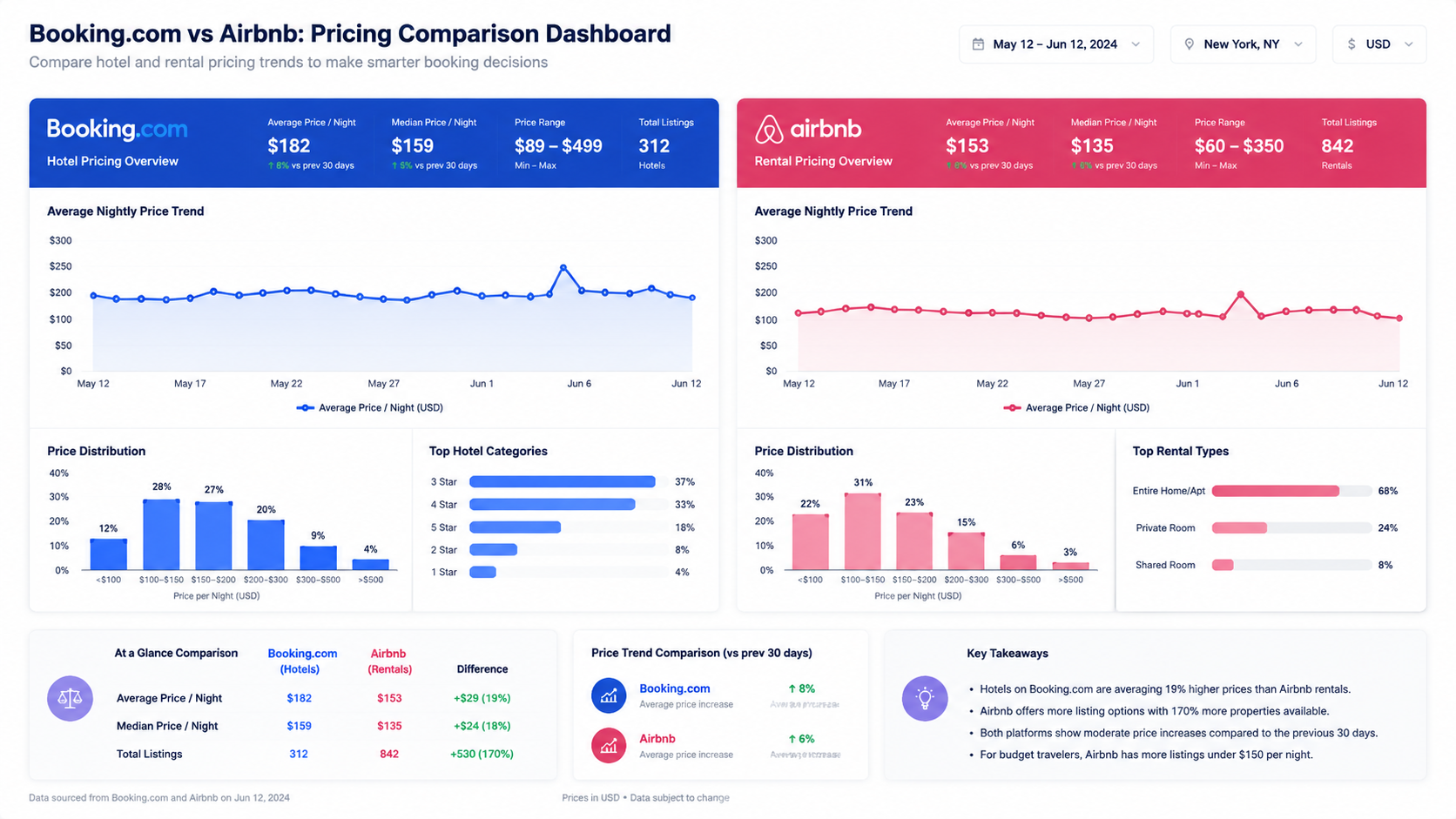
Travel pricing has become one of the most dynamic data ecosystems on the internet.
Open a hotel listing today, and by tomorrow:
- The price may change
- The availability may disappear
- Promotions may shift
- Fees may adjust
- Entire listings may move in rankings
For travel businesses, analysts, investors, and pricing intelligence teams, this creates one critical challenge:
👉 Which platform provides cleaner, more reliable data for forecasting future prices?
And when discussing travel pricing data, two giants dominate the conversation:
- Booking.com
- Airbnb
At first glance, both seem similar:
- Accommodation listings
- Dynamic pricing
- Availability tracking
- Review systems
But from a data intelligence perspective, they are fundamentally different ecosystems.
And those differences matter enormously when building:
- Price forecasting models
- Revenue prediction systems
- Hospitality analytics dashboards
- Demand forecasting pipelines
In this detailed guide, we’ll break down:
- How Booking.com and Airbnb structure pricing
- Which platform produces cleaner forecasting signals
- The biggest data challenges analysts face
- Forecasting reliability differences
- And how businesses can use these datasets strategically
Why “Clean Data” Matters in Price Forecasting
Before comparing platforms, let’s clarify something important.
When analysts say “clean data,” they usually mean:
👉 Data that is:
- Structured
- Consistent
- Predictable
- Standardized
- Easy to normalize
Because forecasting models rely heavily on consistency.
Messy or highly irregular data leads to:
- Forecasting noise
- Poor prediction accuracy
- Model instability
What Makes Travel Pricing Data Difficult?
Travel pricing is one of the hardest forecasting environments because it changes constantly based on:
- Seasonality
- Local demand
- Events
- Occupancy
- Weather
- Holidays
- Competition
- Inventory availability
And both Booking.com and Airbnb handle these variables differently.
Understanding the Core Difference Between the Platforms
This is the single most important concept in the entire discussion.
Booking.com = Structured Hospitality Ecosystem
Booking.com primarily aggregates:
- Hotels
- Resorts
- Managed properties
- Professional accommodations
This creates:
👉 More standardized pricing behavior.
Characteristics of Booking.com Data
- Consistent room structures
- Standardized amenities
- Predictable occupancy models
- Similar cancellation policies
- Comparable nightly pricing systems
Airbnb = Decentralized Host Marketplace
Airbnb operates more like:
👉 A distributed peer-to-peer ecosystem.
Listings vary dramatically:
- Apartments
- Villas
- Shared rooms
- Tiny homes
- Luxury rentals
And pricing behavior depends heavily on:
- Individual host decisions
- Host psychology
- Manual pricing adjustments
Result
Airbnb data tends to be:
- More irregular
- Less standardized
- More volatile
Why Booking.com Usually Produces Cleaner Forecasting Data
Let’s break this down in detail.
1. Standardized Property Types
On Booking.com, hotels generally follow consistent operational structures.
Example:
- Standard room
- Deluxe room
- Suite
Pricing behaves predictably relative to room class.
Why This Helps Forecasting
Models can more easily identify:
- Seasonal pricing patterns
- Occupancy trends
- Market-level demand signals
because room categories are relatively standardized.
Airbnb’s Challenge
On Airbnb:
- Listings differ dramatically
- Property uniqueness increases variance
One listing might include:
- Hot tub
- Ocean view
- Workspace
- Smart home features
Another may not.
This makes normalization significantly harder.
2. Lower Pricing Volatility
Booking.com pricing tends to follow:
👉 Revenue management systems.
Hotels often use:
- Occupancy-driven pricing
- Dynamic yield management
- Competitive benchmarking
These systems create:
👉 Structured pricing curves.
Airbnb Pricing Is More Emotional
Hosts frequently:
- Adjust prices manually
- Overreact to demand
- Change rates unpredictably
This introduces:
👉 Forecasting noise.
Example
A host may:
- Suddenly increase prices after receiving good reviews
- Lower prices impulsively due to low bookings
This unpredictability reduces forecasting stability.
3. Cleaner Fee Structures
One of the biggest forecasting problems:
👉 Hidden pricing components.
Booking.com
Usually displays:
- Near-final prices upfront
- Taxes included more consistently
- Simpler fee structures
Airbnb
Pricing often includes:
- Cleaning fees
- Service fees
- Host-specific fees
These may appear later in the booking flow.
Why This Matters
Forecasting models rely on:
👉 Comparable total pricing.
Complex fee variability creates:
- Data inconsistency
- Difficult normalization
4. Better Inventory Consistency
Hotels on Booking.com:
- Rarely disappear overnight
- Maintain stable room inventories
This creates:
👉 Continuous time-series data.
Airbnb Listings Are Less Stable
Hosts may:
- Pause listings
- Change availability suddenly
- Exit the platform entirely
This creates:
👉 Broken forecasting continuity.
5. Better Geographic Density
In major cities:
- Booking.com provides dense hotel coverage
- Easier market benchmarking
This helps forecasting systems identify:
- City-wide demand patterns
- Regional price trends
Airbnb Data Is More Fragmented
Inventory distribution varies heavily:
- Neighborhood to neighborhood
- Property type to property type
Making city-level forecasting more difficult.
Where Airbnb Data Becomes Valuable
This doesn’t mean Airbnb data is “bad.”
Far from it.
Airbnb provides extremely valuable signals for:
- Alternative accommodation demand
- Leisure travel trends
- Long-stay pricing behavior
- Neighborhood-level demand forecasting
Airbnb Excels In:
- Short-term rental analysis
- Vacation rental forecasting
- Localized travel demand insights
- Non-hotel hospitality trends
The Biggest Technical Challenge: Data Normalization
If you’ve ever worked with hospitality data, you know:
👉 Normalization is everything.
Booking.com Data Normalization
Generally easier because:
- Hotels follow structured schemas
- Room types are comparable
- Pricing systems are standardized
Airbnb Normalization Challenges
More difficult because:
- Property uniqueness is extreme
- Amenities vary heavily
- Descriptions are inconsistent
- Pricing logic differs by host
Example
Two Airbnb properties may both say:
👉 “Luxury apartment”
But one includes:
- Pool
- Balcony
- Full kitchen
while another includes:
- Shared bathroom
- Minimal amenities
This creates semantic inconsistency.
Forecasting Accuracy: Which Performs Better?
For broad market forecasting:
👉 Booking.com usually performs better.
Because:
- Pricing is cleaner
- Time series are more stable
- Variance is lower
- Structure is more consistent
Airbnb Forecasting Strength
Airbnb performs better for:
- Localized demand prediction
- Alternative lodging trends
- Neighborhood-level behavior
Best Use Cases by Platform
| Use Case | Better Platform |
|---|---|
| Hotel pricing forecasts | Booking.com |
| Revenue management models | Booking.com |
| Vacation rental analysis | Airbnb |
| Alternative stay trends | Airbnb |
| Market-wide hotel intelligence | Booking.com |
| Neighborhood demand forecasting | Airbnb |
Dynamic Pricing Behavior: A Huge Difference
Booking.com Pricing Behavior
Driven by:
- Revenue optimization systems
- Occupancy forecasting
- Competitive hotel benchmarking
Result:
👉 More mathematical pricing behavior.
Airbnb Pricing Behavior
Driven by:
- Individual hosts
- Emotional pricing decisions
- Manual adjustments
Result:
👉 Less predictable curves.
Why Data Teams Prefer Booking.com for Forecasting
Most enterprise forecasting teams prioritize:
- Data stability
- Historical consistency
- Structured schemas
And Booking.com generally performs better in all three areas.
But the Smartest Teams Use Both
Here’s the real insight.
The best forecasting systems combine:
- Booking.com structure
with: - Airbnb local demand signals
This creates:
👉 Richer forecasting intelligence.
Real-World Example
Imagine forecasting accommodation prices during a major event.
Booking.com Signals
Shows:
- Hotel occupancy pressure
- Business travel demand
- Professional hospitality pricing behavior
Airbnb Signals
Shows:
- Spillover leisure demand
- Local rental inflation
- Neighborhood saturation
Combined Together
You get:
👉 A more complete market picture.
How MyDataScraper Helps Businesses Build Travel Intelligence
Collecting hospitality pricing data at scale is incredibly challenging.
Because both platforms involve:
- Dynamic pricing
- Anti-bot protections
- Frequent layout changes
- Location-based variations
This is where MyDataScraper helps businesses build scalable travel intelligence systems.
What MyDataScraper Provides
- Booking.com data extraction
- Airbnb listing intelligence
- Historical pricing datasets
- Real-time availability tracking
- Structured forecasting-ready datasets
Business Advantages
With clean travel datasets, businesses can:
- Build forecasting models
- Track hospitality trends
- Monitor competitor pricing
- Improve revenue optimization
The Future of Travel Price Forecasting
Travel forecasting is moving toward:
- AI-driven pricing intelligence
- Hyperlocal demand prediction
- Real-time occupancy modeling
- Multi-platform aggregation systems
And success increasingly depends on:
👉 Data quality.
Not just data quantity.
Final Verdict
If your goal is:
👉 Clean, structured, highly forecastable pricing data
then:
✅ Booking.com generally delivers stronger forecasting consistency.
But if your goal is:
👉 Localized demand intelligence and alternative accommodation trends
then:
✅ Airbnb provides powerful complementary signals.
Final Thoughts
The real winner isn’t necessarily Booking.com or Airbnb.
It’s the businesses that understand:
- How each platform behaves
- What each dataset represents
- And how to combine those signals intelligently.
Because modern travel intelligence isn’t about collecting more data.
It’s about:
👉 Collecting the right data.
Need Hospitality Pricing Intelligence for Your Business?
If you’re looking to extract, monitor, or analyze travel pricing data from Booking.com, Airbnb, or other hospitality platforms:
👉 Visit: https://www.mydatascraper.com/contact-us/
Let’s build a scalable travel data intelligence system for your business ✈️📊