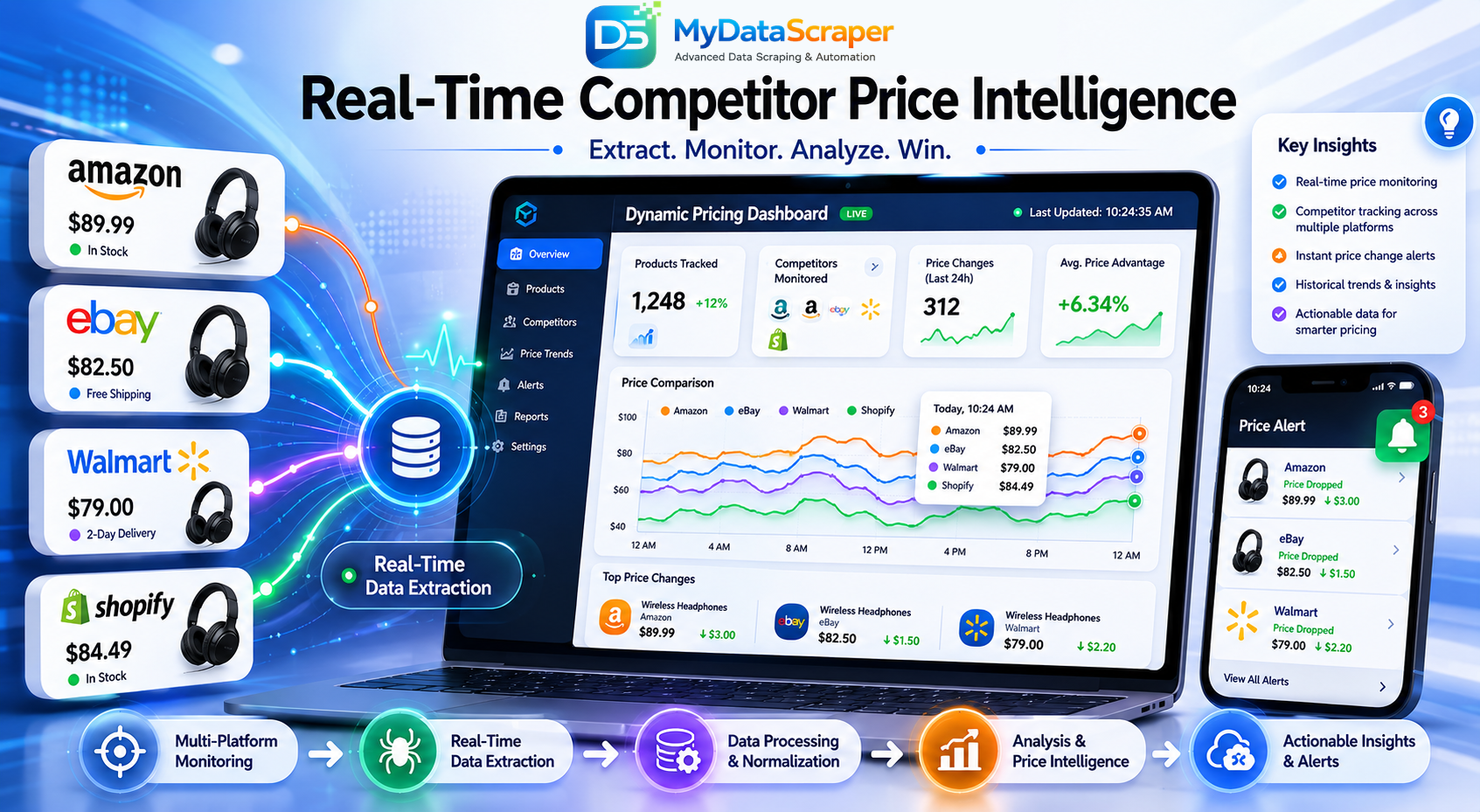
Why Price Monitoring Is the #1 E-Commerce Competitive Lever
Ask any seasoned e-commerce operator what single factor most directly influences whether a customer clicks “Add to Cart” or bounces to a competitor — and the answer is almost always the same: price. In a world where consumers can compare prices across dozens of retailers in seconds, your pricing strategy isn’t just a financial decision. It’s your primary competitive weapon.
Yet most online retailers are making pricing decisions in the dark. They set prices based on cost-plus calculations, gut feeling, or quarterly competitor reviews — while the market moves hourly. Amazon changes prices 2.5 million times per day. Walmart’s pricing algorithms respond to competitor changes within minutes. Meanwhile, independent retailers and mid-size e-commerce businesses are checking competitor prices manually, maybe once a week, and wondering why their conversion rates are slipping.
The solution is web scraping for price monitoring: automated, continuous, large-scale collection of competitor pricing data from every platform that matters — delivered in real time, in the format you need, integrated directly into your pricing workflow. This is how you stop guessing and start winning on price, every day.
In this comprehensive guide, we’ll show you exactly how automated price monitoring works, why it’s become essential for e-commerce competitiveness, the specific platforms and data points that matter most, the pricing strategies it enables, and how MyDataScraper builds custom price intelligence solutions that give you the edge your competitors already have — or will have very soon.
Price changes Amazon makes every single day across its marketplace
Of online shoppers compare prices across at least two retailers before purchasing
Average revenue increase reported by e-commerce businesses implementing dynamic pricing
Of top e-commerce retailers use some form of automated competitive price monitoring
What Is Web Scraping for Price Monitoring?
Web scraping for price monitoring is the automated process of collecting pricing data — current prices, historical prices, promotional prices, shipping costs, and bundle offers — from competitor websites, marketplaces, and online platforms using software bots that visit those pages and extract the relevant data automatically.
Unlike manual price checking (someone visits competitor websites, records prices in a spreadsheet) or expensive third-party pricing tools (limited coverage, shared data, generic reporting), web scraping for price monitoring is:
- Fully automated — runs continuously without human intervention
- Comprehensive — monitors your entire product catalog across all competitor platforms simultaneously
- Real-time — detects price changes within hours, not days or weeks
- Custom-built — designed around your specific products, competitors, and business needs
- Scalable — handles 100 SKUs or 100,000 SKUs with equal efficiency
- Flexible — delivers data in CSV, JSON, or Excel or integrates directly with your pricing tools
The Core Insight: Price monitoring through web scraping doesn’t just tell you what your competitors charge right now. It builds a comprehensive picture of competitor pricing behavior over time — when they discount, how aggressively, which products they price-lead on, and how they respond to market changes. This pricing intelligence is what transforms reactive pricing into proactive strategy.
Price Monitoring in Action: Live Example
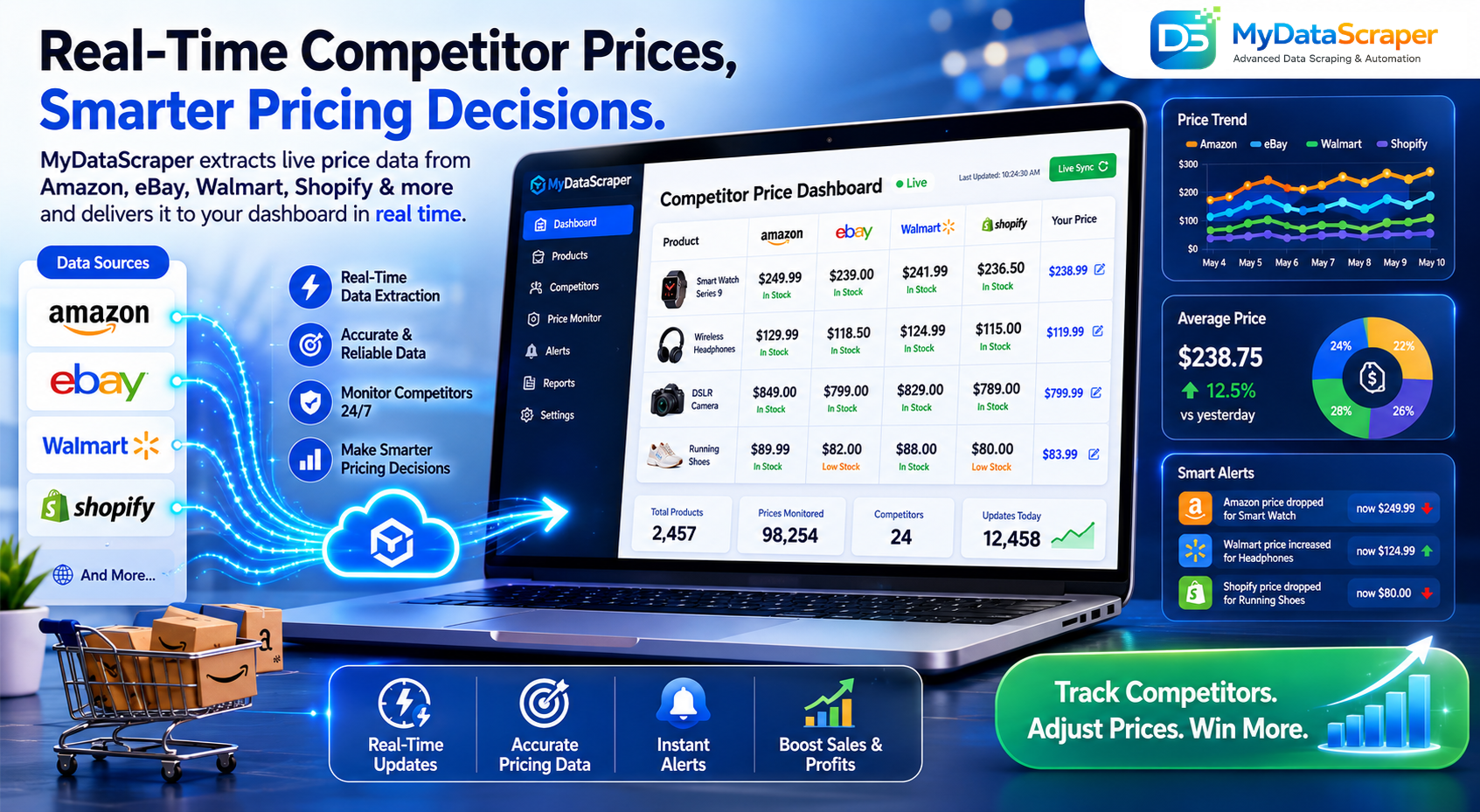
Here’s what a real price monitoring dashboard looks like when powered by web scraping. This is the kind of intelligence your pricing team receives automatically, every morning:
| Product SKU | Your Price | Amazon | Walmart | Best Buy | Lowest Market | Status |
|---|---|---|---|---|---|---|
| SKU-10482 | $189.99 | $194.99 | $196.00 | $192.50 | $189.99 ← You | ✓ LOWEST |
| SKU-20831 | $249.99 | $239.00 | $244.99 | $247.00 | $239.00 Amazon | ↓ HIGHER |
| SKU-33156 | $79.99 | $79.99 | $81.50 | $79.99 | $79.99 Tied | = TIED |
| SKU-47290 | $134.99 | $144.99 | $139.99 | $141.00 | $134.99 ← You | ✓ LOWEST |
| SKU-58847 | $319.99 | $299.00 | $309.99 | $304.50 | $299.00 Amazon | ↓ HIGHER |
This is the level of clarity that automated price monitoring scraping provides. You know instantly which products you’re winning on price, which you’re losing, and exactly how much adjustment is needed. No guesswork. No manual spreadsheet updates. Just clean, actionable pricing intelligence — delivered automatically, every day, for your entire catalog.
Want this kind of intelligence for your e-commerce business? Contact MyDataScraper today and we’ll build your custom price monitoring pipeline.
Why Real-Time Price Intelligence Matters in 2026
The e-commerce pricing environment of 2026 is fundamentally different from what it was even three years ago. Several converging forces have made real-time competitive price monitoring not just advantageous — but essential for any serious e-commerce operation:
Algorithmic Pricing Is Now the Standard
Amazon, Walmart, Target, and virtually every major marketplace now use sophisticated algorithmic pricing systems that adjust prices automatically based on competitor pricing, demand signals, inventory levels, and profit optimization models. If you’re not monitoring these changes in real time, you’re always reacting to a market that moved hours or days ago.
Consumer Price Comparison Is Instant
Browser extensions like Honey, Google Shopping integration, and one-click price comparison tools mean that 82% of online shoppers are actively comparing your price against competitors at the moment of purchase decision. A $5 difference on a $200 product is enough to drive significant cart abandonment.
Marketplace Competition Has Intensified
The explosion of Amazon third-party sellers, Walmart Marketplace growth, and the rise of niche D2C brands has compressed margins across virtually every product category. Standing out on price — precisely and strategically, not just across-the-board discounting — requires granular, current market data.
Dynamic Pricing Is a Proven Revenue Driver
Airlines, hotels, and ride-sharing apps have proven for years that dynamic pricing — adjusting prices based on real-time market conditions — dramatically increases both revenue and margin. E-commerce retailers using data-driven dynamic pricing report average revenue increases of 20-30%, with some categories performing significantly higher.
“In 2026, the retailers that win on price aren’t the ones with the lowest prices — they’re the ones with the most intelligent pricing. Knowing exactly when to be the cheapest, when to hold margin, and when to let a competitor win a low-margin sale is worth far more than blanket discounting.” — E-Commerce Pricing Strategist, 2026
Key Use Cases for E-Commerce Price Scraping
Competitive Price Tracking
Monitor competitor prices across all relevant platforms daily or hourly. Know the moment a key competitor drops their price on your top SKUs — and respond before customers notice.
Dynamic Pricing Optimization
Feed real-time competitor price data into your dynamic pricing engine to automatically adjust your prices based on market position, demand signals, and margin targets — continuously.
MAP Compliance Monitoring
Brands and manufacturers monitor authorized resellers to ensure compliance with Minimum Advertised Price (MAP) policies — automatically identifying violations before they damage brand equity and partner relationships.
Market Price Benchmarking
Understand where your entire pricing sits relative to the market — not just individual competitors. Identify overpriced products dragging conversion and underpriced products sacrificing unnecessary margin.
Price Drop & Promotion Alerts
Receive automated alerts when competitors run flash sales, promotional events, or significant price drops — giving your team time to respond with counter-promotions or stock-up strategies before customers migrate.
Historical Price Trend Analysis
Build historical price databases to identify seasonal pricing patterns, understand competitor pricing cycles, and time your own promotions and price adjustments for maximum market impact.
Marketplace Buy Box Optimization
On Amazon and other marketplaces, winning the Buy Box is the difference between making a sale and being invisible. Real-time price monitoring tells you exactly where your price needs to be to win the Buy Box without sacrificing margin.
Cross-Market Price Intelligence
Monitor prices across different geographic markets to identify regional pricing opportunities, detect cross-border arbitrage risks, and inform market- specific pricing strategies for international expansion.
Platforms You Can Monitor with Price Scraping
Effective e-commerce price intelligence requires monitoring the platforms where your customers and competitors actually operate. Here are the key platforms from which MyDataScraper extracts pricing data:
Amazon
Product prices, Buy Box prices, seller pricing, historical price data, and deal notifications
Walmart
Everyday prices, rollback prices, online vs in-store pricing, and marketplace seller prices
eBay
Fixed price listings, auction prices, completed sales data, and seller pricing strategies
Target
Current prices, Circle member pricing, clearance prices, and promotional offers
Best Buy
Product prices, member deals, open box pricing, and competitive match data
Shopify Stores
D2C brand pricing, promotional codes, bundle deals, and subscription pricing structures
Home Depot / Lowe’s
Hardware and home improvement pricing, contractor pricing, and seasonal promotions
Fashion & Apparel Sites
ASOS, Zappos, Nordstrom, Zara pricing for fashion e-commerce competitive intelligence
Any Competitor Website
Custom scrapers built for any e-commerce website — regardless of platform or technology
Complete Coverage: MyDataScraper can build price monitoring scrapers for any website — not just the popular platforms listed above. If your competitors sell online, we can monitor their pricing. No platform is off-limits for public price data collection.
Pricing Strategies Powered by Scraped Price Data
Raw price data becomes revenue when it’s paired with intelligent pricing strategy. Here are the most effective pricing strategies that competitor price tracking scraping makes possible:
Dynamic Pricing
Automatically adjust prices based on real-time competitor pricing, demand signals, inventory levels, and time of day. The same approach used by Amazon and airlines — now accessible to any e-commerce business with the right data pipeline.
Competitive Pricing
Set and maintain prices at a strategic position relative to competitors — not always the lowest, but always informed. Beat by $0.50 on high-volume items. Hold margin on exclusive products. Know exactly where every product stands.
Penetration Pricing
Use competitor data to identify categories where aggressive pricing will capture significant market share quickly — entering at below-market rates to drive volume before optimizing for margin as position is established.
Premium Positioning
Know exactly where competitors price so you can confidently position premium products above the market — with data to prove to your team and stakeholders that the premium is justified and sustainable.
Time-Based Pricing
Analyze historical competitor price data to identify seasonal patterns, weekend pricing changes, and event-driven price movements — then build your own time-based pricing calendar around those insights.
Bundle & Promotion Strategy
Monitor competitor promotional offers, bundle deals, and loyalty pricing to build counter-promotions that convert their promotional traffic and retain your existing customers during competitor sale events.
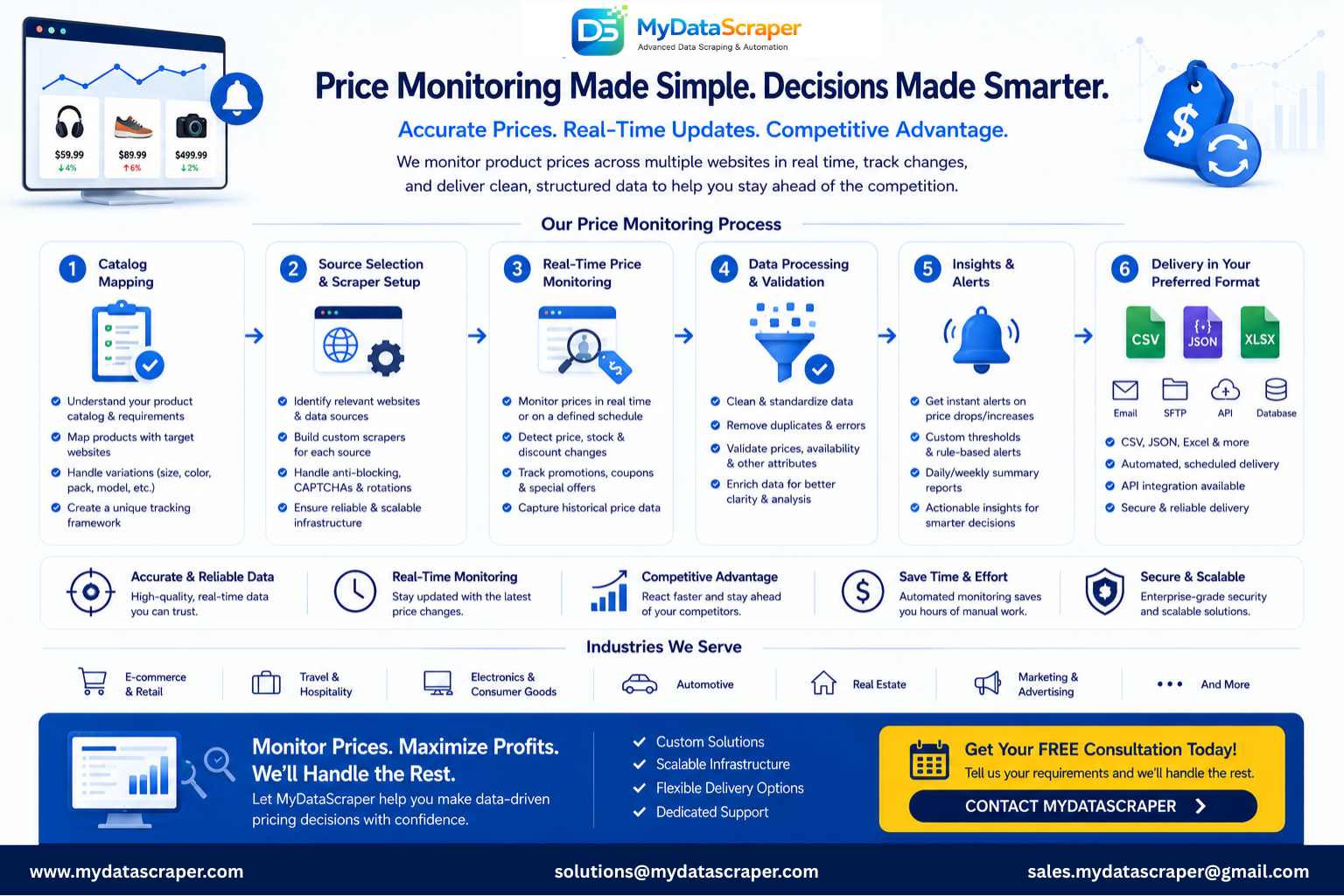
How Price Monitoring Scraping Works: Step by Step
Here is the complete process for building and operating an automated price monitoring scraping system — exactly how we implement it at MyDataScraper:
-
🗂️ Product Catalog Mapping
We start by mapping your product catalog — SKUs, product names, UPCs/EANs, and any variant data (size, color, model) — to equivalent listings on competitor platforms. Accurate product matching is the foundation of meaningful price comparison.
-
🎯 Competitor & Platform Selection
We identify which competitors and marketplaces are most relevant to your pricing decisions — based on your category, geography, and customer segments. We then configure scrapers for each target platform with the right data fields, frequencies, and geographic targeting.
-
🔧 Custom Price Scraper Development
Our engineers build custom scrapers for each target platform — handling JavaScript rendering, pagination, login-free data access, anti-bot countermeasures, geo-routing for location-specific pricing, and all other technical challenges specific to each site.
-
⏱️ Frequency & Scheduling Configuration
Price monitoring frequency is configured to match your market dynamics — hourly for fast-moving consumer electronics categories, daily for most retail categories, or real-time for high-volume marketplace sellers. You choose the cadence that matches your pricing agility.
-
🧹 Data Cleaning & Normalization
Prices from different platforms come in different formats — with or without tax, shipping included or excluded, bundle vs individual pricing. We normalize all price data to a consistent, comparable format so your team is always comparing apples to apples.
-
🚨 Alert Configuration
We configure automated alerts for the pricing events that matter most — competitor price drops beyond a threshold, MAP violations, Buy Box losses, or sudden market-wide price movements. Alerts are delivered via email, Slack, or integrated directly into your pricing platform.
-
📦 Data Delivery & Integration
Clean price intelligence is delivered in your preferred format — CSV, JSON, or Excel — or pushed directly to your pricing software, ERP, or e-commerce platform API. Your team gets exactly the data they need, exactly where they need it, without any manual steps.
-
🔄 Ongoing Maintenance & Adaptation
Competitor websites update frequently — layouts change, new anti-bot measures are deployed, data structures shift. Our team monitors scraper performance continuously and adapts to any changes, ensuring your price intelligence pipeline runs uninterrupted indefinitely.
The Real ROI: Manual vs Automated Price Monitoring
Let’s put real numbers to the comparison between a typical manual price monitoring operation and a MyDataScraper automated solution for a mid-size e-commerce retailer with 2,000 SKUs across 5 competitor platforms:
❌ Manual Price Monitoring
✅ Automated Price Scraping
The Math: In this scenario, switching to automated price monitoring saves $9,100 per month ($109,200 per year) while simultaneously increasing SKU coverage by 10x, platform coverage by 2.5x, data freshness by 48+ hours, and eliminating human error entirely. The ROI of automation here is immediate and substantial.
How an Online Electronics Retailer Used Price Monitoring Scraping to Boost Revenue by 41% in One Year
A mid-size online electronics retailer with 4,200 SKUs was struggling to compete with larger platforms on pricing. Their three-person merchandising team was manually checking Amazon and Best Buy prices for their top 300 products twice a week — a process that consumed 25+ hours of analyst time and still left them reacting to competitor price changes that were already 3-4 days old.
They were losing the Buy Box on Amazon consistently, their conversion rate was declining quarter-over-quarter, and their pricing team had no visibility into how their full catalog was positioned against the market. Sound familiar?
The Challenge
- Only 7% of product catalog monitored for competitive pricing (300/4,200 SKUs)
- Price data 3-4 days old before reaching the pricing team
- Losing Amazon Buy Box on 34% of competed listings
- Conversion rate declining 8% quarter-over-quarter
- No visibility into competitor promotional timing or patterns
- 25+ analyst hours per week consumed by manual price checking
The MyDataScraper Solution
We built a comprehensive automated price monitoring solution covering:
- 100% of 4,200 SKUs monitored across Amazon, Best Buy, Walmart, B&H, and Adorama
- Hourly price updates for top 500 high-velocity SKUs during business hours
- Daily full-catalog price reports delivered in Excel at 5:30 AM
- Real-time Slack alerts for Buy Box losses and competitor price drops above 5%
- Historical price trend database for seasonality and pattern analysis
- MAP violation monitoring for 12 key brand partnerships
- Direct integration with their repricing software via JSON API
Results After 12 Months
Total revenue increase over 12 months post-implementation
Improvement in Amazon Buy Box win rate across all competed listings
Improvement in overall conversion rate from pricing optimization
Annual cost savings vs previous manual monitoring operation
This level of pricing transformation is available to any e-commerce business — regardless of size or category. The technology is proven, the ROI is clear, and the competitive risk of waiting grows every month. Contact MyDataScraper today to get started.
Stop Guessing. Start Monitoring.
Win More Sales with Real-Time Price Intelligence.
MyDataScraper builds custom price monitoring scraping solutions that deliver real-time competitor pricing data for your entire catalog — across every platform that matters. CSV, JSON, or Excel. Integrated with your pricing tools. Starting within days.
💰 Get Your Free Price Monitoring Consultation Explore all our services at www.mydatascraper.comHow MyDataScraper Delivers Price Intelligence That Drives Revenue
At MyDataScraper, we’ve built price monitoring solutions for e-commerce businesses across consumer electronics, home goods, fashion, sporting goods, health & beauty, and industrial supply categories. Here’s what makes our approach uniquely effective:
📊 Full Catalog Coverage — Not Just Top SKUs
Most manual operations monitor 5-10% of product catalogs. Our automated solutions monitor 100% — because the pricing opportunities you’re missing are often in the long tail of your catalog, not just your bestsellers.
⚡ Speed That Matches the Market
Our infrastructure is built for speed. Hourly or real-time price monitoring for fast-moving categories, with alert systems that notify your pricing team within minutes of significant competitive pricing events.
🔗 Seamless Integration with Your Stack
Price data is delivered in the format and via the channel that eliminates friction in your pricing workflow — CSV, JSON, or Excel delivery, direct API integration with repricing tools (Feedvisor, Wiser, Prisync, Skuuudle), or ERP and e-commerce platform (Shopify, WooCommerce, Magento) push integration.
🗂️ Historical Price Database
Beyond point-in-time monitoring, we build and maintain historical price databases that power seasonality analysis, competitor pricing behavior modeling, and long-term strategic pricing decisions.
⚖️ MAP Monitoring Included
For brands and manufacturers, we build MAP compliance monitoring into every price intelligence solution — automatically flagging resellers who drop below your minimum advertised price policy before violations escalate into channel conflict.
Best Practices & Ethical Guidelines for Price Monitoring
✅ Best Practices to Follow
- Monitor only publicly displayed pricing information
- Respect platform terms of service and robots.txt guidelines
- Implement appropriate request rate limiting to avoid server impact
- Use price intelligence for legitimate competitive strategy only
- Maintain historical data securely with proper access controls
- Configure ethical scraping schedules (off-peak where possible)
- Work with professional services for complex platform monitoring
- Review and update compliance practices as regulations evolve
- Combine price data with demand signals for smarter decisions
- Document your data collection practices for internal compliance
❌ Practices to Avoid
- Collecting pricing data from behind login walls without authorization
- Sending requests at speeds that could impact target server performance
- Using scraped pricing data to coordinate pricing with competitors (antitrust risk)
- Republishing competitor pricing data publicly without permission
- Ignoring explicit anti-scraping measures or CAPTCHA systems aggressively
- Violating platform terms of service through misrepresentation
- Using pricing intelligence to engage in predatory pricing practices
- Ignoring changes in platform terms that affect data collection rights
Legal Note: Monitoring publicly displayed prices for legitimate competitive intelligence is well-established practice and generally legal in most jurisdictions. However, using systematically collected price data to coordinate pricing with competitors could raise antitrust concerns in some regulatory environments. Use price intelligence as a unilateral competitive tool — not as a coordination mechanism. When in doubt, consult legal counsel.
Frequently Asked Questions
How often can competitor prices be monitored?
We can configure monitoring at any frequency your business requires — from real-time continuous monitoring, to hourly updates for high-velocity SKUs, to daily or weekly full-catalog sweeps. Most e-commerce clients choose a tiered approach: hourly monitoring for their top revenue SKUs and daily monitoring for their broader catalog. Contact us to discuss the right frequency for your category and business model.
Can you monitor prices on Amazon, including Buy Box data?
Yes. We extract current Amazon prices including Buy Box price (the featured offer price), all competing seller prices for each ASIN, historical price data, Prime vs standard pricing, and promotional offer data. This comprehensive Amazon price intelligence is particularly valuable for marketplace sellers optimizing their repricing strategy.
How is price data delivered and can it integrate with our repricing tools?
We deliver price data in CSV, JSON, or Excel and can also push data directly via API to your existing repricing tools (Feedvisor, Wiser, Prisync, Skuuudle, RepricerExpress, BQool, and others), your ERP, or your e-commerce platform. We design the delivery pipeline to eliminate any manual steps between price monitoring and pricing action.
How many SKUs and platforms can be monitored simultaneously?
Our infrastructure scales to any volume. We’ve built solutions monitoring tens of thousands of SKUs across 10+ platforms simultaneously. For most mid-size e-commerce businesses (1,000-10,000 SKUs, 3-8 platforms), our solutions run efficiently with daily or hourly update frequencies. Scale is not a constraint — your requirements define the solution.
What is MAP monitoring and how does it work?
MAP (Minimum Advertised Price) monitoring involves continuously scraping all authorized reseller websites and marketplaces to detect listings where your product is advertised below your MAP policy price. Violations are flagged automatically and reported to your brand protection team, allowing rapid enforcement action before violations spread across channels and undermine your pricing integrity.
How quickly can a price monitoring solution be set up?
Most price monitoring projects are set up and delivering data within 3 to 7 business days. Simple projects (one competitor, limited SKUs) can often be launched faster. Comprehensive multi-platform, full-catalog solutions typically take 5-10 days to build, test, and deploy. Contact our team today for a timeline specific to your project scope.
Is competitor price monitoring legal?
Monitoring publicly displayed competitor prices for legitimate competitive intelligence is legal in virtually all jurisdictions and is standard practice across the e-commerce industry. Major brands, retailers, and marketplace sellers all engage in price monitoring as a normal business activity. MyDataScraper builds every price monitoring solution with ethical scraping practices that respect platform terms and server resources.
The Retailers Who Win on Price in 2026 Are Already Monitoring in Real Time
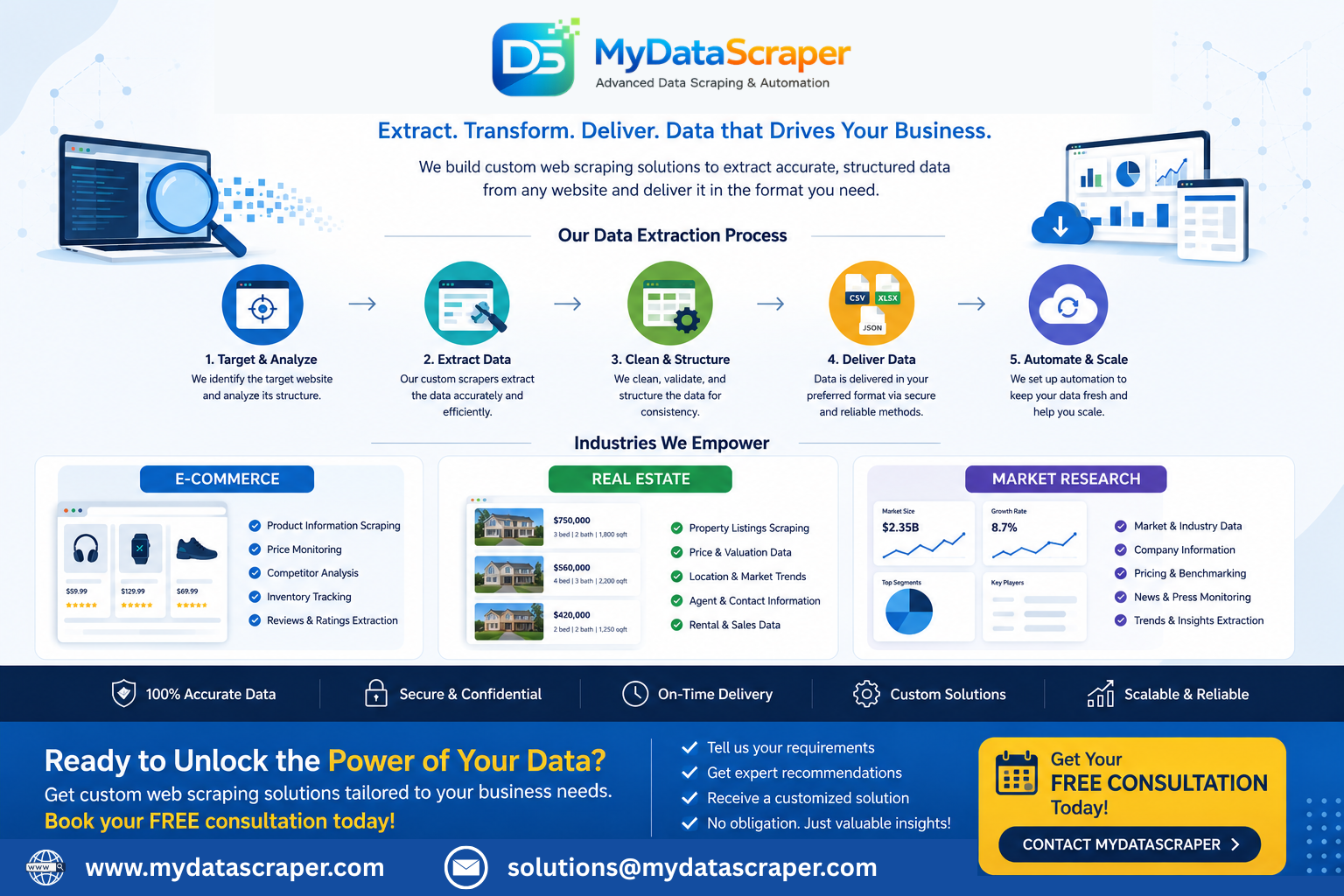
Price is the single most influential factor in e-commerce purchase decisions. Yet the majority of online retailers are still making pricing decisions based on outdated data, incomplete competitor coverage, and manual processes that simply cannot keep pace with markets that move hourly. The gap between those who monitor prices in real time and those who don’t is widening every quarter — in conversion rates, Buy Box wins, revenue, and margin.
Web scraping for price monitoring is the technology that closes this gap. It gives every e-commerce business — from independent retailers to multi-channel brands — the same real-time competitive pricing intelligence that industry giants like Amazon have spent years and millions building. And it’s now accessible, affordable, and deployable within days through professional solutions like those built by MyDataScraper.
Whether you’re an independent Shopify retailer trying to compete with Amazon on key products, a brand protecting MAP compliance across 200 resellers, or a large multi-category retailer building a sophisticated dynamic pricing operation — we build the custom price monitoring scraping solution that fits your business, your catalog, your platforms, and your pricing workflow. Data delivered in CSV, JSON, or Excel. Integrated with your repricing tools. Maintained and updated continuously by our expert team.
Every day without real-time price intelligence is a day your competitors are winning sales you could have had. The fix is faster and more affordable than you think.
Build Your Real-Time Price Monitoring System Today
Free consultation. Fast setup. No technical knowledge needed. Tell us your products, your competitors, and your platforms — and we’ll build the automated price monitoring pipeline that keeps your pricing sharp, competitive, and profitable every single day.
📩 Contact MyDataScraper — Free Consultation Visit www.mydatascraper.com to explore all our e-commerce data extraction services.