Web Scraping for Job Market Intelligence: The Complete Guide to Extracting Job Postings, Salary Data & Hiring Trends for Smarter Workforce Decisions in 2026
In the war for talent, the recruiters and HR teams with the best workforce data consistently win. Discover how automated job market data extraction gives you real-time visibility into hiring trends, competitor talent strategies, salary benchmarks, and skills demand — before the market shifts beneath your feet.
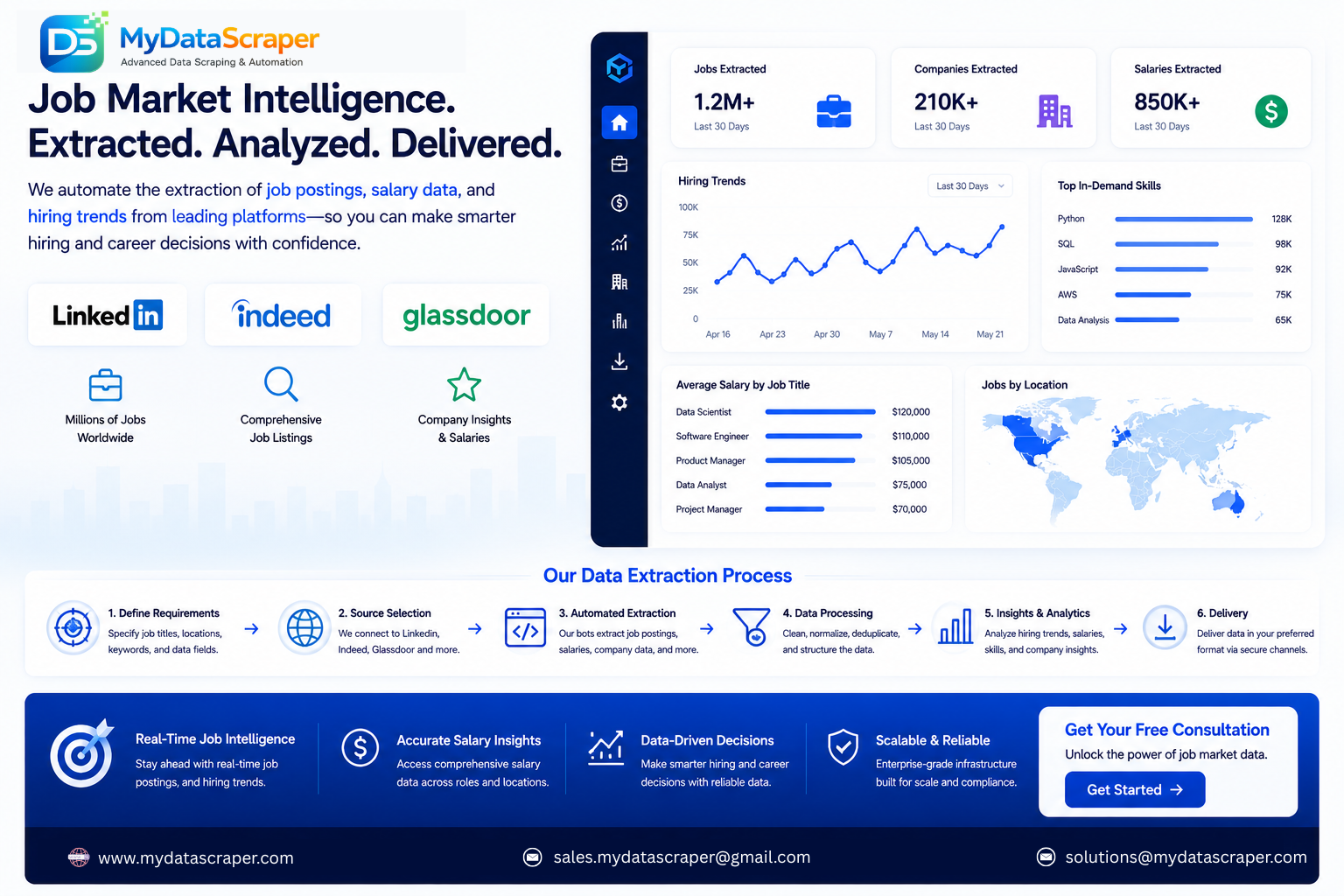
- Why Job Market Data Is Every HR Team's Secret Weapon
- What Is Web Scraping for Job Market Intelligence?
- Job Market Data in Action
- Why Workforce Intelligence Matters in 2026
- Top Job Platforms for Data Extraction
- Complete Job Market Data Dictionary
- Use Cases Across the Talent Ecosystem
- Industries Winning with Job Market Scraping
- The Job Data Extraction Process
- Case Study: Staffing Agency Doubles Placement Rate
- How MyDataScraper Delivers Workforce Intelligence
- Ethical & Legal Framework
- Frequently Asked Questions
- Conclusion
Why Job Market Data Is Every HR Team's Secret Weapon
The most effective recruiters, talent acquisition leaders, and HR strategists in 2026 share one thing in common: they make decisions based on comprehensive, real-time job market data — not gut instinct, outdated salary surveys, or anecdotal competitive intelligence. They know exactly what competitors are hiring for, what salaries the market is demanding, which skills are surging in demand, where the talent supply-demand imbalances exist, and how fast the market is moving in their specific sectors and geographies.
Yet most HR teams and recruitment agencies still operate with a fraction of the job market intelligence they need. They check Indeed and LinkedIn manually, rely on annual compensation surveys that are outdated before they're published, and track competitor hiring activity by occasionally browsing career pages. In a talent market that moves weekly, this level of intelligence is dangerously inadequate.
Web scraping for job market intelligence changes this equation entirely. Automated job posting data extraction collects, structures, and delivers real-time workforce intelligence from every major job board, company career page, and professional platform — giving you the data foundation for every talent decision your organization makes.
In this guide, we'll explore exactly how job market scraping works, what data can be extracted, who benefits most, and how MyDataScraper builds custom solutions that turn the job market web into your competitive intelligence advantage.
New job postings published daily across major job boards in the US alone
Of HR leaders say real-time job market data would significantly improve their hiring decisions
Faster time-to-fill reported by recruiting teams using automated job market intelligence
Better offer acceptance rates when salary offers are benchmarked against real-time market data
What Is Web Scraping for Job Market Intelligence?
Web scraping for job market intelligence is the automated collection of publicly available workforce data — job postings, salary ranges, company hiring activity, skill requirements, location data, remote work signals, employment type, seniority levels, and hiring volume trends — from job boards, company career pages, professional networks, and compensation databases.
Unlike manual job board browsing, expensive HR data subscriptions, or slow annual salary surveys, web scraping builds a custom, continuously updated intelligence pipeline that:
- Monitors every competitor's hiring activity — across all platforms simultaneously
- Tracks salary trends in real time — for any role, seniority, location, and industry
- Maps skills demand evolution — identifying which skills are surging, declining, or emerging
- Detects hiring signals — company growth, departmental expansion, strategic pivots
- Covers every geography — from local markets to global workforce trends
- Delivers in your format — CSV, JSON, or Excel or directly into your ATS, HRIS, or analytics platform
The Core Insight: Job postings are one of the richest publicly available business signals in existence. A company's hiring activity reveals its growth strategy, technology priorities, expansion plans, organizational challenges, and competitive positioning — often months before this information appears in financial reports or press releases. Job posting data extraction turns this signal into structured competitive intelligence for talent, business, and investment decisions alike.
Job Market Data Extraction in Action
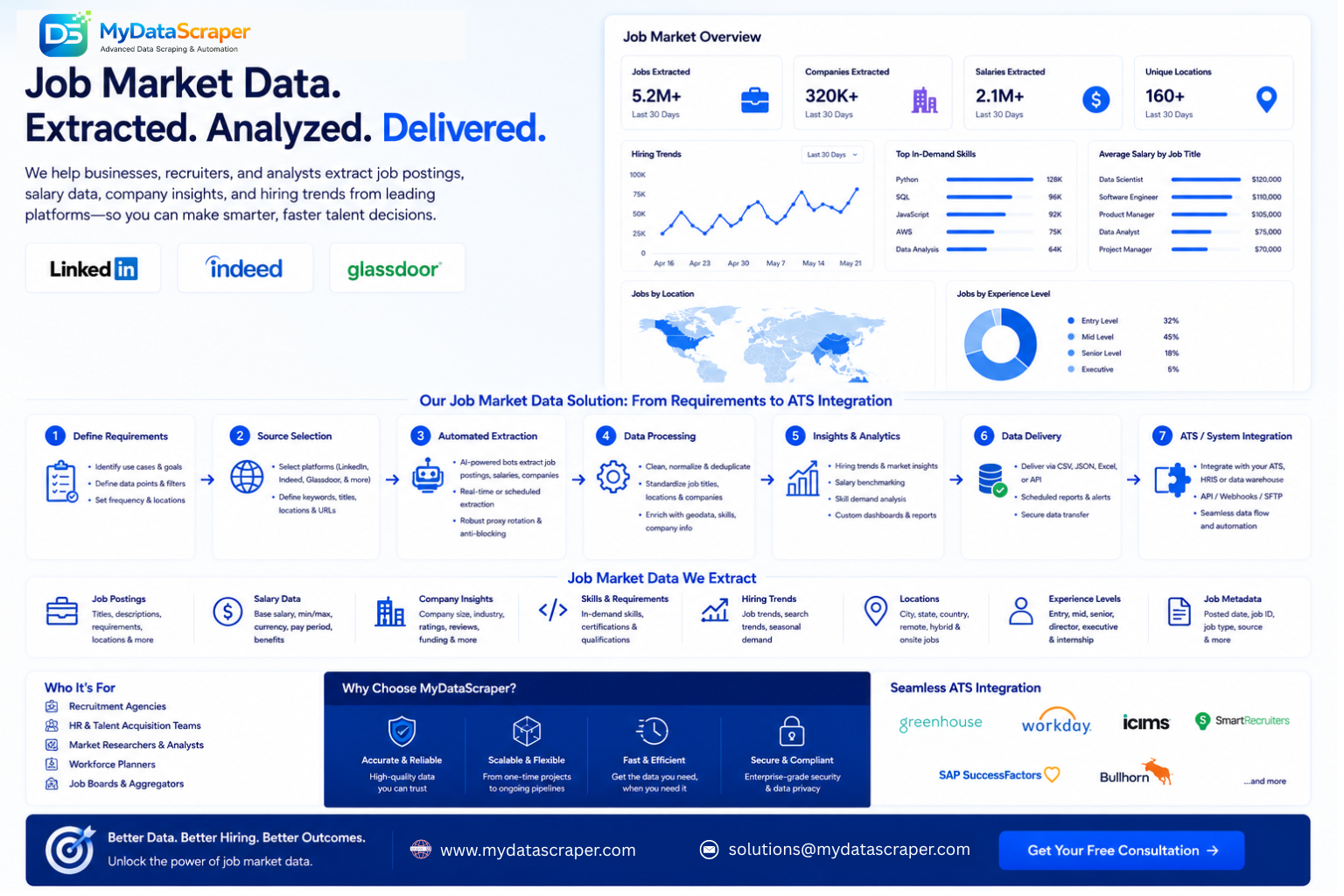
Here's what a job market intelligence dashboard looks like when powered by automated extraction — the kind of structured workforce data MyDataScraper delivers to HR teams and workforce analysts:
| Company | Role | Salary Range | Location | Source | Signal |
|---|---|---|---|---|---|
| Stripe | Sr. ML Engineer | $220K–$290K | San Francisco / Remote | 🔥 HOT SKILL | |
| Shopify | Product Manager | $175K–$230K | Remote (US/Canada) | Careers Page | 🏠 REMOTE |
| JPMorgan | Data Analyst III | $110K–$145K | New York, NY | Indeed | ✨ NEW |
| HubSpot | SDR Team Lead | $85K–$115K + OTE | Boston / Hybrid | Glassdoor | ✨ NEW |
| Competitor X | +47 new roles (7 days) | Various | Multiple cities | Multi-source | 📈 HIRING SURGE |
This is the level of intelligence that workforce intelligence scraping delivers automatically. Every morning, your HR team receives structured data on who's hiring, what they're paying, where the roles are, what skills they require, and whether competitors are scaling up or pulling back — all without anyone visiting a single job board manually.
Why Workforce Intelligence Matters More Than Ever in 2026
The Talent Market Is Evolving Faster Than Annual Surveys Can Track
Annual salary surveys and quarterly hiring reports are useful for board presentations — but they're dangerously outdated for actual talent decisions. In 2026, salary expectations shift monthly, new in-demand skills emerge quarterly, and competitor hiring activity can ramp up from zero to 100 open roles within weeks. Only real-time hiring trends data extraction captures this velocity accurately.
AI Is Reshaping Every Job Description
The AI revolution isn't just creating new roles — it's transforming existing ones. Job postings are the earliest, most granular indicator of how AI adoption is changing skill requirements across every industry. Tracking the language, skills, and tools mentioned in job postings reveals exactly how the workforce is evolving — months before industry reports and academic studies catch up.
Salary Transparency Laws Changed Everything
With salary transparency laws now active in dozens of states and countries, publicly listed salary ranges in job postings have become the most accurate, real-time compensation benchmark available anywhere. Salary data scraping from platforms like Indeed, LinkedIn, and Glassdoor now delivers genuinely actionable compensation intelligence — far more current and specific than any survey vendor can provide.
Competitor Talent Strategies Are Visible in Their Job Postings
A competitor suddenly posting 30 engineering roles is building something big. A competitor posting its first AI/ML role is pivoting strategy. A competitor removing all remote options is restructuring its workforce model. These signals are all publicly visible in job postings — and systematically collecting them creates a window into competitor strategy that no other intelligence source can match.
"Job postings are the most underutilized business intelligence signal in existence. Every company publishes their growth strategy, technology priorities, and compensation philosophy in plain sight — in their job listings. The organizations that systematically collect and analyze this data have a genuine strategic advantage over those that don't." — Workforce Analytics & Talent Intelligence, 2026
Top Job Platforms for Data Extraction
Effective job market intelligence requires monitoring the platforms where jobs are actually posted and where workforce data is publicly accessible. Here are the key sources MyDataScraper extracts from:
LinkedIn Jobs
Public job postings, company hiring activity, role details, seniority levels, skills requirements, and professional network intelligence
Indeed
Job listings with salary data, location, company ratings, employment type, benefits information, and posting volume trends across industries
Glassdoor
Job postings, salary reports, company reviews, interview experiences, CEO ratings, and culture intelligence for employer benchmarking
Company Career Pages
Direct employer job listings, organizational structure signals, role requirements, and hiring priorities — the most authentic source of employer intent data
ZipRecruiter
Job postings with salary estimates, application volume signals, posting freshness, and employer responsiveness metrics across markets
Remote Job Platforms
FlexJobs, We Work Remotely, Remote.co — tracking remote work trends, remote-first company growth, and distributed workforce evolution
Niche & Industry Job Boards
Stack Overflow Jobs (tech), Dribbble (design), AngelList (startups), Dice (IT), HealthcareJobSite — sector-specific talent intelligence
Government Labor Data
Bureau of Labor Statistics, O*NET, state workforce databases — official employment statistics, occupational projections, and labor market metrics
Salary & Compensation Sites
Levels.fyi, Salary.com, PayScale, Comparably — detailed compensation data, benefits intelligence, and pay equity benchmarking across roles and industries
Complete Job Market Data Dictionary
| Data Category | Specific Extractable Fields | Workforce Application |
|---|---|---|
| Job Posting Details | Title, description, company, department, posting date, application deadline, posting URL | Market mapping, competitive tracking, recruitment sourcing |
| Compensation Data | Salary range (min/max/median), OTE, equity, bonuses, benefits, pay transparency status | Salary benchmarking, offer competitiveness, pay equity analysis |
| Skills & Qualifications | Required skills, preferred skills, certifications, education, years experience, tools/technologies | Skills gap analysis, training priorities, job description optimization |
| Location & Work Model | City, state, country, remote/hybrid/onsite, travel requirements, visa sponsorship | Location strategy, remote workforce planning, geographic benchmarking |
| Company Intelligence | Company name, industry, size, funding stage, growth rate, employer rating, Glassdoor score | Competitor talent strategy, employer brand benchmarking |
| Seniority & Career Data | Seniority level, management scope, career progression path, reporting structure | Organizational analysis, career development mapping, talent pipeline |
| Employment Type | Full-time, part-time, contract, freelance, internship, temporary, seasonal | Workforce composition trends, contingent workforce analysis |
| Posting Volume & Velocity | New postings per day/week, removal rate, re-posting frequency, time-to-fill signals | Hiring demand forecasting, market tightness assessment |
| Benefits & Perks | Health insurance, PTO, 401k match, parental leave, learning budget, equity vesting | Total compensation benchmarking, benefits strategy, EVP development |
| Industry Trends | Emerging role titles, new skill mentions, technology adoption signals, industry shift indicators | Workforce planning, strategic hiring, future skills anticipation |
At MyDataScraper, we extract exactly the workforce data your talent strategy requires — delivered in CSV, JSON, or Excel, or integrated directly into your ATS, HRIS, or workforce analytics platform.
Use Cases Across the Talent Ecosystem
Real-Time Salary Benchmarking
Extract salary ranges from thousands of live job postings to build real-time compensation benchmarks for any role, seniority, location, and industry — replacing outdated annual surveys with continuously updated market data.
Competitor Hiring Intelligence
Monitor competitor job postings to track their hiring velocity, department growth, new capabilities being built, technology adoption, and geographic expansion — revealing strategic direction before press announcements.
Skills Gap & Demand Analysis
Analyze skills mentioned across thousands of job postings to identify which capabilities are surging in demand, which are declining, and where critical skills gaps exist in your workforce relative to market requirements.
Workforce Planning & Forecasting
Use hiring volume trends, role type patterns, and geographic demand data to forecast labor market conditions, plan headcount budgets, and time hiring initiatives for maximum effectiveness and minimum cost.
Recruitment Sourcing Intelligence
Identify companies actively hiring for roles that match your candidate pool — revealing placement opportunities for staffing agencies and partnership opportunities for corporate recruiters.
Employer Brand Benchmarking
Compare your employer value proposition — compensation, benefits, work model, culture signals — against competitors based on their actual job posting language and Glassdoor review data to strengthen your talent brand.
Remote Work & Location Strategy
Track the evolution of remote, hybrid, and onsite requirements across your industry and competitors to inform your own workplace strategy, talent acquisition geography, and compensation differentiation by location.
AI & Technology Adoption Tracking
Monitor the emergence of AI-related skills, tools, and role titles across job postings to understand how AI adoption is transforming your industry's workforce needs and plan your own technology talent strategy accordingly.
Labor Market Research & Policy
Government agencies, think tanks, and economic research organizations extract comprehensive job posting data to monitor labor market health, employment trends, wage dynamics, and workforce development indicators.
Industries & Organizations Winning with Job Market Scraping
| Organization Type | Primary Job Data Sources | Key Intelligence Generated | Impact |
|---|---|---|---|
| Corporate HR & TA Teams | Competitor career pages, LinkedIn, Indeed | Salary benchmarks, competitor talent strategy | Better offers, faster hiring |
| Staffing & Recruitment Agencies | All major job boards, company pages | Client demand signals, market opportunity | 2x placement rates |
| HR Tech & Workforce Platforms | Multi-source job data at scale | Platform data foundation, product analytics | Differentiated data products |
| Compensation Consultancies | Salary sites, transparent job postings | Real-time pay benchmarks, equity analysis | More accurate, timely advice |
| Investment Firms | Company career pages, LinkedIn, job boards | Company growth signals, spending patterns | Alternative data for investment thesis |
| Workforce Development / Govt | All job boards, BLS, O*NET | Labor market health, skills demand shifts | Better policy, targeted training |
| EdTech & Training Companies | Job boards, skills databases | In-demand skills, curriculum relevance | Market-aligned course development |
| Management Consultancies | Client industry job data, competitor data | Organizational benchmarking, talent analysis | Data-driven client deliverables |
The Job Market Data Extraction Process: Step by Step
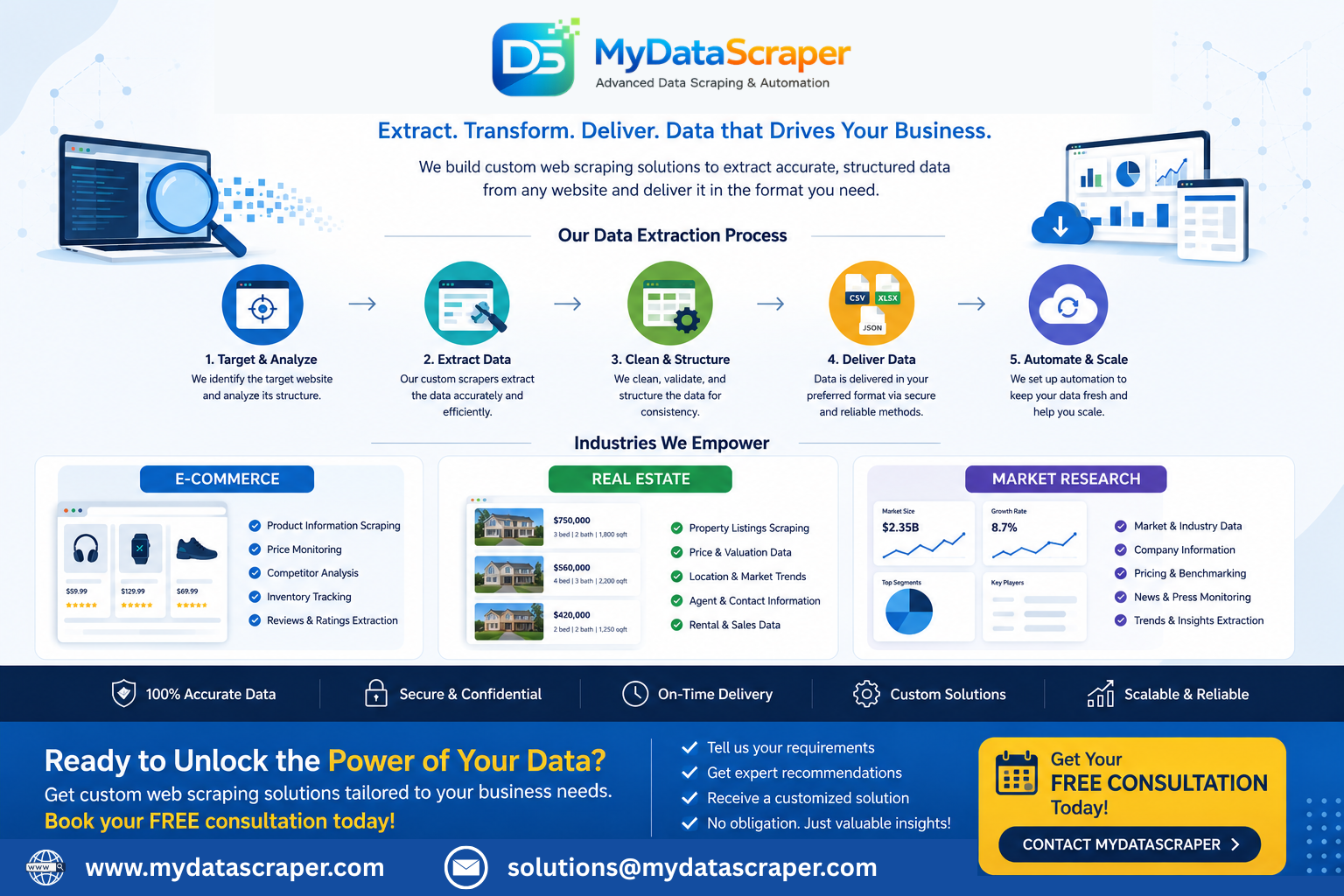
Here's how MyDataScraper builds and operates a custom job posting data extraction pipeline:
-
🎯 Workforce Intelligence Requirements Scoping
We start by defining your exact intelligence needs — which roles, companies, industries, geographies, and salary ranges you want to monitor. Whether you need competitive hiring intelligence, salary benchmarks, skills trend tracking, or comprehensive market mapping, we design the solution around your specific objectives.
-
🗺️ Platform & Source Identification
Based on your intelligence requirements, we identify the specific job boards, company career pages, professional platforms, and salary databases that will yield the most relevant, highest-quality data for your talent decisions.
-
🔧 Custom Job Scraper Engineering
Our engineers build scrapers purpose-built for job market platforms — handling complex search filters, paginated results, dynamic loading, location-based queries, JavaScript-rendered job cards, and the anti-bot measures common on major job boards.
-
🧹 Data Cleaning, Normalization & Deduplication
Job data requires specialized cleaning — standardizing job titles (Sr. Engineer = Senior Engineer = Sr Engineer), normalizing salary formats, deduplicating cross-posted listings, extracting structured data from unstructured descriptions, and classifying roles by seniority, function, and industry.
-
📊 Skills & Trend Tagging
For clients who need skills intelligence, we apply automated skills extraction and classification to job descriptions — identifying the specific technical skills, tools, certifications, and competencies mentioned across thousands of postings, revealing market demand patterns and emerging skill requirements.
-
🔗 System Integration & Delivery
Job market intelligence is delivered in your preferred format — CSV, JSON, or Excel — or integrated directly with your ATS (Greenhouse, Lever, Workday), HRIS, BI platform (Tableau, Power BI), or custom analytics environment via automated pipeline.
-
📈 Historical Job Market Database
From day one, we build a historical database of job postings, salary trends, and hiring volume patterns — enabling year-over-year comparison, seasonal hiring pattern analysis, long-term salary trajectory modeling, and skills evolution tracking over time.
-
🔄 Continuous Monitoring & Adaptation
Job boards update their structures constantly. Our team proactively monitors your scrapers and adapts them to any platform changes — ensuring uninterrupted delivery of workforce intelligence through every hiring cycle.
How a National Staffing Agency Doubled Its Placement Rate Using Automated Job Market Intelligence
A national staffing agency specializing in technology and finance placements was facing a frustrating challenge: their recruitment team was consistently behind the market. By the time they identified hot roles and markets through manual job board browsing, competitors had already submitted candidates. Their salary benchmarking relied on quarterly survey data that was months old, leading to frequent offer rejections. And they had minimal visibility into which companies were ramping hiring — missing business development opportunities.
After partnering with MyDataScraper, we built a comprehensive job market intelligence pipeline:
What Was Built
- Daily scraping of 12 job boards and 200+ company career pages across tech and finance sectors
- Real-time salary benchmarking extraction — salary ranges from 50,000+ live job postings monthly, organized by role, seniority, and location
- Competitor staffing agency monitoring — tracking which agencies were winning which job orders and in which markets
- Hiring surge detection — automated alerts when target companies posted 10+ new roles within a 7-day window (business development signal)
- Skills demand tracking — weekly reports on which technical skills were appearing in increasing frequency across job postings
- All data delivered in Excel to recruitment managers and via JSON to their internal analytics dashboard
Results After 12 Months
Increase in placement rate from better market timing and salary intelligence
Faster time-to-submit — identifying and responding to roles before competitors
Improvement in offer acceptance rates from real-time salary benchmarking
Additional annual revenue from data-driven business development targeting
This kind of workforce intelligence advantage is available to any staffing agency, corporate HR team, or workforce analytics organization that builds systematic job market data collection into their talent strategy. Contact MyDataScraper today to build your workforce intelligence pipeline.
Stop Guessing About the Job Market.
Start Making Data-Driven Talent Decisions.
MyDataScraper builds custom job market data extraction solutions that deliver real-time hiring intelligence, salary benchmarks, skills demand data, and competitor workforce strategies — in CSV, JSON, or Excel. Starting within days.
💼 Get Your Free Workforce Data Consultation Explore all our services at www.mydatascraper.comHow MyDataScraper Delivers Workforce Intelligence That Transforms Talent Strategy
At MyDataScraper, we build job market data solutions that go far beyond simple job posting collection. Here's what makes our approach uniquely valuable for workforce intelligence:
🧠 Workforce-Domain Expertise
We understand job market data — title normalization challenges, salary format variations, seniority classification, skills taxonomy mapping, and the nuances of cross-platform job deduplication. This domain expertise ensures you receive genuinely clean, comparable, decision-ready workforce data.
📊 Skills Intelligence Built In
Beyond basic job posting collection, we extract and classify skills mentioned across job descriptions — building structured skills demand databases that reveal which competencies are surging, declining, or emerging in your target markets. This powers skills gap analysis, training strategy, and future workforce planning.
🚨 Hiring Surge & Market Shift Alerts
We configure automated alerts for the workforce events that matter most — competitor hiring surges, sudden salary increases in target roles, new job categories emerging in your industry, or significant market shifts in remote work adoption — giving your talent team early warning signals to act on.
🔗 ATS & HRIS Integration
Workforce intelligence is delivered in CSV, JSON, or Excel — or integrated directly with your ATS (Greenhouse, Lever, Workday, iCIMS), HRIS (BambooHR, Rippling, Gusto), or business intelligence platform via automated delivery pipeline.
🌍 Any Market, Any Role, Any Scale
Whether you need to monitor 50 competitor roles in a single market or 500,000+ postings across 20 countries, our infrastructure scales to match your workforce intelligence requirements — from boutique recruitment firms to enterprise HR analytics teams.
Ethical & Legal Framework for Job Market Data Scraping
✅ Compliant Job Market Scraping Practices
- Collect only publicly displayed job posting information
- Respect platform terms of service and robots.txt
- Implement proper request rate limiting on all scrapers
- Use job data for legitimate workforce intelligence only
- Anonymize candidate data if any appears in public listings
- Comply with applicable employment and data privacy laws
- Maintain proper data security for all extracted data
- Focus on employer-published information, not candidate data
- Document data sources and collection practices
- Consult legal counsel for jurisdiction-specific requirements
❌ Practices to Avoid
- Scraping candidate resumes or personal profile data without consent
- Collecting data behind login walls or authentication systems
- Using scraped data for discriminatory hiring practices
- Sending requests that overwhelm or disrupt job platforms
- Republishing scraped job listings as your own
- Collecting personal applicant information from job boards
- Violating platform terms through deceptive access methods
- Using data for unsolicited candidate spam or harassment
Key Distinction: Ethical job market scraping focuses on employer-published data — job listings, company hiring activity, salary ranges, and publicly stated requirements — NOT on scraping individual candidate data, resumes, or personal profile information without consent. This employer-focused approach is well-established, widely practiced, and generally permissible when conducted responsibly. MyDataScraper builds this ethical framework into every workforce data project.
Frequently Asked Questions
Is scraping publicly posted job listings legal?
Collecting publicly displayed job posting data for legitimate workforce intelligence purposes is generally legal, consistent with precedents like hiQ v. LinkedIn. Job postings are published by employers with the explicit intent of broad public visibility. The key is collecting only publicly visible employer-published data, respecting platform terms, and using data for legitimate purposes. MyDataScraper builds compliance into every workforce data project.
How accurate is salary data extracted from job postings?
With salary transparency laws now active in many jurisdictions, salary ranges in job postings are increasingly accurate and legally required to be representative of actual compensation. Job posting salary data is often more current and specific than annual survey data because it reflects what employers are offering right now, not what they paid last year. For roles and locations with mandatory pay transparency, this is the most accurate real-time compensation data available anywhere.
How many job postings can be monitored?
Our infrastructure scales to any volume — from monitoring a few hundred competitor roles to collecting hundreds of thousands of postings across multiple markets, industries, and platforms simultaneously. Scale is configurable to match your intelligence requirements and budget. Contact us to discuss volume appropriate for your needs.
What format is job market data delivered in?
We deliver workforce data in CSV, JSON, or Excel — and can integrate directly with your ATS (Greenhouse, Lever, Workday, iCIMS), HRIS (BambooHR, Rippling), or BI platforms (Tableau, Power BI) via automated data feeds or API push. Data arrives ready to use — no manual reformatting required.
Can you track specific competitor companies' hiring activity?
Absolutely. One of the most popular use cases for job posting data extraction is competitor hiring monitoring — tracking exactly what roles specific companies are posting, at what salary levels, in which locations, and how their hiring velocity is changing over time. We can monitor any number of target companies across any combination of job boards and career pages.
Can skills and technology trends be extracted from job postings?
Yes. We apply automated skills extraction and classification to job descriptions — identifying specific technical skills, programming languages, tools, certifications, and soft skills mentioned across thousands of postings. This data powers skills gap analysis, training program design, workforce development strategy, and technology adoption tracking across industries.
How quickly can a job market scraping project be launched?
Standard job market data extraction projects are built and delivering data within 5 to 10 business days of project kick-off, depending on source count, data complexity, and integration requirements. Simpler projects (single job board, limited role scope) can launch faster. Contact our team today for a timeline estimate specific to your workforce intelligence requirements.
The Organizations That Win at Talent in 2026 Are the Ones with the Best Workforce Data
In the war for talent, the competitive advantage doesn't belong to the organizations with the biggest employer brands or the deepest pockets — it belongs to those with the best data. The recruiters who know exactly what the market is paying, right now, for every role in their universe. The HR leaders who can see competitor hiring strategies forming months before they become visible. The workforce planners who understand exactly which skills are about to become critical. The talent acquisition teams that move on opportunities before anyone else even sees them.
Web scraping for job market intelligence is the technology that creates this advantage — systematically, at scale, in real time, and at a fraction of the cost of traditional workforce data vendors. It transforms the world's largest collection of employer-published business signals — job postings — into structured intelligence that powers every talent decision your organization makes.
At MyDataScraper, we build custom workforce data extraction solutions tailored to your specific talent intelligence needs — real-time salary benchmarks, competitor hiring monitoring, skills demand tracking, labor market analysis, and comprehensive job posting databases — delivered in CSV, JSON, or Excel, integrated into your ATS, HRIS, or analytics platforms, on any schedule your talent strategy demands.
Every great hire starts with great data. Every competitive salary offer is built on market intelligence. Every successful workforce plan is grounded in demand signals. The organizations that build these data foundations today are the ones that will lead the talent market tomorrow.
Custom Job Market Intelligence
Built for Your Talent Strategy
Free consultation. Workforce-domain expertise. Fast delivery. Tell us your talent intelligence needs — roles, competitors, markets, skills — and we'll design the automated job market data pipeline that gives your recruiting and HR teams the intelligence edge they need.
📩 Contact MyDataScraper — Free Consultation Visit www.mydatascraper.com to explore all our data extraction services.
Written by the MyDataScraper Team
MyDataScraper is a leading provider of custom web scraping and automated data extraction solutions for job market intelligence, e-commerce, real estate, lead generation, travel, social media, financial, and market research. We help recruiters, HR teams, staffing agencies, and workforce analysts build real-time talent intelligence that drives better hiring decisions. Learn more at www.mydatascraper.com or contact our team today for a free consultation.