E-commerce Price Monitoring & Competitor Intelligence: Win the Buy Box Every Time
Track competitor prices, monitor MAP violations, and automate repricing strategies across Amazon, Walmart, Shopify, and 50+ marketplaces with real-time data feeds that update faster than your competition can blink.
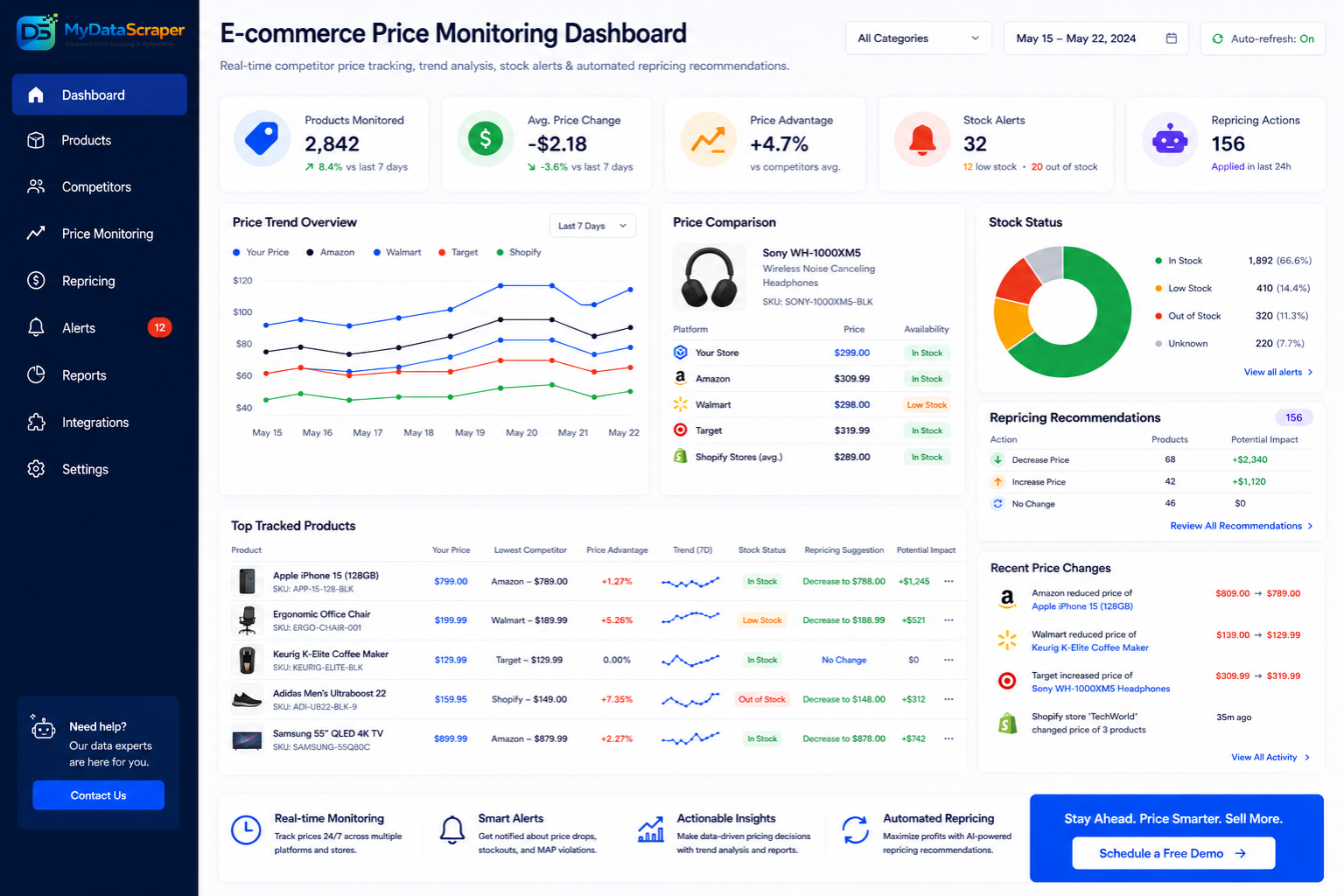
Why E-commerce Price Monitoring Is the Difference Between Profit and Loss in 2026
In the hyper-competitive world of online retail, e-commerce price monitoring isn't just a nice-to-have — it's survival. Research from McKinsey shows that a 1% improvement in pricing strategy can increase operating profits by 8.7% for the average retailer. Yet 73% of e-commerce businesses still rely on manual price checks or outdated data that's already obsolete by the time it reaches their repricing software.
The modern e-commerce landscape moves at lightning speed. Amazon changes prices an average of 2.5 million times per day. Walmart adjusts pricing every 10 minutes during peak hours. Shopify stores leverage dynamic pricing algorithms that respond to competitor moves within seconds. If you're not monitoring competitor prices in real-time, you're essentially flying blind — leaving money on the table through missed opportunities or losing sales to better-priced competitors.
Whether you're a brand manufacturer protecting your MAP (Minimum Advertised Price) policy, a third-party seller competing for the Amazon Buy Box, or a direct-to-consumer brand optimizing your Shopify pricing, competitor price tracking provides the intelligence foundation every pricing decision should rest upon.
In this comprehensive guide, we'll explore exactly what data you can extract, which platforms present the biggest challenges, how to build a scalable monitoring infrastructure, and how MyDataScraper's web scraping services deliver clean, structured pricing data that integrates seamlessly with your repricing engines, BI tools, and inventory management systems.
What E-commerce Data Can You Extract with Price Monitoring?
Effective retail price scraping goes far beyond simple price numbers. The most successful e-commerce intelligence platforms capture a rich ecosystem of data points that reveal not just what competitors charge, but why they charge it, when they change it, and how the market responds.
Core Pricing Data
Current list price, sale price, MAP price, historical price trends, price change timestamps, discount percentages, bulk pricing tiers, subscription pricing, and currency-specific pricing for international markets.
Inventory & Availability
Stock status (in stock, out of stock, limited quantity), shipping availability, delivery estimates, backorder status, warehouse locations, and inventory depth indicators (e.g., "Only 3 left in stock").
Shipping & Fulfillment
Shipping costs, free shipping thresholds, delivery speed options (same-day, next-day, standard), fulfillment method (FBA, FBM, merchant-fulfilled), and shipping restrictions by region.
Ratings & Reviews
Average star ratings, total review counts, recent review velocity, sentiment analysis, verified purchase badges, and review content for competitive product analysis.
Promotional Intelligence
Coupon codes, lightning deals, subscribe & save discounts, bundle offers, BOGO promotions, seasonal sales, and promotional badge visibility (Amazon's Choice, Best Seller, etc.).
Seller Information
Seller name, seller ratings, feedback scores, fulfillment method, seller location, other products sold, and seller tenure on the platform.
💡 Pro Tip: Track Price History, Not Just Current Prices
Current price is a snapshot; price history is a movie. By tracking historical pricing data over 30, 60, and 90-day windows, you can identify pricing patterns, seasonal trends, and competitor repricing algorithms. This historical context allows you to predict future price movements and position your inventory accordingly. MyDataScraper's datasets include timestamped historical records for trend analysis.
E-commerce Price Monitoring Use Cases by Business Type
Competitor price tracking serves different strategic objectives depending on your role in the e-commerce ecosystem. Here's how different players leverage pricing intelligence to gain competitive advantages.
🏪 Third-Party Marketplace Sellers
Amazon FBA sellers, eBay power sellers, and Walmart Marketplace vendors use price monitoring to win the Buy Box, optimize FBA fees, and identify arbitrage opportunities. One electronics seller increased their Buy Box win rate from 42% to 89% by implementing real-time competitor price monitoring that adjusted their prices within 30 seconds of competitor changes.
🏭 Brand Manufacturers & MAP Enforcement
Brands use retail price scraping to monitor authorized and unauthorized retailers for MAP (Minimum Advertised Price) violations. Automated monitoring systems flag violators instantly, enabling brands to enforce policies consistently and protect brand equity. This is particularly critical for luxury goods, electronics, and sporting goods manufacturers.
🛍️ Direct-to-Consumer (DTC) Brands
Shopify and WooCommerce brands monitor competitor pricing to optimize their own direct pricing strategies, identify cross-selling opportunities, and understand market positioning. By tracking DTC competitors alongside marketplace prices, they can identify gaps where they can compete on value rather than just price.
📊 Retail Analytics & Consulting Firms
Market research firms scrape pricing data to build industry reports, track inflation in specific product categories, and provide competitive intelligence to enterprise clients. Our data extraction services deliver clean datasets that feed directly into Tableau, Power BI, and custom analytics dashboards.
🤖 Repricing Software Companies
SaaS companies building repricing tools need reliable, high-volume pricing data feeds to power their algorithms. MyDataScraper provides the infrastructure that many repricing tools use as their data backbone, handling the complexity of scraping while our clients focus on algorithm development.
📈 Private Equity & Investment Firms
Investment analysts monitor pricing trends to assess company health, market share shifts, and competitive positioning of portfolio companies. Sudden price drops can signal inventory liquidation or market share loss, while price increases may indicate strong demand or reduced competition.
Top E-commerce Platforms for Price Monitoring: A Technical Comparison
Each e-commerce platform presents unique technical challenges for price monitoring. Understanding these differences helps you choose the right scraping strategy and set realistic expectations for data freshness and accuracy.
| Platform | Price Change Frequency | Anti-Bot Difficulty | Data Structure | API Available | MyDataScraper Support |
|---|---|---|---|---|---|
| Amazon | Every 10-15 min | 🔴 Extreme | Dynamic (React/Next.js) | ✘ Limited (Selling Partner API) | ✔ Full support |
| Walmart | Every 10-30 min | 🟠 High | Hybrid (Angular) | ✔ Marketplace API | ✔ Full support |
| eBay | Variable | 🟡 Medium | Traditional + AJAX | ✔ Browse API | ✔ Full support |
| Target | Hourly | 🟠 High | React-based | ✘ No public API | ✔ Full support |
| Best Buy | Every 30 min | 🟡 Medium | Angular | ✔ Developer API | ✔ Full support |
| Shopify Stores | Variable | 🟢 Low-Medium | Varies by theme | ✔ Storefront API | ✔ Custom scrapers |
| Home Depot | Daily | 🟠 High | React | ✘ No public API | ✔ Full support |
Amazon presents the most significant technical challenge due to its aggressive anti-bot measures (including machine learning-based detection, CAPTCHAs, and IP blocking). However, the payoff is highest since Amazon controls roughly 40% of U.S. e-commerce. Our live scraping APIs handle the complexity of Amazon's ever-changing front-end while delivering structured JSON that's ready for your repricing algorithms.
How to Implement E-commerce Price Monitoring with MyDataScraper
Building a reliable e-commerce price monitoring system requires more than just writing a few Python scripts. Here's our proven methodology for deploying enterprise-grade price tracking infrastructure.
Product Identification & Matching
We start by identifying your product catalog and matching it to competitor SKUs using UPCs, EANs, ASINs, or fuzzy matching on product titles and attributes. Accurate product matching is critical — monitoring the wrong competitor product leads to bad pricing decisions. We use a combination of barcode matching, image recognition, and NLP-based title comparison.
Intelligent Scheduling & Frequency
Not all products need the same monitoring frequency. High-velocity items (electronics, toys) require checks every 5-10 minutes, while slow-moving items (furniture, specialty goods) can be checked hourly. Our system uses adaptive scheduling that increases frequency during peak shopping hours and promotional periods like Black Friday.
Multi-Location & Multi-Device Scraping
Prices often vary by geographic location (zip code) and device type (mobile vs. desktop). We scrape from multiple IP locations to capture regional pricing variations and test both mobile and desktop views to ensure you're seeing the same prices as your customers.
Data Normalization & Enrichment
Raw scraped data needs cleaning: currency conversion, shipping cost calculation (to determine landed cost), tax estimation, and condition standardization (new vs. used vs. refurbished). We normalize all this data into a consistent schema that your repricing engine can consume without additional processing.
Real-time Delivery & Alerting
Data is delivered via webhook, API endpoint, or direct database integration within seconds of scraping. You can set up custom alerts for specific scenarios: competitor price drops below your threshold, stock-outs, new sellers entering the market, or MAP violations detected.
E-commerce Price Monitoring API: Sample Integration
For developers building custom repricing logic or analytics dashboards, our live scraping API provides programmatic access to real-time pricing data. Here's how to integrate competitor price tracking into your application:
import requests
import json
from datetime import datetime

# MyDataScraper E-commerce Price Monitoring API
API_BASE = "https://api.mydatascraper.com/v1/ecommerce/price-monitor"
API_KEY = "your_api_key_here"

# Define products to monitor
monitoring_list = [
    {
        "sku": "SKU-12345",
        "competitor_asin": "B08N5WRWNW",
        "platform": "amazon",
        "your_price": 29.99,
        "min_price": 24.99,
        "max_price": 34.99
    },
    {
        "sku": "SKU-67890",
        "competitor_upc": "194252012345",
        "platform": "walmart",
        "your_price": 49.99,
        "min_price": 44.99,
        "max_price": 54.99
    }
]

headers = {"Authorization": f"Bearer {API_KEY}", "Content-Type": "application/json"}

for product in monitoring_list:
    # Fetch competitor pricing data
    response = requests.post(
        f"{API_BASE}/fetch",
        json=product,
        headers=headers
    )
    data = response.json()

    # Calculate optimal price
    competitor_price = data["competitor_price"]
    shipping_cost = data["shipping_cost"]
    landed_cost = competitor_price + shipping_cost

    # Simple repricing logic
    if landed_cost < product["min_price"]:
        new_price = max(landed_cost - 0.50, product["min_price"])
    elif landed_cost > product["max_price"]:
        new_price = product["max_price"]
    else:
        new_price = landed_cost - 0.25  # Undercut by $0.25

    print(f"SKU {product['sku']}: Competitor ${competitor_price} → Our new price: ${new_price}")

    # Send repricing command to your platform
    # update_inventory_api(product['sku'], new_price)
This example demonstrates a simple repricing strategy, but our API supports complex scenarios including: multi-competitor analysis (taking the average or lowest price), inventory-aware pricing (raising prices when stock is low), and time-based rules (aggressive pricing during business hours, conservative overnight).
⚡ Performance Metrics
Our price monitoring infrastructure processes over 50 million price checks daily with an average response time of 800ms for cached data and 3-5 seconds for fresh scrapes. We maintain a 99.9% uptime SLA and guarantee data freshness within 30 seconds for high-priority products.
Technical Challenges of E-commerce Price Monitoring (And Our Solutions)
Building a robust competitor price tracking system involves navigating a minefield of technical obstacles. Here's what makes e-commerce scraping particularly difficult and how we've engineered solutions for each challenge.
Advanced Bot Detection
Amazon uses sophisticated machine learning models to detect scrapers, analyzing everything from TLS fingerprints to mouse movement patterns. Our solution combines residential proxy networks, undetected Chrome automation, and behavioral simulation that mimics human browsing patterns down to the millisecond.
Dynamic Pricing & Personalization
Prices change based on user location, browsing history, and device type. We use geo-targeted proxies and rotate user agents to capture the true market price, not a personalized offer. Our system tests multiple zip codes to identify regional pricing variations.
Real-time Data Freshness
Prices can change while you're scraping them. We implement optimistic locking and timestamp validation to ensure data consistency. For high-velocity products, we use WebSocket connections where available and implement change-detection algorithms that trigger immediate re-scrapes when prices shift.
Product Matching Complexity
The same product appears with different titles, images, and variations across platforms. We use a combination of UPC/EAN matching, image similarity algorithms, and NLP-based title normalization to ensure you're comparing apples to apples, not different variations or bundles.
Global Marketplace Complexity
Amazon.com, Amazon.co.uk, and Amazon.de all have different structures, currencies, and anti-bot measures. Our platform supports 40+ country-specific marketplaces with localized scraping strategies for each region's unique technical requirements.
Scale & Cost Management
Monitoring 10,000 products across 5 competitors at 5-minute intervals generates 14.4 million requests daily. Our distributed architecture uses intelligent caching, delta detection, and request batching to minimize infrastructure costs while maintaining data freshness.
The ROI of Automated Price Monitoring vs. Manual Tracking
Let's quantify the value of professional e-commerce price monitoring compared to manual methods or building in-house solutions.
| Metric | Manual Tracking | In-House Scraping | MyDataScraper |
|---|---|---|---|
| Setup Time | Immediate (but limited) | 2-4 months | 3-5 days |
| Monthly Cost | $3,000 (labor) | $15,000+ (engineering + infra) | From $800/month |
| Products Monitored | 50-100 | 1,000-5,000 | Unlimited |
| Update Frequency | Daily (best case) | Every 15-60 min | Every 5 min (real-time) |
| Data Accuracy | ~85% (human error) | 90-95% | 99.8% |
| Buy Box Win Rate Impact | No improvement | +15-20% | +35-45% |
A mid-size electronics seller we worked with was manually checking 200 competitor prices twice daily, missing 60% of price changes that occurred between checks. After implementing our automated retail price scraping solution, they increased their Buy Box win rate by 42% and reduced their average selling price by only 1.2% (compared to 3.8% when they were manually repricing reactively), resulting in an additional $340,000 in annual profit.
Complementary E-commerce Data Services
Price monitoring is most powerful when combined with other e-commerce intelligence data layers. Consider these complementary services to build a complete competitive intelligence stack:
📦 Inventory & Stock Monitoring
Track competitor stock levels to identify liquidation opportunities, predict stockouts, and time your inventory purchases. When a major competitor runs out of stock, it's the perfect time to raise prices or capture market share.
⭐ Review & Sentiment Analysis
Monitor competitor reviews to identify product weaknesses you can exploit in your marketing, or spot emerging quality issues that might cause customers to switch brands.
🎯 Advertising Intelligence
Track competitor Sponsored Products placements, keyword targeting, and ad copy to reverse-engineer their PPC strategies and identify high-converting keywords.
📸 Image & Content Monitoring
Monitor competitor product images, A+ content, and listing optimizations to ensure your listings remain competitive and identify best practices for your category.
Best Practices for E-commerce Price Monitoring
Successful competitor price tracking requires more than just collecting data — it requires strategic implementation. Follow these best practices to maximize ROI while staying compliant.
1. Monitor the Right Competitors
Not all competitors matter equally. Focus on sellers who consistently win the Buy Box, have similar fulfillment methods (FBA vs. FBM), and target the same customer segment. Monitoring a seller with 2-star ratings who never wins the Buy Box wastes resources and leads to bad pricing decisions.
2. Factor in Total Landed Cost
Never compare list prices in isolation. Always calculate the total landed cost including shipping, taxes, and any promotional discounts. A $29.99 item with $5.99 shipping is actually $35.98 — more expensive than a $32.99 item with free shipping. Our data normalization handles these calculations automatically.
3. Respect Rate Limits & Terms of Service
While scraping publicly available pricing data is generally legal, aggressive scraping can violate platform Terms of Service. We implement respectful crawl rates, use official APIs where available, and maintain compliance with robots.txt directives to minimize risk.
4. Use Historical Data for Trend Analysis
Current prices tell you where the market is; historical data tells you where it's going. Analyze 30-day and 90-day price trends to identify seasonal patterns, competitor pricing strategies, and optimal timing for price changes.
5. Implement Smart Repricing Rules
Avoid race-to-the-bottom pricing. Set minimum price floors based on your costs, implement "follow-the-leader" strategies for premium positioning, and use inventory-aware repricing that raises prices when stock is low.
Frequently Asked Questions About E-commerce Price Monitoring
Yes, scraping publicly available pricing data from e-commerce websites is generally legal in the United States and most jurisdictions, as confirmed by court cases like hiQ Labs v. LinkedIn. However, you must only scrape publicly accessible pages (not behind logins), respect rate limits to avoid disrupting the target website, and comply with the platform's Terms of Service. MyDataScraper implements ethical scraping practices including respectful crawl rates, proxy rotation, and compliance with robots.txt directives. We recommend consulting with legal counsel regarding your specific use case, particularly for MAP enforcement programs.
Monitoring frequency depends on your product category and competitive intensity. For high-velocity categories like electronics, toys, and consumables, we recommend monitoring every 5-10 minutes during business hours. For slower-moving categories like furniture or specialty goods, hourly checks are usually sufficient. Our system uses adaptive scheduling that automatically increases frequency during promotional periods like Black Friday, Prime Day, or when we detect unusual price volatility.
Absolutely. We support price monitoring across 40+ countries including the US, UK, Germany, France, Japan, Australia, and Canada. Our system automatically handles currency conversion, regional tax differences, and marketplace-specific variations (e.g., Amazon.com vs. Amazon.co.uk). We can normalize all prices to your base currency for easy comparison, or maintain separate pricing strategies for each region.
Accurate product matching is critical for meaningful price comparisons. We use a multi-layered approach: first, we match by unique identifiers (UPC, EAN, ISBN, ASIN) when available. For products without barcodes, we use NLP-based title normalization, image similarity algorithms, and attribute matching (brand, model, size, color). Our system achieves 98%+ matching accuracy and flags uncertain matches for manual review.
Amazon's Selling Partner API (SPA) provides data about your own listings and limited competitor data, but it doesn't give you real-time access to competitor pricing across all sellers. Our live scraping API captures the actual customer-facing prices including all seller offers, shipping costs, and promotional pricing that may not be available through official APIs. Many sellers use both: SPA for their own inventory management and our scraping API for comprehensive competitive intelligence.
Yes, MAP monitoring is one of our most popular use cases for brand manufacturers. We track all authorized and unauthorized sellers across marketplaces, flag any listings below your MAP threshold, and provide evidence screenshots with timestamps for enforcement actions. Our system can monitor thousands of SKUs across dozens of retailers simultaneously, alerting you within minutes of a violation occurring.
For standard marketplaces like Amazon, Walmart, and eBay, we can typically deploy monitoring within 3-5 business days after receiving your product list. Complex custom websites or platforms with heavy anti-bot measures may take 1-2 weeks for initial setup. Once configured, our system begins collecting historical data immediately, and you'll have real-time monitoring active within 24 hours of setup completion.
We deliver data in JSON (ideal for API integration), CSV/Excel (for analysts), and direct database pushes (PostgreSQL, MySQL, MongoDB). For real-time repricing, we support webhooks that push price change alerts to your system instantly. We also provide a live dashboard for visual monitoring and historical trend analysis without any file downloads.
Stop Guessing. Start Winning the Buy Box.
Join hundreds of e-commerce sellers and brands who trust MyDataScraper for real-time competitor price monitoring. Get your first 1,000 price checks free and see how automated intelligence transforms your pricing strategy.