LinkedIn Data Scraping: The Complete Guide to Extracting Professional Profiles, Company Intelligence & B2B Data for Sales, Recruitment & Research in 2026
With over 1 billion professional profiles, 67 million company pages, and the richest B2B intelligence dataset on the planet, LinkedIn is the definitive source for sales prospecting, recruitment sourcing, and business intelligence. Discover how automated LinkedIn data extraction gives sales teams, recruiters, and researchers the professional intelligence advantage that transforms pipelines and accelerates decisions.
- Why LinkedIn Is the World's Most Valuable B2B Database
- What Is LinkedIn Data Scraping?
- What LinkedIn Data Can Be Extracted?
- Why LinkedIn Intelligence Matters in 2026
- Use Cases: Who Benefits from LinkedIn Data Scraping
- LinkedIn for Sales: Building Your Perfect Prospect Pipeline
- LinkedIn for Recruiting: Talent Intelligence at Scale
- Company Intelligence: The Corporate Research Goldmine
- The LinkedIn Data Extraction Process
- Case Study: SaaS Company Triples Sales Pipeline
- How MyDataScraper Delivers LinkedIn Intelligence
- Ethical & Legal Considerations
- Frequently Asked Questions
- Conclusion
Why LinkedIn Is the World's Most Valuable B2B Database — and Most Businesses Barely Scratch the Surface
LinkedIn has achieved something no other platform has — it has become the definitive global database of professional identity. Over 1 billion professionals across 200+ countries have voluntarily created detailed profiles listing their current employer, job title, career history, skills, education, certifications, and professional interests. Over 67 million companies maintain company pages with employee counts, industry classifications, headquarters locations, and organizational intelligence. And millions of job postings are published daily, each one a real-time signal about organizational priorities and growth trajectories.
For B2B sales teams, this is the most comprehensive prospect database in existence — far richer than any commercial lead vendor. For recruiters, it's the world's largest talent pool with the most detailed professional profiles available anywhere. For market researchers, competitive intelligence analysts, and investors, it's a continuously updated window into organizational structure, talent strategies, and market positioning of virtually every company in the world.
Yet despite this extraordinary data richness, most professionals interact with LinkedIn the same way they always have — searching one profile at a time, browsing company pages individually, and manually building prospect or candidate lists that take hours to compile and cover only a fraction of the available intelligence.
LinkedIn data scraping transforms this equation. Automated extraction of professional profiles, company data, job postings, and organizational intelligence from LinkedIn gives sales teams, recruiters, and researchers systematic access to the B2B intelligence that powers faster prospecting, smarter hiring, and deeper market understanding. At MyDataScraper, we build custom LinkedIn data extraction solutions that deliver this intelligence in CSV, JSON, or Excel — structured, clean, and ready for immediate business use.
The LinkedIn Data Advantage: LinkedIn is the only platform where professionals voluntarily disclose their current employer, exact job title, seniority level, department, career trajectory, and professional network — all publicly or semi-publicly accessible. No CRM, no data vendor, no survey can replicate the breadth, accuracy, and self-updating nature of LinkedIn's professional data. Businesses that build systematic extraction pipelines for this data operate with a B2B intelligence advantage that is virtually impossible to replicate from any other source.
What Is LinkedIn Data Scraping?
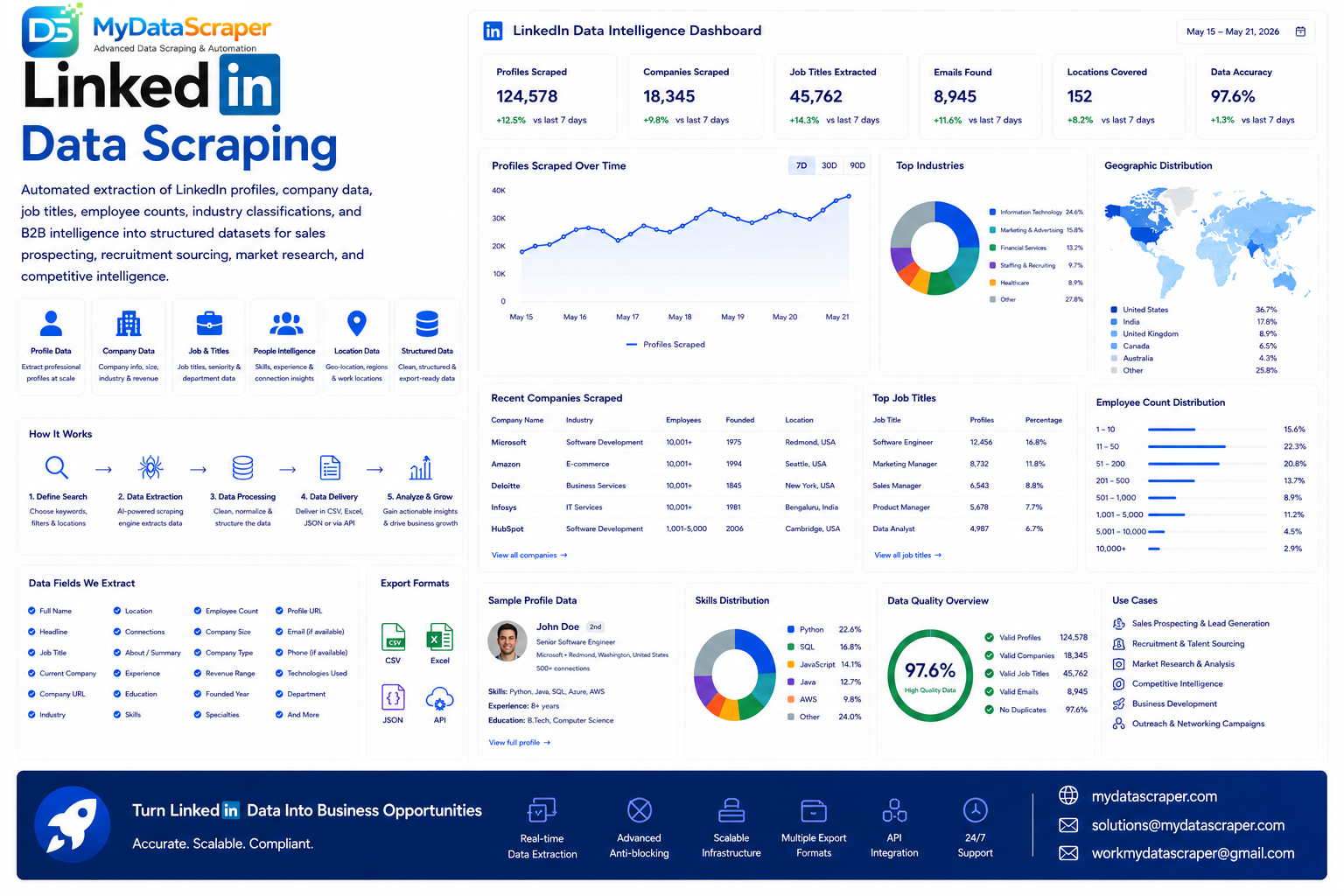
LinkedIn data scraping is the automated collection of publicly and semi-publicly available professional and business data from LinkedIn — including individual professional profiles (names, titles, companies, locations, skills, education), company pages (employee counts, industry, headquarters, growth rate, recent posts), job postings (open roles, salary data, requirements), and organizational intelligence (who works where, in what roles, with what backgrounds).
This is distinct from LinkedIn's own Sales Navigator or Recruiter tools — which provide filtered search access but with LinkedIn's usage limitations, seat-based pricing ($1,200-$10,000+ per year per seat), and strict download restrictions. LinkedIn data scraping provides the raw data flexibility that internal LinkedIn tools were specifically designed not to offer — bulk data access, full dataset exports, custom data models, historical tracking, and integration with your own CRM, analytics, and outreach systems.
The key data dimensions that LinkedIn scraping uniquely provides:
- Professional identity data — current title, company, location, seniority level, department function
- Career trajectory data — employment history, tenure patterns, career progression path
- Organizational mapping — who works at a target company, in what roles, in what departments, at what seniority
- Company intelligence — employee count, growth rate, industry, headquarters, recent news and updates
- Skills and expertise data — endorsed skills, certifications, education, language proficiency
- Job market intelligence — open positions, role requirements, salary ranges (where disclosed), hiring velocity
- Network and influence data — connection count, follower count, post engagement (for public content creators)
Public vs Semi-Public Data: LinkedIn data exists on a spectrum of visibility. Fully public data (visible to anyone, even without a LinkedIn account) includes many company pages and some profile data. Semi-public data (visible to any logged-in LinkedIn member) includes full profiles within network proximity. Our extraction focuses on data within appropriate visibility boundaries. MyDataScraper works with clients to define data scope that aligns with both business needs and responsible data access practices.
What LinkedIn Data Can Be Extracted?
👤 Professional Profile Data
- Full name and professional headline
- Current job title and company
- Location (city, state/country)
- Industry classification
- Employment history (all previous roles and companies)
- Education history (degrees, institutions, years)
- Skills and endorsements (with endorsement counts)
- Certifications and licenses
- LinkedIn profile URL
- Profile summary / about section
- Connection count range
- Profile photo URL
🏢 Company Page Data
- Company name and LinkedIn company URL
- Company description and tagline
- Industry classification
- Company size (employee count range)
- Headquarters location
- Website URL
- Founded year
- Company type (public, private, nonprofit, educational)
- Specialties / focus areas
- Follower count
- Recent company posts and engagement metrics
- Associated employee profiles
💼 Job Posting Data
- Job title and full description
- Company posting the role
- Location and remote/hybrid/onsite designation
- Seniority level
- Employment type (full-time, contract, internship)
- Salary range (where disclosed)
- Required skills and qualifications
- Posting date and application deadline
- Number of applicants signal
- LinkedIn Easy Apply availability
📊 Organizational Intelligence
- Complete employee roster for target companies (public profiles)
- Department-level headcount estimates
- Seniority distribution (C-suite, VP, Director, Manager, Individual Contributor)
- New hire velocity (recent joins)
- Departure velocity (people who recently left)
- Technology stack signals (from employee skill profiles)
- Geographic distribution of employees
At MyDataScraper, we extract exactly the LinkedIn data fields your sales, recruiting, or research strategy requires — delivered in CSV, JSON, or Excel, ready for CRM import, outreach campaigns, or analytical processing.
Why LinkedIn Intelligence Matters More Than Ever in 2026
B2B Buying Committees Are Larger and More Distributed
The average B2B buying decision now involves 6-10 decision makers across multiple departments. Identifying and reaching all relevant stakeholders — not just the single contact in your CRM — requires organizational mapping intelligence that only LinkedIn provides. LinkedIn B2B lead generation through systematic data extraction enables sales teams to map entire buying committees and execute multi-threaded account strategies.
LinkedIn Sales Navigator Limits Are Frustrating Power Users
Sales Navigator is an excellent search and filtering tool — but its download limits, per-seat pricing, and integration restrictions frustrate sales teams that need bulk data access for large-scale prospecting. LinkedIn data scraping provides the raw data flexibility that Sales Navigator specifically restricts — unlimited exports, custom data models, historical tracking, and full CRM integration without per-seat cost escalation.
Talent Competition Requires Systematic Intelligence
In competitive talent markets, the recruiting teams that win are those with the broadest, most current, and most precisely targeted candidate pipelines. Systematic LinkedIn profile data extraction enables recruiters to build comprehensive candidate databases for any role, skill set, and geography — updated continuously and enriched with career trajectory data that reveals the candidates most likely to be open to new opportunities.
Company Intelligence Drives Strategic Decisions
Understanding competitor organizations — their team structure, hiring patterns, technology adoption, geographic expansion, and leadership changes — is intelligence that drives strategic decisions across sales, marketing, product, and investment. LinkedIn company data provides this organizational intelligence at a depth and freshness that no annual report or industry database can match.
"LinkedIn has become the single most important data source for B2B go-to-market strategy. The companies that build systematic extraction pipelines for LinkedIn data — rather than relying on manual Sales Navigator searches — operate with a prospect intelligence, talent intelligence, and competitive intelligence advantage that compounds every quarter." — B2B Sales & Talent Intelligence Strategy, 2026
Use Cases: Who Benefits from LinkedIn Data Scraping
🎯 B2B Sales Prospecting & Account-Based Selling
Build targeted prospect lists of decision-makers at your ideal customer companies — filtered by title, seniority, department, company size, industry, and geography. Map entire organizational hierarchies to identify all stakeholders in a buying committee. The #1 use case for LinkedIn scraping, and consistently delivers higher response rates than purchased lead lists because the data is current, self-reported, and specific to your ICP.
🔍 Recruitment Sourcing & Talent Pipeline Building
Build comprehensive candidate databases for any role, skill set, and location. Extract career history, skills, education, and tenure patterns to identify candidates most likely to be receptive to outreach. Track passive candidates over time, detecting job changes and profile updates that signal openness to new opportunities.
🏢 Competitive Organizational Intelligence
Map competitor organizations systematically — understanding their team structure, department sizes, recent hires, departures, seniority distribution, and technology stack (inferred from employee skills). This intelligence reveals competitor growth strategies, investment priorities, and organizational capabilities months before they become publicly visible through other channels.
📊 Market Research & Industry Mapping
Extract company and professional data across entire industries to understand market structure, company distribution, team composition patterns, and talent flow. This powers market sizing, competitive landscape reports, industry trend analysis, and investor intelligence that traditional research methodologies cannot match in freshness or granularity.
💼 Investment Research & Due Diligence
Investors and VCs use LinkedIn data to validate company claims about team quality, growth trajectory, and organizational maturity. Tracking employee headcount growth, key hire patterns, and departure velocity provides alternative signals that supplement (and sometimes contradict) what companies report through official channels.
📧 Influencer & Thought Leader Discovery
Identify the most influential professionals and content creators in specific industries, topics, or geographies — extracting follower counts, engagement metrics, content themes, and audience demographics to build targeted influencer partnership and content collaboration strategies.
🌍 International Market Entry Research
Before entering new geographic markets, extract LinkedIn company and professional data to understand the competitive landscape, talent availability, industry ecosystem, and business culture of target markets — intelligence that de-risks international expansion decisions.
🏫 Alumni Network & University Intelligence
Extract alumni data by university, degree, and graduation year to build networking databases, track career outcome patterns, and understand which institutions produce professionals in target roles and industries — valuable for both recruiting and educational institution benchmarking.
LinkedIn for Sales: Building Your Perfect Prospect Pipeline
LinkedIn is, without question, the most powerful B2B sales prospecting data source available in 2026. Here's why systematic LinkedIn extraction consistently outperforms every other lead generation approach:
Precision Targeting at Scale
LinkedIn profiles contain the exact data points that define your Ideal Customer Profile — current title, company, department, seniority, industry, company size, and geography. Extracting this data at scale means you can build prospect lists of exactly the right people at exactly the right companies, with precision that no purchased B2B list can match.
Multi-Threading Made Possible
Modern B2B sales requires reaching multiple stakeholders across a buying committee. LinkedIn organizational mapping reveals every relevant contact at a target account — the economic buyer, the technical evaluator, the end user champion, and the executive sponsor. Systematic extraction builds the multi-contact account maps that single-threaded selling cannot.
Career Change Signals = Buying Signals
When a prospect changes companies or roles, it creates a natural buying trigger — new leaders often evaluate and change vendors. Tracking LinkedIn profile changes systematically detects these career moves within days, enabling timely outreach during the window when new decision-makers are most open to new vendor conversations.
The Sales Math: A typical Sales Navigator subscription costs $1,200-1,800/year per seat and limits data exports to 2,500 leads per month. For a 10-person SDR team, that's $12,000-18,000/year with significant download restrictions. Custom LinkedIn scraping from MyDataScraper delivers unlimited, precisely targeted prospect data at a fraction of the per-seat cost — with full CRM integration, historical tracking, and no export limitations. Contact us to compare.
LinkedIn for Recruiting: Talent Intelligence at Scale
LinkedIn is the primary sourcing platform for recruitment — and systematic data extraction transforms how recruiting teams build candidate pipelines:
Passive Candidate Pipeline Building
The best candidates are often passive — not actively job searching but open to the right opportunity. LinkedIn profile data reveals the professional background, current role, tenure (long tenure = potential restlessness), and skill alignment of millions of passive candidates. Systematic extraction builds comprehensive passive candidate databases filtered by your exact requirements.
Competitor Talent Mapping
Understanding who works at competitor companies — their backgrounds, tenures, and skill sets — enables targeted poaching strategies and reveals which competitor employees are most likely to be recruitable based on career patterns and tenure signals.
Salary and Market Rate Intelligence
LinkedIn job postings increasingly include salary ranges (driven by transparency laws). Extracting compensation data from LinkedIn job posts across roles, seniority levels, and geographies builds real-time salary benchmarks that are more current than any annual survey.
The Recruiting Advantage: LinkedIn Recruiter Lite costs $170/month per seat. LinkedIn Recruiter Corporate costs $800+/month per seat. For large recruiting teams, these costs escalate rapidly — and both products limit data exports and candidate tracking capabilities. Custom LinkedIn scraping delivers unrestricted candidate data with full ATS integration, historical tracking, and custom data enrichment at a fraction of per-seat Recruiter pricing.
Company Intelligence: The Corporate Research Goldmine
LinkedIn company data scraping provides organizational intelligence that no other public source replicates:
- Employee growth tracking: Monitor headcount changes over time — the most reliable early indicator of company growth or contraction
- Department composition: Understand how companies allocate resources across engineering, sales, marketing, operations, and other functions
- Hiring velocity signals: Track job posting volume and new hire patterns — revealing investment priorities and expansion plans
- Technology stack inference: Aggregate employee skills data to infer the technologies a company uses — valuable for sales targeting and competitive analysis
- Leadership change detection: Monitor C-suite and VP-level profile changes — leadership transitions often trigger vendor evaluations and strategic pivots
- Geographic expansion signals: Detect when companies start hiring in new locations — an early indicator of market expansion
- Talent quality benchmarking: Compare the educational backgrounds, career trajectories, and skill profiles of employees across competing companies
Company Intelligence as Alternative Data: Investment firms and private equity analysts increasingly use LinkedIn company data as alternative data for evaluating potential investments. Employee headcount growth, department composition changes, and hiring velocity provide leading indicators of company performance that financial statements reveal only in retrospect. MyDataScraper builds LinkedIn company intelligence pipelines for both commercial and investment applications.
The LinkedIn Data Extraction Process: Step by Step
Step 1: 🎯 Target Definition & ICP Mapping
We begin by defining your exact data requirements — target job titles, seniority levels, company sizes, industries, geographies, and any custom filters (specific skills, tenure ranges, education backgrounds). For company intelligence, we define the target company list, data fields, and monitoring frequency. This scoping ensures every extracted record matches your actual business needs.
Step 2: 🔧 Custom LinkedIn Scraper Engineering
Our engineers build scrapers purpose-designed for LinkedIn's architecture — handling dynamic page rendering, profile data extraction from various visibility levels, company page parsing, job posting extraction, pagination through search results, and LinkedIn's anti-automation measures. Every scraper is custom-engineered for reliable, comprehensive data collection.
Step 3: 🧹 Data Cleaning, Standardization & Enrichment
LinkedIn data requires specialized cleaning — job title normalization (VP vs Vice President vs V.P.), company name standardization, seniority level classification, department function categorization, location normalization, and deduplication across multiple extraction sources. We deliver clean, standardized datasets ready for immediate business use.
Step 4: 📦 Structured Delivery & CRM Integration
Clean LinkedIn data is delivered in CSV, JSON, or Excel — or integrated directly with your CRM (Salesforce, HubSpot, Pipedrive), ATS (Greenhouse, Lever, Workday), outreach platform (Apollo, Outreach.io, Salesloft), or business intelligence tools via automated pipeline.
Step 5: 🔄 Ongoing Monitoring & Change Detection
For clients who need continuously updated intelligence, we configure ongoing monitoring — detecting job title changes, company changes, new hires at target companies, leadership transitions, and organizational growth signals. This keeps your prospect and candidate databases perpetually current rather than slowly decaying.
Case Study: How a B2B SaaS Company Tripled Its Sales Pipeline in 6 Months Using LinkedIn Data Extraction
A B2B SaaS company selling marketing automation software to mid-market companies (100-2,000 employees) was hitting a prospecting ceiling. Their 8-person SDR team was spending 60% of their time manually searching LinkedIn Sales Navigator, building prospect lists one profile at a time, and entering data into Salesforce by hand. Despite the enormous time investment, they were generating only 300-400 qualified prospects per month — insufficient to support the company's growth targets.
The core problems were interconnected: slow manual prospecting limited pipeline volume, inconsistent data entry created CRM quality issues, and single-threaded outreach (one contact per account) produced low response rates because SDRs couldn't identify and reach all relevant stakeholders in buying committees.
After partnering with MyDataScraper, we built a comprehensive LinkedIn intelligence pipeline:
What Was Built
- Automated extraction of marketing decision-makers (CMO, VP Marketing, Director of Marketing, Head of Demand Gen, Marketing Manager) at companies with 100-2,000 employees across 14 target industries in the US, UK, and Canada
- Multi-stakeholder account mapping — extracting 3-5 relevant contacts per target company including the marketing leader, CMO, Head of Revenue, and CTO (for technical evaluation)
- Company intelligence enrichment — employee count, industry, growth signals, technology stack inference (from marketing team skill profiles)
- Job change monitoring — weekly detection of prospects who changed companies or roles (buying trigger signal)
- Competitor customer identification — extracting profiles of people at target companies who listed competitor product skills, indicating current competitor usage
- All data delivered weekly in CSV directly into Salesforce with automated lead assignment and scoring
Results After 6 Months
3.1x increase in qualified pipeline — from 350 to 1,100 qualified prospects per month entering the pipeline. SDR prospecting time reduced by 72% — from 60% of working hours to under 17%, freeing time for actual selling activities. 47% higher email response rate — from multi-threaded outreach enabled by organizational mapping (reaching 3-5 contacts per account vs 1). $2.8M additional pipeline value generated in 6 months directly attributable to LinkedIn-sourced prospects.
The most impactful feature was the job change detection system — prospects who had recently changed roles responded to outreach at 3.4x the rate of stable-role prospects, validating the buying trigger hypothesis and creating the highest-converting segment in their entire pipeline.
Contact MyDataScraper today to build your LinkedIn intelligence pipeline.
How MyDataScraper Delivers LinkedIn Intelligence That Transforms Pipelines
At MyDataScraper, LinkedIn data extraction is one of our most in-demand B2B intelligence services. Here's what makes our approach uniquely effective:
🎯 ICP-Perfect Targeting
We don't deliver generic LinkedIn data dumps. Every extraction is built around your specific Ideal Customer Profile — the exact titles, seniority levels, departments, company sizes, industries, and geographies that define your best-fit prospects or candidates. This precision targeting means every record in your delivered dataset is genuinely relevant.
🏢 Organizational Mapping for Account-Based Strategies
For account-based sales and recruiting, we extract and map entire organizational charts — identifying all relevant stakeholders at target accounts, their roles, seniority levels, and professional backgrounds. This enables the multi-threaded engagement strategies that modern B2B selling demands.
📈 Change Detection & Buying Signal Monitoring
We configure ongoing monitoring systems that detect the LinkedIn profile changes that create buying and recruiting opportunities — job changes, promotions, company exits, new skill additions, and profile updates that signal openness to new conversations.
🔗 Seamless CRM & ATS Integration
LinkedIn data is delivered in CSV, JSON, or Excel — or integrated directly with your CRM (Salesforce, HubSpot, Pipedrive), ATS (Greenhouse, Lever, Workday), outreach platform (Apollo, Outreach.io, Salesloft, Lemlist), or business intelligence tools via automated pipeline.
🌍 Global Coverage Across All LinkedIn Markets
We extract LinkedIn data globally — across all 200+ countries and territories where LinkedIn operates — enabling international sales prospecting, global talent sourcing, and cross-market competitive intelligence.
Ethical & Legal Considerations for LinkedIn Data Scraping
✅ Responsible Practices We Follow
- Focus on publicly accessible professional data that individuals have chosen to display
- Respect LinkedIn's terms of service to the extent commercially reasonable
- Implement appropriate rate limiting to minimize platform impact
- Use data exclusively for legitimate B2B business purposes (sales, recruiting, research)
- Comply with applicable data privacy regulations (GDPR, CCPA, PDPA)
- Maintain proper data security for all extracted professional information
- Honor data subject access and deletion requests when received
- Never use extracted data for harassment, discrimination, or unauthorized purposes
❌ Practices We Strictly Avoid
- Collecting private messages, connection lists, or non-public profile information
- Creating fake LinkedIn accounts for data access purposes
- Using extracted data for unsolicited mass spam or robocalling
- Collecting sensitive personal categories of data (religion, political affiliation, health)
- Reselling raw LinkedIn profile data as a commercial data product
- Using data for discriminatory screening or profiling
- Sending requests at volumes that disrupt LinkedIn's service
Critical Legal Context: The legality of LinkedIn data scraping has been significantly shaped by the landmark hiQ Labs v. LinkedIn case, where the US Ninth Circuit Court ruled that scraping publicly available LinkedIn data does not violate the Computer Fraud and Abuse Act (CFAA). This precedent supports the right to access and collect publicly available professional data. However, LinkedIn's Terms of Service restrict automated access, GDPR applies to EU member profiles, and data usage must comply with applicable privacy regulations. MyDataScraper builds compliance considerations into every LinkedIn project and strongly recommends legal counsel for specific implementations, particularly those involving EU data subjects.
Frequently Asked Questions
Is LinkedIn data scraping legal?
The hiQ Labs v. LinkedIn case established that scraping publicly available LinkedIn data is not a violation of the CFAA. However, LinkedIn's Terms of Service restrict automated access, and data privacy laws (GDPR for EU, CCPA for California, PDPA for Singapore) govern how collected professional data is used and stored. The legality depends on what data is collected, how it's accessed, and how it's used. MyDataScraper builds compliance considerations into every project and recommends legal counsel for specific use case guidance.
How does LinkedIn scraping compare to LinkedIn Sales Navigator?
Sales Navigator is an excellent search and filtering tool — but it limits data exports, charges per-seat pricing ($100-800+/month), restricts CRM integration capabilities, and doesn't allow bulk historical tracking. Custom LinkedIn scraping provides unlimited data exports, full CRM integration, historical change detection, organizational mapping, and custom data enrichment — at a fraction of multi-seat Sales Navigator costs. Many sales teams use both: Sales Navigator for day-to-day prospecting interface and custom scraping for bulk data operations.
Can LinkedIn company data be extracted for competitive intelligence?
Yes — company page data (employee count, industry, headquarters, specialties, growth rate, recent posts) and the aggregate profile data of company employees (department distribution, skill composition, hiring patterns) provide rich competitive intelligence. We build company intelligence pipelines that track competitor organizations over time, detecting headcount changes, key hires, department restructuring, and geographic expansion signals.
Can job change events be detected automatically?
Yes — we configure monitoring systems that detect profile changes for tracked prospects or candidates. When someone changes their title, company, or location on LinkedIn, the change is detected and flagged in your next data delivery. This job change detection is one of the highest-ROI features for sales teams, as prospects who have recently changed roles respond to outreach at significantly higher rates.
What format is LinkedIn data delivered in?
We deliver LinkedIn data in CSV, JSON, or Excel — and can integrate directly with CRM platforms (Salesforce, HubSpot, Pipedrive), ATS systems (Greenhouse, Lever, Workday, iCIMS), outreach tools (Apollo, Outreach.io, Salesloft, Lemlist), and BI platforms (Tableau, Power BI) via automated pipeline delivery.
How many LinkedIn profiles or companies can be extracted?
Our infrastructure scales to any volume — from a focused list of 500 target decision-makers to comprehensive extractions of hundreds of thousands of profiles across industries and geographies. Scale is configured to match your business requirements, use case, and responsible data collection practices. Contact us for a volume estimate based on your specific needs.
How quickly can a LinkedIn scraping project be launched?
Standard LinkedIn data extraction projects are built and delivering data within 5 to 10 business days of project kick-off. Focused projects (single title, single geography) can often launch faster. Complex multi-market organizational mapping projects typically take 7-12 days. Contact our team today for a timeline estimate based on your requirements.
LinkedIn Contains the B2B Intelligence That Powers Every Great Sales Pipeline, Every Smart Hire, and Every Strategic Decision — Are You Accessing It Systematically?
LinkedIn is not just a professional networking platform — it is the world's most comprehensive, most current, and most granular database of professional identity and organizational structure. Every sales prospect, every recruitable candidate, every competitive intelligence signal, and every market research data point is represented in LinkedIn's 1 billion+ professional profiles and 67 million+ company pages — voluntarily provided, continuously updated, and publicly or semi-publicly accessible.
The businesses that access this data one profile at a time — through manual Sales Navigator searches and copy-paste workflows — are operating at a fraction of their intelligence potential. The businesses that build systematic LinkedIn extraction pipelines gain access to precisely targeted prospect lists, comprehensive organizational maps, continuous change detection signals, and the kind of B2B intelligence depth that transforms pipeline building, talent acquisition, and strategic decision-making.
At MyDataScraper, we build custom LinkedIn data extraction solutions tailored to your specific B2B intelligence needs — sales prospect pipelines, recruitment candidate databases, competitive organizational intelligence, market research datasets, and investment due diligence data — delivered in CSV, JSON, or Excel, integrated into your CRM, ATS, and business systems, on any schedule your strategy demands.
The B2B intelligence that could transform your sales pipeline, accelerate your recruiting, and sharpen your competitive strategy is on LinkedIn right now — for every industry, every company, every professional, in every market. The question is whether you're collecting it systematically, or leaving this extraordinary data advantage to your competitors.
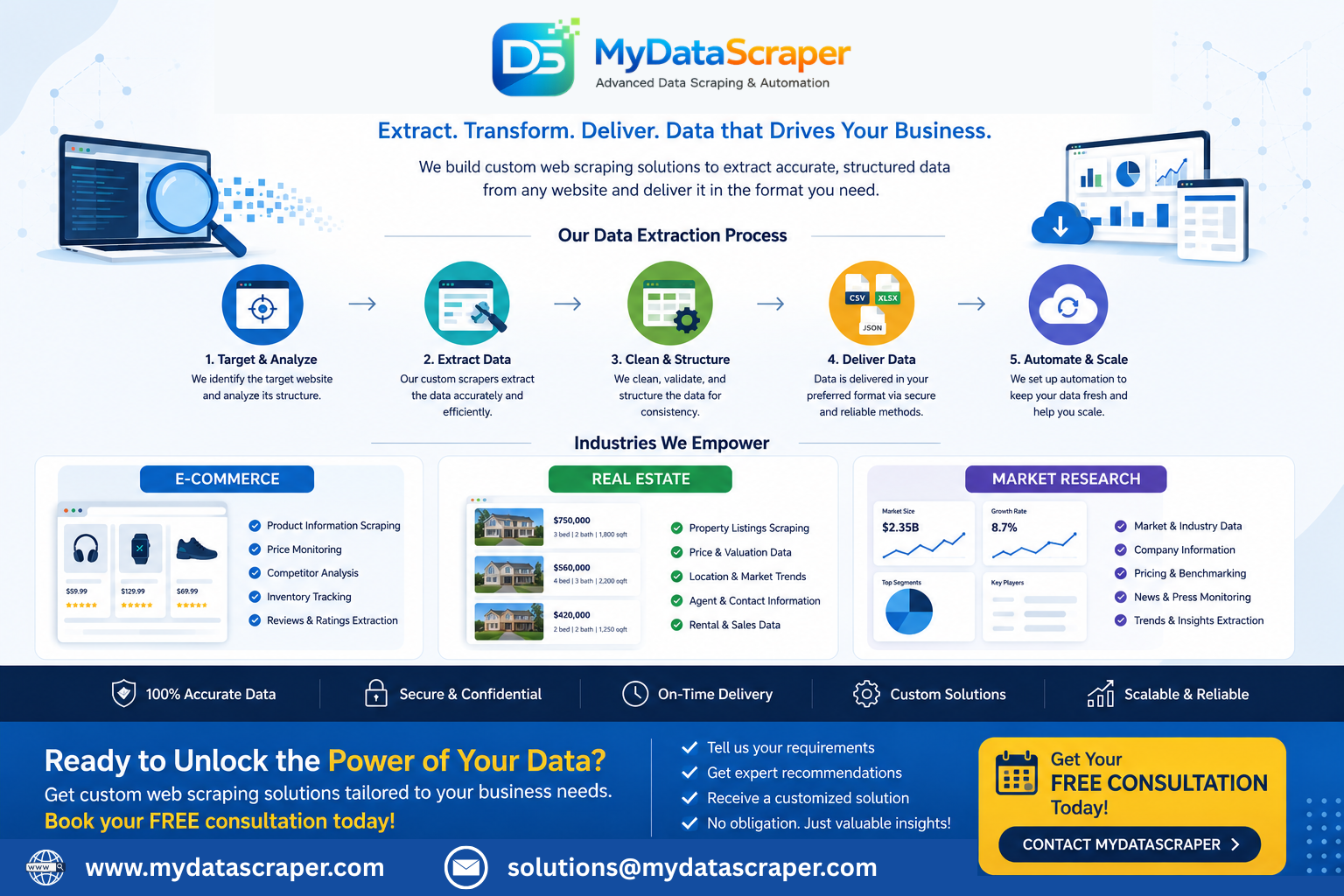
Ready to build your LinkedIn data advantage? Contact MyDataScraper for a free consultation — or visit www.mydatascraper.com to explore all our B2B data extraction services.

Written by the MyDataScraper Team
MyDataScraper is a leading provider of custom web scraping and data extraction solutions for LinkedIn, Google Maps, Amazon, and other major platforms. We help sales teams, recruiters, agencies, and researchers extract the B2B intelligence that drives better prospecting, smarter hiring, and stronger competitive positioning. Learn more at www.mydatascraper.com or contact our team today for a free consultation.