Social Media & Sentiment Data Scraping: Know What the World Is Saying About Your Brand Right Now
Extract brand mentions, competitor sentiment, influencer metrics, viral content signals, consumer opinions, and trending topics from Instagram, TikTok, Reddit, X (Twitter), YouTube, and 50+ platforms — in real time, at scale, with NLP-powered sentiment analysis built in.
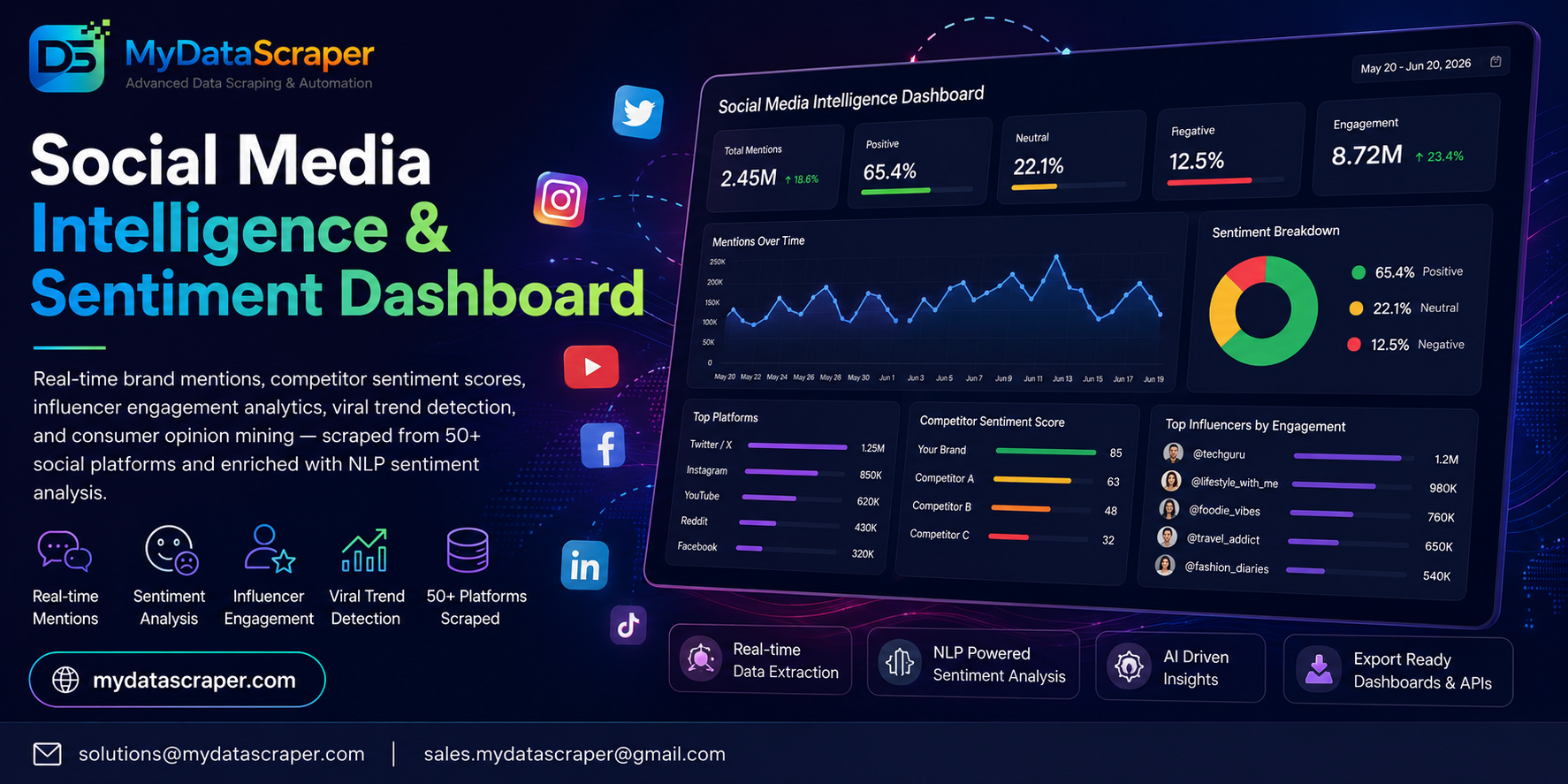
Why Social Media Data Scraping Is the Most Underutilised Source of Consumer Intelligence in 2025
Every 60 seconds, 500 hours of video are uploaded to YouTube, 695,000 Stories are shared on Instagram, 1 million TikToks are viewed, and 6,000 tweets are posted on X. Somewhere in that torrent of content, consumers are talking about your brand, your competitors, your industry, and their unfiltered needs — with a honesty that no focus group could replicate.
The global social media analytics market reached $9.5 billion in 2024 and is growing at 25.8% CAGR — driven by brands finally recognising that social data is not just a marketing metric but a strategic business signal. Companies that listen at scale to social conversations can detect product issues before they become PR crises, identify emerging consumer trends 6-12 weeks before they appear in sales data, find and activate the right influencers before their competitors do, and benchmark their brand health against competitors in real time.
The challenge is that social media platforms are among the most technically aggressive in defending their data. Twitter/X deprecated its free API in 2023, charging $100/month for basic access. Instagram actively blocks scrapers. TikTok employs sophisticated bot detection on its API. Reddit has monetised its data firehose at premium prices. Building and maintaining scrapers across all these platforms — while staying ahead of their constantly evolving defences — requires specialised engineering expertise that most marketing teams simply don't have.
That's the challenge MyDataScraper's social media data scraping services were built to solve. We extract, structure, and enrich social data from 50+ platforms and deliver it with built-in sentiment scores, topic classification, and engagement normalisation — so your team can focus on drawing insights, not fighting APIs.
What Social Media Data Can You Extract & Analyse?
Social media scraping goes far beyond collecting post text. Here's the complete intelligence landscape that systematic social data collection enables.
Brand Mentions & Conversations
Every public mention of your brand name, product names, campaign hashtags, and common misspellings across platforms — including the post text, author details, engagement metrics, timestamps, sentiment score, and topic classification. Includes both direct tags (@brand) and untagged text mentions.
Sentiment Scores & Emotion Analysis
NLP-powered positive/neutral/negative classification at both the post level and the aggregate brand level. Advanced analysis layers include emotion detection (joy, anger, sadness, surprise, fear, disgust), aspect-based sentiment (separating sentiment about price vs. quality vs. customer service within the same post), and sarcasm detection.
Influencer Profiles & Engagement Analytics
Follower count, following count, engagement rate (likes + comments ÷ followers), average views per post, content posting frequency, audience demographics (where available), brand affinity signals, fake follower ratio estimates, and historical brand collaboration history — across Instagram, TikTok, YouTube, and X.
Trending Topics & Viral Content Signals
Real-time trending hashtags by platform and geography, emerging topic clusters before they peak, content velocity tracking (posts per hour for a given topic), viral threshold alerts (when content crosses engagement milestones), and trend lifecycle classification (emerging vs. peaking vs. declining).
Competitor Share of Voice
How much of the conversation in your industry is about you vs. competitors, measured by raw mention volume, engagement-weighted mention volume, and sentiment-adjusted share of voice. Track whether competitors are gaining or losing social presence over time and identify the specific topics driving their growth.
Reviews & Ratings (App Stores, Review Sites)
Google Play and Apple App Store reviews, Google Maps reviews, Trustpilot, G2, Capterra, Yelp, TripAdvisor, and industry-specific review platforms — including star ratings, review text, response rates, and response content. Combined with sentiment analysis to identify specific product and service friction points.
Geographic & Demographic Signals
Location-tagged post analysis to understand where brand conversations are concentrated geographically, language distribution of brand mentions, platform-specific demographic inference from public profile data, and regional sentiment variation (why the same product gets different reactions in different markets).
Video & Visual Content Analytics
YouTube video metadata (title, description, tags, view count, like ratio, comment volume and sentiment), TikTok video engagement metrics, Instagram Reels performance data, and audio trend tracking (sounds and music gaining adoption across TikTok that signal emerging viral moments).
Reddit & Forum Deep Discussions
Reddit thread scraping including post title, full body text, subreddit, upvotes, awards, comment tree, top commenter authority, and cross-post activity. Niche forum monitoring (Discord public servers, Quora, Stack Overflow, industry forums) for long-form consumer opinion that Twitter's character limit can't capture.
💡 Sentiment Shifts Are Your Earliest Warning System
A product defect that leads to a viral complaint thread typically shows up as a negative sentiment spike 72–96 hours before it generates mainstream media coverage. Brands monitoring social sentiment in real time have a 3-4 day window to respond, issue a statement, or proactively reach out to affected customers — turning a potential PR crisis into a brand trust moment. Our live dashboards deliver real-time sentiment alerts the moment a negative spike is detected.
Social Media Scraping: Every Platform Where Your Audience Lives
Social conversations about brands don't happen in one place. Your customers might rave about you on Instagram, complain in detail on Reddit, ask questions on Quora, and post video reviews on YouTube — all simultaneously. Comprehensive brand intelligence requires monitoring all of them.
⚠️ The Platform API Reality in 2025
Most major social platforms have dramatically restricted or monetised their data access in the past 2 years: X (Twitter) charges $100+/month for limited Basic API access, with enterprise-grade firehose access exceeding $40,000/month. Reddit charges $0.24 per 1,000 API calls, making large-scale research prohibitively expensive through official channels. Instagram and TikTok have virtually no public API access for brand mention data. This is precisely why professionally managed web scraping has become the de facto method for social media intelligence gathering — delivering the same publicly visible data at a fraction of the cost.
Social Media Data Scraping Use Cases: Brands, Agencies, and Researchers
Social intelligence serves every function that touches brand, product, or customer — which is to say, virtually every part of a modern organisation.
Brand & Marketing Teams
Brand managers use real-time sentiment monitoring to understand how campaigns are landing, detect PR risks before they escalate, and measure brand health over time. Share-of-voice tracking shows how much of the industry conversation the brand owns versus competitors. Content teams use viral trend detection to identify what formats and topics are gaining traction — informing their next content calendar before the moment passes. One global CPG brand reduced their crisis response time from 48 hours to under 4 hours by implementing our real-time negative sentiment alerting.
PR & Communications Teams
PR professionals use social scraping to monitor media coverage mentions alongside organic social conversations, identify journalists and bloggers covering their industry (who often post about stories before publishing), track spokesperson and executive sentiment, measure the earned media impact of press releases, and get early warning of narratives forming in niche communities that could scale to mainstream coverage within days.
Product & UX Teams
Product managers mine social posts and app reviews for unfiltered user feedback — feature requests, bug reports, usability frustrations, and competitor feature comparisons — at a scale and speed that formal user research cannot match. Aspect-based sentiment analysis identifies which specific product features are loved (protecting them from removal) and which create friction (prioritising fixes). Reddit threads and Quora answers reveal the nuanced mental models customers use when evaluating your product category.
Influencer Marketing Teams
Influencer discovery platforms and marketing teams use scraped influencer data to identify creators with genuine audience engagement (not inflated by bots), analyse which influencers are already organically mentioning their brand or competitors, assess brand safety through historical content analysis, and track the performance metrics of influencer campaigns post-execution — including earned reach, sentiment of audience response, and conversion signals in comments.
Digital Marketing Agencies
Agencies managing multiple client brands use social scraping to deliver competitive intelligence reports at scale — monitoring dozens of brand-competitor pairs simultaneously without the cost of per-seat social listening tool subscriptions. Automated weekly reports on sentiment trends, share-of-voice shifts, and emerging topics replace hours of manual monitoring work and give account teams the data-driven stories clients pay premium retainers for.
Market Research & Consumer Insights
Market research firms use scraped social data to supplement or replace traditional survey research — mining millions of unsolicited consumer opinions on topics ranging from brand perceptions to purchasing triggers to competitor product reactions. Social data provides the "why" behind quantitative survey results, delivered faster and more authentically than any focus group. Several major FMCG research engagements now use scraped Reddit and Instagram data as the primary qualitative research source.
Influencer Discovery & Analytics Through Social Media Scraping
Influencer marketing is a $24 billion industry in 2025 — and the biggest waste of that budget comes from working with the wrong creators. Follower count is a vanity metric. Engagement rate, audience authenticity, content-brand alignment, and historical performance are what actually predict campaign outcomes. All of this is publicly visible on social platforms. All of it can be scraped and structured at scale.
⚠️ Sample influencer profiles for illustration. Real datasets include 10M+ creator profiles with audience demographics and historical collaboration data.
What Influencer Scraping Reveals That Platforms Won't Tell You
- True engagement rate — not the platform's inflated "reach" metric
- Follower authenticity score — estimated fake follower percentage
- Comment quality analysis — ratio of genuine vs. generic comments
- Engagement consistency — does engagement hold steady or spike/drop suspiciously?
- Brand affinity history — which brands has this creator organically mentioned?
- Audience overlap — how much do two influencers' audiences share?
- Content performance by format — which post types get the best results?
- Sentiment of their own audience — are followers genuinely engaged or passive?
Social Media Scraping: Platform Coverage, Data Richness & Difficulty
| Platform | Primary Data Value | Official API Cost | Public Data Available | Scraping Difficulty | MyDataScraper |
|---|---|---|---|---|---|
| Visual brand mentions, influencer metrics | No public API | ✔ Posts, profiles, hashtags | 🔴 Very High | ✔ Full support | |
| 🎵 TikTok | Viral trends, Gen Z sentiment, video engagement | Research API (limited) | ✔ Posts, sounds, profiles | 🔴 Very High | ✔ Full support |
| 🐦 X (Twitter) | Real-time news, brand crises, hashtag trends | $100–$40K+/month | ✔ Tweets, profiles, trends | 🟠 High | ✔ Full support |
| ▶️ YouTube | Long-form brand reviews, video sentiment | Free (rate-limited) | ✔ Videos, comments, channels | 🟡 Medium | ✔ Full support |
| Deep consumer opinions, product discussions | $0.24 per 1K calls | ✔ Posts, comments, subreddits | 🟡 Medium | ✔ Full support | |
| Brand page engagement, public group discussions | Limited Graph API | ✔ Public pages & groups | 🔴 Very High | ✔ Selective support | |
| ⭐ Trustpilot / G2 | Structured brand reviews with star ratings | Paid API plans | ✔ Full review text & ratings | 🟢 Low-Medium | ✔ Full support |
| 💬 Quora | Long-form Q&A, brand comparison discussions | No API | ✔ Questions, answers, topics | 🟢 Low | ✔ Full support |
How MyDataScraper Builds Your Social Media Intelligence Pipeline
From initial brand monitoring setup to real-time sentiment alerts, here's our proven process for delivering social intelligence that your teams can actually act on.
Brand Entity & Monitoring Scope Definition
We start by building a comprehensive monitoring dictionary for your brand: primary brand names, product names, campaign hashtags, executive names, common misspellings and abbreviations, competitor names and their variants, and industry keywords. This entity library is the foundation that determines what gets captured and what gets filtered out — preventing both false negatives (missing real mentions) and false positives (capturing irrelevant content with similar keywords). For global brands, we include language-specific variants and regional spelling differences.
Multi-Platform Scraping Infrastructure Deployment
Each social platform requires a uniquely configured scraper. Instagram requires headless browser sessions with residential proxy rotation to simulate genuine user behaviour. Reddit's pushshift and API endpoints are combined for complete historical and real-time coverage. TikTok's mobile app structure requires mobile device emulation. YouTube's Data API is supplemented with direct HTML scraping for comment data beyond API limits. We deploy platform-specific scrapers with dedicated proxy pools, session management, and adaptive rate limiting — all running 24/7 with automatic failover.
NLP Sentiment Analysis & Topic Classification
Every piece of collected content passes through our NLP enrichment pipeline: (1) Language detection — identifying the post's language; (2) Sentiment classification — positive/neutral/negative scoring using a BERT-based model fine-tuned on social media text across 14 languages; (3) Aspect extraction — identifying which product/brand aspects are being discussed (price, quality, customer service, design); (4) Topic clustering — grouping related posts into coherent topic threads; (5) Entity extraction — identifying all brand, product, person, and place mentions within the post.
Spam, Bot & Irrelevant Content Filtering
Social media is full of noise. Automated spam, bot accounts, duplicate posts, and off-topic content mentioning your keyword in an unrelated context all inflate mention counts and distort sentiment scores if not filtered out. Our filtering pipeline applies: bot account detection (engagement pattern analysis, account age, follower/following ratio), spam pattern recognition (identical text posted by multiple accounts), context disambiguation (filtering mentions of your brand name used in other contexts), and content quality scoring (minimum meaningful content thresholds).
Anomaly Detection & Alert Configuration
Normal brand mention volume has predictable patterns — higher on weekdays, spikes after marketing campaigns, seasonal patterns tied to your industry. We train baseline models on your historical data to distinguish normal variation from genuine anomalies: a sudden negative sentiment spike, an unexpected mention volume surge, a viral post gaining 10,000 likes per hour, or a new competitor hashtag gaining rapid traction. When anomalies exceed your configured thresholds, alerts are pushed immediately via webhook, email, or Slack — not at the next scheduled report.
Delivery, Dashboards & Reporting Automation
Social intelligence data is delivered through multiple channels: our live analytics dashboard with real-time sentiment timelines, share-of-voice charts, trending topic clouds, and influencer leaderboards; a REST API for integration with your existing marketing tools (HubSpot, Hootsuite, Salesforce); weekly and monthly automated report generation in PDF or PowerPoint format for executive stakeholders; and direct database delivery for data science teams building custom models on top of the raw data.
Your Social Intelligence Feed in Real Time
Here's the kind of live data signals our social media scraping pipeline delivers to brand teams, updated continuously throughout the day:
⚠️ Simulated data for illustration. Real feeds delivered live via API and dashboard.
Social Media Sentiment API: Sample Integration Code
For developers building custom brand dashboards, competitive intelligence tools, or sentiment-driven marketing automation, our live API delivers structured social data with NLP enrichment built in. Here's a real-world integration example:
import asyncio
import aiohttp
from datetime import datetime, timedelta

# MyDataScraper Social Intelligence API
BASE_URL = "https://api.mydatascraper.com/v1/social"
API_KEY  = "your_api_key_here"
HEADERS  = {"Authorization": f"Bearer {API_KEY}"}

# ─── 1. Real-time brand mention stream ──────────────────────
async def get_brand_mentions(session, brands, platforms, hours_back=24):
    payload = {
        "entities": {
            "brands": brands,               # ["Nike", "nike", "#justdoit"]
            "include_misspellings": True   # auto-detect common variants
        },
        "platforms": platforms,             # ["instagram","tiktok","reddit","twitter"]
        "since": (datetime.now() - timedelta(hours=hours_back)).isoformat(),
        "nlp": {
            "sentiment": True,           # positive / neutral / negative + score
            "emotion": True,             # joy, anger, surprise, fear, disgust
            "aspects": True,             # price, quality, service, design
            "topics": True,              # auto-cluster into topic groups
            "language": "detect"         # 14 languages supported
        },
        "filter_bots": True,              # remove suspected bot accounts
        "min_followers": 100,             # minimum author follower count
        "limit": 1000
    }
    async with session.post(
        f"{BASE_URL}/mentions", json=payload, headers=HEADERS
    ) as r:
        return await r.json()

# ─── 2. Competitor share-of-voice analysis ──────────────────
async def get_share_of_voice(session, brands, industry_keywords, days=30):
    params = {
        "brands": ",".join(brands),
        "industry_keywords": ",".join(industry_keywords),
        "window_days": days,
        "metric": "engagement_weighted"   # raw or engagement-weighted SOV
    }
    async with session.get(
        f"{BASE_URL}/analytics/share-of-voice", params=params, headers=HEADERS
    ) as r:
        return await r.json()

# ─── 3. Influencer discovery for a niche + brand ────────────
async def discover_influencers(session, niche, brand_affinity=None):
    payload = {
        "niche": niche,                       # "sustainable fashion"
        "brand_mentioned": brand_affinity,     # filter: already mentioned your brand
        "min_engagement_rate": 3.5,            # % minimum engagement rate
        "min_authenticity_score": 80,          # 0-100 real follower score
        "platforms": ["instagram", "tiktok"],
        "follower_range": [10000, 500000],    # micro to mid-tier
        "sort_by": "engagement_rate"
    }
    async with session.post(
        f"{BASE_URL}/influencers/discover", json=payload, headers=HEADERS
    ) as r:
        return await r.json()

# ─── Run concurrently ────────────────────────────────────────
async def main():
    my_brands      = ["Nike", "#Nike", "@Nike", "JustDoIt"]
    competitor_set = ["Nike", "Adidas", "Puma", "New Balance"]
    industry_kws   = ["running shoes", "athletic wear", "sportswear"]

    async with aiohttp.ClientSession() as session:
        mentions, sov, influencers = await asyncio.gather(
            get_brand_mentions(session, my_brands, ["instagram","tiktok","reddit"]),
            get_share_of_voice(session, competitor_set, industry_kws),
            discover_influencers(session, "running fitness", brand_affinity="Nike")
        )

    # Summarize mentions by sentiment
    sentiment_breakdown = mentions["summary"]["sentiment_distribution"]
    print(f"😊 Positive: {sentiment_breakdown['positive']}%")
    print(f"😐 Neutral:  {sentiment_breakdown['neutral']}%")
    print(f"😠 Negative: {sentiment_breakdown['negative']}%")

    # Top influencers to reach out to
    print(f"\n🌟 Top Influencers for outreach:")
    for inf in influencers["results"][:5]:
        print(f"  @{inf['username']}: {inf['followers']:,} followers, {inf['engagement_rate']}% ER")

asyncio.run(main())
⚡ WebSocket Real-time Sentiment Stream
For marketing teams that need to monitor live events — product launches, brand campaigns, influencer activations, or PR situations — our WebSocket stream delivers individual mention records with NLP scores within seconds of being posted. Connect at wss://stream.mydatascraper.com/v1/social for sub-5-second latency from post publication to your dashboard.
Why Social Media Scraping Is the Most Technically Demanding Web Scraping Discipline
Social platforms invest billions in technology to protect their data — because their data is their primary business asset. Here's what makes social media scraping uniquely complex and how our specialised infrastructure handles each challenge.
Machine Learning-Based Bot Detection
Instagram uses a proprietary bot detection system called "Sybil" that analyses hundreds of behavioural signals simultaneously — typing speed, scroll velocity, click patterns, session length, and device fingerprints. Our scrapers use undetected browser automation, human-speed interaction simulation, residential proxy rotation per session, and continuously updated fingerprint profiles to maintain detection-proof sessions.
App-First Architectures & GraphQL APIs
Modern social platforms — Instagram, TikTok — serve their primary content through mobile app API calls using GraphQL or proprietary binary protocols, not HTML pages. Scraping requires intercepting and emulating these API calls, not parsing web pages. Our scrapers emulate authenticated mobile app sessions with correct headers, device identifiers, and request signatures for each platform.
Rate Limiting & Account Banning
Social platforms implement aggressive rate limiting at IP, device, and account levels simultaneously — and bans are cumulative: exceeding limits too often results in permanent blocks on entire IP ranges. Our distributed scraping infrastructure manages request budgets across thousands of residential IPs, implements exponential backoff, and uses session pooling to maintain sustainable, long-term data access.
Multilingual & Slang-Heavy Text Processing
Social media text is the most linguistically complex corpus in existence: slang, abbreviations, emoji, hashtag concatenation, code-switching (mixing languages mid-sentence), and platform-specific conventions ("ratio" on X, "NGL" in TikTok comments). Standard NLP models trained on formal text fail catastrophically on social content. Our models are specifically fine-tuned on social media corpora across 14 languages.
Spam, Coordinated Inauthentic Behaviour & Bot Accounts
Social platforms are riddled with spam accounts, bot networks, and coordinated inauthentic behaviour campaigns. Without sophisticated filtering, scraped brand mention data will be severely distorted by these artificial signals. Our pipeline applies multi-signal bot scoring to every account — engagement pattern analysis, follower network graph analysis, posting frequency patterns, and content repetition detection.
Real-time Volume at Extreme Scale
A brand hashtag during a Super Bowl ad or viral moment can generate 50,000+ mentions per hour — requiring the scraping and NLP processing pipeline to scale from baseline to 50× capacity within minutes, without missing posts or queuing delays that make the data arrive too late to act on. Our elastic infrastructure handles burst scaling with auto-provisioning that triggers in under 60 seconds.
Social Listening Tools vs. Custom Scraping: An Honest Comparison
| Approach | Annual Cost | Platform Coverage | Data Ownership | Custom Queries | Historical Depth |
|---|---|---|---|---|---|
| Brandwatch / Sprinklr | $40,000–$120,000/yr | Major platforms | ✘ Vendor-locked | ⚠ Limited | 1-2 years |
| Hootsuite Insights | $7,200–$18,000/yr | Major platforms | ✘ Vendor-locked | ✘ Preset dashboards | 90 days |
| Mention / Talkwalker | $4,800–$36,000/yr | Web + social | ⚠ Partial export | ⚠ Limited | 1 year |
| DIY API Access | $5,000–$50,000+/yr | API-available only | ✔ You own the data | ✔ Custom | API limits apply |
| MyDataScraper | From $4,200/yr | 50+ platforms | ✔ Full ownership | ✔ Fully custom | Custom archive |
A global consumer electronics brand was spending $84,000 annually on a Brandwatch enterprise subscription, which only covered 8 platforms and delivered data 4-6 hours delayed. Their marketing team couldn't respond to a product-related Reddit thread that went viral in r/technology because they only discovered it 12 hours after it peaked — when it had already accumulated 4,000 upvotes and a significant negative sentiment cloud around a product defect. After switching to MyDataScraper's real-time social pipeline at $18,000 annually, covering 50+ platforms with sub-5-minute latency, their average crisis response time dropped to 18 minutes — fast enough to get ahead of narratives before they spread to mainstream media.
📊 You Own Your Data — Forever
Unlike Brandwatch or Sprinklr, where your historical data disappears the moment you cancel your subscription, all data we deliver belongs to you. We deliver it to your S3 bucket, your database, or your data warehouse — and it stays there, giving you an ever-deepening historical baseline for trend analysis, year-over-year benchmarking, and ML model training that compounds in value over time.
How to Use Social Media Scraped Data Effectively & Ethically
1. Always Filter Out Bots Before Drawing Conclusions
Raw brand mention counts without bot filtering can be inflated by 20-40% on platforms like X and Instagram. A sudden spike in brand mentions that looks like organic buzz may be a coordinated bot campaign — or even your own competitors artificially inflating negative sentiment. Always apply bot scoring and minimum account quality thresholds before using social data for strategic decisions. Our pipeline does this automatically, but if building your own, invest in this filtering layer before anything else.
2. Use Engagement-Weighted Metrics, Not Raw Volume
A single Instagram post with 50,000 likes mentioning your brand carries far more informational weight than 500 tweets with 0 engagement. Weight your share-of-voice calculations, sentiment aggregates, and topic frequency counts by engagement metrics (likes + comments + shares + saves) rather than raw post counts — it gives a far more accurate picture of what conversations are actually reaching consumers.
3. Respect Privacy — Scrape Public Content Only
Social media scraping should be limited strictly to content that users have intentionally made public. Private accounts, direct messages, and friends-only posts are legally and ethically off-limits regardless of technical accessibility. Our pipeline only collects content from public posts and profiles. We also recommend not storing individually identifiable social media content longer than necessary for your use case — aggregate and anonymise where possible.
4. Establish Baseline Sentiment Before Measuring Change
Sentiment numbers are meaningless without context. A 60% positive sentiment rate sounds good — but if your industry average is 78%, you have a problem. If your own baseline is 45%, you've made significant improvement. Always establish historical baselines and industry benchmarks before interpreting current sentiment scores. Our pipeline archives 90 days of historical baseline data during onboarding to ensure your reporting starts from a meaningful reference point.
5. Close the Loop: Connect Social Signals to Business Outcomes
The most mature social intelligence programs connect social sentiment signals to downstream business metrics — sales velocity, customer churn rate, NPS scores, support ticket volume. When a negative sentiment spike in product quality mentions precedes a support ticket increase by 48 hours, that's a genuinely predictive model. Work to integrate your social data pipeline with your CRM and BI tools to close this loop systematically.
Frequently Asked Questions About Social Media & Sentiment Data Scraping
Scraping publicly available social media content — posts visible without logging in, public profiles, and public hashtag streams — is generally legal under U.S. law, supported by the 2022 Ninth Circuit ruling in hiQ Labs v. LinkedIn, which confirmed that accessing publicly available online data does not violate the Computer Fraud and Abuse Act. However, several important considerations apply: (1) You may only collect content that is genuinely public — not private profiles, direct messages, or friends-only posts; (2) Platform Terms of Service prohibit scraping, which creates a breach-of-contract risk (civil, not criminal); (3) In the EU, GDPR applies to any personal data of EU citizens — even if publicly posted — requiring a lawful basis for processing; (4) Specific data uses (e.g., targeting individuals based on their social posts) may have additional legal restrictions. MyDataScraper operates within ethical and legal boundaries, collecting only public content with responsible crawl rates. We recommend clients engage their legal counsel for specific use cases, particularly those involving EU data or individual-level data processing.
Our sentiment classification achieves 94% accuracy on social media text in our validation benchmarks — significantly higher than off-the-shelf NLP models applied to social content (which typically achieve 70-80%) because our models are specifically fine-tuned on social media corpora rather than formal text. The most challenging cases are sarcasm (where "Oh great, another bug 🙄" is negative despite containing the positive word "great") and highly informal slang — our models achieve approximately 84% accuracy on sarcastic posts, which we flag with a sarcasm probability score so analysts can apply appropriate caution. Accuracy varies by language: highest for English (94%), strong for Spanish, French, German, and Portuguese (88-92%), and lower for languages with less training data (78-85% for Thai, Vietnamese, Arabic).
Yes — Instagram is one of our most requested data sources and also one of the most technically demanding to scrape reliably. We maintain a dedicated Instagram scraping infrastructure using undetected browser automation, residential proxy pools with session persistence, human-speed interaction simulation, and continuously updated fingerprint management to stay ahead of Instagram's Sybil bot detection system. We collect public post text, hashtags, like and comment counts, account follower/following counts, and engagement rates. What we cannot collect: private account content (by design — only public posts), exact share counts (Instagram doesn't display these publicly), and Story content (ephemeral by nature). Our Instagram pipeline achieves 97%+ uptime across a 12-month period despite Instagram's frequent anti-bot updates.
Multilingual monitoring requires solving three distinct problems: (1) Entity recognition — identifying your brand name across languages, including transliterated versions (Nike in Arabic: نايكي), translated names, and language-specific abbreviations; (2) Sentiment analysis — we support 14 languages with models fine-tuned specifically for social media text in each language; (3) Geographic targeting — using geo-tagged posts and account profile location data to attribute mentions to specific markets. For brands in markets with non-Latin scripts (Arabic, Chinese, Japanese, Korean, Hindi), we maintain language-specific entity dictionaries and sentiment models. All multilingual data is delivered in a unified schema with a language_code field, enabling easy cross-market sentiment comparison.
For each influencer profile, we capture: follower count, following count, post count, bio text, verified status, average likes per post, average comments per post, calculated engagement rate, posting frequency, content category, hashtag usage patterns, brand mention history (which brands they've tagged organically), and follower growth trend. The Authenticity Score (0-100) is a composite model combining: (1) Follower-to-engagement ratio anomaly detection (accounts with 500K followers but 50 likes per post suggest fake followers); (2) Follower growth pattern analysis (organic growth is gradual — sudden large additions suggest purchased followers); (3) Comment quality ratio (generic "Nice post! 😊" comments suggest engagement pods or bots); (4) Audience account age distribution (very new accounts in the follower base signal fake accounts). Scores above 85 indicate high-authenticity creators; below 65 suggests significant artificial inflation.
Yes — Reddit monitoring is one of our most valuable social data offerings for brand intelligence. We monitor all public subreddits for mentions of your brand, products, competitors, and industry keywords. Data captured includes: post title and full body text, subreddit name and subscriber count, post score (upvotes minus downvotes), upvote ratio, award count, comment count, full comment trees (with nested replies), individual comment scores, and cross-post activity. We also track which subreddits are most active for your category — often revealing unexpected communities where your target customers are highly engaged and where your brand has no presence. Reddit's long-form discussion format makes it particularly valuable for understanding the why behind consumer opinions — the reasoning and context that short-form platforms can't capture.
Our crisis detection system operates on three tiers: (1) Real-time anomaly detection — if mention volume or negative sentiment spikes beyond 2 standard deviations from your 30-day baseline, an alert is triggered within 5-10 minutes of the spike beginning; (2) Viral content monitoring — individual posts gaining more than 1,000 engagements per hour are flagged immediately, regardless of whether they cross your sentiment threshold; (3) Emerging narrative detection — our topic clustering system identifies when multiple posts about the same issue begin appearing simultaneously (a coordinated complaint wave), alerting your team before any single post goes viral. In a documented client case, we detected a TikTok video criticising a product defect within 7 minutes of posting — 4 hours before it went viral with 2M views — giving the brand time to prepare a response and reach out proactively to the creator.
For active ongoing monitoring, we archive all collected data from your pipeline start date indefinitely — building a proprietary historical dataset specific to your brand that grows more valuable over time. For historical backfill (data before your pipeline start date), depth varies by platform: Reddit has excellent historical coverage via Pushshift archives going back to 2005; X (Twitter) historical data is available through our archive partnerships going back 3-5 years; YouTube video metadata is available indefinitely (comments less so for older videos); Instagram and TikTok historical data is significantly limited due to platform structure — typically 3-6 months of publicly available post history before content is progressively hidden. For sentiment trend analysis, we recommend a minimum 12-month historical baseline for meaningful seasonality and trend analysis.
Your Customers Are Talking. Your Competitors Are Listening. Are You?
Every brand mention, every viral complaint, every trending conversation about your industry is happening right now — in real time, in public, ready to be turned into intelligence. MyDataScraper delivers it all to your team, structured and sentiment-enriched, before the moment passes.