Amazon Product Data Scraping: The Complete Guide to Extracting Prices, Reviews, BSR & Marketplace Intelligence from Amazon in 2026
With over 600 million products, 2 million active sellers, and the most sophisticated marketplace algorithm in e-commerce, Amazon generates the richest product intelligence dataset on the planet. Discover how automated Amazon data extraction gives sellers, brands, and analysts the competitive intelligence to dominate their categories — from Buy Box monitoring to BSR tracking to review intelligence at scale.
- Why Amazon Data Is the Foundation of E-Commerce Strategy
- What Is Amazon Product Data Scraping?
- What Makes Amazon Data Uniquely Valuable
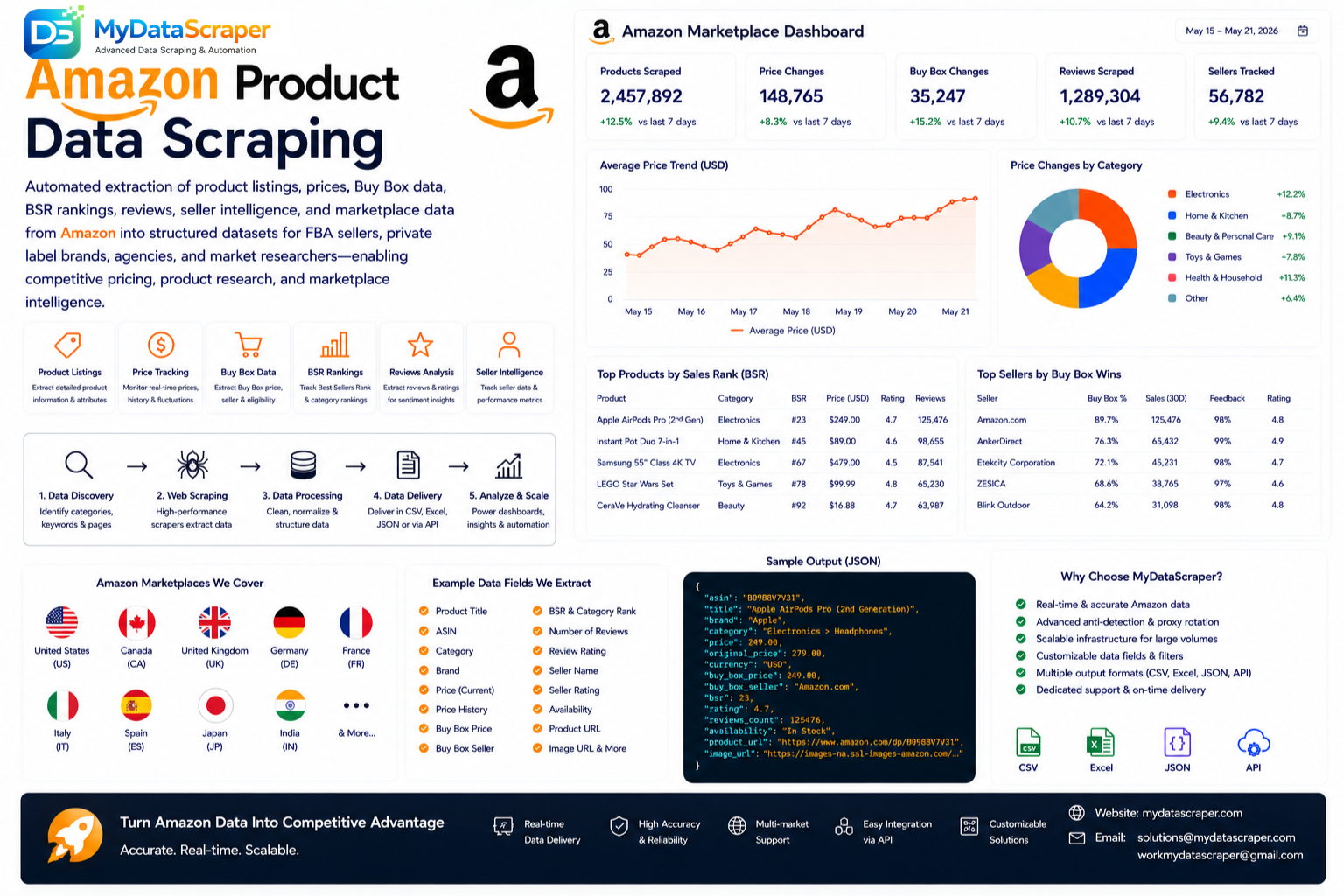
- Complete Amazon Data Dictionary: What Can Be Extracted
- Why Amazon Intelligence Matters More Than Ever in 2026
- Use Cases: Who Benefits from Amazon Data Scraping
- The Buy Box Intelligence Advantage
- BSR Data: Amazon's Hidden Demand Signal
- The Amazon Data Extraction Process
- Case Study: Private Label Brand Scales Revenue 3.2x
- How MyDataScraper Delivers Amazon Intelligence
- Ethical & Legal Considerations
- Frequently Asked Questions
- Conclusion
Why Amazon Data Is the Foundation of Every Serious E-Commerce Strategy in 2026
Amazon is not just the world's largest online marketplace — it is the primary price reference, product discovery engine, and consumer research platform for billions of shoppers worldwide. With over 600 million products listed, more than 2 million active third-party sellers, and an estimated $700 billion+ in annual GMV, Amazon generates the single largest publicly accessible dataset of consumer product intelligence on the planet.
For any e-commerce business — whether you're a private label seller on Amazon FBA, a brand managing distribution across multiple channels, an agency advising retail clients, or a market researcher analyzing consumer trends — Amazon data is foundational. It tells you what consumers are buying (BSR rankings), what they're willing to pay (pricing data), what they think about products (reviews), who's winning the marketplace (Buy Box data), and how demand is shifting in real time (search ranking and new listing velocity).
Yet despite this extraordinary data richness, most Amazon sellers and brands access only a tiny fraction of the intelligence available. They check a few competitor listings manually, glance at their own BSR occasionally, and maybe run a basic pricing check once a week. Meanwhile, the most successful Amazon sellers — the private label brands scaling to 7 and 8 figures, the agencies delivering exceptional client results, the investment firms tracking consumer trends — are running systematic, automated Amazon product data scraping operations that give them comprehensive marketplace intelligence every single day.
In this guide, we'll cover everything you need to know about extracting product data from Amazon — what data is available, who benefits most, the specific intelligence signals that drive Amazon success, and how MyDataScraper builds custom Amazon extraction solutions that deliver structured marketplace intelligence in CSV, JSON, or Excel.
What Is Amazon Product Data Scraping?
Amazon product data scraping is the automated collection of publicly available marketplace data from Amazon — including product listings with titles and descriptions, current and historical pricing, Buy Box winner data, Best Sellers Rank (BSR) numbers, customer reviews and ratings, seller information, inventory signals, keyword ranking positions, and category-level competitive intelligence.
This is fundamentally different from (and far more comprehensive than) what Amazon's official APIs provide. Amazon's Product Advertising API and Selling Partner API have significant limitations — restricted data fields, rate limits, commercial use restrictions, and limited historical data access. Web scraping accesses the full publicly visible Amazon data ecosystem that any shopper can see — providing the complete marketplace intelligence picture that the APIs were never designed to deliver.
For Amazon sellers, this means visibility into every aspect of their competitive landscape — not just the handful of ASINs they manually check, but their entire category, every competing seller, every price change, and every review that affects their market position. For brands, it means comprehensive distribution monitoring across all authorized and unauthorized sellers. For researchers, it means access to the world's largest real-time consumer product dataset.
Why Scraping Over Amazon's API: Amazon's official APIs are designed for building Amazon-integrated applications, not for comprehensive competitive intelligence. They restrict which data fields are accessible, limit the volume of requests, prohibit many competitive analysis use cases in their terms, and provide no historical data. Amazon product data scraping collects the full publicly visible dataset — every data point any Amazon shopper can see — without API rate limits, data field restrictions, or commercial use limitations. This is the foundation of professional-grade Amazon intelligence.
What Makes Amazon Data Uniquely Valuable for E-Commerce Intelligence
Amazon's marketplace generates intelligence signals that no other platform replicates. Understanding these unique data dimensions is key to building an effective Amazon scraping strategy:
🏆 Buy Box Data — The Single Most Important Competitive Signal
Over 82% of Amazon sales go through the Buy Box — the default "Add to Cart" button on a product page. Knowing which seller currently holds the Buy Box, at what price, with what fulfillment method (FBA vs FBM), and how frequently the Buy Box rotates between sellers is the single most commercially important competitive intelligence signal on Amazon. Automated Buy Box monitoring captures this data continuously — not just the snapshot you see when you manually visit a listing.
📊 Best Sellers Rank (BSR) — Amazon's Real-Time Demand Signal
BSR is Amazon's proprietary ranking that reflects how well a product sells relative to other products in its category. Tracking BSR over time reveals demand trends — a rising BSR (lower number) indicates increasing sales velocity, while a falling BSR signals declining demand. Systematic Amazon BSR data extraction across entire categories reveals which products are gaining traction before the market notices, making BSR tracking one of the most powerful product research and investment signals available.
⭐ Review Intelligence — The Voice of the Amazon Customer
Amazon hosts the world's largest collection of authentic product reviews — over 1 billion reviews across all categories. Extracting and analyzing these reviews reveals exactly what consumers love, hate, and wish they had in products — intelligence that directly drives product development, listing optimization, and competitive positioning. Amazon review scraping at scale transforms this unstructured consumer feedback into structured business intelligence.
🏪 Multi-Seller Competitive Dynamics
Unlike most marketplaces where each seller has their own product listing, Amazon aggregates multiple sellers onto a single product page (ASIN). This creates unique competitive dynamics — understanding how many sellers compete on each ASIN, their pricing spread, fulfillment methods, and Buy Box rotation patterns is intelligence that only systematic Amazon scraping can provide comprehensively.
🔍 Keyword & Search Intelligence
Where your product appears in Amazon search results for target keywords directly determines your visibility and sales. Tracking your keyword ranking position — and how competitors rank for the same keywords — is essential for Amazon SEO strategy. Automated keyword position tracking across hundreds of search terms reveals exactly where your listing optimization efforts are working and where competitors are winning the visibility battle.
🌍 Multi-Marketplace Global Intelligence
Amazon operates distinct marketplaces across the US (amazon.com), UK (amazon.co.uk), Germany (amazon.de), Japan (amazon.co.jp), Canada, India, and many other countries. Products, pricing, competition, and consumer behavior vary significantly across these marketplaces — and systematic cross-marketplace scraping reveals global pricing arbitrage opportunities, market entry intelligence, and regional demand patterns.
Complete Amazon Data Dictionary: What Can Be Extracted
Amazon publicly displays an extraordinarily rich dataset across every product listing, seller profile, and category page. Here's the comprehensive breakdown:
💰 Pricing & Buy Box Intelligence
- Current Buy Box price and Buy Box winner seller
- All seller offer prices (new and used offers)
- List price / was-price / deal price / coupon value
- Lightning Deal pricing and countdown data
- Subscribe & Save pricing tier
- Amazon's Choice badge presence
- Price per unit calculations
- Prime vs non-Prime pricing differences
- Historical price tracking over time
📦 Product Details & Content
- Product title and full description
- ASIN and all associated identifiers (UPC, EAN, ISBN)
- Brand name and manufacturer
- Bullet point features (A+ content detection)
- Product specifications / technical details table
- All product images and video URLs
- Product dimensions, weight, and materials
- Variation family data (parent/child ASIN relationships)
- Category and sub-category taxonomy (browse node path)
📊 BSR & Demand Signals
- Best Sellers Rank (BSR) — main category
- BSR across all sub-categories listed
- BSR change over time (historical tracking)
- Best Seller badge detection
- New Release rank data
- Movers & Shakers identification
- "Frequently Bought Together" product associations
- Search result position for target keywords
- Sponsored product detection
⭐ Review & Rating Intelligence
- Overall star rating (average)
- Total review count and total ratings count
- Star distribution breakdown (1-5 stars)
- Individual review text, title, and date
- Verified Purchase indicator
- Helpful vote count per review
- Review images and video content
- Top positive and top critical reviews
- Review velocity (new reviews per period)
🏪 Seller & Fulfillment Data
- All sellers offering the product (with prices)
- FBA (Fulfilled by Amazon) vs FBM (Fulfilled by Merchant) status
- Seller name, ID, and storefront URL
- Seller feedback rating and count
- Seller response time and cancellation rate
- Shipping speed and delivery estimates
- Return policy details per seller
- Amazon as seller detection
📈 Category & Market Intelligence
- Best Sellers list extraction (top 100 per category)
- New Releases list extraction
- Movers & Shakers data (biggest BSR changes)
- Most Wished For products
- Gift Ideas trending products
- Category-wide pricing distribution analysis
- New product launch velocity per category
- Sponsored product share per keyword
At MyDataScraper, we extract exactly the Amazon data fields your strategy requires — from individual ASIN monitoring to comprehensive category-wide intelligence — delivered clean, structured, and analysis-ready in CSV, JSON, or Excel.
Why Amazon Intelligence Matters More Than Ever in 2026
Amazon Advertising Demands Better Competitive Data
Amazon's advertising platform has grown into a $50+ billion business — and sellers running PPC campaigns without comprehensive competitive intelligence are burning ad spend inefficiently. Understanding which competitors rank for your target keywords, at what prices, with what review counts, and how their BSR responds to ad campaigns directly informs your advertising strategy. Amazon marketplace intelligence is now inseparable from Amazon advertising strategy.
Private Label Competition Is at an All-Time High
The number of private label sellers on Amazon has exploded — and differentiation is harder than ever. In 2026, the private label sellers who win are those who identify underserved niches through data analysis, optimize pricing based on real competitor intelligence rather than guesswork, and build review momentum faster than competitors through superior product development informed by review mining. Every step of this process depends on systematic Amazon data.
Amazon's Algorithm Rewards Data-Driven Sellers
Amazon's A9/A10 search algorithm considers pricing competitiveness, conversion rate, review quality, fulfillment reliability, and sales velocity when determining search ranking. Sellers who optimize across all these dimensions — informed by comprehensive competitor data — achieve disproportionately higher organic visibility. The data advantage compounds: better data → better optimization → higher ranking → more sales → even higher ranking.
Multi-Marketplace Expansion Requires Market-Specific Intelligence
As Amazon sellers expand from US to UK, Germany, Japan, and other marketplaces, they need market-specific competitive intelligence — different competitors, different price points, different consumer preferences, different BSR dynamics. Systematic cross-marketplace Amazon scraping provides the localized intelligence needed to expand internationally with confidence rather than guesswork.
"The Amazon sellers who dominate their categories in 2026 are not necessarily the ones with the best products or the biggest budgets — they're the ones with the most comprehensive competitive intelligence systems. They know exactly what every competitor charges, how fast competing products sell, what consumers say in every review, and where the market gaps are. That intelligence advantage is built on systematic data extraction, and it compounds over time." — Amazon Marketplace Strategy Intelligence, 2026
Use Cases: Who Benefits from Amazon Data Scraping
🔍 Private Label Product Research & Validation
Before investing in a new private label product, extract comprehensive Amazon category data — BSR ranges for top products, pricing distributions, review velocity requirements to compete, seller count and competition intensity, and revenue estimates based on BSR-to-sales conversion models. This data-driven approach replaces the guesswork that causes most private label launches to fail with evidence-based product selection.
💰 Competitive Price Monitoring for Amazon Sellers
Monitor competitor prices across your entire Amazon catalog in real time. Know the moment a competitor drops their price, launches a coupon, activates a Lightning Deal, or captures the Buy Box. Automated Amazon price monitoring gives your repricing strategy the real-time data foundation it needs to maintain competitive positioning without manually checking dozens of listings daily.
🏆 Buy Box Monitoring & Win Rate Optimization
Track Buy Box ownership continuously for every ASIN you sell — understanding which sellers hold the Buy Box at what times, at what prices, with what fulfillment methods. Identify the pricing and fulfillment factors that drive Buy Box wins in your specific categories, and optimize your strategy to maximize your Buy Box share — the single most impactful lever for Amazon sales growth.
⭐ Review Mining for Product Development
Extract thousands of customer reviews from Amazon for your products and competitors. Analyze review sentiment systematically to identify the product features customers love, the pain points that drive negative reviews, and the unmet needs that represent opportunities for product improvement or new product development. Amazon reviews are the world's largest free focus group.
📊 BSR Tracking for Demand Intelligence
Track BSR (Best Sellers Rank) for target products over time to understand demand trends, seasonal patterns, and competitive dynamics at the category level. Rising BSR indicates increasing sales velocity — and systematic BSR tracking across an entire category reveals which products are gaining traction before revenue data becomes public, making it a powerful signal for both sellers and investors.
🏪 Seller & Distributor Monitoring for Brands
Brands use Amazon scraping to monitor all sellers offering their products — tracking authorized vs unauthorized sellers, detecting MAP violations, identifying counterfeit or grey market listings, and ensuring brand content accuracy across all seller offers. For brands with distribution networks, this is essential channel health intelligence.
📈 Amazon SEO & Keyword Intelligence
Track your product's search ranking position for target keywords — and monitor how competitors rank for the same terms. Understand which keywords drive the most visibility in your category, how competitor titles and bullet points are optimized, and where keyword gaps exist that your listing optimization could exploit. This data directly improves organic search visibility and reduces dependence on paid advertising.
🌍 Cross-Marketplace Expansion Research
Before expanding to Amazon UK, Germany, Japan, or other marketplaces, extract comprehensive competitive intelligence from target markets — pricing levels, competition intensity, review thresholds, BSR ranges, and category-specific dynamics. This market-specific data prevents the common mistake of assuming US Amazon competitive dynamics apply to other marketplaces.
The Buy Box Intelligence Advantage: Why It Matters and What to Track
The Amazon Buy Box is the most commercially important real estate in e-commerce. Over 82% of all Amazon sales go through the Buy Box — meaning if you don't hold the Buy Box, you're effectively invisible to the vast majority of buyers, regardless of your price or product quality.
Automated Buy Box monitoring through web scraping reveals critical intelligence that manual checking simply cannot capture:
- Buy Box rotation patterns: How frequently the Buy Box rotates between sellers, and whether Amazon's own retail listing dominates or shares
- Price sensitivity thresholds: The exact price difference that triggers Buy Box loss — which varies by category and product
- Fulfillment method impact: How FBA vs FBM status affects Buy Box eligibility and win rate in your specific categories
- Time-of-day patterns: Whether Buy Box ownership shifts during different times of day or days of the week
- New seller entry detection: Immediate alerts when new sellers enter your ASINs — often the first signal of incoming competition or unauthorized distribution
- Historical Buy Box share: Your actual Buy Box win rate over time — the most important KPI for any multi-seller ASIN
The Buy Box Data Edge: Most Amazon sellers check their Buy Box status manually — maybe once or twice a day. But the Buy Box can change hands dozens of times per day as competing sellers' repricers adjust. Only automated, continuous Buy Box monitoring captures the complete rotation pattern — revealing the pricing sweet spot, fulfillment strategy, and competitive timing that maximizes your Buy Box share. Contact MyDataScraper to build your Buy Box intelligence pipeline.
BSR Data: Amazon's Hidden Demand Signal and How to Extract It
Best Sellers Rank (BSR) is Amazon's proprietary ranking system that reflects a product's recent and historical sales velocity relative to other products in the same category. While Amazon doesn't publicly disclose exact sales numbers, BSR serves as the most reliable proxy for estimating Amazon sales volume — and systematic Amazon BSR data extraction across categories creates one of the most powerful product research and market intelligence signals available anywhere.
What BSR Tracking Reveals
- Estimated sales velocity: BSR-to-sales conversion models (which vary by category) allow you to estimate daily, weekly, and monthly unit sales for any Amazon product
- Demand trends: Tracking BSR over time reveals whether demand for a product is growing, stable, or declining — weeks before this becomes apparent in other data
- Seasonal patterns: Historical BSR data reveals exactly when demand peaks and troughs for seasonal products — enabling better inventory planning and promotional timing
- Launch tracking: Monitoring BSR for newly launched competitor products reveals how quickly they gain traction — critical intelligence for competitive response planning
- Market sizing: Aggregating BSR data across all products in a category enables category-level market size estimation — essential for product research and investment decisions
- Advertising impact: Tracking BSR changes after competitor ad campaigns reveals the effectiveness of their advertising spend — intelligence that informs your own ad strategy
BSR as an Investment Signal: Increasingly, quantitative investors and consumer-focused hedge funds use systematic Amazon BSR tracking as an alternative data signal for predicting consumer brand revenue before official earnings releases. Companies whose Amazon BSR improves significantly often report better-than-expected quarterly results — making BSR tracking valuable not just for e-commerce sellers but for anyone making financial decisions about consumer product companies.
The Amazon Data Extraction Process: Step by Step
Here's exactly how MyDataScraper builds and operates a custom Amazon data extraction pipeline:
Step 1: 🎯 ASIN Universe & Intelligence Scope Definition
We start by mapping your monitoring universe — specific ASINs, product categories, competitor brands, target keywords, or seller accounts you need to track. We define which Amazon marketplaces (US, UK, DE, JP, etc.), data fields, and update frequencies your competitive strategy requires. Whether you need to monitor 50 ASINs or 50,000, we scope the extraction precisely.
Step 2: 🔧 Custom Amazon Scraper Engineering
Our engineers build scrapers purpose-built for Amazon's complex architecture — handling JavaScript-rendered product pages, dynamic pricing displays, Buy Box seller rotation tracking, BSR extraction from category pages, review pagination across thousands of reviews, variation/parent-child ASIN relationships, and Amazon's sophisticated anti-bot countermeasures. Every scraper is custom-engineered for your specific data requirements.
Step 3: 🏆 Buy Box & Seller Monitoring Configuration
For sellers competing on multi-seller ASINs, we configure continuous Buy Box monitoring — capturing which seller holds the Buy Box at each data collection point, enabling Buy Box share calculations, rotation pattern analysis, and immediate alerts when Buy Box ownership changes on critical ASINs.
Step 4: ⏱️ Frequency, Alerts & Event Monitoring
We configure collection frequency to match your competitive dynamics — hourly for high-velocity categories and during Amazon sale events (Prime Day, Black Friday, Cyber Monday), daily for standard monitoring. Real-time alerts are configured for significant price drops, Buy Box losses, new competitor seller entries, Lightning Deal launches, and BSR changes beyond threshold on key ASINs.
Step 5: 🧹 Amazon-Specific Data Cleaning & Normalization
Amazon data requires specialized cleaning — parsing variation families (parent/child ASINs), normalizing prices across Prime and non-Prime offers, extracting BSR from multiple category listings, deduplicating reviews across product variations, standardizing seller data across FBA and FBM listings, and handling Amazon's coupon and Subscribe & Save pricing tiers.
Step 6: 📦 Structured Delivery & Tool Integration
Clean Amazon intelligence is delivered in CSV, JSON, or Excel — or integrated directly with your repricing software (RepricerExpress, BQool, Aura, Feedvisor), Amazon Seller Central analytics supplements, inventory management tools (Inventory Lab, RestockPro), e-commerce platforms, or BI dashboards via automated pipeline.
Step 7: 📈 Historical Amazon Intelligence Database
From day one, we build a historical database of Amazon pricing, BSR trajectories, Buy Box patterns, review velocity, and seller landscape changes — enabling seasonal planning, Prime Day preparation, competitor trend analysis, and long-term marketplace strategy development backed by comprehensive historical evidence.
Step 8: 🔄 Continuous Adaptation & Maintenance
Amazon updates its platform continuously — page structure changes, new data presentation formats, anti-bot measure updates, and marketplace feature additions. Our team proactively monitors your scrapers and adapts them to any Amazon changes — ensuring uninterrupted intelligence delivery through every platform update and sale event.
Case Study: How a Private Label Brand Scaled Amazon Revenue 3.2x in 18 Months Using Comprehensive Marketplace Intelligence
A private label brand selling 45 SKUs across three Amazon US categories — kitchen accessories, home organization, and pet supplies — was stuck at a revenue plateau. Despite strong products with 4.3+ average ratings, their growth had flatlined for two consecutive quarters. Their competitive intelligence process consisted of one team member manually checking 20-30 competitor ASINs twice per week — a process that covered less than 10% of their competitive landscape and delivered data that was perpetually outdated.
The core problems were clear but unsolvable without better data: they didn't know which competitor products were gaining BSR traction until those products had already captured market share. They were consistently over-priced on 30% of their catalog without knowing it. Their listing optimization was based on intuition rather than competitor content analysis. And their Prime Day and Q4 promotional strategies were reactive because they had no historical data on competitor promotional patterns.
After partnering with MyDataScraper, we built a comprehensive Amazon intelligence pipeline:
What Was Built
- Full monitoring of all 45 own ASINs + 380 competitor ASINs across three categories — pricing, BSR, Buy Box, reviews, and seller data updated daily
- Category-level BSR tracking for top 100 products in each target category — identifying rising products, declining products, and market share shifts in real time
- Buy Box monitoring on 12 ASINs where they competed with other sellers — capturing rotation patterns and identifying the exact price points that won/lost the Buy Box
- Competitor review mining — monthly extraction and sentiment analysis of 1-star and 5-star reviews from top 10 competitors per category, identifying product improvement opportunities
- Keyword ranking tracking — daily position monitoring for 150 target keywords, with competitor keyword strategy analysis
- Historical Prime Day and Q4 competitor behavior analysis — extracting pricing patterns from previous sale events to inform promotional planning
- All data delivered daily in Excel with weekly strategy briefing reports and real-time Slack alerts for significant competitive events
Results After 18 Months
3.2x revenue growth across all three Amazon categories. 42% improvement in organic keyword rankings through data-driven listing optimization based on competitor content analysis. Buy Box win rate improved from 71% to 94% on multi-seller ASINs through optimized pricing strategy informed by rotation pattern data. 4 new product launches that reached top-20 BSR in their categories within 90 days — all selected through BSR-based market gap analysis. $1.2M additional annual revenue directly attributable to intelligence-driven decisions.
The most impactful single insight came from BSR tracking: they identified that a competitor in the pet supplies category had experienced a significant BSR decline (indicating falling demand) — which investigation revealed was caused by a product quality issue reflected in recent negative reviews. The brand launched an improved competing product targeting the exact pain points mentioned in those negative reviews, capturing significant market share within the first quarter.
Contact MyDataScraper today to build your Amazon intelligence solution.
How MyDataScraper Delivers Amazon Intelligence That Drives Category Leadership
At MyDataScraper, Amazon marketplace intelligence is one of our deepest areas of expertise. We've built Amazon data extraction solutions for private label sellers, major consumer brands, Amazon agencies, and investment firms. Here's what makes our Amazon approach uniquely effective:
📦 Deep Amazon Domain Expertise
We understand Amazon's data ecosystem at a level that goes far beyond surface-level scraping — ASIN variation families, BSR-to-sales conversion models, Buy Box algorithm factors, A9/A10 ranking signals, and the differences between Amazon's regional marketplaces. This expertise is embedded in how we build, clean, and deliver Amazon intelligence.
🏆 Buy Box Intelligence Specialization
Our Buy Box monitoring infrastructure captures ownership changes with the frequency needed to build statistically meaningful win rate analysis — revealing the pricing strategies, fulfillment methods, and seller behaviors that drive Buy Box wins in your specific categories.
📊 BSR-Powered Demand Intelligence
We build BSR tracking systems that capture rank data across entire categories over time — enabling the demand trend analysis, market sizing, and product research intelligence that the most successful Amazon sellers and investors rely on for strategic decision-making.
⭐ Review Intelligence at Scale
We extract and structure Amazon reviews at volume — thousands of reviews per category, with automated sentiment tagging, feature extraction, and competitive comparison — turning Amazon's enormous review ecosystem into structured product development and positioning intelligence.
🌍 Multi-Marketplace Coverage
We build Amazon intelligence solutions covering US (amazon.com), UK (amazon.co.uk), Germany (amazon.de), Canada (amazon.ca), Japan (amazon.co.jp), India (amazon.in), and other Amazon marketplaces — in unified cross-marketplace datasets that support global expansion strategy.
🔗 Amazon Seller Tool Integration
Amazon data is delivered in CSV, JSON, or Excel — or integrated directly with repricing tools (RepricerExpress, BQool, Aura, Feedvisor), Amazon analytics tools (Helium 10, Jungle Scout, Viral Launch supplements), inventory management systems, and BI platforms via automated pipeline.
Ethical & Legal Considerations for Amazon Data Scraping
✅ Compliant Practices We Follow
- Collect only publicly displayed product, pricing, and review data visible to any Amazon shopper
- Respect Amazon's robots.txt and implement appropriate request rate limiting
- Use data exclusively for legitimate competitive intelligence, market research, and business strategy
- Never collect Amazon customer personal data, order data, or account information
- Never access Amazon Seller Central, Vendor Central, or any authenticated portal
- Comply with applicable data privacy laws (CCPA, GDPR for international marketplaces)
- Maintain proper data security for all extracted Amazon intelligence
- Use competitive intelligence for unilateral strategy only — never for price coordination
❌ Practices We Strictly Avoid
- Accessing seller accounts, Seller Central, or any authenticated Amazon systems
- Collecting individual customer data, order details, or personal information
- Using scraped data for review manipulation, shill bidding, or marketplace gaming
- Bypassing CAPTCHA systems or authentication mechanisms aggressively
- Sending request volumes that could impact Amazon's service performance
- Republishing scraped Amazon product content as original content
- Using data for counterfeit product sourcing or brand impersonation
Legal Context: Amazon publicly displays product listings, prices, reviews, BSR data, and seller information specifically for consumer access — this is the fundamental design of Amazon's marketplace. Collecting this publicly displayed data for legitimate competitive intelligence is widely practiced across the e-commerce industry and consistent with general data access principles upheld by courts including the landmark hiQ v. LinkedIn decision. MyDataScraper builds compliance into every Amazon project. Consult legal counsel for jurisdiction-specific guidance.
Frequently Asked Questions
Can Amazon Buy Box data be tracked continuously?
Yes — Buy Box monitoring is one of our most requested Amazon intelligence capabilities. We track Buy Box ownership, winner price, fulfillment method, and rotation patterns at configurable intervals — from hourly to every few minutes for high-priority ASINs. This continuous monitoring enables Buy Box share calculations, pricing sweet spot identification, and immediate alerts when new sellers capture the Buy Box on your products.
Can BSR (Best Sellers Rank) data be extracted and tracked historically?
Yes — systematic BSR tracking is one of the most powerful Amazon intelligence capabilities we build. We extract BSR data for target ASINs and entire categories on daily or more frequent schedules, building historical BSR databases that reveal demand trends, seasonal patterns, competitive dynamics, and estimated sales velocity over time. This data powers product research, market sizing, and investment intelligence.
Can Amazon reviews be extracted at scale for sentiment analysis?
Absolutely. We extract complete review datasets — review text, rating, date, verified purchase status, helpful votes, and reviewer data — for any product or set of competitor products. For clients who need ready-to-analyze intelligence, we apply automated sentiment classification and feature extraction to identify the specific product attributes mentioned positively and negatively across thousands of reviews.
Which Amazon marketplaces can be monitored?
We build Amazon intelligence solutions for all major marketplaces — Amazon.com (US), Amazon.co.uk (UK), Amazon.de (Germany), Amazon.co.jp (Japan), Amazon.ca (Canada), Amazon.in (India), Amazon.com.au (Australia), Amazon.fr (France), Amazon.it (Italy), Amazon.es (Spain), and others. Cross-marketplace unified datasets with currency normalization are a popular configuration for brands monitoring global competitive dynamics.
How does Amazon scraping compare to tools like Helium 10 or Jungle Scout?
Tools like Helium 10 and Jungle Scout provide excellent user-friendly interfaces for Amazon research, but they're designed as standardized SaaS products — same data, same features, same limitations for every user. Custom Amazon scraping from MyDataScraper provides fully customized data extraction tailored to your exact ASINs, categories, competitors, and intelligence needs — with no limitations on data volume, historical depth, or commercial use. Many sophisticated Amazon sellers use both: SaaS tools for day-to-day operations and custom scraping for deep competitive intelligence that standard tools don't support.
What format is Amazon data delivered in?
We deliver Amazon data in CSV, JSON, or Excel — and can integrate directly with repricing tools (RepricerExpress, BQool, Aura), Amazon analytics platforms (supplements to Helium 10, Jungle Scout), inventory management systems (Inventory Lab, RestockPro), e-commerce platforms, and BI dashboards (Tableau, Power BI, Looker) via automated pipeline delivery.
How quickly can an Amazon scraping solution be launched?
Standard Amazon data extraction projects are built and delivering data within 5 to 8 business days of project kick-off. Focused projects (single category, limited ASINs) can often launch faster. Comprehensive multi-category, multi-marketplace projects with full Buy Box monitoring, BSR tracking, and review extraction typically take 7-12 days. Contact our team today for a specific timeline estimate based on your requirements.
On Amazon, the Sellers with the Best Data Build the Best Businesses
Amazon is the most competitive marketplace on Earth — and the gap between data-driven sellers and intuition-driven sellers grows wider every quarter. The private label brands scaling to 7 and 8 figures aren't just building better products — they're making better decisions, faster, informed by comprehensive marketplace intelligence that most competitors don't have. They know what every competitor charges, how fast competing products sell, what consumers say in every review, where the keyword ranking opportunities are, and when the market is shifting — because they have automated systems collecting and structuring this intelligence every single day.
Amazon product data scraping is the technology that makes this intelligence advantage accessible — not just to large brands with big analytics teams, but to any seller, brand, or researcher committed to making data-driven Amazon decisions. It replaces the hours of manual competitor checking with comprehensive, accurate, continuously updated marketplace intelligence delivered automatically in the format your team needs to act.
At MyDataScraper, we build custom Amazon data extraction solutions tailored to your specific marketplace strategy — Buy Box monitoring, BSR demand tracking, competitor pricing intelligence, review mining, keyword ranking analysis, seller landscape monitoring, and comprehensive category research — delivered in CSV, JSON, or Excel, integrated into your Amazon selling tools and strategy workflows, on any schedule your business demands.
Every day without comprehensive Amazon intelligence is a day your competitors are making better decisions with better data. The fix is faster, more affordable, and more impactful than most sellers realize.
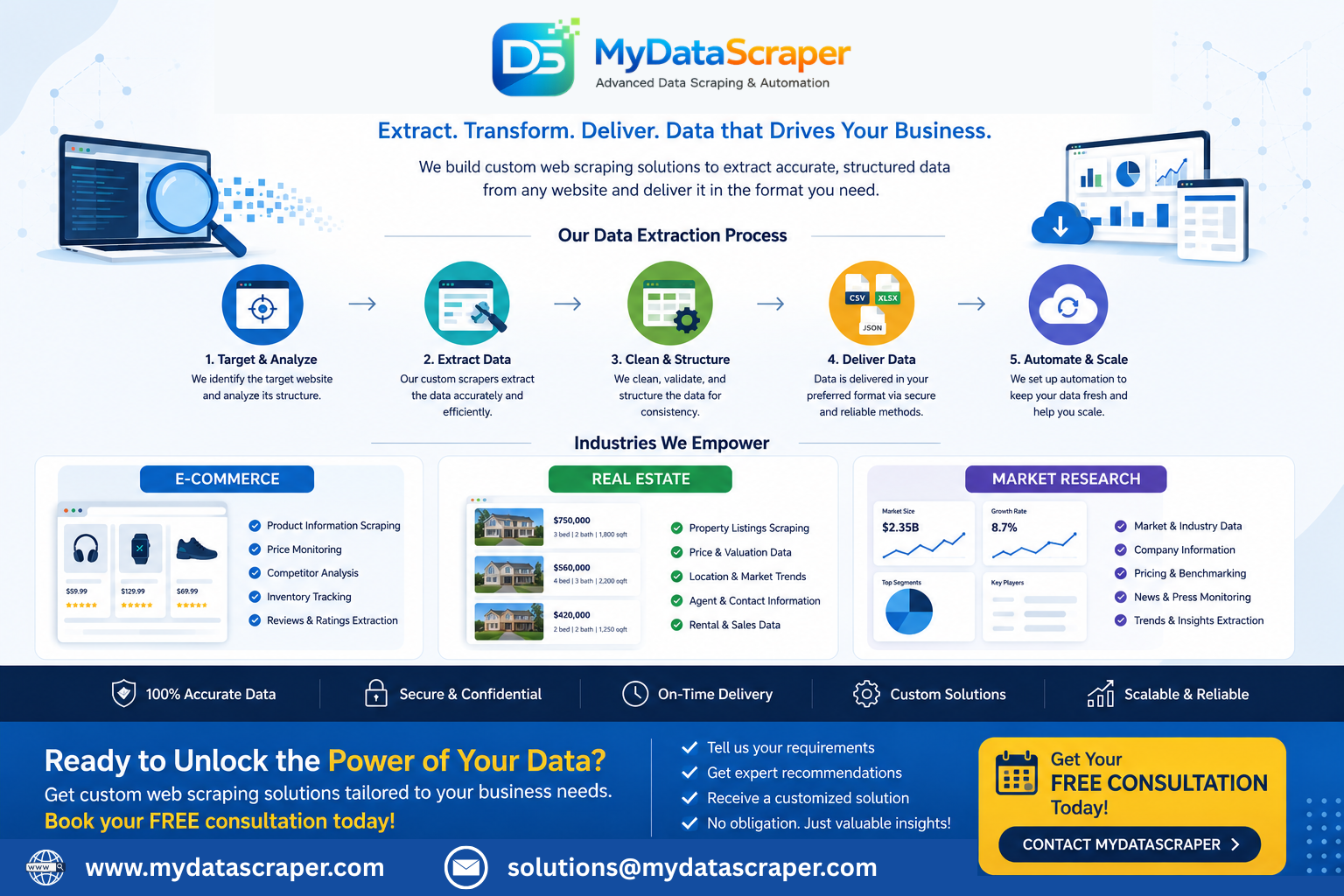
Ready to build your Amazon data advantage? Contact MyDataScraper for a free consultation — or visit www.mydatascraper.com to explore all our marketplace data extraction services.

Written by the MyDataScraper Team
MyDataScraper is a leading provider of custom web scraping and marketplace data extraction solutions for Amazon, Walmart, eBay, Shopee, Cdiscount, and other major global marketplaces. We help FBA sellers, private label brands, e-commerce agencies, and market researchers extract the Amazon intelligence that drives better product decisions, smarter pricing, and stronger revenue growth. Learn more at www.mydatascraper.com or contact our team today for a free consultation.