Dynamic Repricing Data: The Complete Guide to Real‑Time Price Intelligence for Algorithm‑Driven Ecommerce Success in 2026
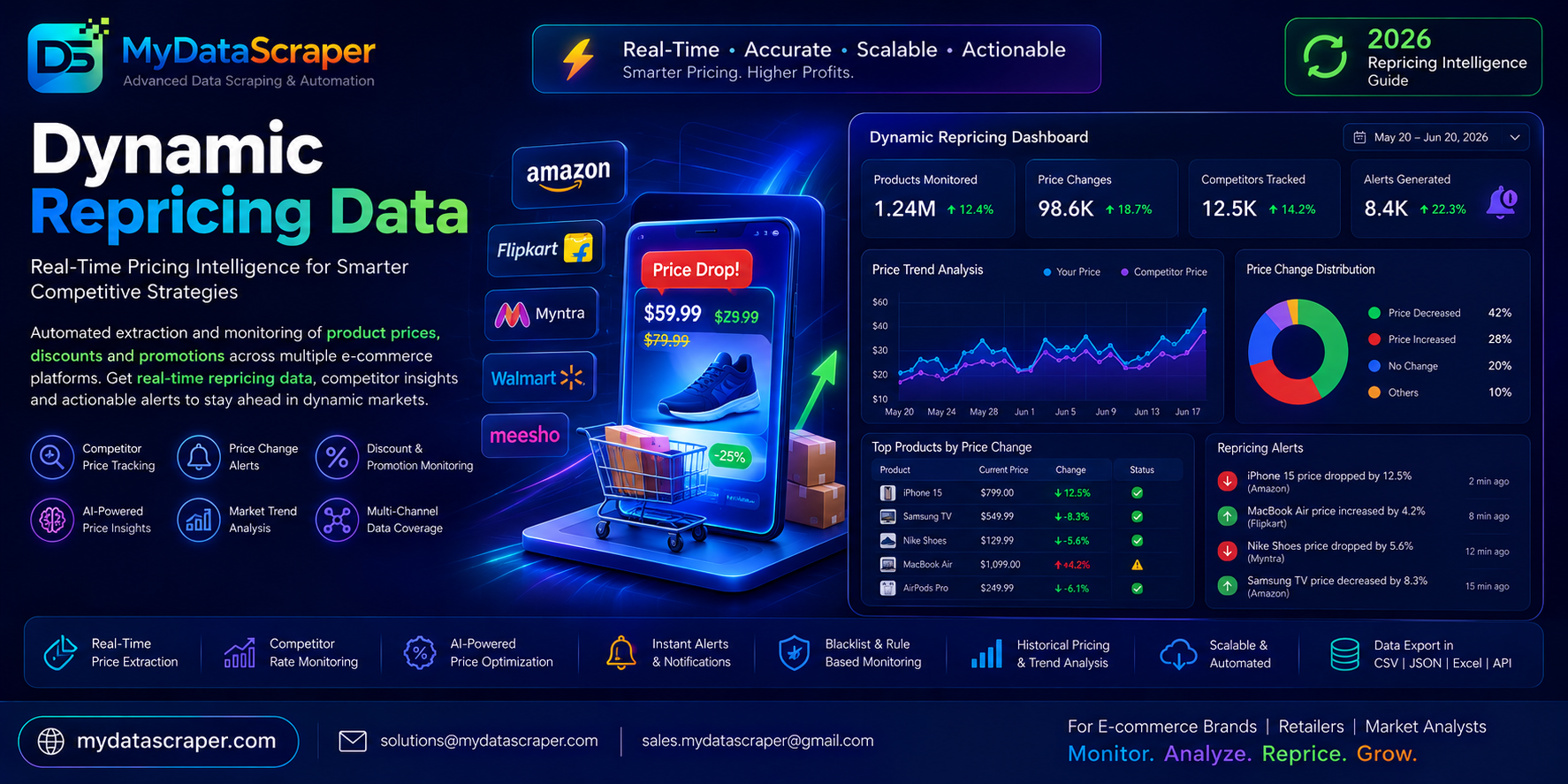
In 2026, dynamic pricing algorithms now determine more than 60% of all online retail transactions. But an algorithm is only as good as the data that feeds it. Discover how automated extraction of clean, structured competitor pricing data transforms repricing engines from reactive rule‑based systems into intelligent profit‑maximizing machines—and why real‑time price intelligence is the new competitive moat for Amazon sellers, DTC brands, and omnichannel retailers.
- Why Dynamic Repricing Data Is the Engine of Modern Ecommerce
- What Is Dynamic Repricing Data?
- What Pricing Data Feeds Can Be Extracted?
- Why Repricing Data Quality Matters More Than Ever
- Use Cases: Who Relies on Repricing Data?
- Algorithm Training & Model Refinement
- Real‑Time Competitor Price Feeds
- Marketplace‑Specific Repricing Signals
- The Repricing Data Pipeline Process
- Case Study: Amazon Seller Doubles Revenue with ML‑Driven Repricing Data
- How MyDataScraper Delivers Repricing Data Excellence
- Ethical & Legal Considerations
- Frequently Asked Questions
- Conclusion
Why Dynamic Repricing Data Is the Engine of Modern Ecommerce
In 2026, static pricing is a relic. Across Amazon, Walmart, eBay, and thousands of DTC storefronts, algorithmic repricing engines now set prices in real time— balancing demand, inventory, competitor moves, and margin targets in milliseconds. But here is the often‑overlooked truth: the most sophisticated repricing algorithm is useless without high‑quality, low‑latency competitor data. Garbage in, garbage out—and in repricing, garbage data costs millions in lost revenue.
Every dynamic price change in the market generates a data signal: competitor base prices, flash‑sale discounts, Buy Box status, shipping offers, and stock depletion events. Capturing these signals systematically and feeding them into repricing engines is what separates market leaders from also‑rans. Without automated data extraction, repricing algorithms react to stale intelligence— typically 6–24 hours behind real market conditions—leading to sub‑optimal pricing, lost Buy Box share, and eroded margins.
Dynamic repricing data extraction is the specialised practice of harvesting structured, timestamped competitor pricing signals from ecommerce platforms at high frequency, normalising them for algorithm ingestion, and delivering them as real‑time data feeds. At MyDataScraper, we build custom dynamic pricing intelligence pipelines that power machine‑learning repricing engines with the fresh, accurate data they demand.
Data Quality = Repricing ROI: A 100‑millisecond latency advantage in competitor price detection translates to a 5–8% higher Buy Box win rate on Amazon. Our live scraping APIs deliver sub‑minute latency feeds designed specifically for high‑frequency repricing engines.
What Is Dynamic Repricing Data?
Dynamic repricing data refers to the structured, high‑frequency pricing intelligence extracted from ecommerce platforms specifically for ingestion by automated pricing algorithms. Unlike generic price monitoring, repricing data is engineered for machine consumption—clean, timestamped, competitor‑labelled, and delivered with millisecond‑level latency.
Typical manual price checks might capture competitor prices every 4–6 hours, but repricing algorithms operating on Amazon's marketplace require updates every 5–15 minutes to win the Buy Box consistently. Automated repricing data extraction solves this by:
- Continuous polling — scraping price‑sensitive product detail pages at intervals as short as 2–5 minutes
- Event‑driven triggers — detecting competitor price changes, stock events, or promotion launches instantly
- Contextual enrichment — capturing shipping costs, fulfillment method (FBA/FBM), seller ratings, and Buy Box holder
- Normalised output — structuring data in algorithm‑ready JSON or CSV schemas with consistent field definitions
- Historical baselines — maintaining price history to enable trend detection and elasticity modelling
- Alert streams — pushing delta updates via webhooks to trigger immediate repricing decisions
Feed‑Ready Intelligence: Our repricing data feeds are built to integrate directly with leading repricing engines (Repricer.com, Bqool, Seller Snap, Price2Spy) or custom ML models. We deliver API‑based data delivery with sub‑minute latency for maximum algorithm effectiveness.
What Dynamic Repricing Data Feeds Can Be Extracted in 2026?
📊 Core Price Signals
- Current product price (base and discounted)
- Price change delta and direction (±%) since last capture
- Timestamped price history (every capture point)
- Buy Box price and winning seller price
- Lowest available price across all sellers
- MSRP / list price vs actual selling price
- Bulk/volume pricing tiers (e.g., 2‑pack vs single)
- Subscription pricing (recurring discounts)
📦 Fulfillment & Total Cost Signals
- Shipping cost by method (standard, expedited, overnight)
- Free shipping eligibility (and minimum spend threshold)
- Fulfillment channel (Amazon FBA, FBM, Walmart Fulfillment, etc.)
- Estimated delivery time (same‑day, 1‑day, 2‑day, standard)
- Total delivered price (product + shipping + tax where available)
- Handling fees or surcharges
🏪 Marketplace Competitive Context
- Number of sellers offering the same product
- Buy Box holder ID and seller rating
- Win‑rate history for the Buy Box (where available)
- Seller feedback score and count
- FBA vs FBM seller breakdown
- Limited‑time deal status (Lightning Deal, Deal of the Day)
- Coupon availability and discount amount
- Stock availability / inventory status (in‑stock, low‑stock, out‑of‑stock)
📈 Price Elasticity & Demand Signals
- Sales rank / BSR (Best Seller Rank) by category
- Historical sales rank correlation with price changes
- Review count and average rating
- Q&A activity and recent review velocity
- “Customers also bought” cross‑sell signals
- Seasonal demand pattern flags
🧹 Algorithm‑Ready Metadata
- Product ASIN, UPC, EAN, SKU
- Product title, brand, and category
- Product dimensions and weight (for shipping logic)
- Image URLs and variation details (size, colour, style)
- Marketplace‑specific identifiers
At MyDataScraper, we custom‑engineer repricing data feeds that capture exactly the signals your algorithm needs— delivered in JSON, CSV, or via REST API, with latency as low as 60 seconds, ready for immediate ingestion.
Why Repricing Data Quality Matters More Than Ever in 2026
Algorithm Competition Has Intensified Exponentially
In 2026, it's no longer humans competing—it's algorithms competing against algorithms. Sellers using basic rule‑based repricers are being outmanoeuvred by machine‑learning systems that learn from thousands of price points per day. The algorithm with the freshest, most accurate data wins the Buy Box more often and at better margin.
Amazon's Buy Box Algorithm Is More Sophisticated Than Ever
Amazon's Buy Box allocation now factors in price, fulfilment speed, seller metrics, and even historical price fairness. Without high‑frequency competitor data, you cannot reverse‑engineer the Buy Box formula for your category. Repricing data feeds provide the raw intelligence needed to optimise on all these dimensions simultaneously.
Dynamic Pricing on Walmart & Retailer.com Has Matured
Walmart, Target, Best Buy, and other major retailers have all rolled out sophisticated dynamic pricing engines. Multi‑platform sellers now need unified repricing data feeds that span Amazon, Walmart, and their own DTC channels to avoid channel cannibalisation and capture cross‑platform arbitrage opportunities.
Data Latency = Margin Erosion
A competitor drops price by 5%. If your repricer reacts in 15 minutes, you may lose 10–20 sales in that window. If it reacts in 6 hours, you could lose hundreds of sales and significant Buy Box share. The speed of data ingestion directly translates to revenue retention.
AI Repricing Requires Dense Training Data
Modern machine‑learning repricers need months of historical price, rank, and inventory data to build accurate demand‑elasticity models. Systematic repricing data extraction isn't just for real‑time execution—it's also the foundation for training next‑generation pricing intelligence.
“In 2026, repricing algorithms are no longer a luxury—they are a commodity. The competitive advantage now lies entirely in the quality, speed, and structure of the data you feed them. Data is the new pricing power.” — Ecommerce AI Infrastructure Report, 2026
Use Cases: Who Relies on Dynamic Repricing Data in 2026
🛒 Amazon FBA & FBM Sellers
Amazon sellers use repricing data feeds to power automated repricing tools, win the Buy Box, protect margins, and adjust to competitor flash sales in real time. Combined with our dynamic pricing intelligence solution, they achieve sustained Buy Box dominance.
🏪 Multi‑Platform Marketplace Sellers
Sellers active on Amazon, Walmart, eBay, and Shopify need unified repricing data that captures competitor activity across all channels—enabling consistent pricing strategy and platform‑specific optimisation.
🏷️ Consumer Brands with DTC Channels
Brands selling on their own websites alongside marketplaces use repricing data to ensure their DTC pricing remains competitive without undermining channel partner relationships. Data feeds inform MAP enforcement and promotional timing.
📊 Repricing Software & SaaS Providers
Repricing software companies integrate our data feeds as the competitive intelligence layer for their platforms—enabling their customers to access fresh competitor data without building their own scraping infrastructure.
📈 Ecommerce Analytics & Market Intelligence Firms
Analytics providers use repricing data to benchmark category pricing trends, model market elasticity, and produce market intelligence reports for investors and retailers.
⚖️ Price Optimization Consultants
Pricing strategy consultants use historical repricing data to diagnose pricing gaps, recommend margin‑improving strategies, and validate the ROI of dynamic pricing implementations.
Algorithm Training & Model Refinement: Data as the Competitive Moat
The most advanced repricing algorithms are no longer simple rule‑based systems ("if competitor price is lower, decrease by X%"). In 2026, the leaders use machine learning and reinforcement learning models that continuously learn from market signals. These models require dense, high‑quality historical data to train effectively:
- Price‑rank correlation datasets: Historical price points paired with sales rank movements to estimate demand elasticity
- Competitor reaction libraries: Time‑series data showing how specific competitors respond to your price changes—enabling predictive modelling of competitor behaviour
- Buy Box attribution data: Historical Buy Box winners correlated with price, fulfilment speed, and seller metrics to identify win patterns
- Seasonal baseline models: Multi‑year pricing cycles to differentiate seasonal demand from competitive noise
- Promotional lift quantification: Data on how price promotions affect conversion, rank, and long‑term retention—helping optimise discount depth
- Multi‑platform elasticity comparison: Training models on how price sensitivity differs across Amazon vs Walmart vs DTC, enabling channel‑specific repricing
Train Smarter, Reprice Better: We deliver clean, deduplicated, timestamped historical price datasets with up to 3 years of depth. This data is the fuel for custom ML repricing models that outperform off‑the‑shelf tools by 15–25% in margin retention.
Real‑Time Competitor Price Feeds: The Core of Repricing Execution
Execution‑ready repricing depends on low‑latency, event‑driven feeds. Our real‑time data pipelines are engineered to deliver exactly that:
- Webhook‑based delta updates: Instead of full data dumps, we push only price changes and status events to your repricing engine—reducing processing overhead and enabling instant reaction
- Sub‑60‑second latency: From competitor price change to your algorithm's decision input, typically under 60 seconds in major marketplaces
- Multi‑ASIN parallel polling: Our infrastructure scales to monitor 100,000+ SKUs simultaneously with uniform latency
- Smart trigger config: You define the event thresholds that matter—price drops, stockouts, review surges, new seller entries—and we send custom alerts
- Fault‑tolerant delivery: Redundant extraction nodes and automatic retry mechanisms ensure 99.99% feed reliability
- Schema‑compatible output: Data is structured to match popular repricing tool APIs (Repricer.com, Bqool, Seller Snap, etc.) or your custom model's input format
React in Milliseconds, Not Hours: Our live scraping APIs are purpose‑built for high‑frequency repricing. We deliver the speed advantage that turns repricing engines from reactive to predictive.
Marketplace‑Specific Repricing Signals You Can't Ignore
Each marketplace has unique data signals that repricing algorithms must consume to optimise effectively:
🛒 Amazon‑Specific Signals
- Buy Box status and win probability score — direct input for repricing decisions
- FBA vs FBM price parity — Amazon customers often pay a premium for FBA due to faster shipping; repricers must account for this
- Amazon's own algorithmic pricing — Amazon often changes prices on products it sells directly; tracking this is critical for competitive positioning
- Lightning Deal & Coupon detection — temporary price reductions that can distort the market; repricers need to react strategically, not blindly match
- Subscription & Subscribe & Save pricing — recurring revenue models require different repricing logic
🏪 Walmart Marketplace Signals
- Marketplace vs Direct pricing — Walmart's own retail pricing often differs from third‑party sellers
- Free shipping threshold impact — the $35 free shipping minimum affects total delivered price competitiveness
- In‑store pickup pricing — some products have lower prices for in‑store pickup; repricers need to differentiate
🖥️ DTC (Shopify, Magento, etc.) Signals
- Loyalty program pricing — logged‑in users may see different prices; repricers need segmented data
- Bundle & cross‑sell discounts — algorithm must understand effective price per item in bundles
- Abandoned cart email pricing — many DTC brands offer win‑back discounts; repricers should not treat these as public market prices
Unified Multi‑Channel Feed: We build integrated repricing data pipelines that normalise signals from Amazon, Walmart, eBay, and your own DTC channels—delivering a single, consistent data stream for cross‑platform repricing intelligence.
The Dynamic Repricing Data Pipeline: Step by Step
Step 1: 🎯 Product Scope & Competitor Definition
We start by defining your product universe (ASINs, SKUs, or product groups) and competitor set (specific sellers, marketplace participants, or category‑ based competitors). For Amazon sellers, this typically includes all sellers competing for the Buy Box on your ASINs.
Step 2: 🔧 High‑Frequency Scraper Engineering
Our engineers build specialized scrapers optimised for sub‑minute polling— handling marketplace search, product page parsing, Buy Box detection, shipping intelligence, and dynamic anti‑bot defences. Every scraper is engineered for low‑latency, high‑reliability extraction.
Step 3: ⏱️ Feed Frequency & Trigger Configuration
We configure your feed based on your repricing strategy. High‑velocity categories (consumer electronics, fashion) require 2‑5 minute polling. Slower categories may use 15‑minute intervals. We also set up event‑based triggers (price drops >5%, stockout events, new seller entries) for immediate webhook delivery.
Step 4: 🧹 Data Normalisation & Deduplication
Raw repricing data is cleaned, deduplicated, and normalised into a consistent schema—ASIN mapping, competitor ID resolution, currency standardisation, shipping cost normalisation, and total delivered price calculation. Data is timestamped to microsecond precision.
Step 5: 🔗 Algorithm Integration & Delivery
Clean repricing data is delivered via REST API, WebSocket, or Webhook directly to your repricing engine, BI platform, or ML model. We also provide historical datasets in CSV or JSON for algorithm training and offline analysis.
Case Study: How an Amazon Seller Doubled Revenue with ML‑Driven Repricing Data
An Amazon seller specializing in consumer electronics (500+ ASINs) was using a basic rule‑based repricer with 6‑hour polling intervals. They were losing the Buy Box 40% of the time, especially during high‑traffic windows when competitors aggressively repriced. Their margins were being squeezed, and their sales velocity was flatlining.
In early 2026, they partnered with MyDataScraper to build a next‑generation repricing data infrastructure:
What Was Built
- 3‑minute polling frequency across all 500 ASINs, capturing price, Buy Box holder, shipping, and stock status
- Real‑time webhook alerts for competitor price drops >3% or stock‑out events
- 18 months of historical repricing data for training a custom ML model (XGBoost with reinforcement learning)
- Unified feed combining Amazon data with Walmart and their own DTC pricing for channel‑consistent strategy
- Data delivered via REST API directly into their custom repricing engine
Results After 10 Months (Entering Q3 2026)
Total revenue doubled (102% increase) across the portfolio. Buy Box win rate jumped from 60% to 89% on high‑volume ASINs. Gross margins improved by 6 percentage points—the ML model learned to avoid unprofitable price wars and instead optimise for margin‑weighted win rates. Inventory turns increased 34% due to better alignment between pricing and stock velocity. Advertising efficiency (ACOS) improved 22% because repricing data also informed bid adjustments in Amazon Ads.
The most transformative insight came from the ML training data: they discovered that competitor price changes on Sunday evenings were 30% more predictive of Monday morning Buy Box shifts than changes at other times. By weighting Sunday data more heavily, their repricer gained a critical early‑week advantage that none of their competitors had.
Contact MyDataScraper today to build your custom dynamic repricing data pipeline for 2026.
How MyDataScraper Delivers Dynamic Repricing Data Excellence
At MyDataScraper, we specialise in high‑frequency price intelligence feeds specifically engineered for dynamic repricing engines—used by Amazon sellers, marketplace aggregators, repricing software vendors, and DTC brands worldwide. Here's what makes our repricing data approach unique:
⚡ Sub‑Minute Latency Infrastructure
Our extraction architecture is optimised for speed—parallel polling, smart IP rotation, and real‑time delta detection deliver competitor price changes to your engine in under 60 seconds on most marketplaces.
🤖 Algorithm‑Native Data Schema
We don't just dump raw HTML—we structure data in schemas designed for machine learning and rule‑based repricing. Clean fields, consistent identifiers, and pre‑calculated metrics (e.g., total delivered price) reduce your pre‑processing overhead.
📊 ML‑Ready Historical Datasets
Beyond real‑time feeds, we provide deep historical datasets (up to 3 years) for training and refining your pricing models. Data includes price, rank, Buy Box status, seller count, and promotional activity—all timestamped.
🛒 Multi‑Marketplace Unification
We build unified repricing data pipelines covering Amazon, Walmart, eBay, and your own DTC channels—delivering a single, coherent data stream for cross‑platform repricing intelligence.
🔗 Seamless Integration
Data is delivered via REST API, WebSocket, Webhook, or file‑based delivery (CSV/JSON)—compatible with leading repricing tools and custom ML infrastructure. Learn more about our API‑based data delivery.
Ethical & Legal Considerations for Dynamic Repricing Data Extraction
✅ Compliant Practices We Follow
- Collect only publicly accessible product and pricing data visible to any shopper
- Respect platform terms of service and implement responsible rate limiting
- Use data for legitimate price optimisation and competitive intelligence—never for price‑fixing or anti‑competitive coordination
- Never collect customer personal data, order histories, or account information
- Comply with GDPR, CCPA, and applicable global data protection regulations
- Maintain data security and anonymise competitive intelligence where appropriate
- Ensure repricing decisions based on scraped data are unilateral—not coordinated with other sellers
❌ Practices We Strictly Avoid
- Accessing customer accounts, purchase histories, or private data
- Using scraped data for coordinated price‑fixing or market manipulation (serious antitrust concerns)
- Sending request volumes that could degrade platform performance
- Bypassing authentication systems or security controls
- Republishing scraped content as original intellectual property
- Manipulating marketplaces through fraudulent activities
2026 Legal Context: Dynamic repricing sits at the intersection of competitive intelligence, antitrust law, and data privacy. Jurisdictions including the US, EU, UK, and others have specific regulations governing algorithmic pricing and data collection. MyDataScraper builds compliance into every repricing data project and recommends legal counsel for large‑scale or cross‑border repricing programs.
Frequently Asked Questions
How fast can dynamic repricing data be delivered?
Our typical delivery latency is under 60 seconds for major marketplaces like Amazon and Walmart, with webhook‑based delta updates for immediate event notifications. For ultra‑high‑frequency requirements, we can achieve latency as low as 15–30 seconds on select ASIN sets.
Can repricing data be integrated with my existing repricing tool?
Yes—we structure data to match the input schemas of leading repricing tools (Repricer.com, Bqool, Seller Snap, Price2Spy, etc.) or your custom API. We also provide flexible delivery via REST API, WebSocket, or webhook for seamless integration.
How many ASINs can be monitored for repricing?
Our infrastructure scales from a few hundred ASINs to over 1 million ASINs with consistent sub‑minute latency. We tailor the polling frequency and parallelism to your specific portfolio size and competitive intensity. Contact us for a volume‑specific quote.
Can you provide historical data for training repricing models?
Yes—we offer historical repricing datasets spanning up to 3 years for leading marketplaces. Data includes price history, Buy Box status, seller count, sales rank, and promotional events—all cleaned and timestamped for machine learning ingestion.
Can the feed handle multiple marketplaces (Amazon, Walmart, eBay, DTC)?
Absolutely—we build unified repricing data pipelines that aggregate signals across all your active sales channels, delivering a single normalised feed for cross‑platform repricing and channel‑consistent strategy.
What format is repricing data delivered in?
Real‑time feeds are delivered via JSON over REST API, WebSocket, or Webhook. Historical datasets are provided as CSV or JSON. We also support direct database delivery or S3 bucket drops for enterprise integrations.
How quickly can a dynamic repricing data project launch in 2026?
Standard repricing data feeds are built and delivering data within 7 to 12 business days of project kick‑off. Complex multi‑marketplace, high‑frequency feeds with ML training datasets typically take 10–15 days. Contact our team today for a specific timeline.
In 2026, Your Repricing Data Is Your Competitive Moat—Is It Working for You?
Dynamic pricing is no longer optional—it's the standard. But in 2026, the algorithms themselves have become commodities. The true differentiator is the quality, speed, and intelligence of the data that powers them. Brands and sellers that invest in high‑frequency, clean, algorithm‑ready repricing data gain a decisive advantage in Buy Box win rate, margin retention, and revenue growth—while competitors relying on stale data fall further behind.
At MyDataScraper, we build custom dynamic repricing data pipelines tailored to your exact competitive landscape and algorithm requirements—real‑time competitor price feeds, ML‑ready historical datasets, multi‑platform unification, and seamless integration with your repricing engine—delivered via REST API, WebSocket, or Webhook, with sub‑minute latency.
Explore our related repricing intelligence services: dynamic pricing intelligence, competitor price monitoring, live scraping APIs, and API‑based data delivery. The repricing data that could transform your 2026 ecommerce performance is waiting to be extracted.
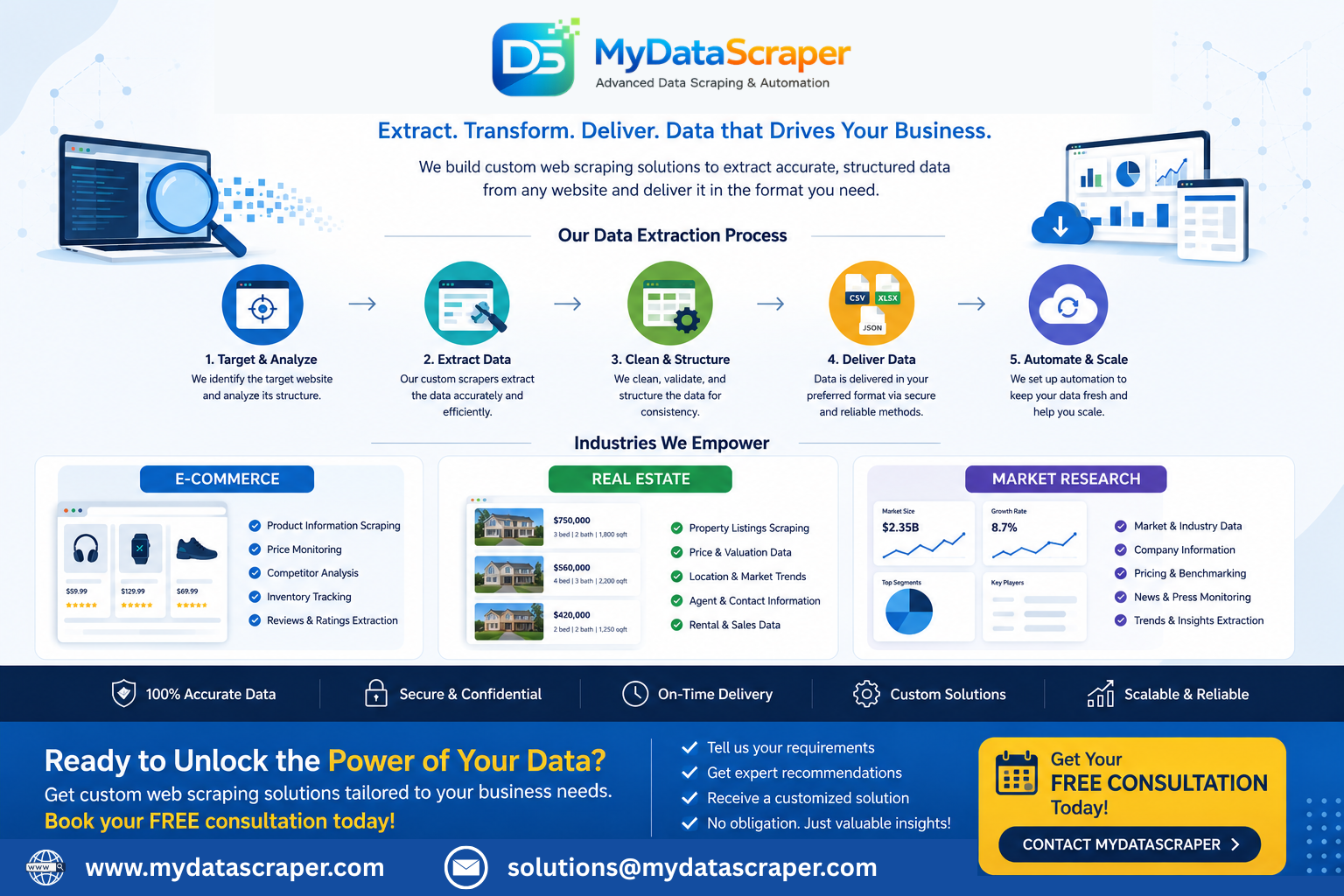
Ready to build your repricing data advantage for 2026? Contact MyDataScraper for a free consultation — or visit mydatascraper.com to explore all our ecommerce intelligence services.

Written by the MyDataScraper Team
MyDataScraper is a leading provider of custom web scraping and data extraction solutions for dynamic repricing, competitive price intelligence, and algorithm‑driven ecommerce optimization. We help Amazon sellers, marketplace aggregators, repricing software vendors, and DTC brands build the data pipelines that power next‑generation pricing strategy in 2026. Learn more at mydatascraper.com or contact our team today for a free consultation.