Ecommerce Price Monitoring: The Complete Guide to Real-Time Competitive Pricing Intelligence & Revenue Growth in 2026
In 2026, ecommerce is more competitive than ever — with millions of sellers adjusting prices multiple times daily across Amazon, Walmart, eBay, Shopify stores, and countless other platforms. Discover how automated price monitoring gives online retailers, brands, and DTC businesses the real-time competitive intelligence to optimize pricing, boost margins, and win market share in today's hyper-dynamic digital commerce landscape.
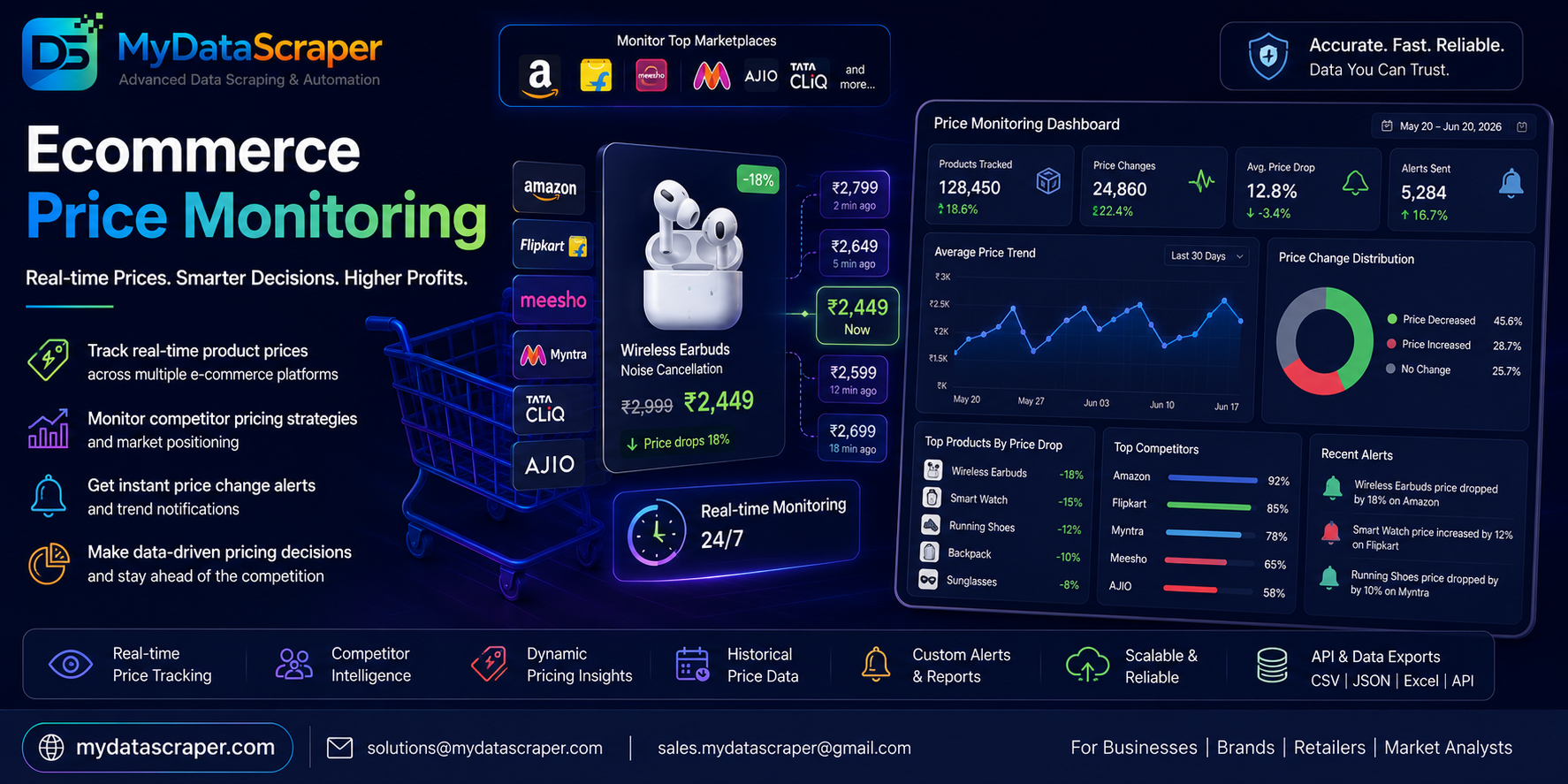
- Why Ecommerce Price Monitoring Is Essential for Online Retail Success in 2026
- What Is Ecommerce Price Monitoring?
- What Pricing Data Can Be Extracted?
- Why Competitive Price Intelligence Matters More Than Ever
- Use Cases: Who Benefits from Price Monitoring
- Dynamic Pricing Intelligence: The New Standard
- Competitor Pricing & Promotional Strategy
- Marketplace-Specific Pricing Dynamics
- The Price Monitoring Process
- Case Study: DTC Brand Boosts Revenue 41% with Real-Time Price Intelligence
- How MyDataScraper Delivers Price Monitoring Excellence
- Ethical & Legal Considerations
- Frequently Asked Questions
- Conclusion
Why Ecommerce Price Monitoring Is Essential for Online Retail Success in 2026
The ecommerce landscape in 2026 is defined by speed, transparency, and relentless competition. With over 12 million online retailers globally, $8.5 trillion in ecommerce sales projected, and consumers armed with price-comparison tools and AI-powered shopping assistants, pricing has become the single most visible and immediate lever for competitive advantage. The businesses that win are those that monitor competitor prices in real-time and adjust their own pricing strategies with surgical precision.
Every product listing across every marketplace reveals pricing intelligence: competitor base prices, promotional discounts, bundled offers, shipping costs, stock availability signals, and consumer demand patterns. Aggregate this data systematically across platforms, categories, and geographies — and you hold the most valuable competitive intelligence in modern commerce.
Yet in 2026, most retailers still monitor competitor prices manually — checking a handful of SKUs once or twice a week, reacting to pricing changes days or weeks after they occur. This approach captures less than 1% of the actual pricing intelligence flowing through ecommerce channels daily and cannot possibly scale to the systematic monitoring required when competitors change prices every few hours.
Automated ecommerce price monitoring transforms this equation entirely. Systematic extraction of product prices, promotions, shipping costs, and stock availability from Amazon, Walmart, eBay, Shopify, and other platforms gives online retailers the intelligence to optimize pricing in real-time, protect margins, and outmaneuver competitors. At MyDataScraper, we build custom competitor price monitoring solutions that deliver this intelligence in CSV, JSON, or Excel.
The Scale of Opportunity: Research shows that businesses implementing real-time price monitoring see average revenue lifts of 15–35% within the first year. Our specialized dynamic pricing intelligence solution is purpose-built to unlock this revenue potential through systematic price intelligence.
What Is Ecommerce Price Monitoring?
Ecommerce price monitoring is the automated collection and analysis of publicly available product pricing data from online retail platforms — including base prices, sale prices, promotional offers, shipping costs, stock availability, ratings, and seller information across marketplaces, brand websites, and retailer storefronts.
Manual price checking captures maybe 10–20 product price points per hour — a rate fundamentally incompatible with the dynamic reality of ecommerce where millions of prices change daily, sometimes hourly. Automated price monitoring systematically extracts pricing data across entire catalogs, entire categories, or entire marketplaces. A single extraction can capture pricing data across 10,000+ SKUs on Amazon, complete with seller variations, Buy Box status, shipping options, and current availability — delivered as structured datasets ready for immediate analysis or integration into pricing engines.
What makes automated price monitoring uniquely valuable in 2026:
- Multi-platform coverage — Amazon, Walmart, eBay, Shopify, Target, Best Buy, Etsy, and hundreds of regional platforms
- Sub-hourly refresh rates — captures price changes as they happen, not hours or days later
- Promotional intelligence — detects coupons, flash sales, volume discounts, and bundle offers
- Buy Box and seller-level insight — critical for marketplace sellers competing for the Buy Box
- Stock and availability signals — out-of-stock events reveal supply chain dynamics
- International price intelligence — track pricing across currencies, regions, and localized marketplaces
- Competitor reaction detection — see how competitors respond to your price changes in near real-time
Speed Is the Competitive Edge: In 2026, the retailer that detects a competitor's price drop first wins. Our live scraping APIs deliver price intelligence with sub-hourly latency, giving you the speed advantage in every pricing decision.
What Ecommerce Pricing Data Can Be Extracted in 2026?
💰 Core Product Pricing
- Current product price (base price)
- Sale/discounted price and discount percentage
- MSRP / list price vs current selling price
- Price history and price drop alerts
- Bulk/volume pricing tiers
- Subscription pricing (recurring vs one-time)
- Dynamic pricing variations by user segment
- Currency and localized pricing
- Price per unit for multi-pack or bundled products
📦 Shipping & Fulfillment Intelligence
- Shipping cost by method (standard, expedited, overnight)
- Free shipping eligibility thresholds
- Estimated delivery times
- Fulfillment channel (Amazon FBA, FBM, Shopify, etc.)
- Same-day / next-day delivery availability
- International shipping costs and availability
- In-store pickup vs delivery pricing
🛍️ Promotional & Discount Intelligence
- Coupon codes and promotional discounts
- Flash sale timing and discount depth
- Seasonal promotion calendars
- Buy-one-get-one (BOGO) offers
- Loyalty program member pricing
- Email subscriber exclusive pricing
- Student/military/first-responder discounts
- First-time buyer incentives
🏪 Marketplace-Specific Data
- Amazon Buy Box status and winning seller
- Amazon FBA vs FBM pricing differences
- Walmart marketplace seller pricing
- eBay auction vs Buy It Now pricing
- Etsy shop pricing and variations
- Shopify store pricing (brand DTC channels)
- Best Buy / Target / other retailer pricing
- Price match guarantees and policies
⭐ Product & Seller Metadata
- Product title, brand, and category
- Product ratings and review counts
- Number of sellers offering the product
- Stock availability / inventory status
- Product images and descriptions
- GTIN / UPC / EAN / SKU identifiers
- Seller name and seller rating
- Product variations (size, color, style) and their pricing
📊 Competitive Set & Market Intelligence
- Competitor product catalogs and pricing
- Category-level pricing benchmarks
- Price positioning analysis (premium, value, mid-market)
- Market share signals by pricing tier
- Geographic price variations
- Seasonal pricing patterns
- New product launch pricing intelligence
At MyDataScraper, we extract exactly the ecommerce pricing fields your retail business requires — delivered in CSV, JSON, or Excel, or as continuous data feeds through our live scraping APIs.
Why Competitive Price Intelligence Matters More Than Ever in 2026
AI-Powered Shopping Assistants Have Changed Everything
In 2026, AI shopping assistants and price-comparison tools have become mainstream consumer behavior. Shoppers routinely compare prices across multiple platforms before purchasing — often using AI tools that alert them to price drops and historical price trends. This transparency means any pricing advantage is immediately visible to consumers. Retailers without real-time price intelligence are effectively pricing in the dark.
Ecommerce Competition Has Intensified Across All Categories
With low barriers to entry and global fulfillment networks, competition in ecommerce has intensified across every category. From consumer electronics to apparel to pet supplies to home goods — every vertical has more sellers, more price transparency, and more aggressive pricing strategies. Without systematic monitoring, retailers are unable to track the competitive moves that directly impact their conversion rates and market share.
Dynamic Pricing Is Now the Industry Standard
Leading retailers have moved beyond occasional price adjustments to algorithm-driven dynamic pricing — with prices changing multiple times daily based on demand signals, competitor movements, inventory levels, and consumer behavior. Without automated price monitoring, retailers cannot possibly keep pace with competitors who adjust prices every few hours.
Buy Box Competition Has Never Been More Intense
For Amazon sellers specifically, the Buy Box is the single most important driver of sales — 82%+ of Amazon sales go through the Buy Box. Winning the Buy Box requires real-time price monitoring of competitors, combined with fulfillment, seller metrics, and inventory signals. Manual approaches simply cannot compete in this environment.
Multi-Platform Expansion Creates Monitoring Complexity
Most successful ecommerce brands now sell across 3–5+ platforms (Amazon, Walmart, eBay, their own Shopify store, and increasingly social commerce). Each platform has different pricing dynamics, competitive sets, and promotional requirements. Multi-platform monitoring has become essential for unified pricing strategy.
"In 2026, price monitoring isn't just a competitive advantage — it's the minimum cost of entry for any serious ecommerce business. The retailers that don't monitor systematically are competing with one hand tied behind their backs. The margin gap between data-driven and manual pricing strategies widens with every product launch and every flash sale." — Ecommerce Revenue Intelligence Report, 2026
Use Cases: Who Benefits from Ecommerce Price Monitoring in 2026
🛒 Online Retailers & DTC Brands
Ecommerce retailers and DTC brands use price monitoring to track competitor pricing across their entire product catalog, detect promotional activity, identify pricing opportunities, and optimize their own pricing in real-time. Combined with our dynamic pricing intelligence solution, this drives systematic revenue optimization and margin protection.
🏪 Amazon FBA & Marketplace Sellers
Amazon sellers use price monitoring to track competitor pricing on the Buy Box, understand pricing dynamics across different sellers, optimize their own pricing for maximum Buy Box share, and monitor price changes that impact their sales rank. Essential intelligence for FBA sellers competing in high-volume categories.
🏷️ Consumer Brands & Manufacturers
Brands selling through multiple channels use price monitoring to enforce MAP (Minimum Advertised Price) policies, detect unauthorized discounting by retailers, understand retail price positioning, and monitor how their products are priced across authorized vs unauthorized channels. Critical for brand integrity and channel management.
📊 Ecommerce Agencies & Consultants
Ecommerce agencies use price monitoring to deliver competitive intelligence to their brand clients — providing pricing recommendations, market positioning analysis, and promotional strategy insights that drive client revenue growth.
📈 Investment & Market Intelligence Firms
Investment analysts and market research firms use ecommerce pricing data to understand category dynamics, track brand performance, identify market share shifts, and make informed investment decisions in the retail sector.
⚖️ Retail Price Matching & Parity Enforcement
Retailers offering price match guarantees use automated monitoring to ensure their price match policies are both competitive and profitable. Similarly, brands monitor for unauthorized discounting that violates pricing agreements.
📱 AdTech & Retail Media Platforms
AdTech platforms and retail media networks use pricing data to optimize advertising and promotional targeting, helping retailers connect with price-sensitive shoppers at the right moment.
📦 Logistics & Fulfillment Providers
Fulfillment providers use pricing intelligence to understand how shipping costs impact total price positioning, helping retailers optimize their logistics strategies to compete on total delivered price.
Dynamic Pricing Intelligence: The New Standard for Ecommerce
Dynamic pricing — adjusting prices in real-time based on demand, competition, and other signals — has evolved from an advanced tactic to the industry standard in ecommerce. Leading retailers now change prices multiple times daily, with sophisticated algorithms optimizing pricing for revenue, margin, and conversion simultaneously. Without systematic monitoring of competitor pricing, dynamic pricing is effectively flying blind.
- Competitor price change detection: Capture every competitor price change as it happens, enabling immediate strategic responses
- Price elasticity intelligence: Understand how competitor price changes impact your conversion rates and sales velocity
- Demand-based pricing signals: Correlate pricing with inventory depletion, social signals, and conversion data
- Hourly vs daily refresh analysis: Determine the optimal refresh frequency for your category and competitive intensity
- Algorithm training data: High-quality historical pricing data is the foundation for building or training dynamic pricing algorithms
- Promotional timing optimization: Identify when competitors launch flash sales, enabling you to time your promotions strategically
- Seasonal price pattern intelligence: Understand year-over-year pricing patterns to anticipate competitor behavior
Algorithm-Readable Data: Our price monitoring delivers data structured specifically for dynamic pricing algorithms — clean, timestamped, competitor-labeled, and ready for ingestion into your pricing engine or RMS. Explore our API-based data delivery services for seamless integration.
Competitor Pricing & Promotional Strategy Intelligence
Understanding competitor pricing strategy requires more than tracking individual price points — it requires systematic analysis of pricing patterns, promotional calendars, and strategic signals across your competitive set. Comprehensive price monitoring delivers:
- Competitive price positioning analysis: How does your pricing compare to competitors across the entire product range? Are you positioned as premium, value, or mid-market?
- Promotional cadence detection: Which competitors run regular flash sales? What are their promotional schedules and discount depths? When do they launch new product pricing?
- Category-level pricing benchmarks: What are the typical price ranges for different product categories? Where do the pricing thresholds that impact conversion sit?
- Competitor reaction analysis: How do competitors respond to your price changes? How quickly? With what magnitude?
- Pricing strategy classification: Identify whether competitors are using cost-plus, value-based, demand-based, or other pricing strategies
- Cross-category pricing intelligence: Are competitors using loss-leader pricing in some categories to drive traffic to higher-margin categories?
- Geographic pricing strategy: How does competitor pricing vary by region, country, or local market? What does this reveal about their global strategy?
Strategic Intelligence, Not Just Data: Our price monitoring delivers actionable intelligence — not raw numbers. We help retailers turn pricing data into competitive strategy that drives revenue growth and market share expansion.
Marketplace-Specific Pricing Dynamics: Amazon, Walmart, eBay & More
Each ecommerce marketplace has unique pricing dynamics, competitive pressures, and strategic considerations. Effective price monitoring must be marketplace-specific to capture the nuances that drive sales on each platform:
🛒 Amazon Marketplace Intelligence
- Buy Box tracking: Which seller has the Buy Box? What price won it? How does Buy Box share correlate with price position?
- FBA vs FBM pricing: How do FBA and FBM sellers price differently? What's the fulfillment cost premium consumers will accept?
- Amazon pricing algorithms: Detect Amazon's own algorithmic repricing patterns and respond strategically
- Sponsored product impact: How does sponsorship affect pricing and Buy Box dynamics?
- Subscribe & Save pricing: Track subscription discounts and how they impact total price positioning
- Limited-time deal monitoring: Capture Lightning Deals, Deal of the Day, and other Amazon promotions in real-time
🛍️ Walmart Marketplace Intelligence
- Walmart marketplace seller dynamics: How many sellers compete for each product? What's their pricing strategy?
- In-store vs online pricing: How does Walmart's online pricing compare to in-store pricing? Important for omnichannel retailers
- Rollback pricing: Track Walmart's signature "Rollback" promotions and their impact on competitive positioning
- Free shipping thresholds: How does Walmart's free shipping threshold impact total price competitiveness?
- Marketplace vs direct pricing: How does Walmart's direct pricing compare to third-party seller pricing?
🏷️ eBay & Other Platform Dynamics
- Auction vs Buy It Now pricing: Track both formats to understand pricing strategy preferences
- New vs used pricing analysis: Important for categories with strong secondary markets
- Best Offer intelligence: Understand the gap between listed price and actual accepted offer price
- Seller rating impact: How does seller rating correlate with price premium?
🖥️ Brand DTC (Shopify & Direct) Intelligence
- Direct channel pricing strategy: How does DTC pricing compare to marketplace pricing? Is there intentional differentiation?
- Loyalty program pricing: How are loyal customers priced vs new customers?
- Subscription program pricing: Track recurring revenue pricing models and their competitiveness
- Bundle and cross-sell pricing: How are product bundles priced to drive average order value?
Unified Multi-Platform Intelligence: Modern ecommerce requires unified visibility across all sales channels. We build integrated monitoring solutions covering Amazon, Walmart, eBay, Shopify, and regional marketplaces — delivering a single source of competitive price intelligence for your entire business.
The Ecommerce Price Monitoring Process: Step by Step
Step 1: 🎯 Product & Platform Scope Definition
We start by defining your monitoring scope — target platforms (Amazon, Walmart, eBay, Shopify, etc.), product catalogs (your SKUs and competitor SKUs), geographic markets, and specific pricing fields required. For multi-platform retailers, we typically cover all active sales channels with unified data delivery.
Step 2: 🔧 Custom Scraper Engineering
Our engineers build scrapers purpose-built for your target platforms — handling product search, category navigation, price extraction, promotion detection, shipping cost capture, Buy Box tracking, and platform-specific pricing nuances. Every scraper is engineered for reliable, high-frequency extraction at scale.
Step 3: ⏱️ Refresh Frequency Configuration
Price refresh frequency depends on your category and competitive intensity. High-velocity categories (consumer electronics, fashion) benefit from 6-12x daily monitoring. Slower categories may need only daily refresh. We configure monitoring frequency based on your pricing strategy and dynamic pricing needs.
Step 4: 🧹 Data Normalization & Enrichment
Raw pricing data requires specialized cleaning — SKU matching across platforms, product normalization, currency conversion, promotion filtering, shipping cost standardization, and competitor identification. We deliver clean, comparable, actionable pricing data.
Step 5: 📊 Competitive Price Analysis
Beyond raw data, we provide competitive price analysis — price positioning maps, promotional calendars, competitor strategy classification, alert triggers, and actionable intelligence that drives strategic pricing decisions.
Step 6: 📦 Delivery & Pricing Engine Integration
Clean pricing intelligence is delivered in CSV, JSON, or Excel — or as continuous data feeds through our API-based data delivery services, integrated with dynamic pricing engines, revenue management systems, or competitive dashboards.
Case Study: How a DTC Home Goods Brand Boosted Revenue 41% and Margins 12% with Real-Time Competitive Price Intelligence
A DTC home goods brand selling across Amazon, Walmart, and their own Shopify store was facing a common but critical challenge: they were losing the pricing game. Competitors with more sophisticated pricing algorithms were undercutting them on key products, winning the Buy Box on Amazon consistently, and eroding their market share. Their manual approach — checking a handful of competitor prices twice weekly — was capturing less than 5% of actual pricing dynamics.
Entering 2026, they partnered with MyDataScraper to build comprehensive price monitoring infrastructure:
What Was Built
- 8x daily price monitoring across Amazon, Walmart, and 15 competitor brand websites covering 2,400+ SKUs
- Buy Box tracking on Amazon including seller-level pricing and fulfillment method
- Promotional and discount detection across all monitored platforms
- Shipping cost capture to track total delivered price competitiveness
- Stock availability monitoring to detect competitor inventory constraints
- Real-time alerts for significant competitor price moves
- Weekly competitive price positioning dashboards
- Data integrated directly into their dynamic pricing engine for automated repricing
Results After 12 Months (Entering Q2 2026)
41% increase in total ecommerce revenue through optimized pricing informed by real-time competitive intelligence. 12% margin improvement through smarter promotional timing and strategic price positioning. Amazon Buy Box share increased from 38% to 67% on key SKUs through precise competitor price matching and fulfillment optimization. Average order value increased 9% through better cross-sell and bundle pricing. Reduced promotional discount depth by 8 percentage points while maintaining conversion — because they understood competitive positioning more precisely.
The single highest-impact insight came from Amazon Buy Box analysis in Q3 2025: they discovered that their Buy Box win rate was significantly lower on products where competitors were offering free shipping while they were charging for shipping. By adjusting their shipping strategy and incorporating total delivered price into their repricing algorithm, they increased Buy Box share by 19 percentage points across those products — an insight impossible to detect without systematic shipping cost intelligence.
Contact MyDataScraper today to build your ecommerce price monitoring solution for 2026.
How MyDataScraper Delivers Ecommerce Price Monitoring Excellence
At MyDataScraper, ecommerce price monitoring is one of our core intelligence services — used by online retailers, consumer brands, marketplace sellers, and ecommerce agencies worldwide. Here's what makes our price monitoring approach uniquely effective in 2026:
🛒 Multi-Platform Coverage Expertise
We deeply understand the pricing architectures of Amazon, Walmart, eBay, Shopify, Target, Best Buy, Etsy, and hundreds of regional and category-specific platforms. Whether you need intelligence from a single platform or unified multi-platform monitoring, our capabilities scale across the entire ecommerce ecosystem.
⚡ Sub-Hourly Refresh Infrastructure
Our infrastructure captures price changes with the frequency modern ecommerce requires — up to 12x daily refresh for high-velocity categories, with intelligent triggering for flash sales, competitor moves, and promotional events. When your competitors change prices, you know within minutes.
📊 Buy Box & Seller-Level Intelligence
For Amazon and marketplace sellers, we deliver specialized Buy Box tracking, seller-level pricing, fulfillment method detection, and market share signals — the critical intelligence needed to win the Buy Box consistently.
📦 Total Delivered Price Intelligence
We capture shipping costs, delivery times, and fulfillment methods alongside product prices — delivering total delivered price intelligence that accounts for the full cost consumers actually pay, not just the product base price.
🎯 Promotional & Discount Detection
We systematically detect and classify promotions — coupons, flash sales, volume discounts, loyalty pricing, subscription discounts — providing comprehensive promotional intelligence that reveals competitor strategies.
🔗 Pricing Engine Integration
Our data cleaning and structuring meets enterprise dynamic pricing standards. Data integrates seamlessly with leading pricing engines or feeds custom repricing tools through our API-based data delivery services.
🔄 Flexible Delivery Options
Pricing intelligence is delivered in CSV, JSON, or Excel — or via live scraping APIs, integrated with our web scraping dashboards, or pushed directly to your pricing engines through automated pipelines.
Ethical & Legal Considerations for Ecommerce Price Monitoring
✅ Compliant Practices We Follow
- Collect only publicly available product and pricing data visible to any shopper
- Respect platform terms of service and implement appropriate rate limiting
- Use data for legitimate business intelligence, competitive analysis, and pricing optimization
- Never collect customer personal data, purchase histories, or account information
- Comply with GDPR, CCPA, and applicable global data protection regulations
- Maintain proper data security for all extracted information
- Use competitor pricing as unilateral competitive intelligence, never for price coordination (serious antitrust concerns)
- Anonymize aggregate data where appropriate
❌ Practices We Strictly Avoid
- Accessing customer accounts, purchase histories, or personal data
- Collecting individual shopper personal data or contact information
- Using scraped data for price coordination with competitors (serious antitrust concerns)
- Sending request volumes that could impact platform performance
- Bypassing authentication systems or security measures aggressively
- Republishing scraped content as original
- Manipulating ratings or reviews through scraped data
- Making fraudulent purchases to access pricing behind checkout flows
2026 Legal Context: Ecommerce price monitoring operates in a complex global legal environment. Jurisdictions including the EU, US, UK, Canada, Brazil, India, and Australia have specific regulations governing data collection, competitive intelligence, and pricing practices. MyDataScraper builds multi-jurisdictional compliance considerations into every price monitoring project and recommends specialized legal counsel for large-scale global monitoring programs.
Frequently Asked Questions
How frequently can ecommerce prices be monitored?
Our infrastructure supports up to 12x daily refresh for high-velocity product categories, with custom triggering for flash sales, competitor price moves, and promotional events. For most retailers, 4–6x daily monitoring provides the optimal balance of intelligence and performance. Contact our team to discuss the right frequency for your category and competitive intensity.
Can pricing data be monitored across multiple platforms simultaneously?
Absolutely — this is our most valuable configuration. We build unified monitoring pipelines covering Amazon, Walmart, eBay, Shopify, Target, Best Buy, and regional platforms — delivering a single, integrated view of competitive pricing across all your sales channels. This unified intelligence is essential for multi-platform retailers.
How many SKUs can be monitored effectively?
Our infrastructure scales to any volume — from focused product sets (100–500 SKUs) to comprehensive catalog monitoring across 100,000+ SKUs. Volume scales to your business requirements and pricing sophistication. Contact us for a volume-specific quote.
Can shipping costs and total delivered price be captured?
Yes — we capture complete shipping intelligence including shipping costs by method, free shipping thresholds, estimated delivery times, and fulfillment channels. This enables total delivered price monitoring — the price consumers actually pay, which is often the most important competitive metric for conversion.
Can price monitoring be integrated with dynamic pricing engines?
Yes — we structure pricing data specifically for integration with dynamic pricing engines, revenue management systems, and repricing tools. Data is delivered in algorithm-ready formats through our API-based data delivery services for seamless ingestion into your pricing infrastructure.
What format is price monitoring data delivered in?
We deliver pricing intelligence in CSV, JSON, or Excel — and can integrate with pricing engines, BI dashboards, or competitive intelligence tools via live scraping APIs. Data arrives clean, structured, and ready for immediate pricing optimization or strategic analysis.
How quickly can a price monitoring project launch in 2026?
Standard price monitoring projects are built and delivering data within 7 to 12 business days of project kick-off. Focused projects (single platform, limited SKU set) can launch in 5–7 days. Complex multi-platform, multi-category projects typically take 10–15 days. Contact our team today for a specific timeline.
In 2026, Ecommerce Price Monitoring Is Your Most Important Competitive Weapon — Are You Deploying It Systematically?
Ecommerce in 2026 moves at unprecedented speed. Competitors change prices multiple times daily. AI-powered shopping assistants compare prices instantly. Consumers expect the best deal, and they can find it in seconds. For online retailers, consumer brands, and marketplace sellers competing in this environment, automated price monitoring isn't optional — it's the foundational intelligence system that enables competitive pricing, margin protection, and revenue growth.
At MyDataScraper, we build custom ecommerce price monitoring solutions tailored to your specific business needs — multi-platform price monitoring, competitive intelligence, promotional detection, Buy Box tracking, shipping cost intelligence, and dynamic pricing integration — delivered in CSV, JSON, or Excel, integrated into your pricing engines and business intelligence systems.
Explore our related ecommerce intelligence services: competitor price monitoring, dynamic pricing intelligence, ecommerce data scraping, market research strategy, and API-based data delivery. The pricing intelligence that could transform your 2026 ecommerce performance is publicly available right now.
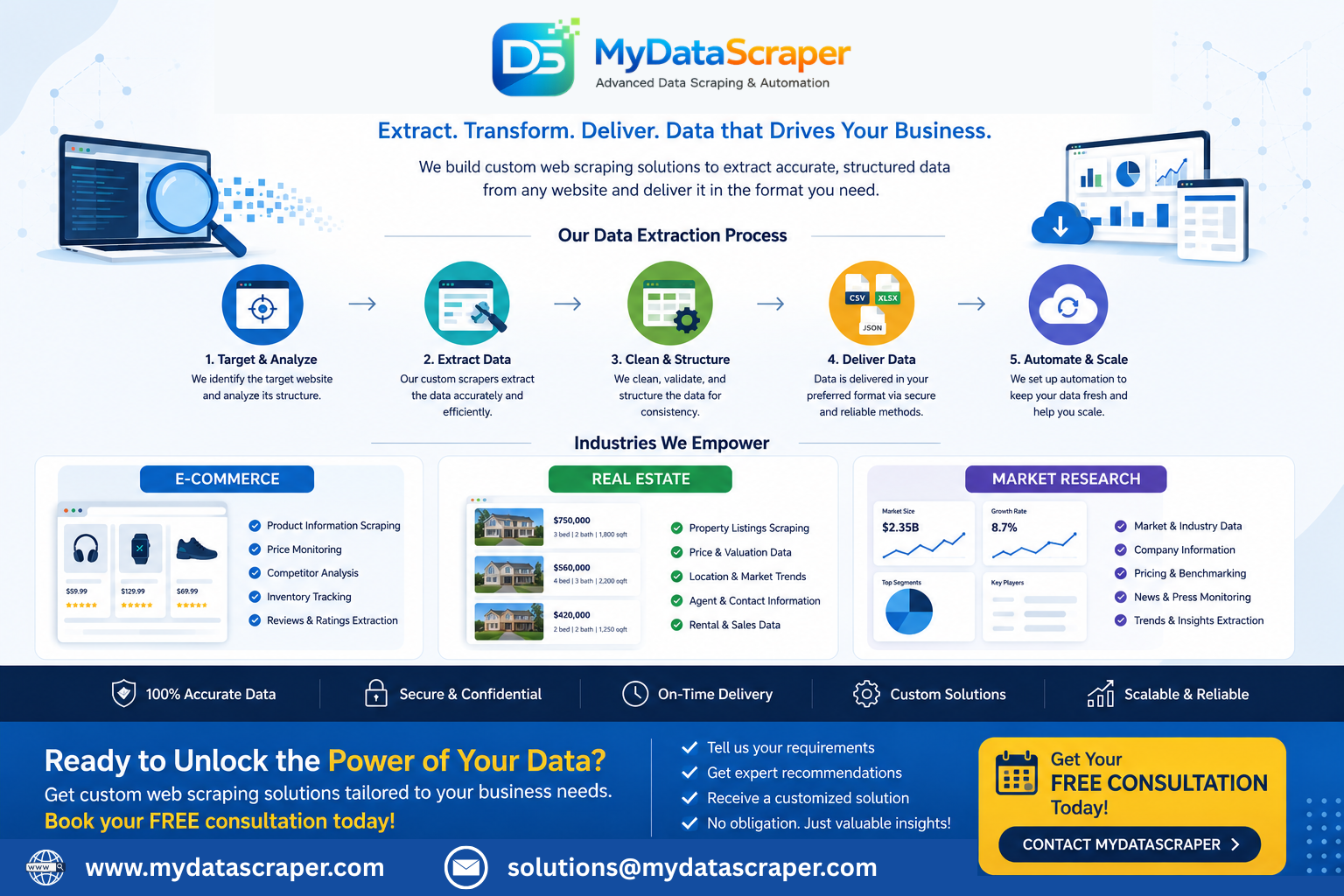
Ready to build your ecommerce price monitoring advantage for 2026? Contact MyDataScraper for a free consultation — or visit mydatascraper.com to explore all our ecommerce data scraping services.

Written by the MyDataScraper Team
MyDataScraper is a leading provider of custom web scraping and data extraction solutions for ecommerce price monitoring, competitive intelligence, and dynamic pricing optimization. We help online retailers, consumer brands, marketplace sellers, and ecommerce businesses extract the pricing intelligence that drives smarter commerce strategy in 2026. Learn more at mydatascraper.com or contact our team today for a free consultation.