MAP Monitoring Guide: The Complete Playbook for Tracking Reseller Pricing, Enforcing Minimum Advertised Price & Protecting Brand Value in 2026
One rogue reseller drops your price below MAP. Within hours, repricing tools cascade the violation across the market, eroding margins, damaging retailer relationships, and resetting customer expectations. In 2026, 53% of unauthorized sellers routinely advertise below MAP[reference:0], and price erosion can spread across the entire channel in under an hour[reference:1]. Discover how automated MAP monitoring gives brands the real‑time intelligence to detect violations instantly, enforce pricing policies consistently, and protect brand equity across every sales channel.
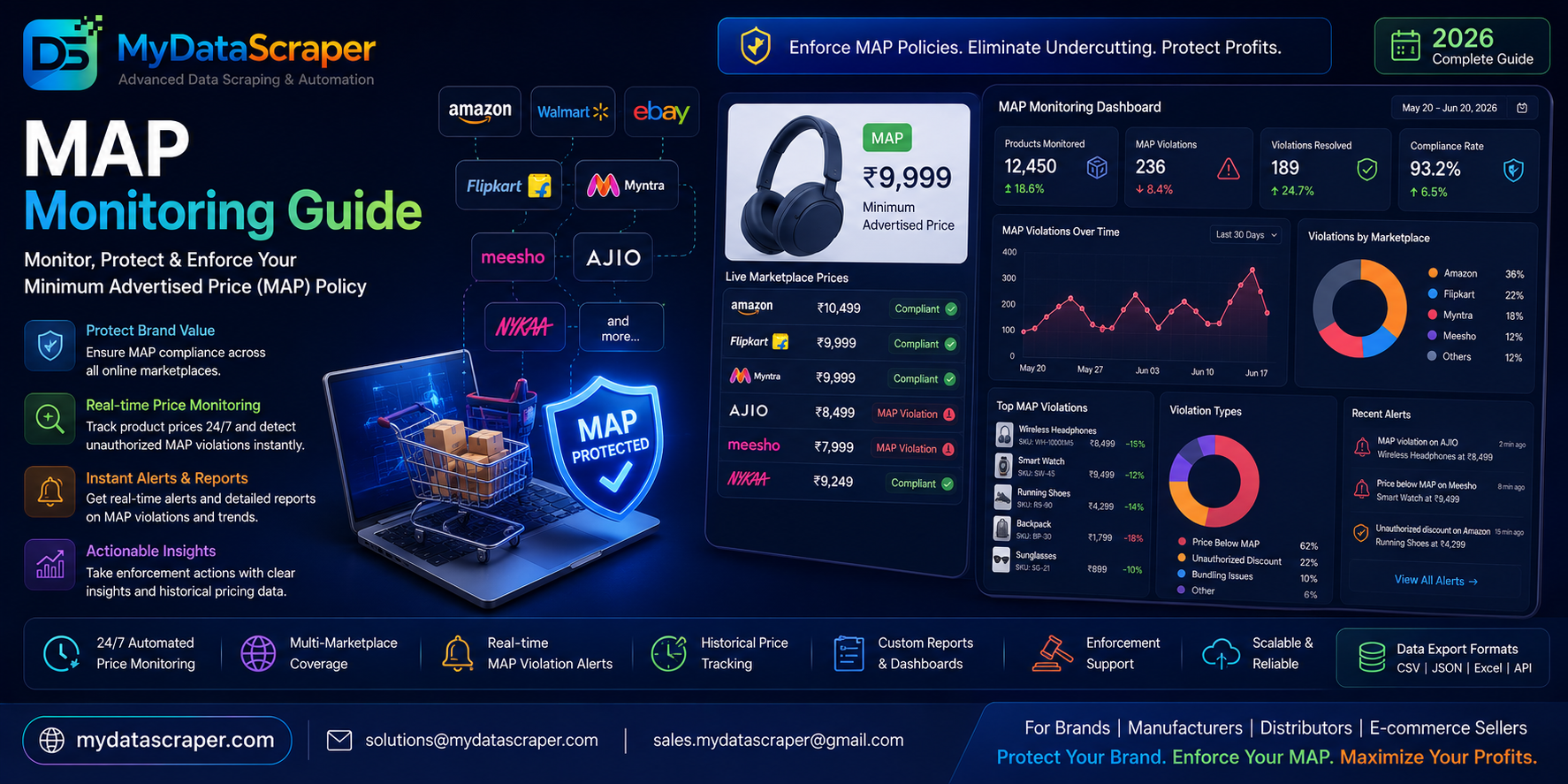
- Why MAP Monitoring Is Critical for Brand Protection in 2026
- What Is MAP Monitoring?
- Why MAP Violations Are More Dangerous Than You Think
- What Reseller Pricing Data Can Be Extracted?
- Who Benefits from MAP Monitoring?
- How MAP Monitoring Works: Detection → Evidence → Enforcement
- MAP Enforcement Best Practices for 2026
- Common MAP Violation Causes & How to Address Them
- MAP Monitoring Tools & Technology Stack
- Case Study: How a Consumer Brand Reduced MAP Violations by 78%
- How MyDataScraper Delivers MAP Monitoring Excellence
- Legal & Compliance Considerations
- Frequently Asked Questions
- Conclusion
Why MAP Monitoring Is Critical for Brand Protection in 2026
You've built a brand. You've invested in product quality, marketing, and distribution. You've set a Minimum Advertised Price (MAP) to protect margins, preserve brand perception, and maintain healthy retailer relationships. Then, one day, you discover that a reseller you've never heard of is advertising your hero SKU for 20% below your carefully set price[reference:2].
This scenario plays out thousands of times daily in 2026. With over 12 million online retailers and automated repricing tools adjusting prices in milliseconds, a single MAP violation can trigger a cascading "race to the bottom" that resets the entire market's pricing expectations within hours[reference:3]. By the time you discover the violation—often through an angry distributor or a retail partner threatening to reduce orders—the damage has already spread[reference:4].
MAP monitoring is the systematic, automated process of tracking reseller pricing across all sales channels to detect when products are advertised below a brand's approved minimum price[reference:5]. It's the difference between reacting to pricing crises weeks after they occur and stopping violations before they trigger market‑wide damage. At MyDataScraper, we build custom MAP monitoring solutions that deliver real‑time violation detection, evidence capture, and enforcement workflows in CSV, JSON, or Excel.
The Cost of Inaction: 53% of unauthorized sellers routinely advertise below MAP[reference:6]. Without automated monitoring, brands miss violations until partners escalate pricing conflicts—by which point the market has already moved. Our pricing intelligence solutions are purpose‑built to prevent this cascade effect.
What Is MAP Monitoring?
MAP (Minimum Advertised Price) monitoring is the automated process of tracking reseller pricing across ecommerce channels to detect when products are advertised below a brand's approved minimum price[reference:7]. It's a compliance‑oriented practice with a single, focused job: detect when an advertised price crosses a threshold and trigger a response[reference:8].
MAP controls the advertised price—the price displayed on product listing pages, PPC ads, Google Shopping listings, and promotional banners[reference:9]. A retailer can technically sell below MAP in private (e.g., with a promo code at checkout), but they cannot advertise that lower price publicly[reference:10]. This distinction matters because the advertised price is what the market reacts to: it's what customers compare, what platforms use to surface listings, and what other sellers watch when setting their own prices[reference:11].
MAP monitoring is fundamentally different from general price tracking. While price tracking captures historical price movements for competitive intelligence, MAP monitoring has a single, compliance‑oriented job: detect violations and enable enforcement[reference:12]. It's not about spying on competitors—it's about enforcing your own pricing policies across your reseller network[reference:13].
MAP vs. MSRP vs. Price Parity
These terms are frequently conflated, creating enforcement blind spots:
- MAP (Minimum Advertised Price): The lowest price a retailer can advertise. It's a policy you enforce with real consequences for violators[reference:14].
- MSRP (Manufacturer's Suggested Retail Price): A recommended selling price that retailers can ignore freely. MSRP sets the ideal; MAP sets the floor[reference:15].
- Price Parity: Requires a retailer to match prices across channels. MAP only prohibits advertising below a fixed threshold on any channel[reference:16].
MAP Is About What Customers See: The price customers see online becomes the reference point, directly affecting how they judge product value and quality[reference:17]. MAP monitoring protects what the market perceives—not just what the final transaction price is.
Why MAP Violations Are More Dangerous Than You Think
The Cascading "Race to the Bottom"
One low price doesn't stay isolated. It triggers a cascade:
- One seller drops below MAP[reference:18]
- Automated repricing tools match the low price[reference:19]
- Other sellers follow to stay competitive[reference:20]
- The market price resets across the entire channel[reference:21]
- Sales teams face price‑match pressure from every partner[reference:22]
Every hour a violation stays live increases the likelihood of this cascade[reference:23]. Detection speed directly impacts revenue protection.
The Damage Runs Deeper Than Margins
MAP violations don't just erode margins—they fundamentally damage your brand:
- Shopper Behavior: When the same product appears at different prices across platforms, shoppers default to the lowest number[reference:24].
- Brand Perception: A product that keeps appearing at lower prices loses its quality association. That shift in perception is slow to build and hard to reverse[reference:25].
- Pricing Power: Once customers settle on a lower price as the norm, the original feels unjustified. Recovering that ground across the market is an uphill task[reference:26].
- Partner Trust: Authorized partners who followed your pricing standards lose sales to those who didn't. Compliance starts costing them business[reference:27].
Why Manual Monitoring Fails
Many brands start with manual or low‑cost MAP monitoring tools. The risks aren't just limited features—it's unreliable data[reference:28]:
- Inaccurate SKU Matching: Cheap tools often fail to match child SKUs, bundles, or variations, causing missed violations or false alerts[reference:29].
- No Visual Proof: Without screenshots and timestamps, sellers dispute violations and enforcement stalls[reference:30].
- Slow Scanning: Budget tools scan daily. Marketplace repricers adjust in minutes[reference:31].
- No Outreach Workflow: Teams still manually gather proof, write emails, and track repeat offenders in spreadsheets[reference:32].
"In 2026, MAP enforcement isn't just pricing policy—it's sales protection. When resellers violate MAP, sales teams absorb the consequences: territory conflict, margin erosion, and partner trust damage. Detection speed directly impacts revenue protection." — MAP Enforcement Intelligence Report, 2026[reference:33]
What Reseller Pricing Data Can Be Extracted for MAP Monitoring?
🏷️ Core Pricing Intelligence
- Advertised price on product listing pages
- MAP policy threshold for each SKU
- Violation severity (percentage below MAP)
- Price change history and timestamps
- Promotional pricing (flash sales, coupons, discounts)
- Bundled pricing where individual product price isn't displayed[reference:34]
🛒 Channel & Marketplace Coverage
- Amazon product pages and Buy Box pricing
- Walmart marketplace listings[reference:35]
- eBay listings (auction and Buy It Now)
- Target, Best Buy, Home Depot, Lowe's, Costco[reference:36]
- Google Shopping and paid ad listings
- Brand DTC websites and authorized retailer sites
- Regional and international marketplaces
📸 Violation Evidence & Proof
- Time‑stamped screenshots of violating listings[reference:37]
- Product page URLs and seller identification
- Violation date and time capture[reference:38]
- Seller identity and contact information
- Repeat offender tracking and history[reference:39]
📊 Compliance & Performance Metrics
- Violation rate by SKU, retailer, and channel[reference:40]
- Time‑to‑resolution tracking[reference:41]
- Repeat offender frequency[reference:42]
- Revenue impact per violation[reference:43]
- Channel‑level compliance scores[reference:44]
- Authorized vs unauthorized seller identification[reference:45]
🔍 Cross‑Retailer SKU Matching
- UPC / GTIN / EAN / MPN matching across retailers[reference:46]
- Fuzzy name matching for catalog discrepancies[reference:47]
- Child SKU and variation tracking[reference:48]
- Normalized price and seller schema[reference:49]
At MyDataScraper, we extract exactly the MAP monitoring data your brand requires— delivered in CSV, JSON, or Excel, or as continuous data feeds through our live scraping APIs.
Who Benefits from MAP Monitoring in 2026?
🏷️ Consumer Brands & Manufacturers
Brands use MAP monitoring to enforce pricing policies across authorized retailers, detect unauthorized discounting, and protect brand equity. Combined with our competitive price monitoring, this ensures consistent brand positioning across all channels.
🏪 Sales & Channel Management Teams
Sales leaders use MAP monitoring to protect territory relationships, prevent partner complaints, and maintain distributor trust. MAP violations are often discovered first by sales teams when compliant partners ask: "Why am I following MAP if someone else isn't?"[reference:50]
⚖️ Brand Protection & Legal Teams
Legal and brand protection teams use MAP monitoring to document violations with visual proof, enforce reseller agreements, and address unauthorized sellers systematically[reference:51].
🛒 Ecommerce & Marketplace Teams
Ecommerce teams monitor MAP compliance across Amazon, Walmart, and other marketplaces to prevent price erosion, protect Buy Box positioning, and maintain competitive pricing discipline[reference:52].
📊 Pricing & Revenue Management Teams
Pricing teams use MAP monitoring to understand channel pricing dynamics, identify root causes of violations, and adjust MAP policies based on market realities.
🔍 Retail & Channel Analytics
Analytics teams use MAP monitoring data to benchmark channel performance, identify high‑risk resellers, and measure the effectiveness of enforcement actions.
How MAP Monitoring Works: Detection → Evidence → Enforcement
Effective MAP monitoring follows a structured workflow: Detection → Evidence → Seller ID → Outreach → Compliance Tracking[reference:53].
Step 1: 🔍 Continuous Detection
Automated scraping technology crawls product pages across marketplaces, retailer websites, and ad platforms—scanning hundreds of pages in seconds[reference:54]. This is not a one‑time check; pricing online changes fast, requiring ongoing tracking, not periodic checks[reference:55].
- Monitor pricing across Amazon, Walmart, and retailer sites[reference:56]
- Track ad pricing (Google Shopping, sponsored listings)[reference:57]
- Detect MAP violations and unauthorized resellers[reference:58]
- Cross‑retailer SKU matching by UPC/MPN[reference:59]
Step 2: 📸 Evidence Capture
When a violation is detected, the system automatically captures time‑stamped screenshots and page data to provide indisputable proof of the violation[reference:60]. This evidence is critical because:
- Sellers often dispute violations without visual proof[reference:61]
- Time‑stamped evidence provides legal defensibility
- Evidence enables consistent, documented enforcement[reference:62]
Step 3: 🏷️ Seller Identification
The system identifies which seller is violating MAP, cross‑ referencing against your authorized‑seller list[reference:63]. This distinction is critical because:
- Unauthorized sellers are significantly more likely to violate MAP than authorized partners[reference:64]
- Different enforcement approaches apply to authorized vs unauthorized sellers
- Seller visibility is critical for sales leadership, not just ecommerce teams[reference:65]
Step 4: 📨 Outreach & Enforcement
With proof and seller identification, brands can execute enforcement consistently[reference:66]:
- Send violation notices with evidence attached
- Escalate through channel management or legal[reference:67]
- Track repeat offender behavior[reference:68]
- Follow a tiered enforcement sequence: written warning first, then removal from the authorized reseller list, then supply restriction[reference:69]
Real‑Time Alerts Are the Game‑Changer: In ecommerce, a price war can start and finish in under an hour[reference:70]. Getting an immediate notification allows you to stop a violation before it triggers a market‑wide "race to the bottom," keeping the playing field level for all your partners[reference:71]. Our live scraping APIs deliver sub‑hourly violation alerts.
MAP Enforcement Best Practices for 2026
1. Get Internal Alignment First
Before sharing your MAP policy externally, your teams need a shared understanding of the realities in your channel. This step transforms a MAP policy from a theoretical document into something enforceable[reference:72]. Key questions:
- How do products move through your distribution channel?[reference:73]
- Who are your actual partners—including hidden distributors and secondary sellers?[reference:74]
- What incentives drive reseller behavior?[reference:75]
2. Treat MAP as Policy Enforcement, Not Competitor Spying
MAP monitoring is about enforcing your own policies—not tracking competitors[reference:76]. Build a SKU × retailer × geo matrix, check advertised prices, capture proof, and escalate through channel management or legal[reference:77].
3. Provide a 60–90 Day Rollout Window
Partners need time to comply before enforcement begins. A structured rollout window with clear communication improves long‑term compliance[reference:78].
4. Monitor the Right Surfaces
MAP violations typically occur on[reference:79]:
- Product listing pages
- Google Shopping ads
- Amazon Sponsored Product listings
- Promotional banners
Plenty of pricing situations fall outside MAP scope[reference:80]:
- In‑cart prices
- Membership‑gated discounts (Amazon Prime)
- Phone orders
- Bundled pricing where individual product price isn't displayed
5. Track the Right Metrics
Effective MAP monitoring tracks five core metrics[reference:81]:
- Violation rate: How many violations are occurring?
- Time to resolution: How quickly are violations resolved?
- Repeat offender frequency: Who keeps violating?
- Revenue impact per violation: What's the cost of each violation?
- Channel‑level compliance scores: Which channels are performing well or poorly?
Stop Treating MAP as a Sales Responsibility: Your salespeople are trying to build relationships and grow revenue. Asking them to also police pricing creates an impossible conflict[reference:82]. MAP monitoring should be a dedicated, automated function.
Common MAP Violation Causes & How to Address Them
MAP violations occur for a variety of reasons, from straightforward errors to predatory behavior[reference:83]:
⚠️ Human Error
An unintentional price decrease may result from a simple misspelling in a back‑end system or a misinterpretation of a promotion's expiration date[reference:84].
Solution: Automated monitoring catches errors immediately, enabling quick correction before they cascade.
📉 Following the Crowd
Resellers see competitors lowering prices and follow to stay competitive, often without realizing they're violating MAP[reference:85].
Solution: Real‑time alerts enable you to intervene with the first violator before others follow.
🤖 Automated Repricing Tools
Repricing tools automatically adjust prices based on competitor moves, often driving prices below MAP without human intervention[reference:86].
Solution: Monitor repricing patterns and work with resellers to set appropriate floor prices in their repricing tools.
🛒 Unauthorized Sellers
Unauthorized third‑party sellers can significantly harm brand equity, damage MAP programs, and disrupt relationships with authorized retailers[reference:87].
Solution: Continuous monitoring of all sellers— not just authorized partners—with automated detection of new sellers entering your product listings.
🌐 Cross‑Border Gray Markets
Products sold in one region may be imported and resold in another at prices that violate regional MAP policies.
Solution: Multi‑region monitoring with localised MAP thresholds and seller identification.
Detection Speed = Revenue Protection: Every hour a violation stays live increases the likelihood of a market‑wide cascade[reference:88]. The difference between hourly and daily monitoring is often the difference between stopping a single violation and managing a channel‑wide pricing crisis.
MAP Monitoring Tools & Technology Stack
Modern MAP monitoring relies on a combination of technologies working together:
🔧 Core Technology Components
- Web Scraping Infrastructure: Automated crawlers that scan product pages across marketplaces and retailer sites[reference:89]
- SKU Matching & Normalization: Cross‑ retailer product matching using UPC/GTIN/EAN/MPN, with fuzzy matching for catalog discrepancies[reference:90]
- Violation Detection Engine: Price threshold comparison with graded severity scoring[reference:91]
- Evidence Capture: Automated time‑stamped screenshots and page data archiving[reference:92]
- Alert & Notification System: Real‑time alerts via email, Slack, or API[reference:93]
- Reporting & Analytics Dashboard: Compliance metrics, violation trends, and channel performance[reference:94]
📊 Leading MAP Monitoring Platforms in 2026
- Wiser MAP Intelligence: Centralized monitoring, violation documentation, and consistent enforcement across all reseller channels[reference:95]
- GrowByData: SKU‑level detection across Walmart, Amazon, and Google Shopping with rich dashboards[reference:96]
- MetricsCart: Automated real‑time monitoring with human‑assisted onboarding[reference:97]
- Thunderbit: AI‑powered MAP price monitoring automation for sales and operations teams[reference:98]
- Apify Multi‑Retailer MAP Monitor: Cross‑retailer SKU matching, graded violation severity, and unauthorized‑seller flagging[reference:99]
- SunTec India: AI‑powered product matching with 99%+ accuracy and human‑verified QA[reference:100]
⚙️ Technical Considerations
- Residential Proxies: Essential for accurate, geo‑targeted price checking to see prices as local customers see them[reference:101]
- JavaScript Rendering: Modern platforms require scrapers that handle dynamic page rendering and pricing overlays[reference:102]
- Rate Limiting: Responsible scraping with polite rate limits and no CAPTCHA bypass[reference:103]
- API Integration: Programmatic access for integration with repricing tools and business systems[reference:104]
Case Study: How a Consumer Electronics Brand Reduced MAP Violations by 78% in 9 Months
A mid‑sized consumer electronics brand with 800+ SKUs sold across Amazon, Walmart, Best Buy, and 200+ authorized retailers was losing control of their pricing. MAP violations were rampant— they were discovering violations only when partners escalated pricing conflicts, typically weeks after the violation occurred. By then, the market price had already reset, margins were eroding, and authorized partners were threatening to reduce orders.
In late 2025, they partnered with MyDataScraper to build a comprehensive MAP monitoring solution:
What Was Built
- Daily automated scanning across Amazon, Walmart, Best Buy, Target, and 50+ authorized retailer websites
- Cross‑retailer SKU matching using UPC/GTIN with fuzzy name matching for catalog variations
- Graded violation severity (warning, moderate, severe) based on percentage below MAP
- Automated time‑stamped screenshot capture for every violation
- Real‑time Slack alerts for severe violations (20%+ below MAP)
- Weekly compliance dashboards showing violation rate, time‑to‑ resolution, and channel‑level scores
- Repeat offender tracking with automated escalation workflows
Results After 9 Months (Entering Q3 2026)
MAP violations reduced by 78% across the portfolio. Time‑to‑detection dropped from 14 days to under 4 hours—enabling intervention before violations cascaded. Authorized retailer satisfaction improved significantly as partners saw consistent enforcement across the channel. Average selling prices increased 6.5% across key SKUs as price erosion was contained. Unauthorized seller listings decreased by 63% through systematic detection and enforcement.
The single most impactful insight came from the repeat offender tracking: they discovered that three resellers were responsible for 42% of all violations. By focusing enforcement on these repeat offenders—with escalating consequences including supply restrictions—they eliminated the vast majority of violations across the entire channel. This insight was invisible without systematic monitoring and offender tracking.
Contact MyDataScraper today to build your MAP monitoring solution for 2026.
How MyDataScraper Delivers MAP Monitoring Excellence
At MyDataScraper, MAP monitoring is one of our specialised brand protection services— used by consumer brands, manufacturers, and sales teams worldwide. Here's what makes our MAP monitoring approach uniquely effective in 2026:
🛒 Multi‑Channel Coverage
We monitor pricing across Amazon, Walmart, eBay, Target, Best Buy, Google Shopping, and hundreds of regional and category‑specific retailer sites—delivering complete visibility into your reseller network.
📸 Automated Evidence Capture
Every violation is automatically documented with time‑stamped screenshots and page data, providing the indisputable proof needed for effective enforcement[reference:105].
🔗 Cross‑Retailer SKU Matching
We handle the complexity of matching SKUs across disparate retailer catalogs using UPC/GTIN/EAN/MPN with fuzzy name matching[reference:106]—ensuring no violation is missed due to catalog discrepancies.
⚡ Real‑Time Alerts
Get notified immediately when a violation is detected, enabling intervention before the violation triggers a market‑wide cascade[reference:107]. Alerts delivered via email, Slack, or API.
📊 Compliance Analytics
Track violation rate, time‑to‑resolution, repeat offender frequency, and channel‑level compliance scores[reference:108]— giving you the metrics to continuously improve your MAP program.
🔄 Flexible Delivery
MAP monitoring data is delivered in CSV, JSON, or Excel— or via live scraping APIs, integrated with your existing enforcement workflows and business systems.
Legal & Compliance Considerations for MAP Monitoring
✅ Compliant Practices We Follow
- Collect only publicly displayed pricing data visible to any shopper—never customer personal data or account information
- Respect platform terms of service with responsible rate limiting and polite crawling[reference:109]
- Use data for legitimate brand protection and policy enforcement—never for price‑fixing or anti‑competitive coordination
- Treat MAP as a unilateral policy enforcement, not a mutual agreement with resellers[reference:110]
- Comply with GDPR, CCPA, and applicable global data protection regulations
- Maintain proper data security for all extracted pricing intelligence
⚖️ MAP vs. Resale Price Maintenance (RPM)
The legal distinction is critical:
- MAP controls only the advertised price—generally legal in the U.S. as a unilateral policy[reference:111]
- Resale Price Maintenance (RPM) controls the actual selling price and is illegal in many places[reference:112]
- Geography matters: The U.S. framework doesn't travel well. In the EU, advertised price restrictions are treated far more strictly and, in many cases, prohibited outright[reference:113]
❌ Practices We Strictly Avoid
- Accessing customer accounts, order histories, or personal data
- Using MAP monitoring data for coordinated price‑fixing with other brands or sellers
- Sending request volumes that could degrade platform performance
- Bypassing authentication systems or CAPTCHA aggressively[reference:114]
- Republishing scraped content as original intellectual property
2026 Legal Context: MAP monitoring sits at the intersection of brand protection, competition law, and data privacy. Jurisdictions including the US, EU, UK, and others have specific regulations governing pricing policies and data collection. MyDataScraper builds compliance into every MAP monitoring project and recommends specialised legal counsel for cross‑border enforcement programs.
Frequently Asked Questions
What is the difference between MAP and MSRP?
MAP (Minimum Advertised Price) is the lowest price a retailer is permitted to advertise—it's a policy you enforce with consequences[reference:115]. MSRP (Manufacturer's Suggested Retail Price) is a recommended selling price that retailers can ignore freely[reference:116]. MSRP sets the ideal; MAP sets the floor.
How frequently should MAP be monitored?
Pricing online changes fast. You need ongoing tracking, not periodic checks[reference:117]. In high‑velocity categories, daily or even sub‑daily monitoring is essential because a price war can start and finish in under an hour[reference:118].
Can MAP monitoring detect violations on Amazon?
Yes—Amazon product pages, Sponsored Product listings, and the Buy Box price are all surfaces where MAP violations occur[reference:119]. Monitoring must capture the advertised price displayed to shoppers, not just the checkout price.
What counts as a MAP violation?
MAP violations typically include product listing pages, Google Shopping ads, Amazon Sponsored Product listings, and promotional banners[reference:120]. Situations outside MAP scope include in‑cart prices, membership‑gated discounts, phone orders, and bundled pricing where the individual product price isn't displayed[reference:121].
How do you handle unauthorized sellers?
Unauthorized sellers are significantly more likely to violate MAP than authorized partners[reference:122]. Effective enforcement involves detecting unauthorized sellers, documenting violations with evidence, and escalating through channel management or legal channels[reference:123].
What format is MAP monitoring data delivered in?
We deliver MAP monitoring intelligence in CSV, JSON, or Excel—and can integrate with enforcement workflows, analytics dashboards, or business systems via API‑based data delivery.
How quickly can a MAP monitoring project launch in 2026?
Standard MAP monitoring projects are built and delivering data within 7 to 12 business days of project kick‑off. Complex multi‑channel, multi‑SKU programs typically take 10–15 days. Contact our team today for a specific timeline.
In 2026, MAP Monitoring Is Your First Line of Brand Defense—Are You Deploying It Systematically?
One rogue reseller. One price drop below MAP. Automated repricing tools cascade the violation across the market within hours. By the time you discover it, the damage is done—margins eroded, retailer relationships damaged, and brand perception shifted. This is the reality of ecommerce in 2026.
At MyDataScraper, we build custom MAP monitoring solutions tailored to your brand's specific needs—multi‑channel price detection, automated evidence capture, real‑time violation alerts, and enforcement workflow integration—delivered in CSV, JSON, or Excel, integrated into your sales and brand protection systems.
Explore our related brand protection services: competitor price monitoring, dynamic pricing intelligence, ecommerce data scraping, and API‑based data delivery. The MAP intelligence that could protect your 2026 brand value is publicly available right now.
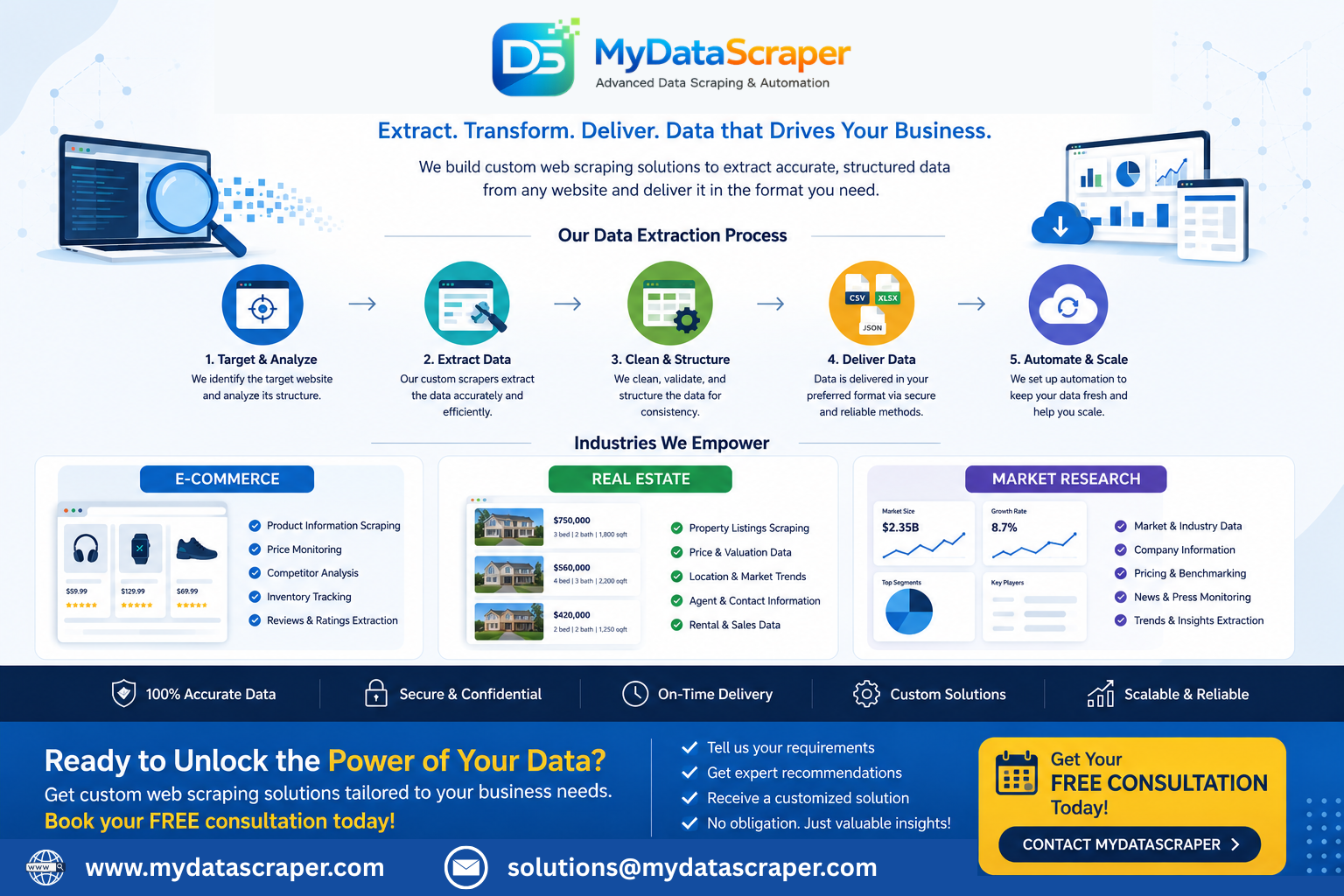
Ready to build your MAP monitoring advantage for 2026? Contact MyDataScraper for a free consultation — or visit mydatascraper.com to explore all our brand protection intelligence services.

Written by the MyDataScraper Team
MyDataScraper is a leading provider of custom web scraping and data extraction solutions for MAP monitoring, reseller pricing enforcement, and brand protection. We help consumer brands, manufacturers, and sales teams protect margins, enforce pricing policies, and maintain healthy retailer relationships in 2026. Learn more at mydatascraper.com or contact our team today for a free consultation.