Retail Price Integrity: The Complete Guide to Consistent Pricing, Channel Protection & Margin Preservation in 2026
In 2026, price integrity is the foundation of sustainable retail. When the same product sells for $49 on Amazon, $59 at Walmart, and $39 on a shady third‑party site, you don’t have a pricing strategy—you have a credibility crisis. 65% of consumers now check at least three channels before purchasing, and price discrepancies erode trust, fuel returns, and create arbitrage opportunities that cannibalise your own sales. Discover how automated retail price integrity monitoring gives brands the visibility to detect channel‑based pricing anomalies, eliminate unauthorised discounting, and protect margins across every sales touchpoint.
- Why Retail Price Integrity Is Non‑Negotiable in 2026
- What Is Retail Price Integrity?
- The True Cost of Price Erosion
- What Pricing Data Must Be Monitored?
- Who Benefits from Price Integrity Monitoring?
- Common Causes of Channel‑Based Price Inconsistencies
- How Price Integrity Monitoring Works
- Building a Price Integrity Program That Works
- Overcoming the Challenges of Multi‑Channel Pricing
- Case Study: How a Sporting Goods Brand Restored Channel Parity and Boosted Margins by 16%
- How MyDataScraper Delivers Price Integrity Excellence
- Compliance & Legal Considerations
- Frequently Asked Questions
- Conclusion
Why Retail Price Integrity Is Non‑Negotiable in 2026
Price integrity is the consistency of a product's price across all sales channels and geographies, in both advertised and transactional forms. In a world where consumers can instantly compare prices across dozens of retailers, price consistency is the bedrock of brand trust. When a customer finds your premium product at a 20% discount on a random marketplace, they don't blame the reseller—they question the value of your brand.
In 2026, the problem has reached crisis proportions. Over $500 billion in brand value is eroded annually due to price inconsistencies, unauthorized discounting, and channel conflict. The rise of automated repricing, cross‑border arbitrage, and gray‑market sellers has made it nearly impossible for brands to maintain price integrity without systematic monitoring and enforcement.
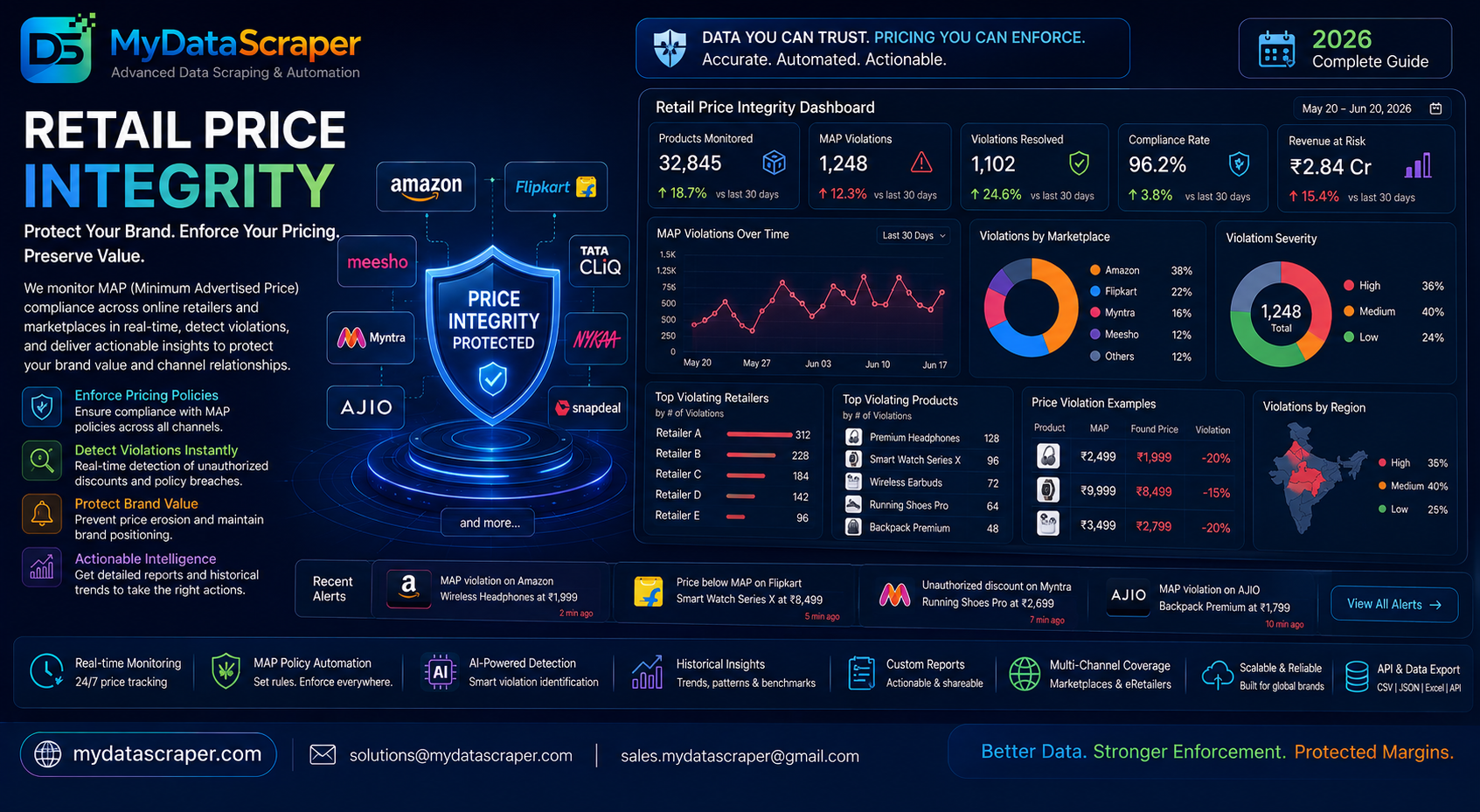
Retail price integrity monitoring is the automated process of tracking product prices across all authorized and unauthorized channels—including online marketplaces, retailer websites, physical stores, and international sites—to detect anomalies, identify root causes, and restore consistency. At MyDataScraper, we build custom price monitoring solutions that give brands full visibility into their pricing ecosystem and the tools to enforce consistency.
Price Integrity = Brand Integrity: When prices are consistent, customers perceive your brand as trustworthy and reliable. When they're not, you lose credibility—and sales. Our dynamic pricing intelligence helps you maintain the right balance between competitive flexibility and channel consistency.
What Is Retail Price Integrity?
Retail price integrity is the state in which a product's price remains consistent—within defined tolerances— across all channels, regions, and retailers, for both advertised and final transaction prices. It's not about having a single global price (regional differences are expected), but about ensuring that discrepancies are explainable and intentional, not random, exploitable, or damaging to the brand.
Price integrity is broader than MAP monitoring. While MAP focuses specifically on advertised prices below a floor, price integrity covers:
- Advertised price consistency across channels (what customers see on listing pages)
- Transactional price consistency (what customers actually pay at checkout, including discounts and fees)
- Geographic price consistency (ensuring regional differences are justified, not arbitrary)
- Channel price consistency (avoiding channel cannibalisation—e.g., Amazon undercutting your own website)
- Promotional price integrity (ensuring flash sales and discounts are applied consistently and don't create long‑term price expectations)
The goal isn't to eliminate all price variation—it's to ensure that variation is intentional, defensible, and consistent with your brand strategy. When a customer sees different prices for the same product, they should understand why (e.g., regional pricing, channel partner agreements) rather than feeling cheated.
Price Integrity vs. MAP: MAP is a subset of price integrity. MAP prevents advertised prices below a floor; price integrity monitors all price discrepancies across all channels, both advertised and transactional, to protect the brand's overall pricing architecture.
The True Cost of Price Erosion
Price erosion isn't just about losing a few dollars on a single transaction. It's a systemic problem with compounding effects:
📉 Margin Erosion
When prices drop across channels, margins compress. A 5% average price decline across your portfolio can wipe out 25–40% of net profit for many consumer goods companies.
🏷️ Brand Perception Damage
Consumers equate price with quality. When your product is consistently available at lower prices, it signals lower quality. This perception shift takes months to reverse and often requires costly advertising and promotion to rebuild.
🤝 Channel Partner Conflict
Authorised retailers who follow your pricing policies lose sales to those who don't. They become angry, demanding concessions, threatening to reduce orders, or even dropping your brand. Channel conflict consumes valuable sales team time and damages long‑term partnerships.
🛒 Customer Confusion & Returns
When customers see a product at a lower price on another channel after purchasing, they often return the product, ask for a price match, or simply lose trust. This increases return rates and customer service costs.
🔄 Unauthorised Reseller Exploitation
Price discrepancies create arbitrage opportunities. Unauthorised sellers buy products from low‑price channels and resell them on other platforms, undercutting authorised partners and destabilising the entire market.
“In 2026, price integrity is not a 'nice‑to‑have'—it's a financial imperative. Brands that systematically monitor and enforce price consistency see 16–25% higher margins and significantly stronger retailer relationships. The cost of inaction is now visible on the P&L.” — Retail Pricing Intelligence Report, 2026
What Pricing Data Must Be Monitored for Price Integrity?
🏷️ Core Price Metrics
- Advertised price on product listing pages
- Checkout price (including taxes and fees)
- Shipping costs and total delivered price
- Discounts and promotional pricing (coupons, flash sales)
- Bulk/volume pricing and bundle deals
- Subscription pricing and recurring discounts
- Currency and region‑specific pricing
🛒 Channel Coverage
- Online marketplaces (Amazon, Walmart, eBay, Etsy)
- Retailer websites (Target, Best Buy, Home Depot, etc.)
- Brand DTC websites (Shopify, Magento, etc.)
- Physical store pricing (where available)
- International and regional sites
- Google Shopping and paid ad listings
- Social commerce platforms
📊 Discrepancy & Anomaly Intelligence
- Price gap analysis between channels for same SKU
- Historical price consistency scores
- Anomaly detection (unexpected price drops or spikes)
- Root‑cause categorisation (unauthorised seller, human error, repricing tool, etc.)
- Impact scoring (revenue and margin impact per discrepancy)
🔍 Seller & Channel Metadata
- Authorised vs unauthorised seller identification
- Channel type (marketplace, retailer, direct)
- Seller location and region
- Reseller tier and agreement status
- Sales volume and rank (where available)
At MyDataScraper, we extract exactly the price integrity data your brand needs— delivered in CSV, JSON, or Excel, or as continuous data feeds through our live scraping APIs.
Who Benefits from Retail Price Integrity Monitoring?
🏷️ Consumer Brands & Manufacturers
Brands use price integrity monitoring to maintain consistent pricing across all channels, protect margins, and prevent unauthorized discounting. Combined with our competitive price monitoring, this ensures a unified brand pricing strategy.
🏪 Sales & Channel Management Teams
Sales leaders use price integrity data to resolve channel conflicts, negotiate with partners, and demonstrate that they're protecting their retailers' interests—building trust and loyalty.
⚖️ Legal & Brand Protection Teams
Legal teams use price integrity monitoring to document unauthorized discounting, enforce distribution agreements, and address grey‑market activity.
📊 Pricing & Revenue Management Teams
Pricing teams use integrity data to understand where and why prices are diverging, adjust pricing strategies, and measure the effectiveness of enforcement actions.
🔍 Retail Analytics & Market Intelligence
Analytics teams use price integrity monitoring to benchmark channel performance, identify high‑risk sellers, and quantify the financial impact of price erosion.
📈 Investor & Private Equity Firms
Investors increasingly evaluate portfolio companies on price integrity as a proxy for brand health and channel management maturity. Strong price integrity signals a well‑managed brand.
Common Causes of Channel‑Based Price Inconsistencies
Understanding why price discrepancies occur is the first step to fixing them:
⚠️ Human Error & System Mistakes
A mis‑entered price in a retailer's system, a missed update after a promotion ends, or a misapplied discount—these are common operational errors that create price anomalies.
Solution: Automated monitoring detects errors immediately, enabling quick correction before they spread.
🤖 Automated Repricing Tools
Repricing software automatically adjusts prices based on competitor moves. Without floor limits, these tools can drive prices below acceptable thresholds, creating channel inconsistencies.
Solution: Monitor repricing patterns and work with retailers to set appropriate floors.
🛒 Unauthorised Sellers & Gray Market
Unauthorised sellers, often operating on marketplaces, have no incentive to follow your pricing policies. They undercut to gain sales velocity, creating significant price gaps.
Solution: Continuous seller identification and enforcement, including takedown requests and legal action where necessary.
🌐 Regional & Currency Discrepancies
Pricing differences across regions (e.g., US vs EU) can create arbitrage opportunities when international buyers purchase from the lower‑priced region and resell in higher‑priced regions.
Solution: Multi‑region monitoring with geo‑targeted price checks and currency normalisation.
📦 Bundling & Variation Mismatches
When products are sold in bundles or with variations (size, colour, style), price comparisons can be misleading. A bundle price may appear lower than the individual product price, creating a perceived violation.
Solution: Sophisticated SKU matching that accounts for bundles and variations, with clear comparison logic.
🔄 Promotional Timing & Co‑op Conflict
When one retailer runs a promotion that others don't, the resulting price disparity can lead to complaints and competitive pressure.
Solution: Monitor promotional activity and provide visibility to all partners to align promotional timing.
Detection Is the First Step to Resolution: You can't fix what you can't see. Our monitoring uncovers the root cause of every discrepancy—whether it's a simple error, a repricing mistake, or an intentional violation— so you can take the right action.
How Retail Price Integrity Monitoring Works
A robust price integrity program follows a structured process: Data Collection → SKU Matching → Price Gap Detection → Root Cause Analysis → Alerts & Reporting.
Step 1: 🌐 Multi‑Channel Data Collection
Automated scraping technology continuously collects product pricing, promotions, and seller information from all your sales channels—online marketplaces, retailer websites, your own DTC site, and international sites.
Step 2: 🔗 Cross‑Channel SKU Matching
Products are identified across channels using UPC/GTIN/EAN/MPN, with fuzzy matching for catalog discrepancies. This ensures that you're comparing the exact same product across channels.
Step 3: 📊 Price Gap Analysis
The system calculates the price difference for each SKU across channels, identifying anomalies where prices diverge beyond defined tolerance thresholds.
Step 4: 🧠 Root Cause Categorisation
Each discrepancy is classified by likely cause: unauthorised seller, human error, repricing tool, promotional timing, or regional variation. This enables targeted resolution.
Step 5: ⚡ Alerts & Reporting
Violations and anomalies trigger alerts to the appropriate teams (sales, legal, pricing) with full evidence packages (screenshots, timestamps, pricing history). Comprehensive dashboards track integrity scores over time.
From Raw Data to Actionable Intelligence: Our platform doesn't just deliver raw prices—we provide structured intelligence that tells you exactly where, why, and how prices are diverging, so you can respond quickly and effectively.
Building a Price Integrity Program That Works
1. Define Your Price Integrity Policy
Start with a written policy that clearly states:
- Your approach to pricing (e.g., uniform pricing vs regional flexibility)
- Acceptable price variation thresholds (e.g., ±5% across channels)
- Who is responsible for price integrity (sales, marketing, or a dedicated team)
- Consequences for violations (for both internal teams and resellers)
2. Establish a Single Source of Truth
Use a central repository (like a product information management system) for all SKU‑level pricing data. All channels should reference the same base data to prevent discrepancies at the source.
3. Automate Monitoring, Don't Rely on Manual Checks
Manual price checks are slow, inconsistent, and fail to catch anomalies in time. Invest in automated monitoring that scans all channels daily or even sub‑daily.
4. Implement a Tiered Enforcement System
Use a graduated response:
- Level 1: Notification and request for correction (with evidence)
- Level 2: Escalation to channel manager or legal
- Level 3: Supply restrictions or termination of partnership
Consistency in enforcement builds credibility.
5. Communicate Proactively with Partners
Share your price integrity policy with all authorised resellers. Explain why price consistency matters to the brand and to their own profitability. Offer to share your monitoring data to help them stay compliant.
6. Monitor Not Just Prices, But Promotions
Promotional discounts are a primary source of price erosion. Track when and how promotions are applied to ensure they don't create long‑term price expectations that damage integrity.
Proactive vs. Reactive: The best price integrity programs are proactive—they use data to anticipate risks (e.g., identifying high‑risk resellers before they violate) rather than just reacting to violations after they've damaged the market.
Overcoming the Challenges of Multi‑Channel Pricing
Maintaining price integrity across dozens of channels is inherently complex. Here are the major challenges and how to address them:
🔗 SKU Matching Across Disparate Catalogs
Different retailers use different product names, variations, and identifiers. Without robust matching, you may miss discrepancies or generate false alerts.
Solution: Use a combination of GTIN/UPC/MPN matching with fuzzy name matching and manual quality assurance for edge cases.
🌍 Geographic Pricing Variations
Prices often vary by region due to taxes, logistics, and local market conditions. Deciding what constitutes a legitimate variation vs. a violation requires clear policies and regional visibility.
Solution: Set regional price bands and monitor within those bands. Investigate any prices that fall outside the band.
🤖 Automated Repricers and Flash Sales
Repricing tools and flash sales can create temporary price drops that violate policies. Distinguishing between legitimate promotions and unauthorised discounting is essential.
Solution: Monitor promotional calendars and flag short‑term drops that don't match your own promotional plan.
🛒 Unauthorised Seller Detection
Identifying which sellers are unauthorised is the first step to enforcement. Many brands rely on manual lists, which are quickly outdated.
Solution: Maintain a dynamic authorised seller database and automatically cross‑reference every seller against it.
📊 Data Volume and Actionability
Collecting millions of price points is useless without turning them into actionable alerts. Teams need to know which discrepancies require immediate action and which are acceptable variations.
Solution: Implement alert prioritisation based on severity (e.g., price below cost vs. minor promotional variation) and assign ownership to the right team.
The Cost of Ignoring These Challenges: Without addressing these complexity factors, price integrity programs fail. The result: continued margin erosion, channel conflict, and brand damage. Our expertise in multi‑channel data normalisation and anomaly detection ensures you overcome these hurdles.
Case Study: How a Sporting Goods Brand Restored Channel Parity and Boosted Margins by 16%
A global sporting goods brand with 2,500+ SKUs sold across Amazon, Dick's Sporting Goods, REI, and 500+ authorised retailers was bleeding margin. Price discrepancies across channels were rampant—the same high‑performance running shoe could vary by as much as 25% between channels. Unauthorised sellers on Amazon and eBay were undercutting authorised partners, causing channel conflict and eroding trust.
In early 2026, they partnered with MyDataScraper to build a comprehensive price integrity program:
What Was Built
- Daily price scanning across Amazon, Walmart, eBay, Dick's, REI, and 200+ other retailer websites
- Cross‑channel SKU matching using UPC/GTIN with fuzzy name matching for catalog discrepancies
- Automated price gap detection with severity scoring (warning, moderate, severe)
- Unauthorised seller detection and automated alerts
- Real‑time Slack alerts for severe discrepancies (≥15% price gap)
- Weekly price integrity dashboards showing channel consistency scores and margin impact
- Integrated enforcement workflow for sales and legal teams
Results After 12 Months (Entering Q3 2026)
Price discrepancies reduced by 73% across the portfolio. Unauthorised seller listings decreased by 58% through systematic detection and enforcement. Average selling price across key SKUs increased 8.6% as price erosion was contained. Gross margins improved by 16 percentage points across the highest‑volume categories. Authorised retailer satisfaction increased significantly as partners saw consistent enforcement and reduced channel conflict.
The most transformative insight came from the root‑cause analysis: 42% of all price discrepancies originated from just three unauthorised sellers who were sourcing through a secondary distributor. By cutting off that supply chain, they eliminated the majority of discrepancies without affecting any authorised partners.
Contact MyDataScraper today to build your retail price integrity program for 2026.
How MyDataScraper Delivers Retail Price Integrity Excellence
At MyDataScraper, retail price integrity is one of our core brand protection services—used by consumer brands, manufacturers, and sales teams worldwide. Here's what makes our approach unique in 2026:
🛒 Multi‑Channel Coverage at Scale
We monitor pricing across 200+ online channels—including Amazon, Walmart, eBay, Target, Best Buy, and hundreds of regional and category‑specific retailers—giving you complete visibility into your pricing ecosystem.
🔗 Advanced Cross‑Channel SKU Matching
We handle the complexity of matching SKUs across disparate retailer catalogs using GTIN/UPC/MPN with fuzzy matching, ensuring you never miss a discrepancy due to catalog differences.
⚡ Real‑Time Anomaly Detection
Our system detects price gaps and unauthorised seller activity as they happen, with alerts delivered via email, Slack, or API. Speed of detection directly impacts the cost of resolution.
📸 Automated Evidence Capture
Every violation is automatically documented with time‑stamped screenshots and page data, providing the indisputable proof needed for enforcement.
📊 Actionable Intelligence, Not Just Raw Data
We provide root‑cause categorisation, severity scoring, and margin impact analysis—turning raw price data into strategic intelligence that drives decision‑making.
🔄 Flexible Delivery & Integration
Price integrity data is delivered in CSV, JSON, or Excel—or via live scraping APIs, integrated with your sales, legal, and analytics workflows.
Compliance & Legal Considerations for Price Integrity Monitoring
✅ Compliant Practices We Follow
- Collect only publicly displayed pricing data—never customer personal data or account information
- Respect platform terms of service with responsible rate limiting
- Use data for legitimate brand protection and channel management—never for price‑fixing with competitors
- Treat price integrity as a unilateral policy, not a mutual agreement with resellers
- Comply with GDPR, CCPA, and applicable global data protection regulations
- Maintain data security and anonymised reporting where appropriate
⚖️ Legal Framework: MAP, MSRP, and RPM
- MAP controls advertised prices—generally legal in the US as a unilateral policy
- MSRP is a suggestion, not a constraint
- Resale Price Maintenance (RPM) controls actual selling prices—illegal in many jurisdictions
- International variations: The EU treats advertised price restrictions far more strictly, often prohibiting them outright
❌ Practices We Strictly Avoid
- Accessing customer accounts, order histories, or personal data
- Using price integrity data for coordinated price‑fixing with other brands or competitors
- Sending request volumes that could degrade platform performance
- Bypassing authentication or CAPTCHA aggressively
- Republishing scraped content as original intellectual property
2026 Legal Context: Price integrity monitoring sits at the intersection of brand protection, competition law, and data privacy. Jurisdictions including the US, EU, UK, and others have specific regulations. MyDataScraper builds compliance into every project and recommends specialised legal counsel for cross‑border enforcement programs.
Frequently Asked Questions
What is the difference between price integrity and MAP monitoring?
MAP monitoring focuses specifically on advertised prices below a minimum threshold. Price integrity is broader: it monitors all price discrepancies across all channels, both advertised and transactional, to ensure overall consistency and protect the brand's pricing architecture.
How often should we monitor prices for integrity?
At a minimum, daily monitoring is essential because prices change rapidly. In high‑velocity categories, sub‑daily monitoring (every few hours) is recommended to catch discrepancies before they cascade.
Can price integrity monitoring detect unauthorised sellers?
Yes—a key capability is identifying sellers that are not on your authorised list. By cross‑referencing every seller against your database, you can detect unauthorised activity and take targeted enforcement action.
What are the acceptable price variations across channels?
This depends on your brand strategy. Some brands aim for complete parity (±0%), while others allow 5–10% variation to account for channel differences. The key is to define your tolerance upfront and monitor against it consistently.
How do you handle price discrepancies caused by promotions?
We track promotional activity separately and can flag when a price drop is promotional (and therefore temporary) vs. a permanent pricing change. This distinction is critical for effective enforcement.
What format is price integrity data delivered in?
We deliver in CSV, JSON, or Excel—and can integrate with your sales, legal, and analytics systems via API‑based data delivery.
How quickly can a price integrity program launch in 2026?
Standard projects are built and delivering data within 7 to 12 business days of kick‑off. Complex multi‑channel, multi‑SKU programs typically take 10–15 days. Contact our team today for a specific timeline.
In 2026, Price Integrity Is the Foundation of Brand Trust—Are You Protecting It?
Price integrity is more than a pricing policy—it's a commitment to your customers, your partners, and your brand's long‑term value. When prices are consistent across channels, customers trust your brand, partners feel protected, and margins remain healthy. When they're not, you face erosion, conflict, and a steady decline in brand equity.
At MyDataScraper, we build custom retail price integrity solutions that give you complete visibility into your pricing ecosystem— multi‑channel monitoring, cross‑SKU matching, real‑time anomaly detection, and enforcement workflows—delivered in CSV, JSON, or Excel, integrated into your sales and brand protection systems.
Explore our related pricing intelligence services: competitor price monitoring, dynamic pricing intelligence, ecommerce data scraping, and API‑based data delivery. The price integrity that could protect your 2026 margins is waiting to be extracted.
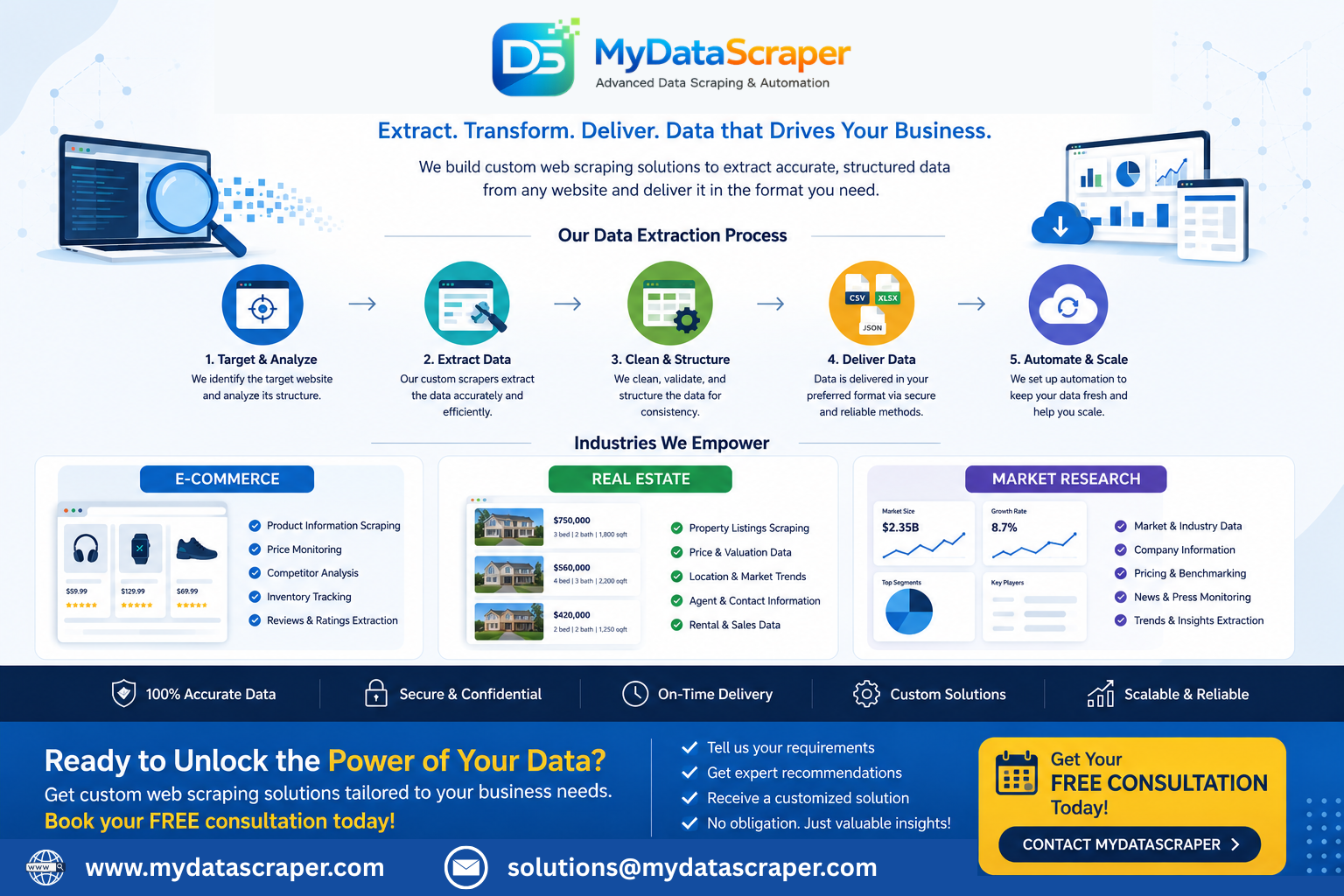
Ready to build your price integrity advantage for 2026? Contact MyDataScraper for a free consultation — or visit mydatascraper.com to explore all our brand protection intelligence services.

Written by the MyDataScraper Team
MyDataScraper is a leading provider of custom web scraping and data extraction solutions for retail price integrity, channel pricing consistency, and brand protection. We help consumer brands, manufacturers, and sales teams maintain consistent pricing, protect margins, and build trust with channel partners in 2026. Learn more at mydatascraper.com or contact our team today for a free consultation.