Walmart Product Data Scraping: The Complete Guide to Extracting Prices, Product Data & Marketplace Intelligence from Walmart in 2025
With over 420 million products, 150,000+ marketplace sellers, and the most influential pricing strategy in American retail, Walmart generates some of the most commercially valuable publicly available product data in e-commerce. Discover how automated Walmart data extraction gives sellers, brands, and analysts the real-time marketplace intelligence to compete effectively — on Walmart and across the entire US retail landscape.
- Why Walmart Data Is Essential for E-Commerce Success
- What Is Walmart Product Data Scraping?
- Walmart Intelligence in Action
- What Walmart Data Can Be Extracted?
- Why Walmart Intelligence Matters in 2026
- Use Cases for Every Business Type
- Manual vs Automated Walmart Monitoring
- The Walmart Data Extraction Process
- Case Study: Brand Grows Walmart Revenue 44%
- How MyDataScraper Delivers Walmart Intelligence
- Ethical & Legal Considerations
- Frequently Asked Questions
- Conclusion
Why Walmart Data Is Essential for E-Commerce Success in 2026
Walmart is no longer just the world's largest brick-and-mortar retailer — it has rapidly become America's second-largest online marketplace, and a formidable global e-commerce competitor to Amazon. With over 420 million products listed on Walmart.com, a rapidly growing third-party marketplace surpassing 150,000 active sellers, and a unique omnichannel model that bridges online and in-store commerce, Walmart generates some of the most commercially valuable publicly available product data in the retail industry.
For any brand, seller, or analyst operating in the US e-commerce landscape, ignoring Walmart's data ecosystem means ignoring the purchasing behavior and pricing dynamics affecting over 150 million weekly Walmart customers across online and physical channels. Walmart's Everyday Low Price philosophy creates a pricing floor that influences the entire retail market — and understanding how Walmart prices products, how marketplace sellers compete, and how consumer demand signals play out on the platform is essential intelligence for any competitive e-commerce strategy.
Walmart product data scraping makes this intelligence systematically accessible. Automated extraction of product listings, pricing data, Rollback deals, seller information, reviews, and category trends from Walmart.com gives every e-commerce business the real-time market visibility needed to compete effectively — not just on Walmart's platform, but across the entire US retail landscape. At MyDataScraper, we build custom Walmart data extraction solutions that deliver this intelligence in CSV, JSON, or Excel, integrated into your pricing and strategy workflows.
The Walmart Intelligence Advantage: Walmart's pricing — particularly its Everyday Low Price strategy, Rollback promotions, and Walmart+ member pricing — sets the market reference point for consumer price expectations across the entire US retail market. Any business competing in US e-commerce without monitoring Walmart pricing is competing without understanding the price floor that consumers expect. Walmart price monitoring through web scraping gives you this foundational intelligence automatically.
In this comprehensive guide, we'll cover everything you need to know about extracting product data from Walmart — what's available, who benefits most, how the process works, and how MyDataScraper builds custom solutions that turn Walmart's enormous publicly available data ecosystem into your competitive advantage.
What Is Walmart Product Data Scraping?
Walmart product data scraping is the automated collection of publicly available product data from Walmart.com — including product listings, current and historical prices, Rollback pricing, clearance deals, Walmart+ member pricing, third-party marketplace seller data, customer reviews and ratings, product specifications, category structures, availability status, and promotional information.
Instead of manually browsing Walmart.com, copying prices into spreadsheets, and periodically spot-checking competitor listings — a process that is slow, error-prone, and covers only a tiny fraction of Walmart's 420+ million listings — automated Walmart scraping builds a continuous intelligence pipeline that monitors your entire competitive landscape on the platform.
What makes Walmart data particularly valuable and distinct from Amazon data:
- Omnichannel pricing intelligence — online prices, in-store pickup pricing, and ship-to-home pricing can differ, creating unique data points
- Rollback & Everyday Low Price tracking — Walmart's promotional structures are distinct from Amazon's Lightning Deals
- Walmart+ pricing signals — member-only pricing creates a pricing layer that increasingly affects competitive dynamics
- Marketplace vs 1P dynamics — Walmart's own first-party retail listings compete directly with third-party sellers, creating different competitive dynamics than Amazon
- Cross-channel comparison — comparing Walmart vs Amazon vs Target pricing for the same products reveals market positioning
- Physical store influence — Walmart's pricing online is influenced by its 4,700+ US physical stores in a way no pure-play e-commerce marketplace replicates
Walmart's Unique Position: Unlike Amazon, which is a pure-play online marketplace, Walmart operates as an omnichannel retailer — meaning its online pricing strategy is influenced by, and in turn influences, its 4,700+ physical store network. This creates pricing data that reflects real-world retail dynamics in a way no other online platform offers. For brands and retailers competing across both online and physical channels, Walmart data provides intelligence that Amazon data simply cannot replicate.
Walmart Intelligence in Action: What Your Dashboard Looks Like
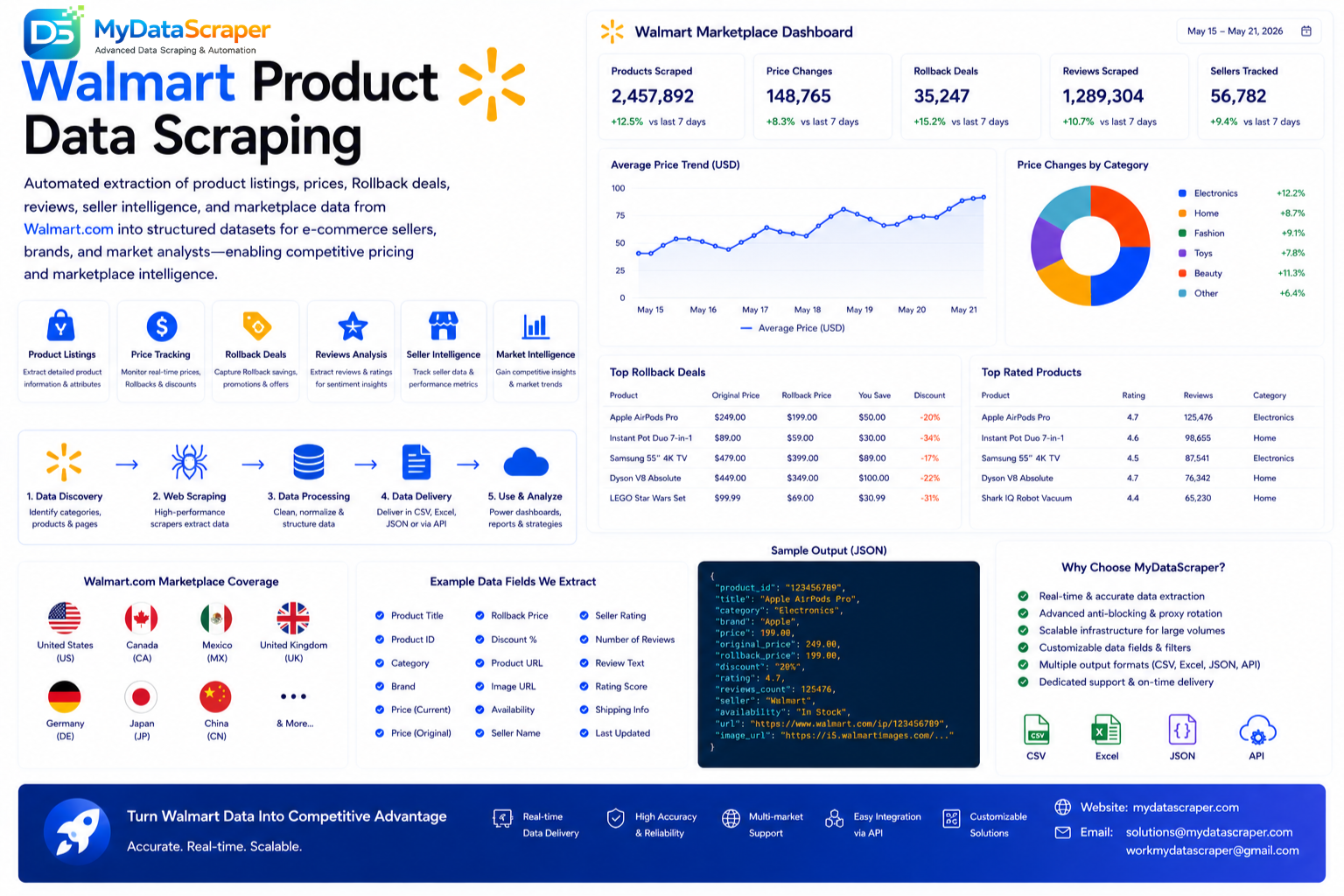
Here's a real-world example of the kind of structured Walmart product intelligence that automated extraction delivers. This is the data MyDataScraper provides to brands, sellers, and analysts — automatically, every day:
📊 Sample Walmart Product Intelligence Report
Consider tracking a category like "Wireless Earbuds" across Walmart.com. An automated Walmart scraping pipeline delivers:
- Product details: Full product title, Walmart Item ID, UPC/GTIN, brand, specifications, image URLs, and category path for every competing listing
- Pricing intelligence: Current price ($29.97), was-price ($39.99), Rollback flag (active), Walmart+ member price ($26.97), shipping cost ($0 — free delivery), and price-per-unit calculation
- Seller data: Sold by "Walmart.com" (first-party) vs "ElectroDirect LLC" (marketplace seller), fulfillment method (Walmart Fulfillment Services vs seller-shipped), and seller rating
- Demand signals: Review count (3,847), average rating (4.5 stars), "Popular Pick" badge, "Best Seller" designation, and stock availability status
- Competitive context: Same product on Amazon ($34.99), Target ($32.99), Best Buy ($36.99) — Walmart is the price leader at $29.97
This level of structured competitive intelligence — across your entire product catalog, updated daily — transforms how you compete on Walmart and across the broader US retail landscape. Every pricing decision is informed by real market data, not assumptions.
What Walmart Data Can Be Extracted?
Walmart.com publicly displays rich product data across every listing, category, and seller profile. Here's the comprehensive breakdown of extractable data categories:
💰 Pricing & Promotions
- Current listing price
- Was-price (original / strikethrough price)
- Rollback pricing & duration
- Clearance pricing & markdowns
- Walmart+ member pricing tier
- Price per unit / per ounce calculations
- Bundle deal pricing
- Flash Deals & limited-time offers
- Historical price tracking over time
📦 Product Details
- Product title & full description
- Walmart Item ID & UPC/GTIN
- Brand & manufacturer information
- Product specifications table
- Product images (all angles)
- Product dimensions, weight, materials
- Category & subcategory taxonomy path
- Product variants (size, color, configuration)
- Rich media content detection (videos, 360° views)
⭐ Reviews & Ratings
- Overall star rating
- Total review count
- Star distribution (1-5 breakdown)
- Individual review text
- Verified purchase indicator
- Review date and reviewer location
- Helpful vote count per review
- Seller response data
- Photo/video reviews
🏪 Seller & Fulfillment Intelligence
- Sold by Walmart.com (1P) vs marketplace seller (3P)
- Marketplace seller name, ID, and rating
- Walmart Fulfillment Services (WFS) vs seller-fulfilled
- Shipping speed and cost (free delivery thresholds)
- Return policy details by seller
- Seller product count and category presence
- Pro Seller badge status
📊 Demand & Visibility Signals
- Best Seller designation
- Popular Pick badge
- In-stock / out-of-stock / limited availability
- Pickup availability (store-level)
- Delivery date estimates
- Category page ranking position
- Search result position for target keywords
- Sponsored listing indicators
At MyDataScraper, we extract exactly the Walmart data fields your business strategy requires — delivered clean, structured, and analysis-ready in CSV, JSON, or Excel on your preferred schedule.
Why Walmart Intelligence Matters More Than Ever in 2026
Walmart Marketplace Is the Fastest-Growing E-Commerce Channel in the US
Walmart's third-party marketplace has grown from 10,000 sellers in 2020 to over 150,000 active sellers in 2026 — a 15x increase in just five years. With Walmart aggressively courting Amazon sellers to cross-list on its platform, and investing billions in fulfillment infrastructure (Walmart Fulfillment Services), the marketplace is rapidly becoming the most important second channel for any US e-commerce seller. Monitoring Walmart marketplace pricing and seller dynamics is no longer optional — it's a core competitive requirement.
Walmart's EDLP Philosophy Sets the Market Price Floor
Walmart's Everyday Low Price commitment isn't just a tagline — it's an algorithm-driven pricing strategy that ensures Walmart is price-competitive on millions of products at all times. When Walmart drops a price, consumers notice, competitors respond, and market-wide price expectations shift. Without real-time Walmart price monitoring, you're always reacting to a market floor that moved while you weren't watching.
Walmart Connect Advertising Demands Better Data
Walmart's advertising platform (Walmart Connect) has grown into a $3.4 billion business — and sellers running Walmart ads need the same quality of competitive intelligence (keyword positioning, competitor pricing, and content optimization data) that Amazon advertisers expect. Walmart competitor tracking data directly informs advertising strategy, bid optimization, and ROAS improvement on the platform.
Cross-Platform Price Consistency Is Now a Consumer Expectation
Modern consumers compare Walmart, Amazon, and Target prices before every significant purchase — and expect consistency from brands selling across all three platforms. Brands that don't monitor their own pricing and competitor pricing across all major platforms risk price perception problems that damage conversion everywhere. Systematic cross-platform price monitoring starts with Walmart data.
"Walmart's marketplace is the single largest untapped competitive intelligence opportunity for US e-commerce sellers in 2026. It has the scale of Amazon, the pricing influence of the world's largest retailer, and — critically — far fewer sellers are systematically monitoring it. The data advantage for early movers is significant and growing." — US E-Commerce Marketplace Intelligence, 2026
Use Cases: Who Benefits from Walmart Data Scraping?
💰 Competitive Price Monitoring for Walmart Marketplace Sellers
Monitor competitor prices across your entire Walmart product catalog in real time. Know the moment a competitor drops their price, wins the Buy Box equivalent, or launches a Rollback promotion — and respond before you lose sales volume. This single use case delivers immediate, measurable ROI for any serious Walmart seller.
📦 Product Catalog Management & Content Intelligence
Extract product titles, descriptions, specifications, images, and category data from Walmart to populate and optimize your own product catalog. Understand how top-performing competitors structure their listing content — what keywords they use in titles, how they organize bullet points, and what specification fields drive higher conversion rates on Walmart's search algorithm.
⚖️ MAP & Reseller Compliance Monitoring for Brands
Brands and manufacturers monitor Walmart.com to ensure authorized resellers maintain Minimum Advertised Prices, detect unauthorized third-party sellers offering grey market or counterfeit products, and verify that their products are listed with correct brand content, images, and specifications across all Walmart selling partners.
⭐ Review Mining for Product Development & Positioning
Extract customer reviews from Walmart for your own products and competitors to understand what consumers value, what common complaints reveal about product weaknesses you can exploit, and how Walmart's consumer base — which skews differently from Amazon's — perceives products in your category. Walmart review sentiment often reveals insights not visible in Amazon reviews due to the different demographic profiles.
📈 Rollback & Promotion Intelligence
Track Walmart Rollback promotions, clearance pricing, and limited-time deals across your competitive categories — understanding the frequency, depth, and timing of Walmart's promotional pricing cycles. This intelligence informs your own promotional calendar and helps you anticipate competitive pricing pressure during Walmart's major sale events.
🌍 Cross-Platform Price Comparison (Walmart vs Amazon vs Target)
Build unified pricing intelligence datasets that compare the same products across Walmart, Amazon, Target, and other major US retailers — identifying where you're price-competitive, where competitors are undercutting you, and where pricing gaps create opportunities for margin optimization or market share capture. MyDataScraper builds multi-platform extraction pipelines that deliver all of this in a single unified dataset.
🏪 Walmart 1P vs 3P Competitive Dynamics
Understanding when Walmart's own first-party retail listings compete with your third-party marketplace listings — and how Walmart prices its own inventory versus marketplace sellers — is critical for any Walmart marketplace strategy. Automated scraping reveals exactly where Walmart's 1P pricing creates headwinds for 3P sellers and where 3P sellers can win on selection, speed, or value.
🔍 New Product Research & Market Entry Analysis
Before launching a new product on Walmart marketplace, extract comprehensive competitive data — pricing ranges, review thresholds needed to compete, seller competition intensity, and promotional requirements for category visibility — to set realistic launch strategies backed by current market evidence rather than assumptions.
Manual vs Automated Walmart Monitoring
Let's be direct about the comparison between manual Walmart monitoring and automated extraction:
- Manual monitoring: Covers 50-100 products per week, data is 24-48 hours old by the time it's compiled, misses Rollback promotions and price changes between checks, and requires significant analyst time that could be spent on strategy instead of data collection.
- Automated Walmart scraping: Covers 10,000+ products per day, delivers hourly or real-time price updates, captures every Rollback and promotional change, detects new marketplace sellers within hours of listing, and frees your team to focus entirely on analysis and action.
The cost difference is equally stark. A typical manual monitoring operation costs $4,000-7,000 per month in analyst time and tools while covering a fraction of the product landscape. An automated MyDataScraper solution costs a fraction of that while covering your entire competitive universe comprehensively, accurately, and continuously.
The Math: Automated Walmart data extraction typically delivers 10-20x more coverage at 40-60% lower cost compared to manual monitoring — while simultaneously improving data accuracy from sample-based estimates to complete dataset intelligence. For any serious Walmart seller or brand, the ROI is immediate and substantial. Contact MyDataScraper for a custom quote based on your specific monitoring needs.
The Walmart Data Extraction Process: Step by Step
Here's exactly how MyDataScraper builds and operates a custom Walmart data extraction pipeline:
Step 1: 🎯 Product Universe & Intelligence Scope
We start by mapping your monitoring universe — specific Walmart Item IDs, product categories, competitor brands, keywords, or seller accounts you need to track. We define which data fields (pricing, reviews, seller data, all) and what update frequency your competitive strategy requires.
Step 2: 🔧 Custom Walmart Scraper Engineering
Our engineers build scrapers purpose-built for Walmart.com's architecture — handling JavaScript-rendered product pages, dynamic pricing displays, Rollback and clearance badge parsing, marketplace seller carousel extraction, variant-level pricing, and Walmart's anti-bot countermeasures. Every scraper is custom-built for reliability and completeness.
Step 3: ⏱️ Monitoring Frequency & Alert Configuration
We configure monitoring frequency to match your competitive environment — hourly for high-velocity products and during Walmart sale events, daily for standard catalog monitoring. Real-time alerts are configured for Rollback launches, significant competitor price drops, stock depletion signals, and new marketplace seller entries on your key products.
Step 4: 🧹 Walmart-Specific Data Cleaning
Walmart data requires specialized cleaning — normalizing Rollback vs Everyday Low Price vs clearance pricing types, parsing Walmart+ member pricing tiers, distinguishing 1P (Walmart) vs 3P (marketplace seller) offers, standardizing product variant pricing, and deduplicating cross-referenced listings across Walmart.com and Walmart's app.
Step 5: 📦 Structured Data Delivery & Integration
Clean, structured Walmart data is delivered in CSV, JSON, or Excel — or integrated directly with your repricing software, ERP, e-commerce platform (Shopify, Magento, WooCommerce), Walmart Seller Center analytics supplements, or BI platform via automated pipeline at your required frequency.
Step 6: 📈 Historical Walmart Intelligence Database
From day one, we build a historical database of Walmart pricing, Rollback patterns, seller activity, and review trends — enabling seasonal pricing analysis, Walmart sale event preparation, year-over-year competitive benchmarking, and long-term Walmart marketplace strategy development.
Step 7: 🔄 Ongoing Maintenance & Adaptation
Walmart updates its platform frequently. Our team monitors your scrapers continuously and adapts them to any structural changes — ensuring uninterrupted data delivery through every Walmart platform update and sale season.
Case Study: How a Consumer Electronics Brand Grew Walmart Revenue by 44% Using Automated Price Intelligence
A mid-size consumer electronics brand selling 280 SKUs on Walmart Marketplace was struggling with declining conversion rates and increasing competition from both Walmart's own first-party listings and aggressive third-party sellers. Their marketing team checked competitor prices manually once per week — but consistently missed Rollback pricing that shifted competitive dynamics for days at a time.
The breaking point came during a Walmart Deals for Days event when a competitor ran an aggressive promotion on their overlapping product line for 72 hours. The brand's team didn't detect the pricing change until day three — by which point they had lost significant search ranking position and hundreds of sales they would have captured with a timely pricing response.
After partnering with MyDataScraper, we built a comprehensive Walmart intelligence solution:
What Was Built
- Full monitoring of all 280 SKUs across 15 competitor sellers and Walmart's own 1P listings — updated hourly during sale events and daily otherwise
- Rollback detection system — Slack alerts within 1 hour of any competitor launching a Rollback or clearance promotion on overlapping products
- Walmart vs Amazon cross-platform pricing comparison — daily report showing price positioning relative to both platforms for every SKU
- Review monitoring — weekly sentiment analysis on their products and top 5 competitors across key product categories
- Walmart 1P vs 3P tracking — flagging when Walmart's own retail team started competing directly on a product their 3P listing held
- Historical price database — enabling quarterly business review presentations with data-backed competitive positioning analysis
- Data delivered daily in Excel + real-time Slack alerts for Rollbacks and price drops exceeding 10%
Results After 12 Months
44% revenue growth on Walmart Marketplace within 12 months of implementation. 58% improvement in competitive price positioning — the percentage of time their prices were at or below the leading competitor. 3 hours average response time to competitor Rollback promotions — down from 5+ days with manual monitoring. $480K additional annual revenue directly attributable to data-driven Walmart pricing optimization.
The most impactful moment came during the next Walmart Deals for Days event — where, armed with real-time competitor Rollback alerts and historical promotion pattern data, the brand launched pre-planned counter-promotions within hours of competitor pricing moves, maintaining their search ranking position throughout the entire event and achieving their highest-ever Walmart sales week.
Contact MyDataScraper today to build your Walmart intelligence solution.
How MyDataScraper Delivers Walmart Intelligence That Drives Revenue
At MyDataScraper, we build Walmart data extraction solutions that understand the unique dynamics of Walmart's marketplace — not just the technical structure of the website, but the commercial patterns, Rollback cycles, 1P vs 3P dynamics, and omnichannel pricing behaviors specific to Walmart's ecosystem.
🏪 Walmart-Specific Domain Expertise
We understand Walmart's pricing architecture — Everyday Low Price floors, Rollback promotional structures, clearance markdown cadences, Walmart+ member pricing tiers, and the 1P vs 3P competitive dynamics that make Walmart fundamentally different from Amazon. This domain expertise is embedded in how we build, clean, and deliver Walmart data.
⚡ Rollback Speed — Where Walmart Revenue Is Won
Walmart Rollback promotions can launch and end within 48 hours — reshaping competitive dynamics faster than manual monitoring can detect. Our infrastructure delivers alerts within 1 hour of any Rollback launch on your competitive products, giving your pricing team the response time needed to compete during these critical promotional windows.
🔗 Cross-Platform Intelligence
We frequently build unified pipelines that combine Walmart, Amazon, Target, and other US retailer data into a single cross-platform competitive dataset — giving brands and sellers complete visibility into how their pricing positions across the entire US retail landscape, not just on Walmart in isolation.
📦 Seamless Integration
Walmart intelligence is delivered in CSV, JSON, or Excel — or integrated directly with your repricing software, Walmart Seller Center analytics, e-commerce platform, ERP, or BI platform via automated pipeline. Your team gets Walmart data exactly where they need it, in the format they already work with.
📊 Historical Intelligence for Strategic Planning
Beyond real-time monitoring, we build comprehensive historical databases that power Walmart seasonal strategy — Deals for Days preparation, holiday pricing planning, quarterly business reviews with data-backed competitive analysis, and year-over-year performance benchmarking across your entire Walmart catalog.
Ethical & Legal Considerations for Walmart Data Scraping
Responsible Walmart data extraction follows clear ethical and legal principles:
✅ Compliant Practices We Follow
- Collect only publicly displayed product and pricing data from Walmart.com
- Respect Walmart's terms of service and robots.txt guidelines
- Implement appropriate request rate limiting to avoid server impact
- Use data exclusively for legitimate competitive intelligence and market research
- Never collect Walmart customer personal data, order information, or account data
- Comply with applicable data privacy laws (CCPA for California residents)
- Maintain proper data security for all extracted Walmart information
- Use price intelligence as unilateral competitive analysis, never for price coordination
❌ Practices We Strictly Avoid
- Accessing Walmart Seller Center account data or private seller analytics
- Collecting buyer personal information or transaction records
- Using scraped data to coordinate pricing with competing sellers (antitrust risk)
- Bypassing Walmart's CAPTCHA or authentication systems aggressively
- Sending requests that overwhelm or disrupt Walmart.com performance
- Republishing scraped Walmart product content as original content
- Making fraudulent purchases to access pricing data behind authentication
Legal Context: Scraping publicly displayed product data from Walmart.com for legitimate competitive intelligence is consistent with general data access principles upheld across US jurisdictions. Walmart publicly displays product pricing, descriptions, reviews, and seller information specifically for consumer access — using this publicly visible data for competitive business analysis is widely practiced across the retail industry. MyDataScraper builds compliance into every Walmart project and recommends legal counsel for specific use cases.
Frequently Asked Questions
Can Walmart Rollback and promotional pricing be tracked automatically?
Yes — Rollback detection is one of our most requested Walmart intelligence capabilities. We monitor product pages for Rollback badges, clearance flags, and promotional pricing tags, delivering alerts within 1 hour of any competitor Rollback launch on your category products. This speed is critical because Rollback promotions on Walmart can shift category competitive dynamics dramatically and quickly.
Can Walmart data be combined with Amazon and Target data?
Absolutely — and this is one of our most powerful configurations. We frequently build multi-platform pipelines combining Walmart, Amazon, Target, Best Buy, and other US retailer data into a single unified dataset. This gives brands complete cross-platform competitive intelligence with unified pricing comparison, review sentiment analysis, and seller landscape visibility across the entire US retail ecosystem.
Can Walmart marketplace third-party seller data be extracted?
Yes. We extract complete marketplace seller data — seller name and ID, seller rating and review count, fulfillment method (WFS vs seller-fulfilled), product count, shipping speed, return policy, and Pro Seller badge status. This seller-level intelligence is critical for understanding who you're actually competing against on Walmart's marketplace.
What format is Walmart data delivered in?
We deliver Walmart data in CSV, JSON, or Excel — and can integrate directly with repricing software, ERP systems, e-commerce platforms (Shopify, Magento, WooCommerce, BigCommerce), Walmart Seller Center analytics, and BI platforms (Tableau, Power BI, Looker) via automated API delivery. Data arrives ready to use with zero manual processing required.
How many Walmart products can be monitored?
Our infrastructure scales to any volume — from monitoring a focused competitive set of 200 products to comprehensive category coverage of 50,000+ products. We've built Walmart pipelines monitoring hundreds of thousands of products daily for large retail operations. Scale is configured to match your business requirements and budget.
Can Walmart in-store vs online pricing differences be tracked?
We extract publicly available online pricing from Walmart.com including ship-to-home pricing, pickup pricing, and delivery pricing where displayed. In-store pricing that differs from online pricing is displayed on some product pages (via "Check nearby stores" features) and can be captured where publicly visible. Full in-store price scraping across physical locations is not within scope, but online pricing (which covers the vast majority of competitive intelligence needs) is comprehensively monitored.
How quickly can a Walmart scraping solution be launched?
Standard Walmart data extraction projects are built and delivering data within 5 to 8 business days of project kick-off. Focused projects with limited product scope can often launch faster. Complex multi-category, cross-platform projects with custom integrations typically take 7-12 days. Contact our team today for a specific timeline estimate based on your requirements.
On Walmart's Marketplace, the Brands with the Best Data Win the Shelf — Both Digital and Physical
Walmart is not just another marketplace to monitor — it is the pricing backbone of American retail. With the largest physical store network in the US, a rapidly growing third-party marketplace, and a pricing philosophy that sets consumer expectations across the entire market, Walmart's influence on e-commerce extends far beyond its own platform. Any brand, seller, or retailer competing in US e-commerce without systematic Walmart pricing and competitive intelligence is competing without understanding the single most influential force in American retail pricing.
Walmart product data scraping is the technology that makes this intelligence accessible — comprehensively, in real time, and at a cost that makes institutional-grade competitive intelligence available to businesses of every size. It gives Walmart marketplace sellers the pricing agility to win in an increasingly competitive environment. It gives brands the visibility to protect pricing integrity across the nation's most important retail channel. It gives market researchers the transaction and pricing data to understand US consumer behavior at the deepest level.
At MyDataScraper, we build custom Walmart data extraction solutions tailored to your specific competitive intelligence needs — product pricing, Rollback monitoring, marketplace seller intelligence, review mining, cross-platform comparison, and comprehensive category research — delivered in CSV, JSON, or Excel, integrated into your existing business systems, on any schedule your retail strategy demands.
The intelligence that could transform your Walmart performance and broader US retail competitiveness is publicly available on Walmart.com right now. The businesses winning in your categories are already collecting it systematically. The question is: when will you start?
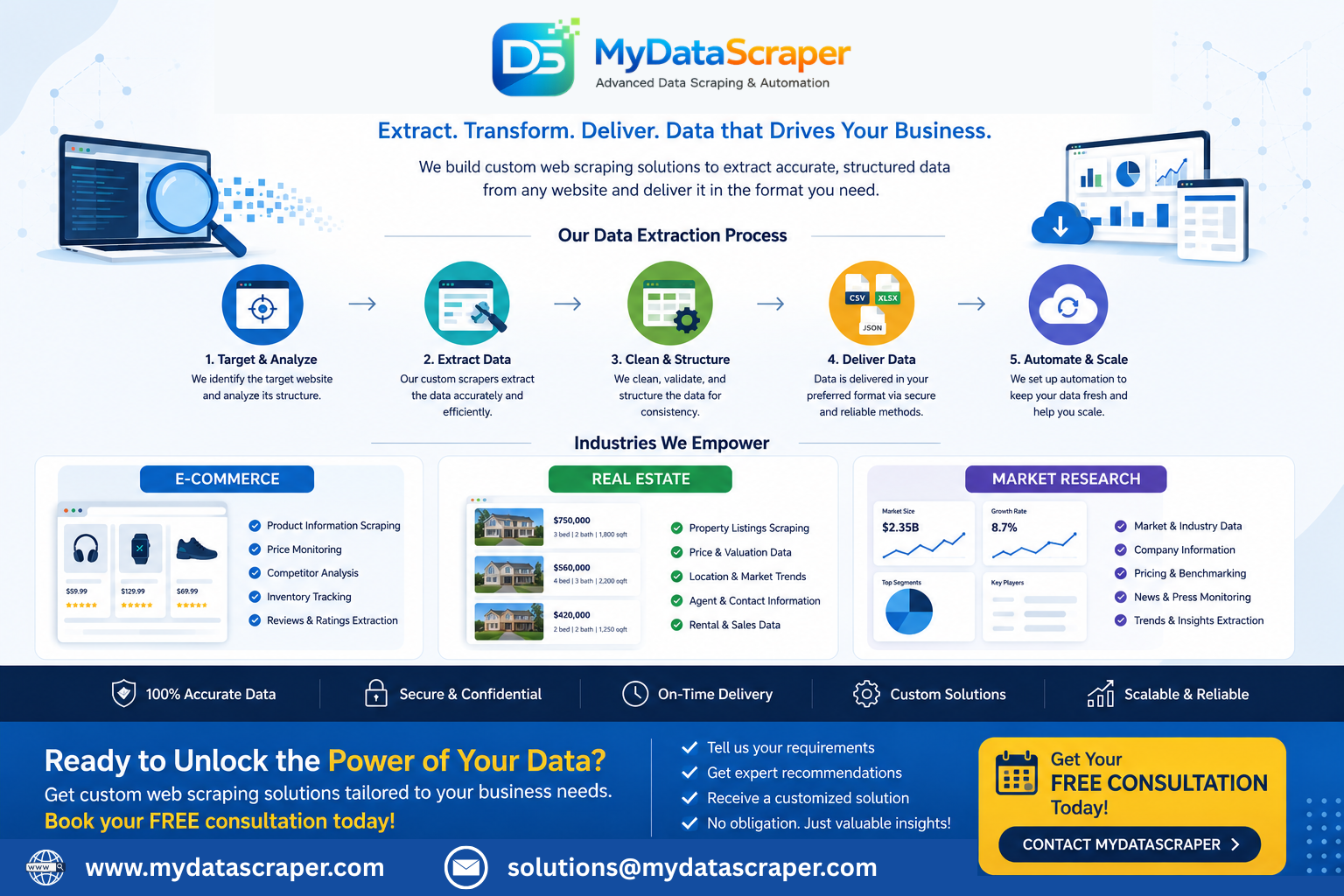
Ready to build your Walmart data advantage? Contact MyDataScraper for a free consultation — or visit www.mydatascraper.com to explore all our marketplace data extraction services.

Written by the MyDataScraper Team
MyDataScraper is a leading provider of custom web scraping and marketplace data extraction solutions for Walmart, Amazon, eBay, Shopee, Cdiscount, and other major global marketplaces. We help sellers, brands, and market researchers extract the competitive intelligence that drives better pricing, smarter strategy, and stronger revenue growth across the US retail landscape. Learn more at www.mydatascraper.com or contact our team today for a free consultation.