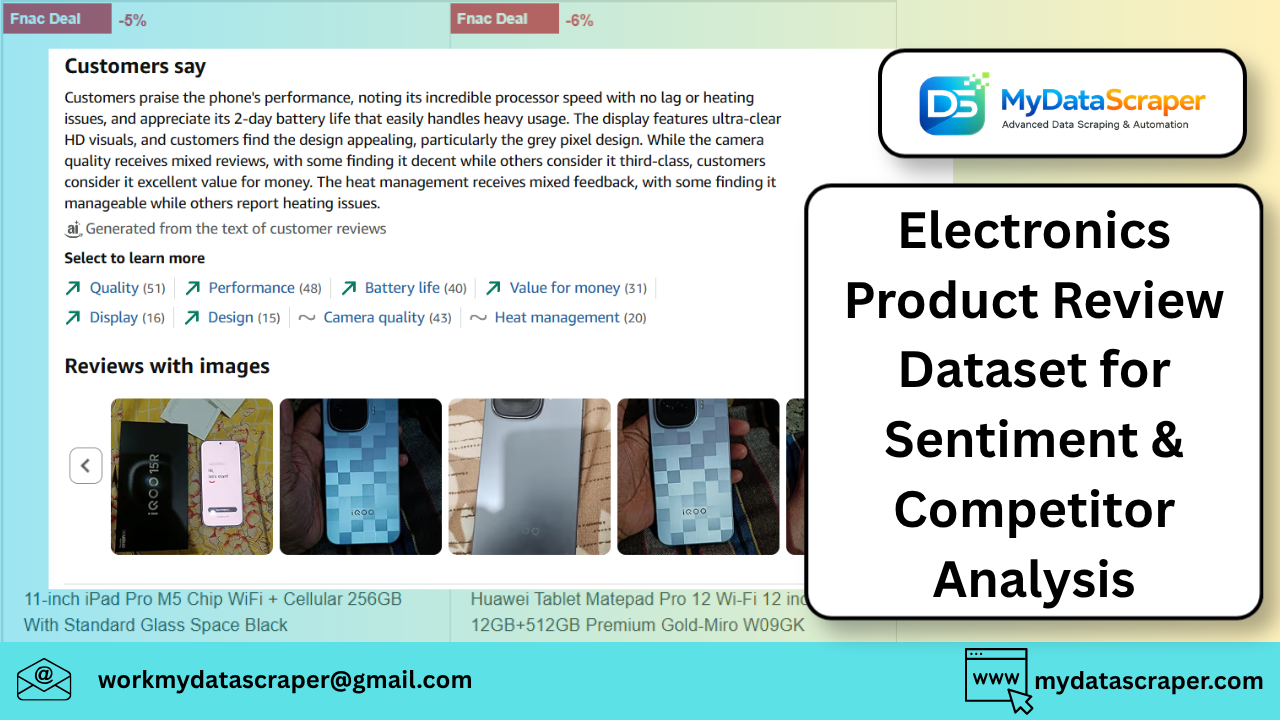
If you’re building anything around sentiment analysis, product intelligence, or e-commerce analytics, an electronics product review dataset is one of the most valuable assets you can have.
From smartphones to laptops, customers leave millions of reviews across platforms, and hidden inside that data are insights that can shape pricing, product design, and marketing strategies.
In this guide, we’ll break down:
- What an electronics review dataset looks like
- Where to get it
- How to build your own
- Real-world use cases
- And how to scale it for serious analytics
🧠 Why Electronics Review Data Matters
Let’s start with a simple observation.
A few months ago, while comparing headphones online, I noticed something interesting:
- 5-star reviews praised sound quality
- 1-star reviews complained about durability
- 3-star reviews gave the most balanced feedback
That middle layer—often ignored—is where real product insights live.
👉 Businesses use review datasets to:
- Improve product features
- Track competitor weaknesses
- Understand customer sentiment
- Predict product success
📦 What Does an Electronics Review Dataset Include?
A high-quality dataset typically contains:
🧾 Product Information
- Product name
- Brand
- Category (mobile, laptop, accessories)
- Product ID / ASIN
⭐ Review Data
- Review title
- Review text
- Rating (1–5 stars)
- Review date
👤 User Information
- Reviewer name
- Verified purchase flag
- Reviewer location (if available)
👍 Engagement Metrics
- Helpful votes
- Comments / replies
🧠 Derived Fields (Optional)
- Sentiment score
- Keywords
- Topic classification
🌐 Popular Sources for Electronics Review Data
1. Amazon
- Massive dataset
- Rich review metadata
- Ideal for sentiment analysis
2. Flipkart
- Strong in Indian market
- Useful for regional insights
3. Best Buy
- Detailed product reviews
- Good for US-focused datasets
4. Newegg
- Tech-heavy audience
- Detailed technical feedback
5. Open Datasets
- Kaggle datasets
- Public research datasets
- Review corpora for NLP
🛠️ How to Build Your Own Dataset (Python Approach)
Step 1: Choose Platform
Example: scraping reviews from Amazon (using ASIN)
Step 2: Basic Python Script
import requests
from bs4 import BeautifulSoupHEADERS = {
    "User-Agent": "Mozilla/5.0",
    "Accept-Language": "en-US,en;q=0.9"
}def scrape_reviews(url):
    response = requests.get(url, headers=HEADERS)
    soup = BeautifulSoup(response.text, "html.parser")    reviews = []    for r in soup.select('[data-hook="review"]'):
        try:
            title = r.select_one('[data-hook="review-title"]').text.strip()
            rating = r.select_one('[data-hook="review-star-rating"]').text.strip()
            body = r.select_one('[data-hook="review-body"]').text.strip()            reviews.append({
                "title": title,
                "rating": rating,
                "review": body
            })
        except:
            continue    return reviews
Step 3: Handle Pagination
Loop through multiple pages:
for page in range(1, 6):
    url = f"https://www.amazon.com/product-reviews/ASIN?pageNumber={page}"
Step 4: Store Dataset
Save as:
- CSV (for quick use)
- JSON (for APIs)
- Database (for large-scale systems)
📊 Sample Dataset Structure
[
  {
    "product_name": "Wireless Headphones",
    "rating": 5,
    "review": "Amazing sound quality and battery life!",
    "date": "2025-01-12",
    "verified": true
  },
  {
    "product_name": "Wireless Headphones",
    "rating": 2,
    "review": "Stopped working after 2 months",
    "date": "2025-02-03",
    "verified": true
  }
]
📈 Real-World Use Cases
1. Sentiment Analysis
Train NLP models to:
- Classify positive/negative reviews
- Detect customer satisfaction trends
2. Product Improvement
Brands analyze reviews to find:
- Common complaints
- Feature requests
3. Competitor Analysis
Compare:
- Ratings across brands
- Customer sentiment differences
4. Recommendation Systems
Use reviews to:
- Suggest better products
- Personalize user experience
5. Fake Review Detection
Identify:
- Spam reviews
- Bot-generated feedback
🚧 Challenges in Building Review Datasets
1. Anti-Scraping Protection
Platforms block bots via:
- CAPTCHA
- Rate limits
2. Data Noise
Reviews may include:
- Spam
- Irrelevant text
3. Language Diversity
Global platforms include:
- Multiple languages
4. Changing HTML Structure
Selectors may break frequently
🚀 Scaling Your Dataset
For large-scale datasets:
Use:
- Playwright / Selenium
- Rotating proxies
- Async scraping
Store in:
- MongoDB
- BigQuery
- Elasticsearch
🤖 How MyDataScraper Can Help
If you want ready-to-use datasets without building infrastructure:
MyDataScraper provides:
✔ Large-Scale Review Datasets
Millions of electronics reviews
✔ Multi-Platform Coverage
Amazon, Flipkart, Best Buy & more
✔ Clean & Structured Data
Ready for ML and analytics
✔ Real-Time Updates
Track new reviews automatically
🔮 Future of Review Data Analytics
We’re moving toward:
- AI-powered sentiment engines
- Voice & video review analysis
- Real-time customer feedback loops
- Predictive product success models
🏁 Final Thoughts
An electronics product review dataset is more than just text—it’s a direct line to customer thinking.
If you can:
- Collect it properly
- Clean it effectively
- Analyze it intelligently
👉 You gain a serious competitive advantage.
💬 Let’s Talk
What are you planning to build with review data?
- Sentiment analysis model?
- Product comparison tool?
- AI recommendation engine?
Tell me—I can help you design the dataset structure or pipeline.
📩 Need a Ready Electronics Review Dataset?
If you want a scalable dataset without dealing with scraping challenges:
👉 https://www.mydatascraper.com/contact-us/
Let’s turn review data into actionable insights 🚀