Google Maps Data Scraping: The Complete Guide to Extracting Business Listings, Reviews & Location Intelligence for Lead Generation & Market Research in 2025
Google Maps is the world's largest database of local businesses — with over 200 million business listings, billions of reviews, and the richest location intelligence dataset on the planet. Discover how automated Google Maps data extraction powers lead generation, market research, and competitive analysis for businesses of every size and industry.
- Why Google Maps Is the Ultimate Local Business Database
- What Is Google Maps Data Scraping?
- What Google Maps Data Can Be Extracted?
- Why Google Maps Intelligence Matters in 2025
- Use Cases: Who Benefits from Google Maps Scraping
- Google Maps as the Ultimate Lead Generation Engine
- Review Intelligence: Mining Google Maps Reviews at Scale
- The Google Maps Data Extraction Process
- Case Study: Agency Builds 50K Qualified Lead Database
- How MyDataScraper Delivers Google Maps Intelligence
- Ethical & Legal Considerations
- Frequently Asked Questions
- Conclusion
Why Google Maps Is the Ultimate Local Business Database for Every Industry
Google Maps isn't just a navigation tool — it is the world's most comprehensive, continuously updated database of local businesses. With over 200 million business listings across 220+ countries, Google Maps contains the name, address, phone number, website, business category, operating hours, reviews, ratings, and photos of virtually every business that serves customers locally — from single-person service providers to multinational chain locations.
For any business that needs to find potential customers, research local markets, analyze competition, or build targeted outreach lists, Google Maps represents the single richest publicly accessible data source in existence. Every restaurant, dentist, plumber, law firm, real estate agency, auto repair shop, salon, gym, and retail store in the world is cataloged in Google Maps — along with what their customers think about them (reviews), how busy they are (popular times), and how they compare to competitors (ratings and review volume).
Yet despite this extraordinary data richness, most businesses access Google Maps data the same way consumers do — by searching one business at a time, manually copying contact information, and scrolling through reviews individually. This manual approach is like having access to the world's largest library and reading one page per day.
Google Maps data scraping changes this equation entirely. Automated extraction of business listings, contact data, reviews, ratings, and location intelligence from Google Maps gives businesses systematic access to the local market data that powers smarter lead generation, deeper market research, and comprehensive competitive analysis. At MyDataScraper, we build custom Google Maps extraction solutions that deliver this intelligence in CSV, JSON, or Excel — structured, clean, and ready for immediate business use.
The Scale of Google Maps Data: Google Maps contains more business contact data than any CRM database, more customer reviews than any review platform, and more location intelligence than any commercial data vendor — all publicly accessible. The businesses that build systematic collection pipelines for this data operate with a local market intelligence advantage that their competitors — still searching Google Maps one listing at a time — simply cannot match.
What Is Google Maps Data Scraping?
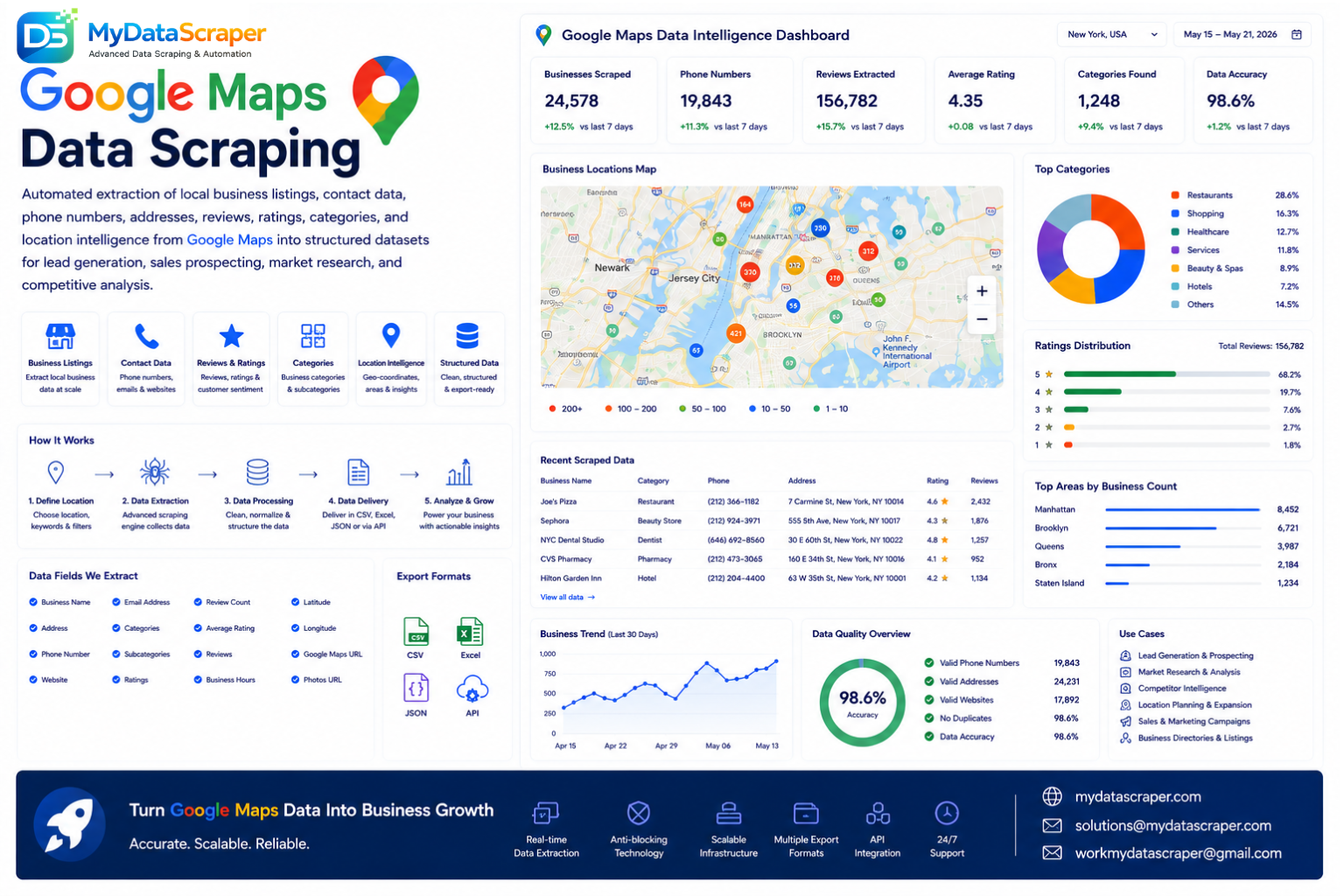
Google Maps data scraping is the automated collection of publicly available business information from Google Maps — including business names, addresses, phone numbers, website URLs, business categories, operating hours, customer reviews, star ratings, review counts, photos, popular times data, and geographic coordinates — for any geographic area, business category, or search query you specify.
Instead of manually searching "plumbers in Austin TX" on Google Maps and copying 20 results into a spreadsheet, automated Google Maps scraping runs that same query — and thousands like it simultaneously — extracting every business listing that appears, with every publicly visible data field, organized into clean structured datasets ready for use in your CRM, outreach platform, or analysis tools.
The power of Google Maps scraping lies in its combinatorial scale. You can extract:
- Any business category — from "restaurants" to "patent attorneys" to "industrial equipment suppliers"
- Any geographic scope — from a single zip code to an entire country
- Any level of detail — from basic name and phone to comprehensive profiles with reviews, ratings, photos, and hours
- Any combination — "all dental clinics within 25 miles of downtown Chicago with 4+ stars and 50+ reviews"
- Any update frequency — one-time extraction or continuous monitoring for new businesses and review changes
What Makes Google Maps Data Uniquely Valuable: Unlike business directory databases that are updated annually (if ever), Google Maps data is updated continuously by both Google's own systems and by business owners themselves. This makes Google Maps the most current, most comprehensive, and most geographically complete business database available — significantly more accurate and up-to-date than purchased lead lists or commercial business databases.
What Google Maps Data Can Be Extracted?
Google Maps publicly displays rich business data for every listed business. Here's the comprehensive breakdown of extractable data fields:
🏢 Business Core Data
- Business name (official listing name)
- Full street address
- City, state/province, zip/postal code, country
- Phone number (primary business phone)
- Website URL
- Google Maps URL / Place ID
- Business category (primary + secondary categories)
- Business description
⏰ Operations Data
- Operating hours (daily breakdown)
- Temporarily closed / permanently closed status
- Popular times / busy hours data
- Service options (dine-in, takeout, delivery, appointment, etc.)
- Accessibility information
- Payment methods accepted
⭐ Reviews & Reputation Data
- Overall star rating (1-5 average)
- Total review count
- Individual review text
- Reviewer name and profile link
- Review date
- Review star rating (per review)
- Business owner response to reviews
- Review photos
📍 Location & Geographic Data
- Latitude and longitude coordinates
- Plus code
- Neighborhood / area name
- Nearby landmarks
- Distance from search center point
🏷️ Additional Intelligence
- Price level indicator ($, $$, $$$, $$$$)
- Google Business Profile claimed status
- Photos (interior, exterior, menu, products)
- Menu link (restaurants)
- Booking/appointment link
- Social media links (where displayed)
- Questions & Answers data
At MyDataScraper, we extract exactly the Google Maps data fields your business needs — from basic contact lists for sales outreach to comprehensive business profiles with review intelligence — delivered in CSV, JSON, or Excel.
Why Google Maps Intelligence Matters More Than Ever in 2025
Purchased Lead Lists Are Increasingly Outdated and Unreliable
Traditional B2B data vendors sell business contact lists that are often 12-24 months old, contain 20-30% invalid data (wrong phone numbers, closed businesses, changed addresses), and are sold to dozens of competing companies simultaneously. Google Maps data is updated continuously — by Google, by business owners, and by customer reviews — making it significantly more current and accurate than any purchased list. Google Maps lead generation through scraping replaces stale vendor data with fresh, verified, locally-sourced business intelligence.
Local Market Research Requires Local-Level Data Granularity
Understanding a local market — whether you're opening a new location, launching a service in a new city, or analyzing competition at the neighborhood level — requires business-by-business, location-by-location data that no industry report can provide. Google Maps scraping delivers this hyper-local granularity for any geography, any category, at any scale.
Reviews Have Become the Primary Consumer Decision Factor
Over 90% of consumers read online reviews before visiting a local business, and Google Maps is the #1 source of local business reviews globally. Systematic Google Maps review scraping at scale enables businesses to monitor their own reputation, analyze competitor review sentiment, and identify service quality patterns across entire markets — intelligence that drives both marketing strategy and operational improvement.
Every Industry Needs Local Business Intelligence
From insurance agencies prospecting small businesses to real estate firms analyzing neighborhood commercial activity, from franchise systems monitoring competitor locations to marketing agencies building client prospect lists — virtually every industry has use cases where systematic Google Maps data provides actionable business intelligence that drives revenue.
"Google Maps is the most underutilized business intelligence resource available. It contains more accurate, more current, and more comprehensive local business data than any commercial database — and it's publicly accessible. The businesses that build systematic extraction pipelines for this data have a lead generation and market intelligence advantage that money literally cannot buy from traditional data vendors." — Local Business Intelligence & Lead Generation Strategy, 2025
Use Cases: Who Benefits from Google Maps Data Scraping
📞 B2B Lead Generation & Sales Prospecting
Build targeted prospect lists of businesses in any category, any location, filtered by rating, review count, and other quality signals. Extract phone numbers, websites, and addresses for direct outreach. This is the #1 use case for Google Maps scraping — and it consistently delivers higher-quality leads than purchased lists because the data is current, verified by Google, and exclusive to your pipeline.
🏪 Competitive Analysis for Local Businesses
Understand your competitive landscape at the local level — how many competitors operate in your service area, their ratings, review volumes, pricing tiers, operating hours, and what customers say about them in reviews. This competitive intelligence informs everything from pricing strategy to service differentiation to marketing positioning.
📊 Market Research & Location Intelligence
Analyze business density, category distribution, and competitive intensity across geographic markets — essential for franchise site selection, retail expansion planning, market sizing, and understanding local economic dynamics. Google Maps data provides the ground-level business intelligence that satellite data and census reports cannot match.
🏠 Real Estate & Property Market Intelligence
Real estate professionals extract Google Maps data to analyze neighborhood commercial activity — understanding which areas have thriving local business ecosystems, which are developing, and which show signs of commercial decline. This intelligence informs property investment decisions, commercial lease pricing, and development opportunity assessment.
⭐ Reputation Monitoring & Review Intelligence
Monitor your own Google Maps reviews and competitor reviews systematically — tracking rating trends, review sentiment patterns, and response rates across your entire market. For multi-location businesses, this means centralized reputation monitoring across all locations with comparative benchmarking.
📧 Marketing Agency Client Prospecting
Marketing agencies use Google Maps scraping to identify businesses with poor online presence (low review counts, no website, unclaimed Google profiles) — these businesses are the ideal prospects for digital marketing services. Building targeted prospect lists based on online presence deficiencies creates highly qualified agency lead pipelines.
🛠️ Service Business Territory Planning
Service businesses (HVAC, plumbing, cleaning, landscaping, etc.) use Google Maps data to map competitor coverage, identify underserved geographic pockets, and build territory plans that maximize market opportunity while minimizing competitive overlap.
🏥 Healthcare Provider Directory Building
Healthcare companies, insurance providers, and health tech platforms extract Google Maps data to build and maintain comprehensive provider directories — dentists, physicians, clinics, pharmacies, therapists — with current contact information, specialties, ratings, and patient review intelligence.
Google Maps as the Ultimate Lead Generation Engine
Google Maps is, without exaggeration, the most powerful B2B and B2C lead generation data source available in 2025. Here's why it consistently outperforms traditional lead vendors:
Freshness: Data Updated in Real Time vs Annual Snapshots
Google Maps business data is updated continuously — businesses add new information, change phone numbers, update hours, and customers leave reviews every day. By contrast, traditional lead vendors compile databases annually and sell the same stale data to hundreds of buyers. Scraped Google Maps data is current at the moment of extraction.
Accuracy: Verified by Google vs Self-Reported to Vendors
Google verifies business information through multiple signals — owner claims, customer check-ins, phone verification, address validation, and satellite imagery. Commercial lead databases rely on self-reported data that is rarely verified after initial collection. Google Maps data accuracy consistently exceeds commercial lead list accuracy by significant margins.
Completeness: Every Local Business vs Vendor's Limited Database
Google Maps aims to catalog every business in the world — and comes remarkably close. No commercial lead database approaches this coverage, particularly for small businesses, new businesses, and businesses in non-major markets. If a business exists and serves customers, it's almost certainly on Google Maps.
Enrichment: Reviews + Ratings Give You Quality Signals
Unlike basic contact lists that give you just a name and phone number, Google Maps data includes review count, average rating, price tier, and customer sentiment — quality signals that allow you to prioritize outreach toward the most promising prospects. A business with 200 reviews and a 4.5 rating is a fundamentally different prospect than one with 3 reviews and a 2.8 rating.
The Lead Gen Math: A typical Google Maps extraction for "dentists in Houston, TX" returns 800+ businesses with names, addresses, phone numbers, websites, ratings, and review counts. From a lead vendor, a similar list would cost $400-800, contain 20%+ stale data, and include no quality signals. From MyDataScraper, this extraction is fresher, more accurate, enriched with quality signals, and costs a fraction of vendor pricing. Contact us to discuss your lead generation needs.
Review Intelligence: Mining Google Maps Reviews at Scale
Google Maps hosts the world's largest collection of local business reviews — and systematic extraction of this review data creates intelligence that no other source can replicate.
What Review Mining Reveals
- Customer satisfaction patterns: What do customers consistently praise or criticize about businesses in your category? What themes drive 5-star vs 1-star reviews?
- Competitor weaknesses: What are competitors' customers complaining about? These complaints are your differentiation opportunities.
- Service quality benchmarks: What review scores and response rates define the top performers in your market?
- Reputation trajectory: Are your reviews improving or declining over time? How does your trajectory compare to competitors?
- Geographic sentiment patterns: Do customer expectations and satisfaction levels vary by neighborhood, city, or region?
- Response rate intelligence: Which competitors respond to reviews (and how quickly), and which ignore them — revealing their customer service investment level?
For multi-location businesses, franchise systems, and local marketing agencies, systematic Google Maps review extraction across dozens or hundreds of locations creates centralized reputation intelligence that manual monitoring simply cannot scale to achieve.
Review Data as Market Research: Google Maps reviews are unsolicited, authentic customer opinions — making them more genuine than survey responses and more abundant than focus group feedback. Extracting and analyzing reviews at scale across an entire industry category in a geographic market reveals consumer preferences, price sensitivity, service expectations, and competitive positioning dynamics that no formal market research methodology can replicate at equivalent cost and freshness.
The Google Maps Data Extraction Process: Step by Step
Here's exactly how MyDataScraper builds and operates a custom Google Maps data extraction pipeline:
Step 1: 🎯 Search Query & Geographic Scope Definition
We start by defining exactly what you need — business categories (keywords), geographic targets (cities, states, zip codes, radius from a point, or entire countries), and any filtering criteria (minimum rating, minimum review count, specific business attributes). This scoping phase ensures the extraction delivers precisely the data your business needs, not a generic data dump.
Step 2: 🔧 Custom Google Maps Scraper Engineering
Our engineers build scrapers purpose-built for Google Maps' complex architecture — handling JavaScript-rendered map interfaces, infinite scroll result loading, dynamic search result pagination, business detail panel extraction, review loading and pagination, and Google's sophisticated anti-bot measures. Every scraper is custom-engineered for comprehensive, reliable extraction.
Step 3: 📍 Multi-Location Grid Extraction
For comprehensive geographic coverage, we implement grid-based extraction — dividing large geographic areas into systematic grid cells to ensure every business in the target area is captured. Google Maps limits search results per query, so grid extraction overcomes this limitation to capture the complete business universe in your target geography.
Step 4: ⭐ Review Extraction & Depth Configuration
For review intelligence projects, we configure review extraction depth — whether you need just overall ratings and review counts (fast, high-volume), or complete individual review text extraction (comprehensive, deeper analysis). We can extract all reviews for target businesses or configure sampling for large-scale market research projects.
Step 5: 🧹 Data Cleaning, Deduplication & Validation
Google Maps data requires specialized cleaning — phone number format standardization, address normalization, duplicate business removal (the same business often appears in overlapping grid cells), website URL validation, and category taxonomy standardization. We deliver clean, deduplicated datasets ready for immediate use.
Step 6: 📦 Structured Delivery & CRM Integration
Clean Google Maps data is delivered in CSV, JSON, or Excel — or integrated directly with your CRM (Salesforce, HubSpot, Pipedrive), outreach platform (Apollo, Outreach.io, Salesloft), marketing automation tools, or business intelligence platforms via automated pipeline.
Step 7: 🔄 Ongoing Monitoring & Refresh
For clients who need continuously updated local business intelligence, we configure ongoing extraction schedules — monthly refreshes to capture new businesses, updated contact information, changed ratings, and new reviews. This keeps your local business intelligence perpetually current rather than slowly decaying.
Case Study: How a Digital Marketing Agency Built a 50,000-Business Qualified Lead Database Using Google Maps Scraping
A growing digital marketing agency specializing in local SEO and Google Business Profile optimization for service businesses (dentists, lawyers, contractors, restaurants) was struggling with its lead generation process. Their sales team was manually searching Google Maps city by city, copying business contact information into spreadsheets, and cold-calling from lists that took days to compile and covered only a fraction of their target market.
Their core problem was clear: the manual process could compile approximately 200 qualified leads per week — a volume that couldn't sustain the agency's growth targets. And the leads they did compile lacked the quality signals (review count, rating, website presence) needed to prioritize outreach toward the businesses most likely to need and pay for their services.
After partnering with MyDataScraper, we built a comprehensive Google Maps lead generation pipeline:
What Was Built
- Systematic extraction of all businesses in 8 target service categories (dental, legal, home services, restaurants, auto repair, medical, fitness, salon/spa) across 25 major US metro areas
- Full business profile data: name, address, phone, website (or absence of website — a key sales signal), Google Maps URL, category, hours
- Quality signal enrichment: star rating, total review count, review velocity (new reviews per month), Google Business Profile claimed status, photo count
- Lead scoring model: businesses scored 1-100 based on signals indicating likelihood of needing digital marketing services — low review count, no website, unclaimed profile, low rating, low photo count
- Monthly refresh schedule: new business detection, updated ratings, and re-scoring of existing leads
- Data delivered in Excel with separate worksheets per metro area, integrated via CSV import into HubSpot CRM with automated lead scoring tags
Results After 12 Months
50,000+ qualified business leads compiled across 25 metro areas — a 250x increase over their previous manual capacity. 38% higher cold outreach response rate compared to previously used purchased lead lists — because the data was more current and the lead scoring identified businesses with genuine marketing needs. $420K additional annual revenue from new clients acquired through the Google Maps-sourced pipeline. 62% reduction in cost per qualified lead compared to their previous manual research and lead vendor combination.
The most impactful insight was the "no website" signal — businesses listed on Google Maps without a website were 4x more likely to respond positively to digital marketing outreach, and this signal was only available through Google Maps data, not from any traditional lead vendor.
Contact MyDataScraper today to build your Google Maps lead generation solution.
How MyDataScraper Delivers Google Maps Intelligence That Drives Revenue
At MyDataScraper, Google Maps data extraction is one of our most in-demand services — used by agencies, service businesses, franchise systems, real estate firms, and market research companies worldwide. Here's what makes our approach uniquely effective:
📍 Grid-Based Complete Geographic Coverage
Google Maps limits search results per query. Our grid-based extraction methodology systematically divides target geographies into overlapping cells, ensuring every business in your target area is captured — not just the first page of results. This delivers genuinely comprehensive local business data, not the incomplete sample that manual searching or basic scraping tools provide.
📞 Lead-Ready Data Quality
Every extracted record is cleaned, validated, and deduplicated before delivery. Phone numbers are standardized, addresses are normalized, websites are validated, and duplicate listings from overlapping grid cells are removed. You receive lead-quality data ready for immediate CRM import and outreach — not raw data requiring hours of manual cleanup.
⭐ Review Intelligence Built In
We don't just extract business listings — we capture the review and reputation data that turns a contact list into a qualified prospect database. Review count, average rating, review velocity, and owner response rate are the quality signals that enable intelligent lead scoring and outreach prioritization.
🔗 CRM & Outreach Platform Integration
Google Maps data is delivered in CSV, JSON, or Excel — or integrated directly with your CRM (Salesforce, HubSpot, Pipedrive, Zoho), outreach platform (Apollo, Outreach.io, Salesloft, Lemlist), or marketing automation tools via automated pipeline. Data arrives where your sales team works — ready to action.
🌍 Global Coverage — Any Country, Any Category
We build Google Maps extraction solutions for any geography — from a single zip code to an entire country, across any of Google Maps' 220+ country coverages. Whether you need 500 businesses in a single city or 500,000 across a national market, our infrastructure scales to match.
🔄 Continuous Freshness Through Scheduled Refreshes
Local business data decays — businesses open, close, change phones, update hours. We configure monthly or quarterly refresh schedules that detect new businesses, update changed information, and remove closed businesses from your database — keeping your local intelligence perpetually current.
Ethical & Legal Considerations for Google Maps Data Scraping
✅ Compliant Practices We Follow
- Collect only publicly displayed business listing data visible to any Google Maps user
- Respect Google's terms of service and implement appropriate rate limiting
- Use data exclusively for legitimate business intelligence and lead generation purposes
- Never collect individual consumer personal data from Google Maps
- Comply with applicable data privacy regulations (GDPR for EU, CCPA for California)
- Maintain proper data security for all extracted information
- Use extracted contact data for legitimate B2B outreach — never for spam or harassment
- Focus on business-published information — names, addresses, phones, and public reviews
❌ Practices We Strictly Avoid
- Collecting individual user data, reviewer personal information, or Google account data
- Accessing authenticated Google services or private business management interfaces
- Sending request volumes that could impact Google Maps service performance
- Using scraped data for unsolicited mass email spam or robocalling
- Republishing Google Maps content (reviews, photos) as original content
- Bypassing CAPTCHA or security measures through deceptive methods
- Using business data for fraudulent impersonation or deceptive practices
Legal Context: Google Maps business listing data is published by business owners and Google specifically for public consumer access — it is designed to be found, viewed, and acted upon. Collecting this publicly displayed business data for legitimate commercial purposes (lead generation, market research, competitive analysis) is widely practiced across industries. However, Google's Terms of Service restrict automated access, and data privacy laws govern how collected data is used for outreach. MyDataScraper builds compliance considerations into every project and recommends legal counsel for specific use case guidance, particularly for outreach-focused applications.
Frequently Asked Questions
Can Google Maps data be used for lead generation and cold outreach?
Google Maps business data — names, addresses, phone numbers, websites — is published by business owners for the specific purpose of being contacted by potential customers and business partners. Using this publicly published contact data for legitimate B2B outreach is widely practiced. However, applicable regulations (TCPA for phone calls, CAN-SPAM for emails, GDPR for EU contacts) govern how outreach is conducted. We recommend consulting legal counsel regarding your specific outreach methodology and jurisdiction.
How many businesses can be extracted from Google Maps?
Our extraction capacity scales to any volume. We've built Google Maps pipelines extracting from a few hundred businesses in a single neighborhood to over 500,000 businesses across national markets. Volume depends entirely on your geographic scope and category targets. Contact us for a volume estimate based on your specific requirements.
Can Google Maps reviews be extracted in bulk for sentiment analysis?
Yes — we extract Google Maps review data at scale, including review text, star rating, review date, reviewer name (public display name), and business owner response. For large-scale market research, we can extract reviews across hundreds or thousands of businesses in a category and geography, enabling category-wide sentiment analysis and competitive reputation benchmarking.
Can specific business categories be targeted precisely?
Absolutely. Google Maps categorizes businesses using a detailed taxonomy — and we can target extractions with surgical precision. Examples: "personal injury lawyers in Miami," "Italian restaurants in Manhattan with 4+ stars," "HVAC contractors within 50 miles of Phoenix," or "all pharmacies in the UK." Any search you can run on Google Maps, we can automate and scale.
How is Google Maps data delivered?
We deliver Google Maps data in CSV, JSON, or Excel — and can integrate directly with CRM platforms (Salesforce, HubSpot, Pipedrive, Zoho), outreach tools (Apollo, Outreach.io, Salesloft), marketing automation platforms, or BI dashboards via automated pipeline. Data arrives clean, deduplicated, and ready for immediate use.
Can the data be filtered by rating, review count, or other quality signals?
Yes — we can configure extraction filters and post-extraction filtering to deliver only businesses matching your quality criteria. Common filters include minimum star rating (e.g., 4.0+), minimum review count (e.g., 50+ reviews), businesses with websites vs without, businesses open during specific hours, and specific service attribute requirements. This filtering enables precise lead qualification at the data extraction stage.
How quickly can a Google Maps scraping project be launched?
Standard Google Maps extraction projects are built and delivering data within 3 to 7 business days of project kick-off. Simple, focused extractions (single category, single city) can often be delivered in 2-3 days. Large-scale national projects with full review extraction and CRM integration typically take 5-8 days. Contact our team today for a timeline estimate based on your specific requirements.
Google Maps Contains the Local Business Intelligence That Powers Every Smart Business Decision — Are You Accessing It Systematically?
Google Maps is not just a map — it is the world's largest, most current, and most comprehensive database of local business information. Every lead generation campaign, every local market research project, every competitive analysis, and every location intelligence initiative is made stronger, faster, and more accurate when built on systematically extracted Google Maps data.
The businesses that access this data manually — searching one query at a time, copying 20 results per session — are operating at a fraction of their potential intelligence capacity. The businesses that build systematic Google Maps extraction pipelines gain access to tens of thousands of qualified business contacts, enriched with review intelligence and quality signals, delivered automatically in formats ready for immediate business use.
At MyDataScraper, we build custom Google Maps data extraction solutions tailored to your specific intelligence needs — lead generation prospect lists, competitive landscape analysis, market research databases, review intelligence monitoring, and location analytics — delivered in CSV, JSON, or Excel, integrated into your CRM and business systems, on any schedule your business requires.
The local business intelligence your team needs to prospect smarter, research deeper, and compete more effectively is publicly available on Google Maps right now — for every category, every geography, every business. The question is whether you're collecting it systematically, or leaving this extraordinary intelligence advantage to your competitors.
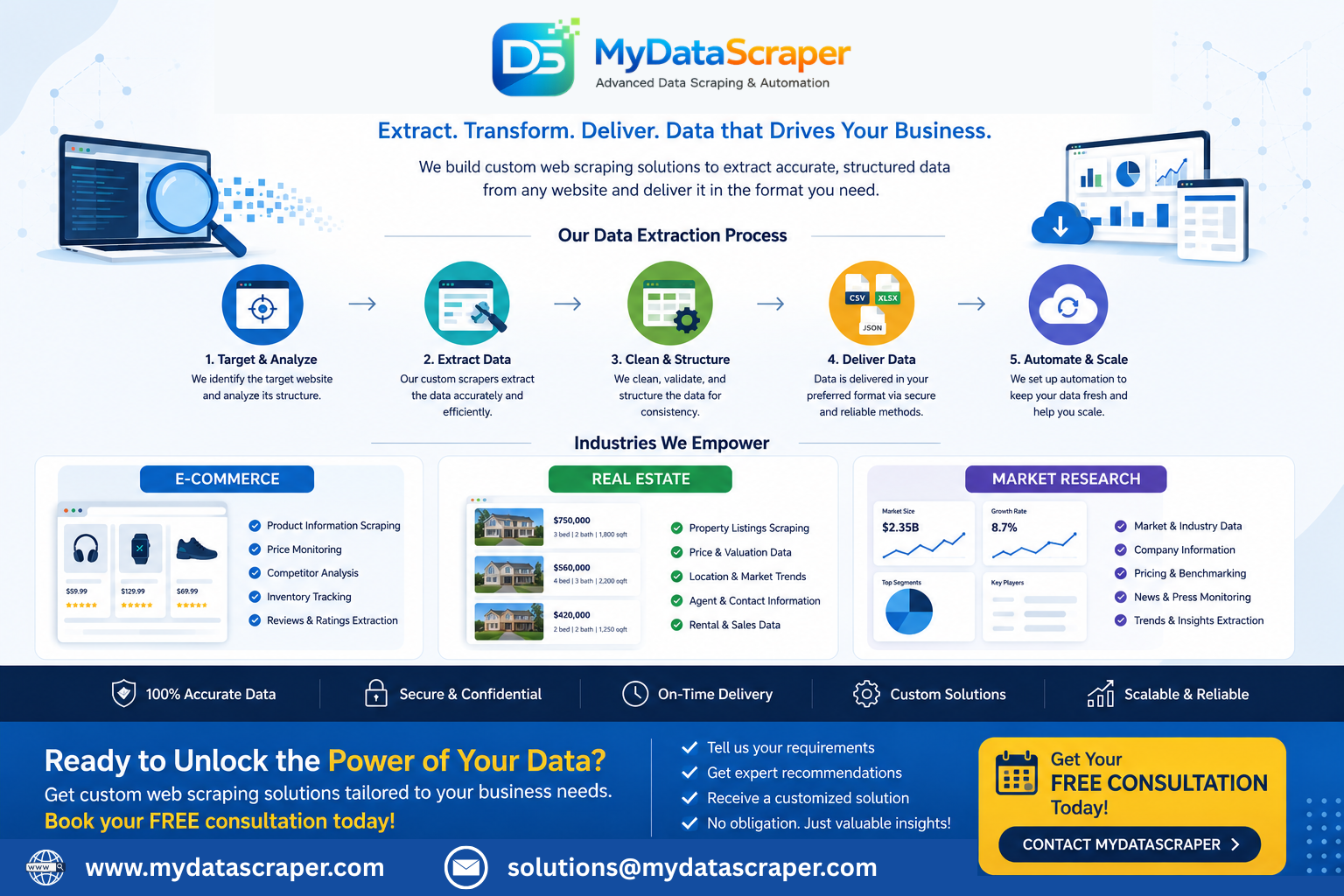
Ready to build your Google Maps data advantage? Contact MyDataScraper for a free consultation — or visit www.mydatascraper.com to explore all our data extraction services.

Written by the MyDataScraper Team
MyDataScraper is a leading provider of custom web scraping and data extraction solutions for Google Maps, e-commerce marketplaces, real estate, lead generation, and market research. We help businesses extract the local business intelligence that drives better lead generation, smarter market research, and stronger competitive positioning. Learn more at www.mydatascraper.com or contact our team today for a free consultation.