Introduction: The Real Estate Market Runs on Data — Are You Getting Yours?
Let’s be honest. Finding a great real estate deal in today’s market feels like searching for a needle in a haystack — except the haystack is the entire internet, and it’s constantly changing. Thousands of new property listings appear every single day across platforms like Zillow, Redfin, Realtor.com, Trulia, and hundreds of regional MLS websites. Prices shift weekly. Neighborhoods evolve. Rental yields fluctuate with economic conditions.
The investors, agents, and analysts who consistently win in real estate aren’t necessarily the smartest or most experienced people in the room. They’re the ones with the best data. And in 2026, the fastest, most reliable way to collect that data at scale is through real estate data scraping.
Whether you’re a property investor hunting for undervalued homes, a real estate agent building a competitive market analysis, a developer researching land opportunities, or a proptech company building the next big platform — web scraping for real estate can completely transform how you work. And the good news? You don’t need to be a tech wizard to get started.
In this guide, we’ll cover everything — what real estate data scraping is, why it matters, how it works, real-world use cases, the data you can extract, and how MyDataScraper delivers custom property data extraction solutions that give you a genuine edge in the market.
💡 Did You Know? According to the National Association of Realtors, over 95% of homebuyers begin their property search online. That’s a massive ocean of publicly available listing data — and real estate web scraping lets you tap into all of it, automatically.
What Is Real Estate Data Scraping?
Real estate data scraping is the automated process of extracting property-related information from websites, online listing platforms, public records databases, and property portals. Instead of manually visiting each listing page, copying details into a spreadsheet, and spending hours on repetitive research — a web scraper does it all automatically, in a fraction of the time, and at a scale no human team could match.
Think of it like having a tireless research assistant who visits thousands of property websites simultaneously, extracts every piece of relevant data, organizes it perfectly, and delivers it to you in a clean, ready-to-analyze format — every single day.
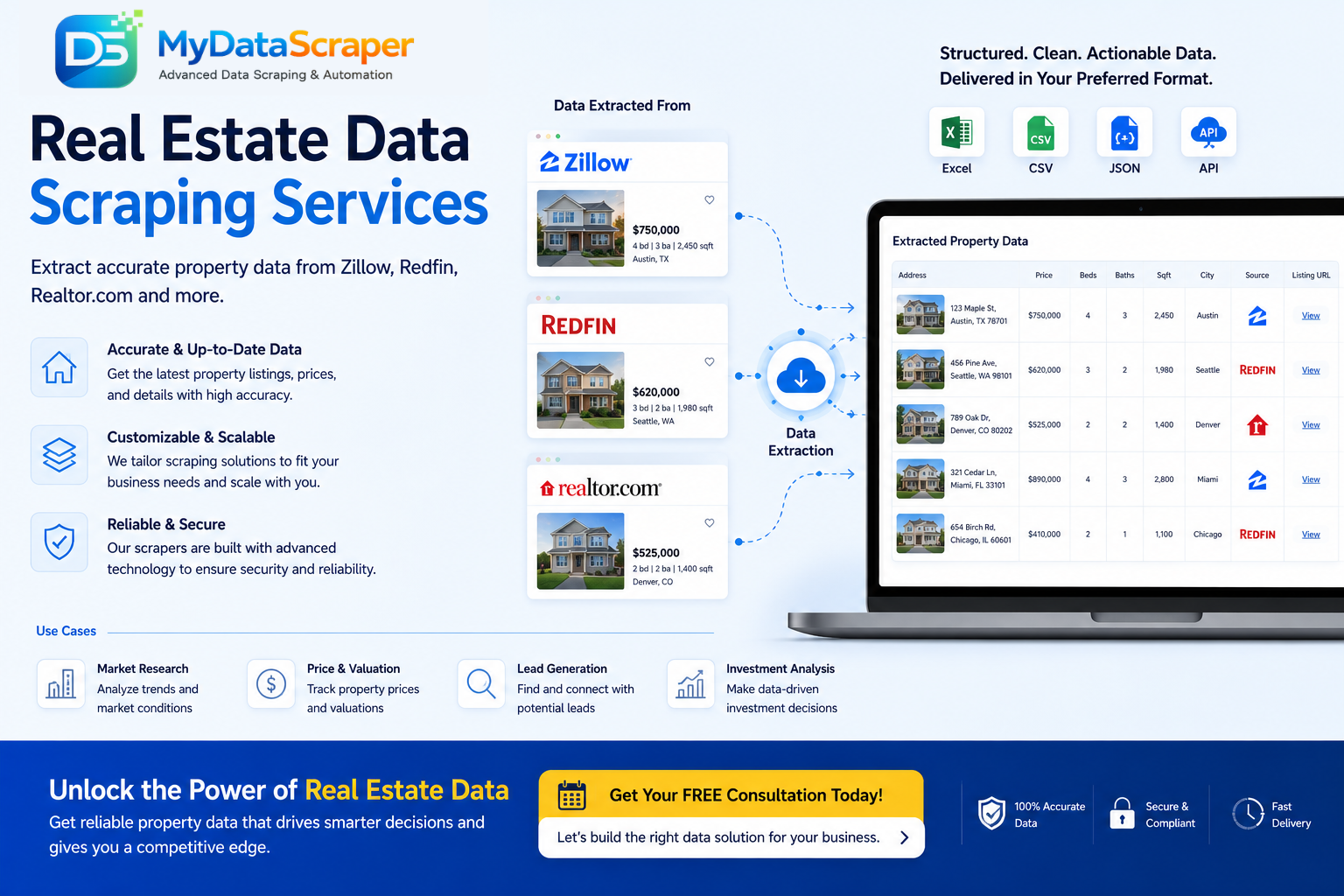
What Kinds of Data Can Be Scraped from Real Estate Websites?
| Data Category | Examples | Business Use |
|---|---|---|
| Property Details | Address, bedrooms, bathrooms, square footage, lot size, year built | Property comparison, valuation |
| Pricing Data | Listing price, price history, price per sq ft, sold price | Market analysis, investment decisions |
| Listing Information | Days on market, listing date, MLS number, listing agent | Identifying motivated sellers |
| Location & Neighborhood | Zip code, school ratings, walk score, proximity to amenities | Neighborhood analysis, buyer targeting |
| Rental Data | Monthly rent, rental yield, occupancy rates, Airbnb revenues | Buy-to-let investment analysis |
| Agent & Broker Details | Agent name, contact, agency, listings count | Lead generation, partnership building |
| Property Images | Exterior, interior, floor plans, virtual tours | Automated listing creation |
| Tax & Public Records | Property tax history, ownership records, zoning information | Due diligence, investment research |
At MyDataScraper, we can extract all of this data and more — from virtually any real estate website or platform — and deliver it in your preferred format: CSV, JSON, or Excel.
Why Real Estate Data Scraping Matters More Than Ever in 2026
$4.8T
Estimated global real estate market value in 2026, making data-driven decisions more critical than ever
2.5M+
New property listings added to U.S. real estate platforms every month — impossible to track manually
68%
Of real estate investors say access to better market data would significantly improve their investment returns
10x
Faster research and analysis when using automated data extraction versus manual methods
The real estate market has always been data-intensive, but the digital transformation of property listings, valuations, and transactions has made the volume of available data truly staggering. The challenge is no longer finding data — it’s collecting, organizing, and acting on it faster than your competitors.
Here’s the hard truth: top-performing real estate investment firms, iBuyers like Opendoor and Offerpad, and large brokerages have been using automated property data extraction for years. They’ve built sophisticated data pipelines that give them a clear picture of market trends, pricing opportunities, and emerging neighborhoods — before the information reaches the average investor or agent.
Real estate data scraping levels the playing field. It gives independent investors, boutique agencies, and growing proptech companies access to the same quality of market intelligence that was previously only available to well-funded enterprises.
“In real estate, the deal is won before you make the offer. The investor with better data makes better offers, faster — and that’s exactly what web scraping delivers.”
9 Powerful Use Cases of Real Estate Web Scraping
1. Property Investment Analysis
For property investors, timing and pricing are everything. By scraping property listings from Zillow, Redfin, Realtor.com, and local MLS platforms, investors can build comprehensive datasets of available properties — complete with price history, days on market, property characteristics, and neighborhood metrics. This enables systematic investment analysis at a scale that was previously impossible without a large research team.
Imagine filtering thousands of listings to find properties that have been on the market for more than 60 days, priced below the neighborhood median, with motivated sellers — all within minutes. That’s real estate data scraping in action.
2. Rental Market Research
Whether you’re evaluating a buy-to-let investment or building a rental portfolio analysis tool, scraping rental listing platforms gives you granular data on rental rates, occupancy trends, and yield potential across different zip codes, neighborhoods, and property types. This real estate market data is invaluable for making confident investment decisions in the rental sector.
3. Comparative Market Analysis (CMA)
Real estate agents use CMAs to advise clients on listing prices and purchase offers. Traditionally, this involves manually researching comparable sales. With web scraping for real estate, agents can automate the entire CMA process — pulling sold prices, listing details, and market trends for any neighborhood within seconds, making them faster and more accurate advisors to their clients.
4. Competitor Tracking for Agencies
Real estate agencies can scrape competitor websites to monitor their listings volume, pricing strategies, new service areas, and agent activity. This intelligence helps agencies identify market gaps, benchmark their own performance, and discover neighborhoods where competitors are underperforming — revealing expansion opportunities.
5. Short-Term Rental & Airbnb Analysis
Investors considering short-term rental properties need data on Airbnb occupancy rates, average daily rates, seasonal trends, and competitive supply in target areas. Scraping short-term rental platforms provides this critical rental property data that isn’t available through traditional real estate channels.
6. Commercial Real Estate Market Intelligence
Commercial real estate investors and brokers scrape listings for office spaces, retail units, industrial properties, and land parcels to track cap rates, vacancy rates, rental trends, and transaction activity across different markets. This commercial real estate data extraction supports both deal sourcing and portfolio management.
7. Lead Generation for Agents and Brokers
One of the most impactful uses of real estate web scraping for agents is lead generation. By scraping FSBO (For Sale By Owner) listings, expired MLS listings, pre-foreclosure records, and property owner databases, agents can build highly targeted prospecting lists and reach motivated sellers before competitors do.
8. Property Valuation Models (AVM)
Automated Valuation Models (AVMs) — like those used by Zillow (Zestimate) and lenders for mortgage underwriting — rely entirely on large datasets of property characteristics, sales history, and market trends. Property data extraction is the foundation of building and training accurate AVMs for proptech companies and financial institutions.
9. New Development & Land Opportunity Research
Real estate developers and land investors scrape planning permission databases, zoning records, and vacant land listings to identify development opportunities in target markets. This data helps developers move quickly on high-potential sites before they hit the open market.
🏡 Ready to Extract Real Estate Data at Scale?
MyDataScraper builds custom property data extraction solutions tailored to your exact needs — whether you’re an investor, agent, developer, or proptech company. Get your data in CSV, JSON, or Excel. Let’s talk.
Get a Free Consultation →Major Real Estate Platforms You Can Extract Data From
The property data extraction possibilities are vast. Here are some of the most valuable real estate platforms where data can be collected:
- Zillow — Property listings, Zestimate valuations, price history, rental estimates, and neighborhood data
- Redfin — Active listings, sold data, days on market, listing agent details, and market reports
- Realtor.com — MLS listings, open house schedules, price reductions, and property features
- Trulia — Property listings, crime data, school ratings, and neighborhood insights
- Apartments.com — Rental listings, floor plans, amenities, availability, and rental prices
- Airbnb & VRBO — Short-term rental listings, occupancy data, pricing, and host information
- LoopNet & CoStar — Commercial real estate listings, cap rates, and lease terms
- Auction.com — Foreclosure and bank-owned property listings
- Homes.com — Residential listings, market data, and agent directories
- Local MLS Websites — Regional property listings and sold data specific to target markets
Every website has its own structure, anti-scraping measures, and data presentation format. At MyDataScraper, our team of expert developers builds scrapers specifically engineered for each platform — handling JavaScript rendering, pagination, CAPTCHAs, and dynamic content to ensure you get complete, accurate data every time.
How MyDataScraper Delivers World-Class Real Estate Data Extraction
There are plenty of off-the-shelf scraping tools out there, but real estate websites are notoriously complex — they use sophisticated anti-bot technology, dynamic JavaScript rendering, geo-restricted content, and frequently changing page structures. Generic tools simply can’t keep up. That’s where MyDataScraper stands apart.
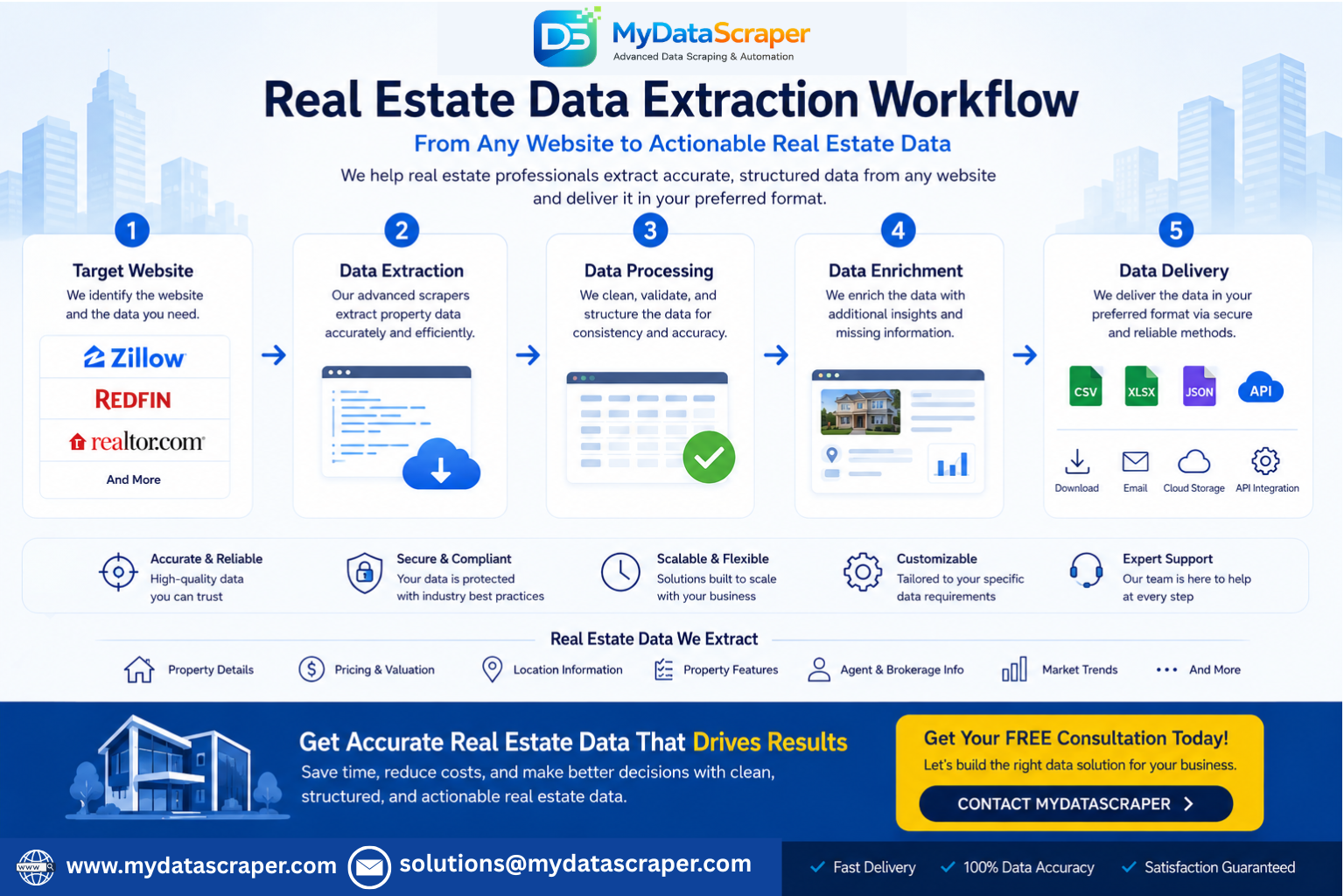
🔧 Step 1: Requirements Discovery
We start with a thorough consultation to understand exactly what data you need, from which platforms, at what frequency, and in what format. Every project is different — a property investor’s needs look very different from a proptech startup’s — and we design our solutions accordingly.
🛠️ Step 2: Custom Scraper Development
Our development team builds scrapers purpose-built for your target websites. We handle all technical complexities — IP rotation, browser emulation, CAPTCHA solving, session management, and adaptive parsing — so your data pipeline runs reliably without interruption.
🧹 Step 3: Data Cleaning & Validation
Raw scraped data often contains duplicates, formatting inconsistencies, and missing fields. We apply rigorous data cleaning and validation processes to ensure every record you receive is accurate, complete, and ready for analysis. No messy data. No guesswork.
📦 Step 4: Data Delivery in Your Preferred Format
Your clean, structured data is delivered in the format that fits your workflow best — CSV for spreadsheet users, JSON for developers and API integrations, or Excel for business analysts. We can also set up automated delivery on a schedule — daily, weekly, or real-time — directly to your inbox, cloud storage, or database.
🔄 Step 5: Ongoing Maintenance & Support
Websites change constantly — layouts update, new anti-scraping measures are deployed, data structures shift. Our team monitors your scrapers continuously and adapts them to any website changes, ensuring uninterrupted data flow. You focus on using the data. We handle everything else.
🌟 Why Choose MyDataScraper? We provide custom, scalable web scraping solutions for real estate, e-commerce, and market research — built by experienced developers who understand your industry. Get started today at www.mydatascraper.com
Real-World Case Study: How a Property Investor Used Data Scraping to Generate $280K in One Year
Meet David — a real estate investor based in Texas with a portfolio of 12 residential properties. Despite his experience, David was struggling to scale his acquisition strategy. Finding undervalued properties in a competitive market felt like a full-time job, and his manual research process — browsing Zillow and Redfin for hours each evening — wasn’t sustainable.
After reaching out to MyDataScraper, here’s how his workflow transformed:
The Problem
- Spending 15+ hours per week on manual property research
- Missing time-sensitive deals because of slow research processes
- No systematic way to identify motivated sellers or distressed properties
- Limited visibility into emerging neighborhood trends
The Solution
We built a custom real estate data scraping solution that:
- Scraped 8 major real estate platforms daily, covering 150,000+ listings across 5 Texas markets
- Extracted pricing history, days on market, price reductions, and seller contact information
- Flagged properties that met David’s investment criteria automatically — below-median price, 60+ days on market, motivated seller indicators
- Delivered a curated shortlist of 20-40 high-potential properties every morning in Excel format
- Included neighborhood trend data — median price movements, rental yields, and new development activity
The Results (Within 12 Months)
6
New investment properties acquired using data-driven targeting
$280K
Net profit generated from data-identified deals in the first year
90%
Reduction in time spent on manual property research
3x
Increase in deal pipeline compared to previous year
David’s story is not unique. Across the real estate industry, investors, agents, and developers who embrace property data extraction consistently outperform those who rely on manual research and intuition alone.
Want to build a similar data-driven advantage? Contact MyDataScraper today and let’s design a custom real estate scraping solution for your business.
Best Practices for Ethical Real Estate Data Scraping
Like any powerful tool, real estate web scraping should be used responsibly. Here are the key principles to follow:
1. Only Scrape Publicly Available Data
Focus exclusively on data that is publicly visible without requiring authentication. Publicly listed property information, prices, and descriptions are generally fair game for extraction.
2. Respect Website Terms of Service
Before scraping any platform, review its terms of service carefully. Some platforms prohibit automated data collection. Understanding these boundaries is essential for responsible scraping.
3. Implement Proper Rate Limiting
Avoid overwhelming target servers with excessive requests. Well-designed scrapers use appropriate delays and request pacing to minimize server impact — and reduce the risk of being blocked.
4. Comply with Data Privacy Laws
If any extracted data could be linked to individuals — such as contact information for property owners or agents — ensure your use of that data complies with GDPR, CCPA, and other applicable privacy regulations.
5. Work with Professional Scraping Services
The safest and most effective way to scrape real estate data is to partner with a professional web scraping service that understands both the technical and legal landscape. MyDataScraper builds compliant, ethical, and highly reliable data extraction solutions for the real estate industry.
Frequently Asked Questions About Real Estate Data Scraping
Is it legal to scrape real estate websites like Zillow or Redfin?
Scraping publicly available data is generally permissible, but website terms of service vary. Some platforms restrict automated access. Working with a professional service like MyDataScraper ensures your data collection activities are handled ethically and responsibly, minimizing legal risks.
How often can real estate data be updated?
Depending on your needs, we can configure scrapers to run hourly, daily, weekly, or on any custom schedule. For active property investors who need to track new listings and price changes in real time, daily or even multiple-times-daily scraping is common.
What format will I receive my real estate data in?
We deliver data in CSV, JSON, or Excel — whichever suits your workflow. We can also set up automated delivery to your email, cloud storage (Google Drive, AWS S3, Dropbox), or directly to your database or CRM system.
Can you scrape data from multiple real estate platforms simultaneously?
Absolutely. We regularly build multi-source scraping solutions that consolidate data from multiple platforms into a single unified dataset — giving you a comprehensive view of any market without switching between tools.
How much does a real estate web scraping project cost?
Pricing depends on the complexity of the target websites, volume of data, frequency of extraction, and delivery requirements. We offer flexible pricing for projects of all sizes — from one-time data extractions to ongoing enterprise data pipelines. Contact us for a custom quote.
Do I need technical knowledge to use your real estate scraping services?
Not at all. We handle all the technical complexity — scraper development, infrastructure, maintenance, and data delivery. You simply tell us what data you need, and we deliver it ready to use. No coding required on your end.
Conclusion: In Real Estate, Data Is the New Location
The old adage says real estate is all about “location, location, location.” In 2026, it’s equally about “data, data, data.” The investors who identify undervalued markets early, the agents who price listings perfectly, the developers who spot emerging neighborhoods before they’re trendy — they all have one thing in common. They make decisions based on comprehensive, up-to-date, accurately extracted property data.
Real estate data scraping is the engine behind this data advantage. It automates the tedious work of property research, delivers insights at a scale impossible to achieve manually, and gives every player in the market — from independent investors to large brokerages — the intelligence they need to compete and win.
At MyDataScraper, we’ve helped real estate professionals across the spectrum — investors, agents, developers, and proptech companies — build custom data pipelines that transform how they operate. Our custom, scalable web scraping solutions are built around your specific needs, delivering clean, structured property data in CSV, JSON, or Excel — on any schedule you need.
The question isn’t whether you should be using real estate data scraping. The question is: how much longer can you afford not to?
🚀 Start Extracting Real Estate Data Today
Get a free consultation with our team. Tell us what data you need, and we’ll build you a custom solution that delivers results — fast. No technical knowledge required. Just better data, better decisions, better deals.
Contact MyDataScraper Now →Or visit us at www.mydatascraper.com to explore all our services.