Financial & Stock Market Data Scraping: Quantitative Edge at the Speed of the Market
Extract real-time stock prices, earnings reports, SEC filings, options chains, macroeconomic indicators, and alternative financial data from 150+ sources — structured, normalized, and delivered before the next tick.
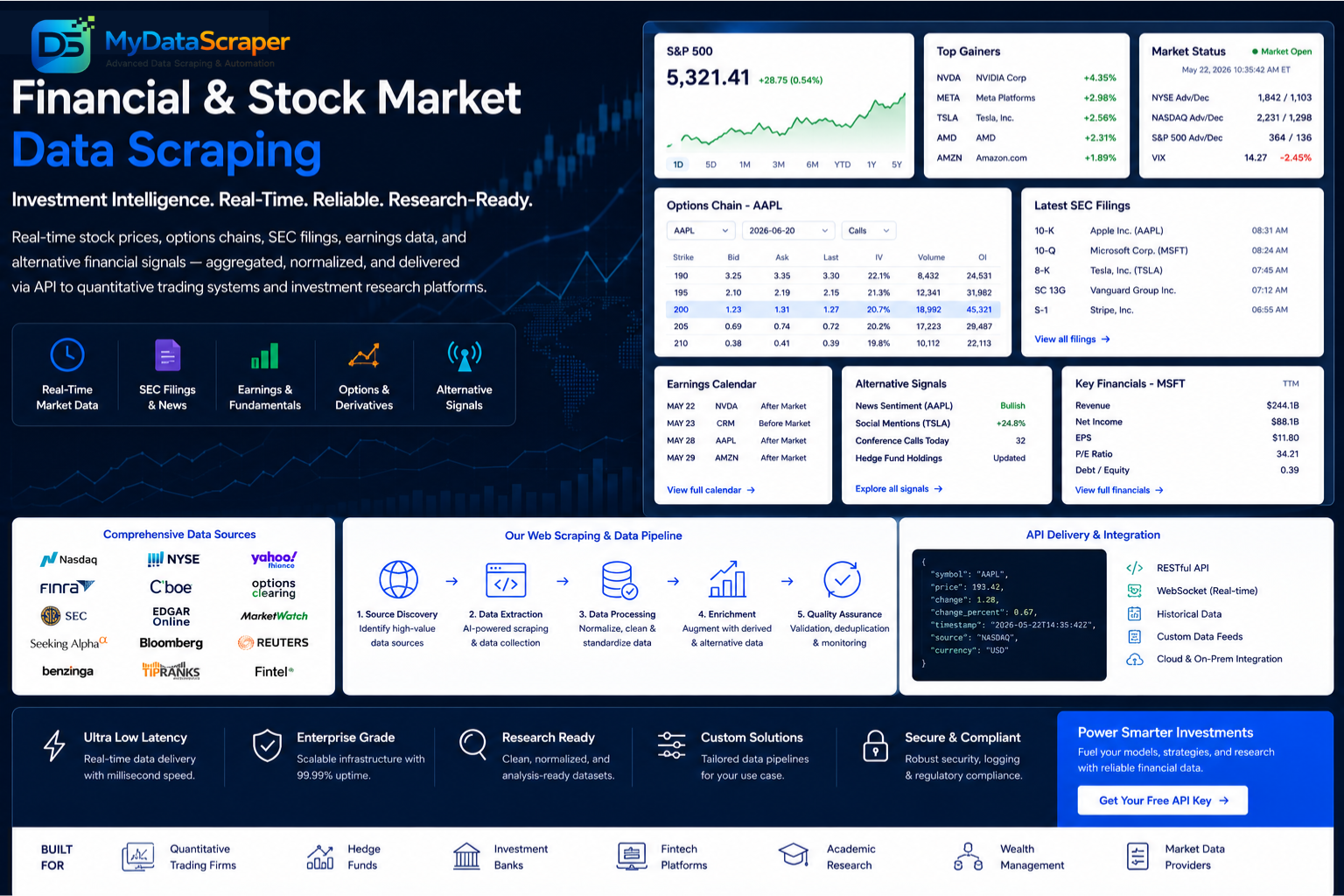
Why Financial Data Scraping Is the Backbone of Modern Investment Intelligence
In capital markets, information asymmetry is the only sustainable edge. The firms that consistently outperform — Renaissance Technologies, Two Sigma, Citadel — don't just have better traders; they have better data infrastructure. And increasingly, that data advantage is built on web scraping.
The global alternative data market — which is largely built on scraped financial information — was valued at $7.3 billion in 2023 and is projected to reach $143 billion by 2030 (Grand View Research). Hedge funds now spend an average of $1.7 million per year on alternative data sets. But here's the thing: the underlying data these firms pay for is overwhelmingly sourced from public websites, regulatory filings, and online platforms through web scraping.
The challenge is that financial data sources are among the most technically complex and legally sensitive to scrape. The SEC's EDGAR system presents unique parsing challenges. Yahoo Finance and Bloomberg defend their data aggressively. Crypto platforms update order books in milliseconds. Building and maintaining scrapers across all these sources in-house can cost over $500,000 per year in engineering time alone.
That's where MyDataScraper's financial data scraping services provide an immediate ROI: we handle the entire extraction, normalization, and delivery pipeline so your quant analysts and portfolio managers can focus on generating alpha — not debugging scrapers.
What Financial Data Can You Extract with Web Scraping?
The universe of scrapeable financial data is far broader than most people realize. Here's a comprehensive breakdown of the data categories our clients extract and the insights each unlocks.
Real-time & Historical Stock Prices
OHLCV data (Open, High, Low, Close, Volume), bid/ask spreads, pre/post-market prices, intraday tick data, adjusted prices (dividends, splits), and multi-year historical archives for backtesting trading strategies.
SEC Filings & Regulatory Documents
10-K, 10-Q, 8-K, S-1, 13F, and proxy filings from SEC EDGAR. Institutional holdings changes, insider trading reports (Form 4), short interest data, and M&A disclosures — extracted and structured within minutes of filing.
Earnings Data & Analyst Estimates
Earnings call transcripts, EPS surprises, revenue beats/misses, forward guidance changes, analyst price target revisions, consensus estimates from Seeking Alpha, Motley Fool, and Zacks — all structured for quantitative analysis.
Cryptocurrency & DeFi Data
Spot prices across 50+ exchanges (Binance, Coinbase, Kraken), order book depth, on-chain metrics, DeFi protocol TVL, liquidity pool data, whale wallet movements, and NFT floor prices and trading volumes.
Macroeconomic Indicators
GDP growth, inflation rates (CPI, PPI), employment figures (NFP, jobless claims), central bank interest rate decisions, trade balance, housing starts, consumer confidence indices — scraped from government agencies, central banks, and economic research organizations globally.
News Sentiment & Alternative Signals
Financial news sentiment scores from Reuters, Bloomberg, WSJ, and 500+ financial news sites. Social media sentiment from Reddit (WallStreetBets), X (Twitter), and StockTwits. Job posting data as a leading indicator of corporate health.
⚠️ Sample data for illustration purposes only. Real scraped data is delivered via API.
💡 Alternative Data: The New Alpha Signal
Traditional financial data (prices, earnings) is already priced into markets by the time you see it. The real edge comes from alternative data scraped from non-traditional sources: satellite imagery of parking lots (predicting retail earnings), shipping container tracking (supply chain insights), job posting trends (company growth signals), and patent filings (R&D pipeline visibility). MyDataScraper's data extraction services can build custom pipelines for any alternative data source.
Financial Data Scraping Use Cases: Who Uses It and How
From billion-dollar hedge funds to individual quant researchers, financial data scraping powers decision-making across the entire investment ecosystem.
Hedge Funds & Quant Firms
Quantitative hedge funds use scraped financial data to build systematic trading strategies, factor models, and risk management systems. SEC 13F filings reveal institutional positioning; scraped short interest data signals crowded trades. One systematic macro fund we work with processes 15 million scraped data points daily across 47 markets to power their global macro model.
Fintech & WealthTech Platforms
Robo-advisors, stock research apps, and portfolio management platforms need clean, real-time market data to power their interfaces. Companies like Robinhood and Acorns built their data foundations on aggregated market feeds. Our live scraping APIs provide the data infrastructure fintech startups need without the cost of Bloomberg Terminal subscriptions ($24,000/year per seat).
Investment Banks & Asset Managers
Equity research teams scrape earnings call transcripts, analyst report summaries, and competitor disclosures to supplement their fundamental research. M&A teams monitor regulatory filings for deal signals. Fixed income desks scrape central bank communications and economic calendar data for rate expectations modeling.
Algorithmic & Retail Traders
Individual algo traders and retail quantitative investors use scraped options flow data, unusual volume alerts, and short squeeze indicators to time their entries. Reddit WallStreetBets sentiment scraping became famous during the GameStop saga — but sophisticated traders have been using social sentiment data for years.
Financial Regulators & Academics
University finance departments and regulatory bodies like the CFTC use scraped market data to study market microstructure, detect anomalies, and research systemic risk. The Federal Reserve's research staff regularly publish papers based on data collected from publicly available financial websites.
Financial Media & Data Vendors
Financial content platforms, market data vendors, and financial newsletters use web scraping to aggregate market data, track analyst ratings, and monitor corporate announcements in real time. This aggregated data powers financial widgets embedded across thousands of websites and apps.
Top Financial Data Sources for Web Scraping: Coverage & Difficulty
Not all financial data platforms are equally accessible or valuable. Here's how the major sources compare across the dimensions that matter most for building a reliable financial data pipeline.
| Source | Data Type | Update Frequency | Cost to Access | Scraping Difficulty | MyDataScraper |
|---|---|---|---|---|---|
| Yahoo Finance | Prices, Fundamentals, News | Real-time / Daily | Free | 🟠 High (API deprecated) | ✔ Full support |
| SEC EDGAR | Filings, Insider Trades | Minutes after filing | Free | 🟡 Medium | ✔ Full support |
| Seeking Alpha | Analysis, Earnings, Ratings | Continuous | Paid | 🔴 Very High | ✔ Full support |
| Macrotrends | Historical Financial Data | Quarterly | Free | 🟢 Low | ✔ Full support |
| CoinGecko / CoinMarketCap | Crypto Prices, Market Cap | Real-time | Limited Free API | 🟡 Medium | ✔ Full support |
| Finviz | Screener, Fundamentals, News | Daily / Real-time (Elite) | Freemium | 🟠 High | ✔ Full support |
| Federal Reserve (FRED) | Macro Indicators, Rate Data | Monthly / Quarterly | Free (API) | 🟢 Low | ✔ Full support |
| Bloomberg / Reuters | News, Prices, Analysis | Real-time | $24K+/year | 🔴 Extreme | ✔ Selective support |
⚠️ Important Note on Bloomberg & Premium Sources
Bloomberg Terminal data carries strict redistribution terms, and scraping their platform may conflict with contractual obligations if you hold a subscription. We advise clients to rely on Bloomberg only through official API licensing for premium data, and use web scraping for data from publicly accessible sources. In most cases, combining free sources (Yahoo Finance, SEC EDGAR, FRED, CoinGecko) with targeted scraping of financial news sites provides 85%+ of the data coverage that Bloomberg offers — at a fraction of the cost.
How to Build a Financial Data Scraping Pipeline with MyDataScraper
Building a reliable, low-latency financial data pipeline requires infrastructure far beyond a simple Python script. Here's our end-to-end approach to delivering institutional-quality financial data.
Data Requirements Discovery
We start by mapping your exact data needs: which securities (equities, bonds, crypto, FX, commodities), which sources, which specific fields, required latency (real-time vs. daily batch), historical depth needed for backtesting, and how the data will be consumed (API, database, file delivery). This discovery phase typically takes 1-2 days and results in a detailed data specification document.
Source Selection & Legal Review
Not all data sources are equal in legality, quality, or accessibility. We identify the optimal source for each data type — favoring official APIs where available (FRED, SEC EDGAR's official API, CoinGecko API) and supplementing with web scraping for data points that have no official API. Our compliance team reviews every new source before scrapers are deployed.
Low-Latency Scraper Engineering
For financial data, speed matters more than almost any other use case. Our engineering team builds optimized scrapers using async Python (aiohttp), implements connection pooling, and co-locates scraping nodes near target servers to minimize network latency. For real-time feeds, we implement persistent connections and change-detection algorithms that only transmit when data actually changes — reducing noise and bandwidth costs.
Data Normalization & Enrichment
Raw financial data arrives in inconsistent formats: different date formats, currency representations, ticker symbols, and data structures. We normalize everything into standardized schemas — unified ticker symbols (handling name changes, delisting, and splits), ISO 4217 currency codes, and consistent decimal precision. We enrich data with computed fields: adjusted prices, market cap, moving averages, and custom indicators your models require.
Quality Validation & Anomaly Detection
Financial data errors are uniquely costly — a single bad data point can trigger a wrong trade worth millions. Our QA pipeline runs multi-source cross-validation (comparing prices from 3+ sources), statistical outlier detection (flagging prices that deviate more than 3σ from the rolling average), timestamp consistency checks, and gap detection for missing time periods.
Delivery & Integration
Data is delivered via real-time WebSocket feeds or REST API for low-latency applications, direct database injection (TimescaleDB, InfluxDB, PostgreSQL) for time-series storage, Apache Kafka topics for stream processing pipelines, or S3/GCS files for batch consumption by ML training jobs. Monitor everything through our analytics dashboard.
Financial Data Scraping API: Real-World Code Examples
Our financial data API is built for quantitative developers. Here's an example of how to pull multi-source stock data, SEC filing alerts, and sentiment scores in a unified async pipeline:
import asyncio
import aiohttp
from datetime import datetime, timedelta

# MyDataScraper Financial Intelligence API
BASE_URL = "https://api.mydatascraper.com/v1/financial"
API_KEY  = "your_api_key_here"
HEADERS  = {"Authorization": f"Bearer {API_KEY}"}

# ─── 1. Real-time multi-source price feed ───────────────────
async def get_realtime_prices(session, tickers):
    params = {
        "symbols": ",".join(tickers),
        "sources": "yahoo,finviz,marketwatch",
        "fields": "price,volume,bid,ask,pe_ratio,52w_high,52w_low",
        "validate": "cross_source"  # auto-validate across sources
    }
    async with session.get(f"{BASE_URL}/prices", params=params, headers=HEADERS) as r:
        return await r.json()

# ─── 2. SEC EDGAR filing monitor ────────────────────────────
async def get_sec_filings(session, tickers, form_types):
    params = {
        "tickers": ",".join(tickers),
        "form_types": ",".join(form_types),  # "10-K,10-Q,8-K,4"
        "since": (datetime.now() - timedelta(days=1)).isoformat(),
        "parse_financials": True  # extract tables from XBRL
    }
    async with session.get(f"{BASE_URL}/sec-filings", params=params, headers=HEADERS) as r:
        return await r.json()

# ─── 3. News sentiment aggregator ───────────────────────────
async def get_sentiment(session, tickers):
    params = {
        "tickers": ",".join(tickers),
        "sources": "reuters,wsj,seekingalpha,reddit,stocktwits",
        "window_hours": 24,
        "model": "finbert"  # finance-tuned NLP model
    }
    async with session.get(f"{BASE_URL}/sentiment", params=params, headers=HEADERS) as r:
        return await r.json()

# ─── Run all requests concurrently ──────────────────────────
async def main():
    watchlist = ["AAPL", "MSFT", "NVDA", "TSLA", "AMZN"]

    async with aiohttp.ClientSession() as session:
        prices, filings, sentiment = await asyncio.gather(
            get_realtime_prices(session, watchlist),
            get_sec_filings(session, watchlist, ["8-K", "4"]),
            get_sentiment(session, watchlist)
        )

    # Process unified intelligence view
    for ticker in watchlist:
        price_data    = prices["data"][ticker]
        sentiment_score = sentiment["scores"][ticker]["composite"]
        new_filings   = [f for f in filings["filings"] if f["ticker"] == ticker]

        print(f"\n{ticker}: ${price_data['price']} | Sentiment: {sentiment_score:+.2f}")
        if new_filings:
            print(f"  ⚡ {len(new_filings)} new SEC filing(s) detected!")

asyncio.run(main())
🔌 WebSocket Real-time Feed
For algorithmic trading applications that need sub-second latency, we offer WebSocket streaming that pushes price updates and filing alerts the moment they're detected — without polling. Average latency from scrape detection to your WebSocket client is 380–620ms depending on source. Connect with: wss://stream.mydatascraper.com/v1/financial
Why Financial Data Scraping Is Uniquely Complex
Financial data scraping shares some challenges with general web scraping but introduces several unique technical and compliance complexities that make it a specialty discipline.
Microsecond-Level Time Sensitivity
A stock price delayed by 30 seconds can mean the difference between profit and loss. We optimize every layer of the stack — from DNS resolution to parsing logic — to minimize latency. Our scrapers are deployed in AWS regions co-located with major financial data centers.
Complex Data Parsing (XBRL, PDF)
SEC filings are submitted in XBRL (a complex XML-based financial reporting format) and PDF. Extracting structured financial tables — income statements, balance sheets, cash flows — from these formats requires specialized parsing logic, not just HTML scraping.
Multi-Exchange Symbol Harmonization
The same company trades under different ticker symbols on NYSE, NASDAQ, LSE, and Frankfurt — and symbols change due to mergers, splits, and delistings. We maintain a continuously updated universal security master database that maps all identifiers (ISIN, CUSIP, SEDOL, local ticker) to a single entity.
Aggressive Legal & Bot Defenses
Yahoo Finance deprecated its API specifically to stop scraping. Seeking Alpha uses Cloudflare Enterprise with behavioral analysis. Bloomberg employs a multi-layer defense system combining legal cease-and-desist letters with technical blocking. Each source requires a carefully calibrated approach.
Data Quality & Survivorship Bias
Historical financial databases often suffer from survivorship bias — delisted companies disappear from current data. Our historical datasets include delisted securities to ensure your backtests reflect reality. We also flag data corrections and restatements to prevent look-ahead bias.
Regulatory Compliance Complexity
Financial data handling intersects with securities law in complex ways. Certain data (material non-public information, subscription-only research) carries specific legal risks. We have financial and legal expertise to navigate these boundaries and structure pipelines that capture maximum insight while maintaining compliance.
Cost Comparison: Building Financial Data Infrastructure
The economics of financial data acquisition have traditionally favored large institutions that can afford Bloomberg Terminals and Refinitiv subscriptions. MyDataScraper changes that equation significantly.
| Approach | Annual Cost | Data Latency | Coverage | Customization | Maintenance Burden |
|---|---|---|---|---|---|
| Bloomberg Terminal | $24,000/seat/yr | Real-time | Excellent | ✘ Fixed schemas | ✔ None |
| Refinitiv Eikon | $22,000/seat/yr | Real-time | Excellent | ⚠ Limited | ✔ None |
| In-house Scraping Team | $180,000–$500,000/yr | Variable | Limited | ✔ Full custom | ✘ High (20+ hrs/wk) |
| Free APIs (Yahoo, FRED) | $0 | 15–60 min delay | Very Limited | ✘ Fixed endpoints | ⚠ API changes |
| MyDataScraper | From $2,400/yr | <500ms (real-time) | 150+ sources | ✔ Fully custom | ✔ Zero |
A quantitative hedge fund we onboarded was spending $340,000 annually on Bloomberg Terminal seats (14 seats × $24,000) plus an additional $220,000 on two in-house data engineers. After migrating their core data needs to MyDataScraper — supplemented by selective Bloomberg access for specific institutional data — they reduced annual data costs to $87,000 while actually increasing data coverage from 12 to 47 sources. Their engineers were redeployed to alpha signal research, contributing directly to a 2.3% improvement in annual fund performance.
📊 Explore Our Analytics Dashboard
All financial data pipelines include access to our real-time monitoring dashboard where you can visualize data freshness, monitor pipeline health, explore historical trends, and set up custom alerts. View dashboard capabilities →
Best Practices for Financial Data Scraping: Accuracy, Compliance & Performance
1. Always Validate Across Multiple Sources
Never trust a single source for financial data. A temporary glitch on Yahoo Finance showed Apple's stock at $0.01 for 4 minutes in 2022, triggering erroneous stop-loss orders. Our multi-source validation cross-checks every data point against at least two independent sources and flags discrepancies exceeding 0.5% for human review before distribution.
2. Handle Corporate Actions Meticulously
Stock splits, reverse splits, spin-offs, and dividends must be properly accounted for in historical price series. A 4:1 Apple stock split in 2020 means pre-split prices must be adjusted to maintain comparability. Unadjusted historical data will produce wildly incorrect backtests. We maintain a corporate actions database that automatically adjusts historical series.
3. Respect Market Data Redistribution Rules
Even public market data has redistribution restrictions. NYSE and NASDAQ require fees for real-time data redistribution in commercial applications. Using scraped real-time prices in a consumer-facing financial product may require exchange licensing agreements. Understand the difference between scraping for internal analysis (generally permissible) versus building a competing data product (requires licensing).
4. Implement Circuit Breakers for Anomalous Data
Financial algorithms that ingest bad data can make catastrophically wrong decisions. Implement circuit breakers that halt automated consumption if incoming data fails validation checks — prices outside historical ranges, impossible volume spikes, or timestamp gaps exceeding your tolerance threshold.
5. Store Raw Data Before Processing
Always store the raw scraped data in addition to your processed, normalized version. When a parsing bug is discovered (and it will be discovered), you'll need the raw data to retroactively correct your processed dataset. Storage is cheap; missing historical data is irreplaceable.
Frequently Asked Questions About Financial Data Scraping
Scraping publicly displayed financial data from sites like Yahoo Finance, Finviz, and Macrotrends for internal analytical purposes is generally legal under U.S. law, as supported by the hiQ Labs v. LinkedIn Ninth Circuit precedent. However, several important caveats apply: (1) Using this data in a consumer-facing financial product may require exchange licensing agreements; (2) Real-time price data from major exchanges (NYSE, NASDAQ) carries redistribution restrictions even when publicly displayed; (3) Scraping subscription-only content behind login walls violates ToS and potentially the Computer Fraud and Abuse Act. We advise all clients to have their legal team review specific use cases, particularly those involving commercial redistribution.
SEC EDGAR has an official API (EDGAR Full-Text Search API and Company Facts API) that we use as the primary source for filing metadata and XBRL-tagged financial data. For the full filing content — which often requires parsing complex HTML, XML, and PDF documents — we use a combination of the official API plus targeted scraping of EDGAR's viewer pages. Our XBRL parser extracts standardized financial statements (income statement, balance sheet, cash flows) into clean JSON with proper period-over-period alignment. Form 4 insider trading reports are processed within 5 minutes of filing using our EDGAR webhook monitoring system.
Our real-time price feed achieves an average end-to-end latency of 380–620 milliseconds from when a price change appears on the source website to when your WebSocket client receives it. This is not suitable for high-frequency trading (HFT) at the microsecond level, which requires co-located direct market access. However, it's entirely adequate for quantitative strategies operating on minute or higher timeframes, position monitoring, risk management systems, and financial research applications. For ultra-low latency requirements, we recommend pairing our data with official exchange feeds where licensing is required.
Yes, crypto data scraping is one of our fastest-growing service areas. We cover spot prices across 50+ exchanges, order book depth, funding rates, perpetual swap premiums, DeFi protocol TVL from platforms like DeFi Llama, Uniswap and Aave analytics, NFT collection floor prices and volume from OpenSea and Blur, and on-chain metrics (active addresses, transaction fees, miner revenue) aggregated from blockchain explorers like Etherscan and Glassnode's public pages. For institutional-grade on-chain analytics, we recommend pairing our scraping with Glassnode or Nansen API subscriptions.
Historical depth varies by data type: Stock prices — up to 30+ years for major U.S. equities (adjusted for splits and dividends); SEC filings — EDGAR archives go back to 1993; Earnings data — typically 10-20 years depending on source; Macro indicators — FRED data goes back decades for most series; Crypto data — from inception of each asset (Bitcoin from 2010). For backtesting purposes, we recommend specifying your required lookback period during onboarding so we can validate data completeness and flag any gaps before you build models on it.
Yes. We scrape earnings call transcripts from Seeking Alpha, Motley Fool, and Fool's Transcripts within 30-60 minutes of each call's completion. Transcripts are delivered as structured JSON with speaker segmentation (CEO, CFO, Analyst), question/answer identification, and optional NLP enrichment including FinBERT sentiment scores per paragraph, keyword extraction (revenue guidance language, risk factors), and tone analysis. Many of our quant clients use transcript sentiment as a short-term price prediction feature in their ML models.
Commercial sentiment products (Bloomberg BSENT, RavenPack, Refinitiv News Analytics) cost $50,000–$200,000+ annually and use proprietary NLP models. Building your own sentiment pipeline through web scraping offers: (1) Full control over which sources you include; (2) Ability to customize the NLP model (use FinBERT, custom fine-tuned models, or LLM-based analysis); (3) Inclusion of alternative text sources like Reddit, StockTwits, and niche financial forums that premium vendors often miss; (4) Cost savings of 70-90%. The trade-off is higher setup complexity, which is where MyDataScraper's managed pipeline handles the data acquisition layer so your data scientists can focus on model development.
For standard data types (stock prices, SEC filings, basic fundamentals from well-supported sources), we can deploy and deliver first data within 5-7 business days. Complex pipelines involving multiple international exchanges, custom NLP enrichment, or unusual data sources typically take 2-4 weeks. We offer a fast-start option for common data needs (U.S. equity prices, EDGAR filings, crypto prices) that can be provisioned within 48 hours. Contact our team for a free consultation and timeline estimate for your specific requirements.
Build Your Quantitative Edge on Data That Actually Delivers
Stop overpaying for Bloomberg seats or wasting engineering talent on broken scrapers. Get institutional-quality financial data — from stock prices to SEC filings to crypto on-chain metrics — delivered reliably, accurately, and at a fraction of the cost.