Healthcare & Pharma Data Scraping: Accelerate Decisions with Real-time Medical Market Intelligence
Extract drug pricing, clinical trial data, physician directories, medical device approvals, formulary information, and FDA regulatory data from 200+ healthcare sources — structured, compliant, and delivered at the speed your business decisions demand.
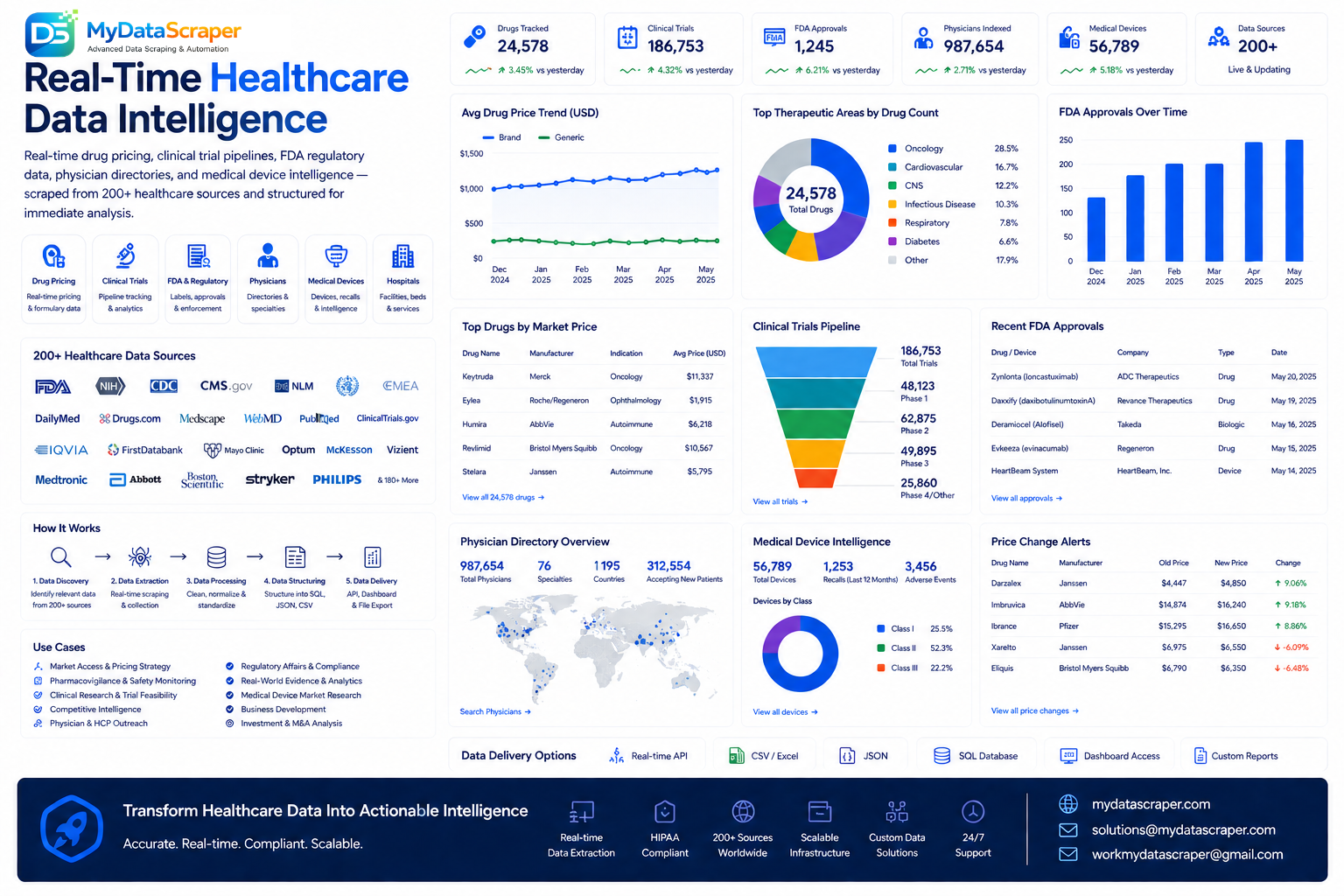
Why Healthcare Data Scraping Is Becoming a Competitive Necessity in Life Sciences
The global healthcare data analytics market is projected to reach $150.8 billion by 2031, growing at a 22.1% CAGR. Yet despite this explosive growth, the majority of actionable healthcare market intelligence still sits in plain sight on publicly available websites — FDA databases, ClinicalTrials.gov, pharmacy chain pricing pages, hospital formularies, medical device registries — waiting to be systematically collected and structured into business intelligence.
Consider what's happening right now as you read this: Pfizer's competitors are monitoring which of their drugs are gaining new formulary positions. A health insurer's data team is comparing drug prices across 12,000 pharmacy locations to find outliers. A medical device startup is tracking every FDA 510(k) approval in their category to understand the competitive landscape. A pharmaceutical market research firm is scraping ClinicalTrials.gov to identify which drug candidates in a therapeutic area are about to enter Phase 3 trials — a signal that acquisition conversations may soon follow.
The challenge is that healthcare data is among the most fragmented in the world. Drug pricing data alone exists across pharmacy benefit manager (PBM) portals, retail pharmacy websites, manufacturer copay card pages, state Medicaid fee schedules, and international formulary databases — each with different structures, update frequencies, and anti-bot measures. Building and maintaining scrapers for even a fraction of these sources is a full-time engineering effort.
That's the gap MyDataScraper's healthcare data scraping services fill: a single managed pipeline that aggregates, normalises, and delivers the healthcare market intelligence your organisation needs — without the engineering overhead or compliance uncertainty of building it yourself.
What Healthcare & Pharmaceutical Data Can You Extract?
The healthcare data landscape is extraordinarily rich and diverse. Here's a comprehensive breakdown of the data categories our clients extract — and the specific business intelligence each unlocks.
Drug Pricing & Formulary Data
Retail drug prices across CVS, Walgreens, Rite Aid, Costco Pharmacy, and 60,000+ independent pharmacies. GoodRx coupon prices, manufacturer list prices (WAC), Average Wholesale Prices (AWP), Medicaid State Maximum Allowable Cost (SMAC) schedules, and Medicare Part D formulary coverage tiers by plan.
Clinical Trial Intelligence
Trial title, phase, status (recruiting, completed, terminated), sponsor, drug/intervention name, indication (disease area), enrollment targets, primary & secondary endpoints, trial site locations, principal investigators, estimated completion dates, and results posts — all scraped from ClinicalTrials.gov, EU Clinical Trials Register, and ISRCTN.
FDA Regulatory Data
Drug approvals (NDA, ANDA, BLA), 510(k) and PMA medical device clearances, FDA warning letters, drug shortage notifications, product recalls, REMS program requirements, Orange Book patent expiration dates, Purple Book biosimilar listings, and FDA inspection records.
Physician & Provider Directories
Physician name, specialty, NPI number, practice location, hospital affiliations, medical school, board certifications, insurance accepted, patient ratings, appointment availability, telemedicine capability, and disciplinary history from state medical board records.
Medical Device Market Intelligence
510(k) clearance filings, device classification, predicate device, manufacturer, intended use, cleared date, device description, adverse event reports (MAUDE database), recall history, and competitive device landscape mapping by therapeutic category.
Insurance Coverage & Reimbursement
Medicare CMS reimbursement rates by procedure code (CPT/HCPCS), Prior Authorization requirements by payer and drug, step therapy protocols, formulary tier placements, coverage gap calculations, and out-of-pocket cost estimates across major commercial insurance plans.
Medical Literature & Research Signals
PubMed publication metadata, abstract content, author affiliations, citation counts, journal impact factors, conference presentation abstracts, press releases from pharma companies, and biotech pipeline announcements that signal R&D direction shifts.
Biosimilar & Generic Drug Tracking
Generic drug entry timelines, first-to-file applicants (180-day exclusivity periods), biosimilar interchangeability designations, patent cliff calendars, and authorised generic agreements — essential for both incumbent brands and generic manufacturers planning market entry.
International Regulatory Approvals
EMA (European Medicines Agency) EPAR database, Health Canada drug approval notices, TGA (Australia), PMDA (Japan), and ANVISA (Brazil) approval records — enabling global regulatory landscape mapping for international market entry planning.
💡 Why Drug Price Gaps Matter More Than You Think
The price difference for Atorvastatin 40mg between the lowest and highest pharmacy is 145% — for the exact same generic drug. For patients and insurers paying out-of-pocket, this is a $155/year difference per patient. Multiply that across millions of prescriptions and the business case for systematic pharmacy price monitoring becomes immediately obvious. Our data extraction services deliver this data at scale for PBMs, insurers, and price transparency platforms.
Clinical Trial Data Scraping: Mapping the Global Drug Pipeline
ClinicalTrials.gov alone lists over 450,000 research studies across 220 countries and is updated with hundreds of new trial registrations daily. The EU Clinical Trials Register, ISRCTN, WHO ICTRP, and Japan's JRCT add tens of thousands more. For pharmaceutical companies, biotech investors, and medical researchers, this publicly available data is a goldmine — but only if you can collect and structure it at scale.
Manual monitoring of clinical trial databases is prohibitively time-consuming. Our automated pipeline watches for every new trial registration, status update (from recruiting to completed, or from active to terminated), results publication, and enrollment milestone — in your therapeutic areas of interest — and delivers structured alerts the same day they appear.
🔭 What Clinical Trial Monitoring Reveals
- Competitor drugs entering your indication's pipeline at Phase 1
- Trials terminated early (potential safety signals or efficacy failures)
- New combination therapy approaches emerging in your therapeutic area
- Academic medical centres actively researching your drug class
- Biotech companies with promising Phase 2 data — potential acquisition targets
- Patent cliff timelines for branded drugs based on trial phase timelines
- KOL (Key Opinion Leader) identification from principal investigator lists
📊 Therapeutic Areas We Monitor
- Oncology (solid tumours, haematological malignancies)
- Immunology & Autoimmune (RA, IBD, psoriasis)
- Neurology (Alzheimer's, Parkinson's, MS)
- Cardiovascular & Metabolic (diabetes, heart failure)
- Rare & Orphan Diseases
- Infectious Disease (antivirals, antibacterials, vaccines)
- Gene & Cell Therapy
- Any custom therapeutic area on request
⚠️ Simulated data for illustration. Real pipeline data delivered daily via API or dashboard.
Healthcare Data Scraping Use Cases: Across Pharma, Insurance, and Health Tech
Healthcare data scraping serves an extraordinarily diverse range of organisations — each extracting different insights from overlapping public data sources.
Pharmaceutical Companies
Pharma companies use scraped competitive intelligence across three primary workflows: (1) Pipeline intelligence — monitoring competitor clinical trials and regulatory submissions to anticipate new market entrants; (2) Pricing strategy — tracking competitor drug prices across pharmacy chains and formularies to inform WAC and net price decisions; (3) Market access — monitoring formulary placements to track their own drug's coverage across insurance plans and identify barriers to patient access. A top-5 pharma company we work with reduced their competitive intelligence research time by 78% by automating trial and regulatory monitoring through our pipeline.
Health Insurance & PBMs
Health insurers and Pharmacy Benefit Managers use drug price scraping to monitor retail pharmacy pricing across their network for anomalies and opportunities. Understanding the spread between WAC, AWP, and GoodRx discount prices allows PBMs to negotiate more effective rebate contracts. Insurers also scrape competitor plan formularies to benchmark their own drug coverage competitiveness during open enrollment periods.
Medical Device Manufacturers
Medical device companies monitor FDA 510(k) clearance databases to track competitive device approvals in real time — a critical signal for product development prioritisation. The MAUDE (Manufacturer and User Facility Device Experience) database, which records adverse events, is scraped to monitor safety reports on competitor devices. CMS reimbursement code updates are tracked to understand changes in device reimbursement that affect market access.
Health Tech & Digital Health Startups
Digital health startups building price transparency tools, medication adherence apps, formulary comparison platforms, and clinical decision support systems all need healthcare data at their core. Rather than building complex direct relationships with data vendors or navigating complicated health data licensing, many startups use our scraping APIs to power their data layer — launching to market months faster than competitors who built data infrastructure from scratch.
Healthcare Investment & Private Equity
Biotech and healthcare-focused investment funds use scraped clinical trial data as a primary investment signal. Tracking Phase 2 success rates by therapeutic area, identifying drugs approaching critical Phase 3 readouts, and monitoring FDA Advisory Committee meeting schedules allows portfolio managers to position ahead of major catalysts. Several hedge funds have built systematic biotech trading strategies built primarily on real-time clinical trial data feeds.
Academic Medical Research
Academic researchers use scraped healthcare data to study drug pricing disparities across demographics and geographies, analyse clinical trial enrollment inequities, track the impact of FDA policies on drug development timelines, and study physician referral patterns from public directory data. Several peer-reviewed papers published in JAMA and NEJM have been based on data collected through web scraping of publicly available healthcare databases.
Key Healthcare Data Sources: Coverage, Difficulty & Update Frequency
The healthcare data ecosystem is built on a mix of government regulatory databases, commercial pharmacy chains, and medical society directories — each with vastly different structures, update frequencies, and accessibility challenges.
| Data Source | Data Type | Update Frequency | Access Type | Scraping Difficulty | MyDataScraper |
|---|---|---|---|---|---|
| ClinicalTrials.gov | Clinical Trials | Daily | Public + API | 🟢 Low | ✔ Full + enriched |
| FDA Drug Databases | Approvals, Recalls, Warnings | Daily/Weekly | Public + API | 🟢 Low | ✔ Full support |
| GoodRx | Drug Discount Prices | Daily | Public web | 🟠 High | ✔ Full support |
| CVS / Walgreens / RiteAid | Retail Drug Prices | Daily | Public web | 🟠 High | ✔ Full support |
| NPI Registry (NPPES) | Physician/Provider Directories | Weekly | Public + API | 🟢 Low | ✔ Full + enriched |
| CMS Medicare Data | Reimbursement Rates, Utilisation | Quarterly | Public datasets | 🟢 Low | ✔ Full support |
| FDA MAUDE Database | Device Adverse Events | Monthly | Public + API | 🟢 Low | ✔ Full support |
| EMA / EU Databases | EU Drug & Device Approvals | Weekly | Public web | 🟡 Medium | ✔ Full support |
| PubMed / MEDLINE | Medical Literature | Daily | Public + API | 🟢 Low | ✔ Full + NLP enriched |
| Hospital Formulary Sites | Formulary Drug Lists | Monthly | Mixed (some restricted) | 🟠 High | ✔ Selective support |
⚠️ Important Compliance Note on Healthcare Data
MyDataScraper exclusively extracts publicly available healthcare data from government databases, public-facing pharmacy websites, and open medical registries. We do never collect or process Protected Health Information (PHI), individually identifiable patient data, or any information protected under HIPAA. All our healthcare data pipelines are designed around de-identified, publicly displayed information — regulatory databases, drug pricing pages, and provider directory information that is intentionally made public. We recommend clients also consult their legal and compliance teams before building healthcare data products.
How MyDataScraper Builds Your Healthcare Intelligence Pipeline
Our end-to-end healthcare data pipeline is designed to handle the unique complexity of medical data — from navigating government database structures to normalising drug names across nomenclature systems.
Healthcare Data Needs Assessment
We begin with a structured discovery session to understand your specific intelligence requirements. Which therapeutic areas? Which data categories (pricing, trials, regulatory, providers)? Which geographies (U.S., EU, global)? Which competitor companies are you tracking? What are the downstream systems consuming this data — your analytics platform, your CRM, your pipeline tracking tool? This scoping process ensures we build exactly the pipeline your team needs, not a generic feed that requires additional processing.
Source Identification & Compliance Review
We map the optimal data sources for each intelligence category — preferring official government APIs (FDA API, ClinicalTrials.gov API, CMS Data APIs) where available for reliability and compliance, and using targeted web scraping to supplement with data only available on public-facing websites. Every new source undergoes a compliance review: is it publicly accessible? Does it contain any PHI? Are there specific redistribution restrictions? Only sources that pass all checks are added to your pipeline.
Drug Name & Entity Normalisation
Healthcare data contains some of the most complex entity normalisation challenges in any industry. The same drug appears as a brand name (Humira), generic name (adalimumab), INN (International Nonproprietary Name), RXCUI code, NDC (National Drug Code), and dozens of misspellings and abbreviations across different sources. We maintain a comprehensive drug master database mapped to standardised identifiers (RxNorm, ATC classification, NDC) that normalises every drug reference into a consistent schema — essential for cross-source drug price comparisons.
Structured Extraction & NLP Processing
For structured data sources (FDA databases, NPI registry), we extract fields directly into a defined schema. For semi-structured sources (pharmacy websites, hospital formulary pages), we deploy targeted parsers that identify and extract specific data fields despite inconsistent HTML formatting. For free-text clinical trial descriptions, drug labels, and medical literature, we apply domain-specific NLP models to extract entities — drug names, dosages, indications, adverse events, endpoints — from unstructured text at scale.
Quality Validation & Cross-Source Verification
Healthcare data errors carry particularly high stakes — wrong pricing data could influence formulary decisions; an incorrectly attributed trial sponsor could affect investment decisions. Our QA pipeline applies multi-source cross-validation (comparing prices across 3+ sources), range checks (flagging drug prices outside historical bounds), completeness scoring (ensuring all mandatory fields are populated), and anomaly detection that automatically holds suspicious records for review before delivery.
Delivery, Alerting & Integration
Clean data is delivered via your preferred method: REST API for real-time queries, daily/weekly batch files (JSON, CSV, Parquet) for analytical workflows, direct injection into your Snowflake, BigQuery, or PostgreSQL database, or pushed to your existing BI platform. Configurable alerts notify your team via webhook, email, or Slack when critical events occur — an FDA approval in your therapeutic area, a competitor trial reaching Phase 3, or a drug price change exceeding your threshold. Monitor all pipeline health through our live analytics dashboard.
Healthcare Data API: Sample Integration Code
Our live API gives developers programmatic access to structured healthcare data. Here's how to query drug prices, monitor clinical trials, and set up an FDA approval alert in a single workflow:
import requests
import json
from datetime import datetime, timedelta

# MyDataScraper Healthcare Intelligence API
BASE_URL = "https://api.mydatascraper.com/v1/healthcare"
API_KEY  = "your_api_key_here"
HEADERS  = {"Authorization": f"Bearer {API_KEY}"}

# ─── 1. Drug price comparison across pharmacy chains ────────
def get_drug_prices(drug_name, ndc=None, zip_code="10001", radius_miles=25):
    params = {
        "drug_name": drug_name,          # "atorvastatin 40mg" or brand name
        "ndc": ndc,                      # optional: specific NDC for precision
        "zip_code": zip_code,            # geographic targeting
        "radius_miles": radius_miles,
        "sources": "cvs,walgreens,riteaid,costco,goodrx,walmart",
        "include_coupons": True,          # include GoodRx and manufacturer coupons
        "normalize_to_rxnorm": True      # standardize drug identifier
    }
    r = requests.get(f"{BASE_URL}/drugs/prices", params=params, headers=HEADERS)
    return r.json()

# ─── 2. Monitor competitor clinical trials ──────────────────
def get_competitor_trials(sponsors, indication, phase=None):
    payload = {
        "sponsors": sponsors,                # ["AstraZeneca", "Merck", "Pfizer"]
        "indication": indication,          # "non-small cell lung cancer"
        "phase": phase,                    # "Phase 2", "Phase 3", or None for all
        "status": "recruiting|active",      # filter by status
        "updated_since": (datetime.now() - timedelta(days=30)).isoformat(),
        "include_endpoints": True,         # extract primary/secondary endpoints
        "include_investigators": True      # identify KOLs (key opinion leaders)
    }
    r = requests.post(f"{BASE_URL}/trials/search", json=payload, headers=HEADERS)
    return r.json()

# ─── 3. Set up FDA approval alert webhook ───────────────────
def create_fda_alert(therapeutic_areas, alert_types, webhook_url):
    payload = {
        "therapeutic_areas": therapeutic_areas,   # ["oncology", "immunology"]
        "alert_types": alert_types,             # ["NDA_approval", "recall", "warning_letter"]
        "regulators": ["FDA", "EMA", "Health_Canada"],
        "delivery": {
            "webhook": webhook_url,
            "email": "regulatory@yourcompany.com",
            "latency_target": "same_day"       # delivered same day as FDA action
        }
    }
    r = requests.post(f"{BASE_URL}/alerts/regulatory", json=payload, headers=HEADERS)
    return r.json()

# ─── Example execution ──────────────────────────────────────
if __name__ == "__main__":

    # Check Ozempic prices across pharmacies in Manhattan
    prices = get_drug_prices("semaglutide 0.5mg", zip_code="10001")
    print(f"\n💊 {prices['drug_normalized']} — {prices['quantity']} units")
    for pharmacy in sorted(prices["results"], key=lambda x: x["price"]):
        print(f"  {pharmacy['pharmacy']}: ${pharmacy['price']:.2f}")

    # Monitor AstraZeneca's NSCLC pipeline
    trials = get_competitor_trials(
        sponsors=["AstraZeneca", "Daiichi Sankyo"],
        indication="non-small cell lung cancer",
        phase="Phase 3"
    )
    print(f"\n🧬 Active Phase 3 NSCLC trials found: {trials['total_count']}")
    for trial in trials["trials"][:3]:
        print(f"  {trial['sponsor']}: {trial['drug']} — {trial['status']}")

    # Set up FDA approval alerts for oncology and immunology
    alert = create_fda_alert(
        therapeutic_areas=["oncology", "immunology"],
        alert_types=["NDA_approval", "BLA_approval", "drug_recall"],
        webhook_url="https://yourapi.com/webhooks/fda"
    )
    print(f"\n✅ FDA alert configured: {alert['alert_id']}")
🧬 Drug Name Normalisation — Included Automatically
Every drug query response includes standardised identifiers: RxNorm CUI, NDC codes, ATC classification, and both brand and generic names — eliminating the need to build your own drug name mapping database. This is particularly valuable for cross-source price comparisons where "Ozempic," "semaglutide," and the NDC code all refer to the same product.
Why Healthcare Data Scraping Is Uniquely Complex
Healthcare data sits at the intersection of technical complexity, regulatory sensitivity, and business criticality. Here's what makes it particularly challenging — and how our specialised infrastructure handles each obstacle.
Drug Name Synonym Explosion
A single drug may be referenced by dozens of names across different sources: brand name, generic INN, USAN, BAN, chemical name, multiple NDC codes, RxNorm CUI, and regional variants. Without a comprehensive drug master mapping database — which we maintain and continuously update — cross-source price comparisons become meaningless.
PHI Boundary Management
The line between publicly available healthcare information and protected health information requires constant vigilance. Pharmacy websites, while displaying public prices, may also generate session-specific data that could touch on patient interactions. Every data source and extraction method is reviewed by our compliance team before deployment.
Price Expression Heterogeneity
Drug prices appear in wildly inconsistent formats: per pill, per day, per 30-day supply, per 90-day supply, per vial, per mg, per mL — sometimes switching formats mid-page. Converting all these into a standardised comparable unit requires drug-specific dosage logic and pharmaceutical domain knowledge that generic scrapers don't possess.
Pharmacy Anti-Bot Systems
Major pharmacy chains — CVS, Walgreens, Rite Aid — employ pharmacy-specific anti-bot measures beyond standard Cloudflare. Some require geographic IP matching to display local prices. Others use session tokens tied to previous interaction patterns. Our pharmacy-specific scraping infrastructure includes geo-targeted proxy pools and session simulation tuned for each major chain.
Regulatory Document Parsing (PDF, XML)
FDA documents, drug labels (structured product labels — SPL), and clinical trial results are published in complex XML schemas and PDFs. Extracting structured data from these formats — adverse event tables, dosing information, clinical endpoint results — requires specialised parsers beyond standard HTML scrapers.
Multi-Regulatory Body Harmonisation
A drug approved by the FDA may be under EMA review, already approved in Japan, and withdrawn in Australia — simultaneously. Harmonising regulatory status information across FDA, EMA, TGA, Health Canada, PMDA, and ANVISA into a single global regulatory picture requires source-specific parsers and a cross-market normalisation layer.
Healthcare Data: Build vs. Buy vs. Traditional Research
The economics of healthcare competitive intelligence have historically favoured large pharmaceutical companies that could afford six-figure data subscriptions. Here's how the approaches compare.
| Approach | Annual Cost | Data Freshness | Therapeutic Area Flexibility | Setup Time | Coverage |
|---|---|---|---|---|---|
| IQVIA / Veeva Pulse | $100K–$500K+/yr | Monthly updates | ⚠ Fixed reports | Months (contracts) | Excellent (proprietary) |
| Citeline / Pharmaprojects | $80K–$200K/yr | Weekly | ⚠ Semi-custom | Weeks | Good (pipeline focus) |
| In-house Research Team | $300K–$600K/yr | Weekly (manual) | ✔ Fully custom | Months to hire | Limited by headcount |
| Free Gov. Databases (manual) | $0 (time cost) | Real-time (but manual) | ✔ Custom | Immediate | Excellent but unstructured |
| MyDataScraper | From $4,800/yr | Daily or real-time | ✔ Fully custom | 5–10 business days | 200+ sources, custom scope |
A mid-size specialty pharma company we partnered with was spending $180,000 annually on a Citeline subscription plus $240,000 on two competitive intelligence analysts — for a total of $420,000 per year in competitive intelligence costs. After implementing our clinical trial monitoring, FDA regulatory alert, and drug pricing pipeline, they achieved equivalent coverage for $28,000 per year — freeing their CI team to focus on strategic analysis rather than data collection. Within six months, their competitive intelligence response time dropped from 2 weeks to 48 hours.
📊 Access Your Healthcare Data Through Our Dashboard
All healthcare data pipelines include access to our live analytics dashboard with purpose-built healthcare views: drug price trend charts, clinical trial pipeline visualisations, FDA approval timelines, and competitor hiring heatmaps. Non-technical stakeholders get immediate visual intelligence without waiting for BI teams to build reports.
Best Practices for Healthcare & Pharma Data Scraping
1. Maintain Absolute PHI Boundaries
The single most important rule in healthcare data scraping: never collect, store, or process Protected Health Information (PHI). This means no patient names, no insurance member IDs, no prescription histories tied to individuals, no diagnostic codes linked to specific people. Every data source must be evaluated for PHI risk before scraping begins. If there is any uncertainty, consult your legal team before proceeding. The business value of publicly available healthcare data is substantial without ever touching PHI.
2. Use Standardised Drug Identifiers, Not Brand Names
Building any analytics system on brand name drug strings is a recipe for data quality failures. Always normalise to standardised identifiers: RxNorm CUI for clinical drug concepts, NDC for specific manufacturer formulations, and ATC classification for therapeutic categorisation. This is the only way to reliably compare prices for the same drug across different pharmacy chains and data sources that each use different naming conventions.
3. Validate Drug Prices Against Historical Ranges
Drug prices are remarkably stable week-to-week for most generics, but can change dramatically due to shortages, manufacturer changes, or regulatory actions. Implement anomaly detection that flags price changes exceeding 20% from the prior week's average — these may be genuine market changes requiring urgent attention, or data quality issues requiring investigation before the data is used in business decisions.
4. Timestamp Every Data Point to the Minute
Healthcare data is time-sensitive in ways that most other data types are not. A drug shortage notification posted at 9:00 AM may cause purchasing decisions by 10:00 AM. An FDA recall notice needs to be acted on within hours, not days. Every scraped record should carry a precise extraction timestamp so downstream systems know exactly how current the data is — and so you can audit exactly what information was available at any decision point.
5. Archive Raw Data Before Processing
Always archive the raw scraped content (HTML, XML, JSON) before applying your normalisation pipeline to it. FDA documents are occasionally revised retroactively; clinical trial status updates sometimes correct erroneous entries; pharmacy prices may display incorrectly for short windows. Having raw archives allows you to retroactively audit any data quality questions and reprocess historical data when your normalisation logic improves.
Frequently Asked Questions About Healthcare & Pharma Data Scraping
HIPAA applies specifically to Protected Health Information (PHI) — individually identifiable health information held or transmitted by covered entities and their business associates. The data we collect is exclusively publicly available information: drug prices displayed openly on pharmacy websites, clinical trial information published on government registries, physician information in public NPI databases, and FDA regulatory actions published in public databases. None of this constitutes PHI under HIPAA's definition. We never collect patient-level data, prescription histories, or any health information that can be linked to a specific individual. That said, if you're building a healthcare product using our data, your own application may have HIPAA obligations depending on how you process and use the data. We recommend consulting your compliance team or healthcare attorney for guidance on your specific use case.
We achieve 99.4% field accuracy for drug price extraction from supported pharmacy sources. For major national chains (CVS, Walgreens, Rite Aid, Costco Pharmacy, Walmart Pharmacy), we update prices every 4-6 hours. The remaining 0.6% error rate occurs primarily during pharmacy website maintenance windows, when temporary display issues cause extraction failures — these are flagged automatically and marked as stale pending re-verification. We cross-validate prices against at least two independent sources for every drug/pharmacy combination to catch display anomalies before they reach your pipeline. For GoodRx coupon prices, we update every 24 hours as their coupon pricing is recalculated nightly.
Yes — and this is one of our most popular healthcare data use cases. We monitor ClinicalTrials.gov, the EU Clinical Trials Register, and the WHO International Clinical Trials Registry Platform (ICTRP) continuously. You define your monitoring parameters: therapeutic area (using MeSH term taxonomy or plain-language disease names), drug type or mechanism of action, geographic focus, sponsor type (industry vs. academic), and trial phase. When new trials matching your parameters are registered, or when existing trials change status (e.g., a Phase 2 trial advances to Phase 3 recruitment), you receive a structured alert within 24 hours via webhook, email, or Slack. Results postings — which contain actual efficacy and safety data — are flagged as a priority alert within hours of appearing on the registry.
For FDA drug approvals (NDA, ANDA, BLA), device clearances (510(k), PMA), and drug recalls, we typically deliver structured alerts within 2-4 hours of the action appearing on the relevant FDA database. For drug shortage notifications (FDA Drug Shortages Database), we check every 2 hours. FDA Warning Letters are monitored daily and delivered within 24 hours of posting. Our system monitors the FDA's RSS feeds, database update logs, and direct database pages simultaneously to minimise latency. For the most time-critical regulatory events (major approvals, Class I recalls), we can configure Slack or SMS push notifications in addition to email and webhook delivery.
Yes. The National Plan and Provider Enumeration System (NPPES) NPI Registry is a public federal database containing over 7 million individual and organisational healthcare providers. We extract and deliver complete provider records including: NPI number, provider name, credential type, specialty (taxonomy code and description), practice address, mailing address, phone number, and entity type. We enrich NPI data with additional fields from supplementary public sources: hospital affiliation from hospital websites, patient rating aggregates from Healthgrades and Zocdoc public pages, board certification status from ABMS, and disciplinary history from state medical board public disclosure pages. Provider data is updated weekly to reflect new NPI registrations, address changes, and deactivations.
Yes. Our international regulatory monitoring covers: EMA (European Medicines Agency — EPAR database and European Clinical Trials Register), Health Canada (drug product database and clinical trial applications), TGA (Australia's Therapeutic Goods Administration), PMDA (Japan's Pharmaceuticals and Medical Devices Agency), ANVISA (Brazil's National Health Surveillance Agency), MHRA (UK Medicines and Healthcare products Regulatory Agency, post-Brexit), and NMPA (China's National Medical Products Administration) for key approval categories. Cross-regulatory pipeline views — showing a drug's approval status across all monitored jurisdictions simultaneously — are available through our analytics dashboard.
Drug price normalisation across different dosages, quantities, and formulations is one of the most technically challenging aspects of pharmacy data scraping. Our normalisation pipeline handles: (1) Quantity standardisation — converting prices from per-pill to per-30-day-supply using drug-specific dosing protocols; (2) Strength normalisation — expressing prices on a per-mg or per-mL basis for cross-strength comparisons; (3) Formulation mapping — linking tablet, capsule, extended-release, and injectable formulations of the same active ingredient; (4) Package size adjustment — pro-rating 90-day supply prices to 30-day equivalents. Every price record includes both the raw scraped price and the normalised comparison price, with full metadata about the conversion applied.
Setup time depends on the complexity and scope of your requirements. For standard pipelines built on well-supported sources (ClinicalTrials.gov, FDA databases, major pharmacy chains, NPI registry), we can have your first data delivery within 5-7 business days. More complex pipelines involving multiple international regulators, custom NLP processing of drug labels, or direct database injection into enterprise systems typically take 10-15 business days. Clients requiring immediate access to clinical trial and FDA regulatory data can use our standard healthcare data feeds while bespoke elements are being configured. Contact our team for a detailed timeline estimate based on your specific requirements.
The Intelligence That Drives Better Healthcare Decisions Is Already Public. Let Us Deliver It.
From drug pricing across 60,000 pharmacies to real-time FDA approval alerts and clinical trial pipeline monitoring — MyDataScraper turns publicly available healthcare data into structured intelligence that accelerates your most important business decisions.