Shopee Competitor Monitoring: Outsell Every Rival with Real-time Market Intelligence
Automatically track competitor prices, flash sale schedules, review velocity, keyword rankings, and shop performance metrics across Shopee — and turn raw data into winning strategies before your competitors even notice.
Why Shopee Sellers Who Don’t Monitor Competitors Are Slowly Losing Market Share
Shopee is Southeast Asia’s most competitive e-commerce battlefield. With over 343 million active buyers across 9 markets and more than 12 million active sellers competing for the same eyeballs, the difference between a thriving shop and a stagnant one often comes down to a single factor: how fast you can act on market intelligence.
Consider this: a top Shopee seller in the Philippines changes their price on a bestselling product an average of 11 times per week. Flash sales run across Shopee’s platform 24 hours a day, reshuffling search rankings and stealing sales from non-participating sellers in real time. A competitor who drops their price by ₱50 at 11:00 PM on a Tuesday can drain your sales for the next 48 hours — and you won’t even know it happened until you check your dashboard days later.
The problem is that Shopee doesn’t offer sellers a native tool to monitor competitors comprehensively. The platform shows you your own metrics. What competitors are doing — especially off-peak price changes, subtle stock manipulation, and review farming tactics — happens invisibly, outside your Seller Centre dashboard.
That’s exactly why MyDataScraper’s Shopee data scraping services exist. We extract structured, real-time competitive data from Shopee’s product pages, search results, shops, and review sections — giving you the complete picture your Seller Centre will never show you.
What Shopee Competitor Data Can You Extract?
Shopee competitor monitoring goes far deeper than simply checking a rival’s price. Here’s the complete intelligence picture our scraping infrastructure captures for you.
Pricing & Discount Intelligence
Original price, discounted price, discount percentage, voucher availability, bundle pricing, coin cashback offers, instalment options, and full historical price change logs with timestamps. Know exactly when competitors discount and by how much.
Flash Sale & Campaign Participation
Which competitors are in Shopee’s Flash Sale, 9.9, 10.10, 11.11, or payday sales. Flash sale prices, sale duration, flash sale frequency patterns, and sell-through rates during campaigns. Critical for planning your own promotional calendar.
Sold Quantity & Sales Velocity
Total units sold (lifetime and estimated monthly), sold quantity velocity changes (sudden spikes indicate promotions or viral content), and stock level indicators (“X left in stock”). Track which competitors are genuinely growing vs. inflating numbers.
Reviews & Ratings Monitoring
Total review count, average star rating, review velocity (new reviews per day), recent review content, rating distribution by star, photo/video review ratio, and response rate from sellers. Identify products with sudden review spikes — a common sign of campaign launches.
Search Keyword Rankings
Competitor product positions for target keywords in Shopee search results, ranking changes over time, sponsored vs. organic placement distinction, and category bestseller badge tracking. Know exactly which keywords your competitors are winning.
Shop-Level Analytics
Competitor shop follower count, response rate, response time, overall shop rating, Preferred Seller and Mall status, total products listed, estimated monthly revenue range, and shop decoration/banner changes that signal new campaigns.
Listing Optimization Signals
Product title keyword composition, main image changes, number of product images, video availability, product description length and structure, variation count (colors, sizes), and shipping options offered. Learn what listing improvements are working for top performers.
Shipping & Logistics Data
Shipping options enabled (standard, express, instant), free shipping threshold, estimated delivery timeframes by location, and Shopee-fulfilled vs. self-shipped status. Shipping competitiveness is a major purchase decision factor in SEA markets.
New Product Launch Detection
Automated alerts when competitors list new products in your categories, including listing date, initial price point, early sales velocity, and whether the product enters flash sales within its first 30 days — a strong growth signal.
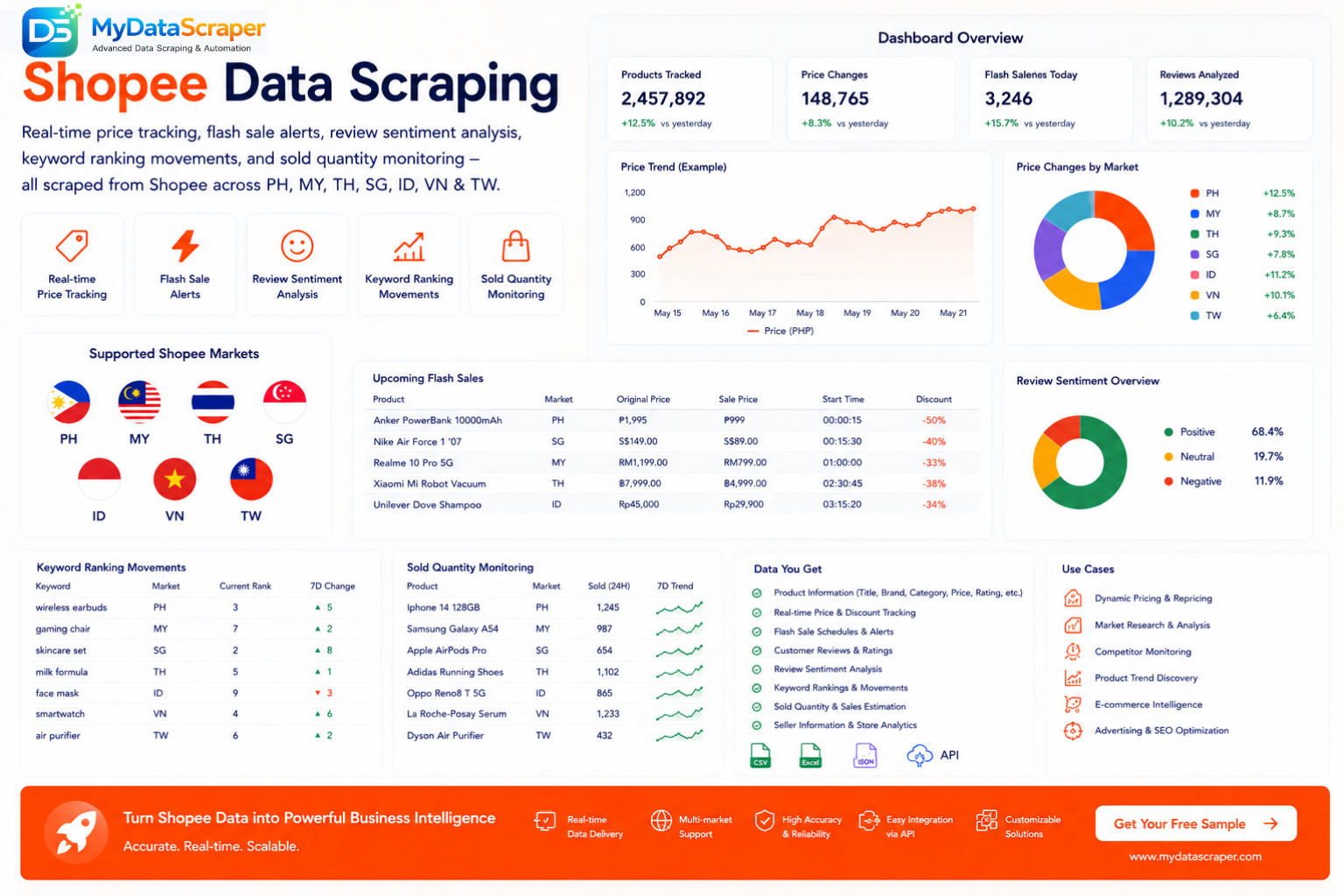
⚠️ Simulated data for illustration. Real feeds are delivered to your system via API or dashboard.
Shopee Competitor Monitoring Across All 9 Active Markets
Shopee operates with meaningfully different competitive dynamics in each market. Prices, top sellers, category leaders, and campaign schedules vary dramatically between the Philippines, Malaysia, Indonesia, and Singapore. Our scraping infrastructure covers all active Shopee markets — simultaneously if needed — with localized currency, language parsing, and geo-targeted data collection.
🌏 Cross-Market Intelligence Is a Hidden Superpower
Many product trends and pricing strategies emerge first in one Shopee market before spreading to others. Brands that first conquered Shopee Indonesia (the largest market by volume) often export their strategies to Philippines and Malaysia 3-6 months later. Cross-market monitoring lets you spot these trends before they hit your home market — and prepare accordingly. Our datasets service can deliver combined cross-market reports on a weekly basis.
Shopee Competitor Monitoring Use Cases: Sellers, Brands & Agencies
Whether you’re a solo Shopee seller managing 50 SKUs or a brand with a dedicated e-commerce team across five SEA markets, competitor intelligence fundamentally changes how you make decisions.
Independent Shopee Sellers
Solo and small-team sellers use competitor monitoring to identify pricing windows where they can undercut without entering a race to the bottom, spot flash sale opportunities they’d otherwise miss, and copy listing improvements (keyword-rich titles, more images) that are clearly working for higher-ranked competitors. One fashion accessories seller in Manila grew monthly revenue by 67% in 4 months by implementing weekly competitor analysis from our scraped data.
Brand Manufacturers & Distributors
Brands operating official Shopee Mall stores monitor authorized resellers and gray-market sellers for MAP violations, track counterfeit product listings appearing in their category, and benchmark their official store performance against resellers. We’ve helped electronics brands identify over 200 unauthorized MAP violators per week using automated monitoring, protecting both margin and brand integrity.
E-commerce Agencies & Consultants
Digital agencies managing multiple Shopee client accounts need competitive benchmarking data to justify their strategy recommendations and demonstrate value. Rather than manually checking competitor shops for each client, agencies use our API to pull structured competitor data that feeds directly into client reports and strategy dashboards. One agency serving 18 Shopee clients reduced reporting time from 40 hours per week to under 3 hours using our automated feeds.
Product Sourcing & Trading Companies
Trading companies use Shopee competitor data to identify high-demand products (via sold quantity velocity) before sourcing inventory, monitor price floors to ensure their buying prices remain profitable, and track emerging product trends in specific categories. Spotting a product with rapidly growing sold counts and limited competition is the first step to a successful sourcing bet.
Repricing & Automation Tool Builders
SaaS companies building Shopee repricing software or seller management tools need reliable, high-frequency competitor data feeds as the engine of their product. Our live scraping API powers the data layer of several third-party Shopee tools across Southeast Asia, handling the complexity of extraction so product teams can focus on algorithm development and UX.
Market Research & Investor Intelligence
Investment firms and market research companies track Shopee category leaders, monitor GMV trends by product category, and analyze consumer demand patterns across SEA markets. Shopee sold-quantity data is a powerful leading indicator of consumer sentiment that traditional retail data sources can’t provide in real time.
Shopee Monitoring: What Data Is Available vs. What Tools Typically Offer
Most off-the-shelf Shopee analytics tools offer only surface-level data. Here’s how comprehensive web scraping compares to what’s typically available through Shopee’s Seller Centre and third-party analytics tools.
| Data Point | Shopee Seller Centre | Typical SaaS Tools | MyDataScraper | Update Frequency |
|---|---|---|---|---|
| Your own product prices | ✔ Full access | ✔ Via API | ✔ Included | Real-time |
| Competitor current prices | ✘ Not available | ⚠ Limited (top 5-10) | ✔ Unlimited competitors | Every 15 min |
| Competitor price history (90 days) | ✘ Not available | ✘ Not available | ✔ Full history | Historical archive |
| Flash sale participation | ⚠ Your shop only | ✘ Not available | ✔ All competitors | Real-time detection |
| Competitor sold quantity | ✘ Not available | ⚠ Estimate only | ✔ Exact figure | Every 15 min |
| Review velocity & content | ⚠ Your shop only | ⚠ Count only | ✔ Full text + sentiment | Hourly |
| Keyword search rankings | ✘ Not available | ⚠ Top keywords only | ✔ All target keywords | Daily |
| Competitor shop-level metrics | ✘ Not available | ⚠ Basic metrics | ✔ Full shop profile | Daily |
| New competitor product alerts | ✘ Not available | ✘ Not available | ✔ Real-time alerts | Within 1 hour of listing |
| Cross-market monitoring (9 countries) | ✘ Not available | ✘ Not available | ✔ All 9 markets | Per market schedule |
How MyDataScraper Builds Your Shopee Competitor Monitoring Pipeline
From setup to ongoing intelligence delivery, here’s our proven process for building reliable Shopee data pipelines — without requiring any technical setup on your side.
Competitor & Keyword Mapping
You tell us which product categories you operate in, which competitors to monitor (by shop name or URL), and which search keywords matter most for your business. We can also run a category analysis to identify the top competitors you might not be aware of — surfacing shops ranked in the top 20 for your target keywords that you should be watching.
Scraper Configuration & Anti-Detection Engineering
Shopee uses Cloudflare protection, browser fingerprinting, and behavioral analysis to identify and block scrapers. Our engineering team configures headless browser sessions with rotating residential proxies (with IP pools specific to each Shopee market’s country), realistic user-agent rotation, and session management that mimics genuine buyer browsing patterns. We handle CAPTCHAs automatically and maintain session persistence across paginated category pages.
Scheduled & Event-Driven Collection
Standard product data runs on your chosen schedule (every 15 minutes, hourly, or daily). But we also implement event-driven triggers: when a competitor’s price changes by more than your defined threshold, or when a new flash sale is detected in your category, or when a competitor lists a new product — your system receives an alert immediately, not at the next scheduled run. This is the difference between proactive and reactive competitor management.
Data Normalization & Enrichment
Raw Shopee data arrives in inconsistent formats across markets — different currency symbols, number formatting, date displays, and product variation structures. We normalize everything: currency to ISO codes, prices to consistent decimal format, sold quantities extracted from text strings like “1.2k sold,” and review dates normalized to UTC timestamps. We also compute derived metrics like price change percentage, review velocity (reviews per day), and estimated monthly sales based on sold quantity delta.
Delivery & Integration
Data is delivered however your workflow needs it: REST API with JSON responses for custom dashboards and tools, webhook push for real-time alerts, Google Sheets auto-update for non-technical teams, CSV/Excel exports for analysts, or direct database injection into your PostgreSQL or MySQL system. All pipelines include access to our live analytics dashboard for visual monitoring without any setup.
Ongoing Maintenance & Shopee Layout Adaptation
Shopee updates its front-end every 2-4 weeks — changing CSS selectors, API endpoints, and page structures in ways that break conventional scrapers overnight. We monitor all active pipelines 24/7. When our systems detect extraction failures, automated adaptation routines attempt a fix within minutes, and our engineering team is alerted for manual intervention if needed. Clients experience less than 0.4% downtime annually across all Shopee markets.
Shopee Competitor API: Sample Integration Code
For sellers and agencies building custom dashboards or repricing logic, our live API provides programmatic access to all Shopee competitor data. Here’s how to pull a comprehensive competitor snapshot and set up a price alert webhook:
import requests
import json
from datetime import datetime

# MyDataScraper — Shopee Competitor Intelligence API
BASE_URL = "https://api.mydatascraper.com/v1/shopee"
API_KEY  = "your_api_key_here"
HEADERS  = {"Authorization": f"Bearer {API_KEY}"}

# ─── 1. Pull competitor product snapshot ───────────────────
def get_competitor_snapshot(shop_ids, market="ph"):
    params = {
        "market": market,                  # ph, my, sg, th, id, vn, tw
        "shop_ids": ",".join(shop_ids),
        "fields": "price,sold_qty,rating,review_count,stock,flash_sale,shipping",
        "include_history": "30d",         # include 30-day price history
        "include_reviews": True            # include recent review content
    }
    r = requests.get(f"{BASE_URL}/competitors/snapshot", params=params, headers=HEADERS)
    return r.json()

# ─── 2. Track keywords rankings ────────────────────────────
def get_keyword_rankings(keywords, market="ph"):
    payload = {
        "market": market,
        "keywords": keywords,              # list of target keywords
        "pages": 3,                        # scrape top 3 pages (60 results)
        "include_sponsored": True          # separate organic vs paid positions
    }
    r = requests.post(f"{BASE_URL}/keywords/rankings", json=payload, headers=HEADERS)
    return r.json()

# ─── 3. Register a price alert webhook ─────────────────────
def create_price_alert(product_ids, threshold_pct=5, webhook_url=None):
    payload = {
        "product_ids": product_ids,
        "alert_when": {
            "price_drop_pct": threshold_pct,  # alert if price drops >5%
            "flash_sale_start": True,          # alert on flash sale entry
            "stock_low": True,                # alert when stock drops low
            "review_spike": 20               # alert if +20 reviews in 24hrs
        },
        "delivery": {
            "webhook": webhook_url,
            "email": "alerts@yourshop.com"
        }
    }
    r = requests.post(f"{BASE_URL}/alerts/create", json=payload, headers=HEADERS)
    return r.json()

# ─── Run example ───────────────────────────────────────────
if __name__ == "__main__":
    # Monitor top 3 competitors in Shopee PH
    competitors = ["shop_id_111", "shop_id_222", "shop_id_333"]
    data = get_competitor_snapshot(competitors, market="ph")

    for shop in data["shops"]:
        print(f"\n🏪 {shop['shop_name']} ({shop['preferred_seller']})")
        print(f"  Products tracked: {shop['product_count']}")
        print(f"  Avg price: ₱{shop['avg_price']:,.0f}")
        print(f"  Flash sale active: {shop['flash_sale_active']}")
        print(f"  Reviews (7d): +{shop['review_velocity_7d']}")

    # Register alert for any price drops >5%
    all_products = [p["item_id"] for s in data["shops"] for p in s["products"]]
    alert = create_price_alert(all_products, threshold_pct=5,
                                webhook_url="https://yourapp.com/webhooks/shopee")
    print(f"\n✅ Alert created: {alert['alert_id']}")
🔔 Smart Alerting — Not Just Data Dumps
Many clients don’t need a constant stream of data — they need to be notified the moment something important happens. Our alert system sends targeted notifications via webhook, email, or Telegram bot when: a competitor’s price drops below yours, a flash sale starts in your category, a competitor lists a new product, or an unusual review spike is detected. This means your team can focus on running the business and only engage the data when it demands action.
Why Scraping Shopee Is Harder Than It Looks
Shopee is one of the more technically sophisticated e-commerce platforms to scrape in Southeast Asia. Understanding these challenges explains why a professional managed service pays for itself quickly.
Cloudflare Enterprise + Custom Bot Detection
Shopee runs Cloudflare’s Enterprise tier combined with their own in-house bot detection layer that analyzes browser fingerprints, JavaScript execution timing, mouse movement patterns, and request header characteristics. Standard scraping libraries (BeautifulSoup, Scrapy) are blocked within seconds. Headless browsers without anti-detection measures fail within minutes.
App-First Architecture
Shopee was originally designed as a mobile-app-first platform. Key data — particularly flash sale status, exact sold quantities, and certain promotional data — is sometimes only available through Shopee’s mobile API endpoints, not the desktop website. Our scrapers emulate mobile app requests where necessary to capture the complete data picture.
Geo-Locked Content & Country-Specific Responses
Shopee serves completely different product listings, prices, and rankings based on the user’s IP location. Scraping Shopee Philippines from a Singapore IP returns results localized to Singapore. Every market requires its own country-specific residential proxy pool to capture accurate, locally-served data.
Aggressive Rate Limiting & Session Expiry
Shopee implements aggressive rate limiting that triggers on IP level, browser fingerprint level, and behavioral pattern level simultaneously. Sessions expire faster than most platforms and require re-authentication flows. Our infrastructure manages session pools across thousands of IPs to maintain consistent data collection without triggering blocks.
Obfuscated Data Presentation
Shopee often displays sold quantities as formatted strings (“1.2k sold,” “sold 10k+”) rather than exact integers, and stock levels as vague indicators (“few left”) rather than numbers. Our parsing logic includes NLP-based quantity extraction and context-aware stock level classification that converts these fuzzy displays into structured, queryable values.
Highly Dynamic Flash Sale Ecosystem
Flash sales can start and end within 2 hours. A competitor product that’s in a flash sale at 9:00 AM may be back to full price by 11:00 AM, and you’d never know it happened. Detecting flash sales requires continuous monitoring (not just scheduled checks), which demands a resilient, always-on scraping infrastructure that standard cron-job scrapers can’t provide.
What Shopee Seller Intelligence Actually Delivers: Real Results
Here’s how the cost and outcome of Shopee competitor monitoring compares across different approaches — from manual checking to a fully managed scraping solution.
| Approach | Time Investment | Monthly Cost | Data Freshness | Competitors Tracked | Alert Speed |
|---|---|---|---|---|---|
| Manual checking | 10-15 hrs/week | Labor only (~₱15,000) | Daily at best | 3-5 shops | Hours to days |
| Basic SaaS tools | 2-3 hrs/week (setup) | $29-$199/month | Every 4-24 hrs | 5-20 products | Hours |
| DIY Python scraper | 20+ hrs setup + 5 hrs/wk maintenance | $0 + proxy costs ($150+) | Inconsistent (breaks often) | Limited by maintenance | Manual check only |
| MyDataScraper | <1 hr/week (strategy only) | From $350/month | Every 15 minutes | Unlimited | <5 minutes |
A sports equipment seller based in Kuala Lumpur was manually monitoring 5 competitor shops, spending 12 hours per week across their team. They were missing flash sales completely (only checking twice daily) and responding to competitor price cuts an average of 2.3 days after they happened. After implementing MyDataScraper’s 15-minute monitoring pipeline, their team reduced competitor analysis time to 45 minutes per week, and their average response time to competitor price changes dropped to under 20 minutes. Monthly revenue increased by MYR 28,000 in the first 90 days — a 23% improvement attributed primarily to better flash sale participation and faster price competitiveness.
✅ The Hidden ROI: Flash Sale Timing
Flash sale participation is the single highest-ROI action most Shopee sellers can take. Products in Shopee Flash Sale see an average 340% increase in sold quantity during the sale period. But most sellers participate reactively — applying weeks in advance based on guesswork. With competitor flash sale monitoring, you can see exactly which products your competitors are putting in flash sales, infer demand patterns, and plan your own submissions more strategically.
How to Turn Shopee Competitor Data into Winning Actions
1. Build a Price Band Strategy, Not a Race to the Bottom
The worst outcome of competitor price monitoring is using it to simply undercut every competitor automatically. This destroys margins across the entire category. Instead, use price history data to identify the price band where top-performing products cluster — then position yourself within that band based on your differentiation (better reviews, faster shipping, stronger brand). Only drop below the band for specific strategic moments like payday campaigns.
2. Use Review Velocity as a Leading Sales Indicator
Review count changes are a lagging indicator — by the time you see a competitor has 500 more reviews, the sales have already happened. But review velocity (rate of new reviews per day) is a leading indicator of current sales momentum. If a competitor’s review velocity triples overnight, they likely just launched a promotion or entered a flash sale. Set review velocity alerts and investigate immediately when spikes appear.
3. Monitor New Product Launches Before They Gain Traction
The easiest time to compete against a new competitor product is in the first 30 days, before it accumulates reviews, sold quantity badges, and keyword ranking history. Our new product detection alerts flag competitor launches the same day they list — giving you the opportunity to adjust your own listings or pricing before the new product finds its footing.
4. Learn from Competitor Listing Improvements
When a competitor’s ranking suddenly improves without a price change, it’s likely a listing optimization: a new main image, a keyword-stuffed title update, more product variants, or a video addition. Monitor competitor listing changes weekly and reverse-engineer what’s working in your category. This is free market research you’d otherwise have to pay a consultant to provide.
5. Use Cross-Market Data to Forecast Trends
If a product is trending in Shopee Indonesia (the largest market), there’s a high probability it will become popular in Malaysia and Philippines within 2-3 months. Use cross-market sold quantity trends to get ahead of demand before the trend arrives in your primary market. Source inventory early, optimize listings, and build reviews before competitors even notice the category heating up.
Frequently Asked Questions About Shopee Competitor Monitoring
Scraping publicly visible data from Shopee product pages — prices, sold quantities, review counts, ratings, and shop information — is generally permissible under most jurisdictions’ laws when done for competitive intelligence purposes. This data is displayed publicly without requiring a login to view. The key legal principle established in cases like hiQ Labs v. LinkedIn is that scraping publicly accessible content does not violate computer fraud laws. That said, Shopee’s Terms of Service prohibit automated data collection, which creates a ToS compliance consideration (as opposed to a legal one). MyDataScraper implements responsible scraping practices — respectful crawl rates, no login wall access, and focus on publicly visible data only. We recommend clients consult legal counsel for their specific jurisdiction and use case, particularly for commercial redistribution of the scraped data.
Shopee displays sold quantity as a cumulative total on each product listing — for example, “4,821 sold.” We scrape this figure directly as displayed, with 99.6% accuracy (the remaining 0.4% accounts for temporary display issues during Shopee maintenance windows). To calculate sales velocity (units sold within a specific period), we take the delta between two successive scrapes: if a product shows 4,821 sold at 9:00 AM and 4,863 sold at 9:15 AM, we know 42 units sold in that 15-minute window. For Shopee products displaying rounded figures like “1.2k sold” or “10k+ sold,” our parser applies intelligent normalization — rounding to the nearest significant figure and flagging the estimate precision level in the data output.
Yes, flash sale monitoring is one of our most requested Shopee features. Our system checks target competitor products every 15 minutes by default, and can be configured for 5-minute intervals for high-priority products. When a competitor product enters a flash sale (identifiable by the orange flash sale badge, discounted flash price, and countdown timer), our system immediately triggers an alert to your configured webhook or email within minutes of the change being detected. We also track flash sale metadata: sale price, percentage discount, time remaining, and quantity sold during the flash period.
We support all 9 active Shopee markets: Philippines, Malaysia, Singapore, Thailand, Indonesia, Vietnam, Taiwan, Brazil, and Mexico. Each market is scraped from country-specific residential IP pools to ensure geo-accurate results. Yes, you can monitor multiple markets simultaneously — and for cross-market analysis, we normalize data into a unified schema with a market field, making it straightforward to compare prices, ranking trends, and sales velocity across different Shopee country platforms in a single data query.
There is no hard limit on the number of shops or products you can monitor — our pricing scales with volume rather than capping coverage. Typical clients monitor between 50 and 500 competitor products. Enterprise clients (agencies and brands operating across multiple markets) monitor upwards of 10,000 product SKUs simultaneously. For category-level monitoring (tracking all products within a category rather than specific shops), we can scrape entire Shopee category pages across multiple markets, which may encompass tens of thousands of product listings per refresh cycle.
Yes. We scrape complete review data including: reviewer username, star rating, review text content (in the local language), review date, photo/video attachments (URL capture), seller response, and verified purchase status. For sentiment analysis, we offer optional NLP enrichment using multilingual models that handle Filipino (Tagalog), Bahasa Malaysia/Indonesia, Thai, Vietnamese, and Mandarin — the primary Shopee review languages. Sentiment scores are returned at both the individual review level and as a product-level composite score. Review content analysis is particularly useful for identifying competitor product weaknesses that you can exploit in your own listing copy.
For standard monitoring of specific competitor shops and products on major Shopee markets (PH, MY, SG, ID), we can have data flowing within 3-5 business days of receiving your requirements. This includes scraper configuration, anti-detection setup, data normalization, and delivery integration. For more complex setups — multiple markets simultaneously, custom NLP enrichment, or direct database injection into your existing systems — plan for 7-10 business days. Contact our team and we’ll give you a precise timeline based on your specific needs.
Yes — and this cross-marketplace intelligence is increasingly where competitive advantage is being built. We support Shopee, Lazada, TikTok Shop, Tokopedia, Blibli, and other major SEA marketplaces. Many of our clients monitor the same competitor products across Shopee and Lazada simultaneously to understand where competitors are prioritizing their pricing strategy and promotional investment. We deliver cross-platform data in a unified schema so you can compare apples to apples across marketplace. See our e-commerce APIs →
Stop Watching Competitors Win. Start Knowing What They’ll Do Before They Do It.
Join Shopee sellers across Southeast Asia who use MyDataScraper to monitor competitor prices, track flash sales, and act on market intelligence in real-time. Set up takes less than a week — and your first competitor data report is free.