Zomato Data Scraping: The Complete Guide to Extracting Restaurant Data, Menu Prices & Delivery Intelligence in 2026
With over 1.5 million restaurants across 1,000+ cities and the richest food delivery marketplace intelligence in South Asia and beyond, Zomato is the definitive data source for restaurants, cloud kitchens, food delivery businesses, and market researchers. Discover how automated Zomato data extraction transforms restaurant strategy, competitive analysis, and food delivery market intelligence.
- Why Zomato Data Is the Foundation of Restaurant Intelligence
- What Is Zomato Data Scraping?
- What Zomato Data Can Be Extracted?
- Why Zomato Intelligence Matters in 2026
- Use Cases: Who Benefits from Zomato Scraping
- Menu Intelligence: The Pricing Goldmine
- Review Mining for Restaurant Reputation
- Cloud Kitchen & Dark Kitchen Intelligence
- The Zomato Data Extraction Process
- Case Study: Cloud Kitchen Chain Scales 3x
- How MyDataScraper Delivers Zomato Intelligence
- Ethical & Legal Considerations
- Frequently Asked Questions
- Conclusion
Why Zomato Data Is the Foundation of Modern Restaurant & Food Delivery Intelligence
Zomato has transformed how India, and increasingly the world, discovers, orders, and reviews food. With over 1.5 million restaurant listings across 1,000+ cities, hundreds of millions of monthly active users, and one of the most comprehensive food delivery marketplace datasets available anywhere, Zomato is not just a platform for consumers — it is the single most important intelligence source for restaurants, cloud kitchens, food delivery businesses, food-tech investors, and market researchers operating in modern food commerce.
Every restaurant menu published on Zomato reveals pricing strategy, category positioning, and competitive dynamics. Every customer review published on Zomato is unfiltered voice-of-customer data. Every delivery time signal reveals operational capacity and market coverage. Every restaurant rating and photo count reveals market performance signals. Aggregate this data across an entire city, cuisine category, or restaurant chain — and you have market intelligence that no traditional research methodology can match in freshness, comprehensiveness, or actionability.
Yet most restaurant operators, cloud kitchen brands, and food delivery businesses access Zomato data manually — checking a few competitor restaurants, reading reviews individually, and browsing menu prices one listing at a time. This manual approach captures a tiny fraction of the intelligence available and cannot scale to the systematic monitoring that modern food business strategy requires.
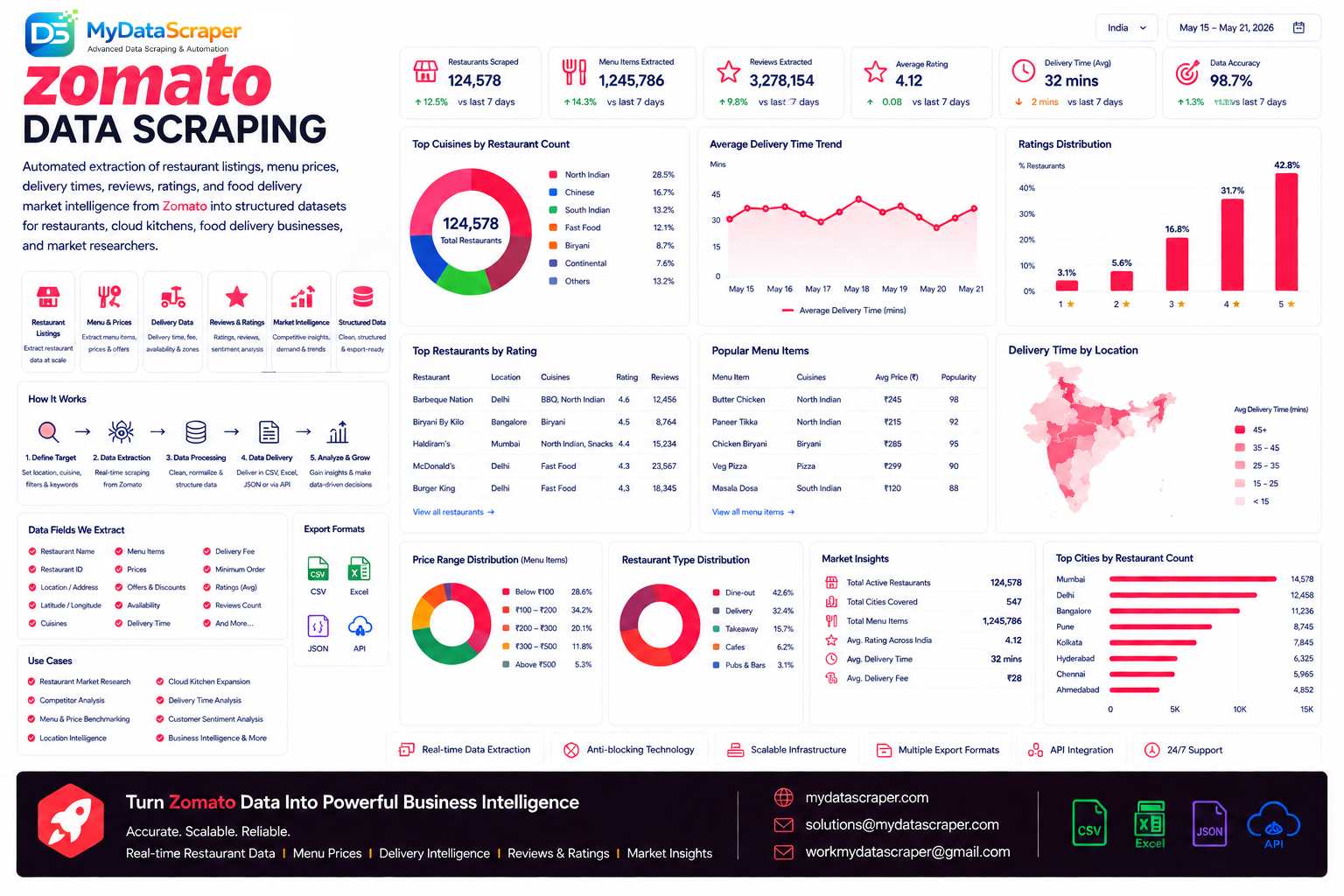
Zomato data scraping transforms this equation entirely. Automated extraction of restaurant listings, menu data, prices, reviews, ratings, and delivery intelligence from Zomato gives food businesses systematic access to the market intelligence that powers smarter menu pricing, deeper competitive analysis, better location decisions, and stronger operational strategy. At MyDataScraper, we build custom Zomato data scraping solutions that deliver this intelligence in CSV, JSON, or Excel — clean, structured, and ready for immediate business use.
The Zomato Intelligence Advantage: Zomato is the only platform that combines comprehensive restaurant discovery data, real-time menu pricing, delivery operational signals, and voice-of-customer reviews into a single publicly accessible ecosystem. Businesses that build systematic extraction pipelines for Zomato data operate with restaurant market intelligence that no traditional food industry research provider can match. Our food delivery data scraping services unlock this intelligence at scale.
What Is Zomato Data Scraping?
Zomato data scraping is the automated collection of publicly available restaurant and food delivery data from Zomato — including restaurant listings, complete menu data with item names and prices, customer reviews and ratings, delivery time estimates, restaurant photos, cuisine classifications, operating hours, and geographic location data.
Instead of manually browsing Zomato restaurant by restaurant — a process that captures perhaps 20-30 competitors per hour of research — automated Zomato scraping systematically extracts data across entire cities, cuisine categories, or delivery zones. A single extraction can capture data on 5,000 restaurants across a city, complete with their menus, pricing, reviews, and delivery metrics — delivered as a structured dataset ready for immediate analysis.
Key capabilities that make Zomato scraping uniquely valuable for food businesses:
- Menu intelligence at scale — every item, every price, every restaurant in your competitive set
- Cuisine category monitoring — track pricing and competition across entire food categories
- Geographic delivery zone analysis — understand market coverage and competitive density by area
- Rating and review aggregation — voice-of-customer intelligence across thousands of restaurants
- Cloud kitchen & dark kitchen mapping — identify delivery-only operators emerging in each market
- Delivery time benchmarking — operational performance signals across your competitive set
The Restaurant Market Difference: Zomato data provides intelligence you simply cannot get from any other source — the actual current prices on active menus, the real-time customer sentiment across thousands of reviews, and the operational delivery signals that reveal market dynamics. This is the foundation of every modern restaurant menu data extraction strategy.
What Zomato Data Can Be Extracted?
🏢 Restaurant Profile Data
- Restaurant name and Zomato URL
- Complete address and geographic location
- Cuisine types and categories
- Restaurant type (dine-in, delivery-only, cloud kitchen)
- Operating hours (daily breakdown)
- Phone number and contact info (where displayed)
- Average cost for two people
- Price range indicator (₹, ₹₹, ₹₹₹)
- Restaurant photos and cover images
- Chef/owner information (where displayed)
🍽️ Menu Data
- Complete menu structure with categories
- Individual dish/item names
- Item descriptions and ingredients
- Current item pricing
- Item photos
- Vegetarian/non-vegetarian classification
- Bestseller and recommended items
- Combo and meal deal pricing
- Add-on and customization options
- Menu item popularity signals
⭐ Reviews & Ratings
- Overall restaurant rating (out of 5)
- Total review count
- Delivery rating separately from dine-in rating
- Individual review text
- Reviewer name and profile
- Review date
- Star rating per review
- Review photos
- Owner response to reviews
- Rating trend over time
🚴 Delivery & Operations Data
- Delivery time estimate
- Minimum order value
- Delivery fee
- Available payment methods
- Delivery availability by area
- Currently open/closed status
- Serviceability radius
- Currently accepting orders indicator
🎯 Offers & Promotions
- Zomato Pro member offers
- Restaurant-specific discount codes
- Percentage-off promotions
- Free delivery offers
- Combo deals and meal bundles
- Happy hours and time-based offers
At MyDataScraper, we extract exactly the Zomato data fields your food business strategy requires — delivered in CSV, JSON, or Excel, or as continuous data feeds through our food delivery APIs.
Why Zomato Intelligence Matters More Than Ever in 2026
Menu Prices Are Now Dynamic — And Competitors Are Adjusting Constantly
Modern restaurants and cloud kitchens update menu prices frequently in response to ingredient costs, delivery fees, competitor pricing, and demand patterns. Without automated price monitoring, you're always pricing based on data that's already outdated. Real-time Zomato menu extraction reveals exactly what competitors charge for equivalent items, right now.
Cloud Kitchen Explosion Is Reshaping Competitive Landscapes
Cloud kitchens and dark kitchens have proliferated across food delivery markets — creating hundreds of "virtual restaurants" that compete for the same delivery orders as traditional restaurants. Systematic Zomato data extraction reveals these delivery-only operators (invisible through traditional restaurant industry data), their menu strategies, and their competitive positioning. Our cloud kitchen data intelligence service is specifically designed for this analysis.
Delivery Time Is the New Price Differentiator
Consumer research consistently shows that delivery time is a top-3 decision factor in food delivery — often more important than price differences of 10-15%. Monitoring competitor delivery time performance on Zomato reveals operational competitive positioning that traditional restaurant metrics ignore entirely.
Reviews Drive Buying Decisions in Food Delivery
Over 78% of food delivery customers read at least one review before ordering from a new restaurant. Systematic Zomato review extraction across your competitive set reveals what customers value, what triggers negative reviews in your category, and how your reputation performance compares to direct competitors. Our review and rating data extraction services transform this unstructured feedback into structured business intelligence.
"In modern food delivery, restaurant operators who don't monitor Zomato systematically are competing blind. Menu pricing changes, new competitor entries, delivery time shifts, and review sentiment trends all happen faster than manual monitoring can track. The restaurants and cloud kitchens winning in 2026 are those with automated Zomato intelligence pipelines feeding their pricing, operations, and marketing decisions." — Food Delivery Market Intelligence Report, 2026
Use Cases: Who Benefits from Zomato Data Scraping
🍽️ Restaurant Menu Pricing Strategy
Extract complete menu data from direct competitors in your area to inform your own menu pricing. Understand how competitors price equivalent items, what combo strategies drive volume, and where pricing gaps create opportunities for margin or market share optimization. Combined with our dynamic pricing intelligence solution, this becomes the foundation of data-driven menu management.
☁️ Cloud Kitchen & Ghost Kitchen Intelligence
Cloud kitchen operators use Zomato scraping to map the entire delivery-only restaurant landscape in their target markets — identifying competitor kitchens, monitoring their menu strategies, tracking new entrants, and detecting operational patterns that reveal successful cloud kitchen playbooks.
🚴 Food Delivery App Competitive Intelligence
Food delivery platforms and aggregators use Zomato data extraction to benchmark restaurant availability, menu pricing consistency, and delivery time performance across markets — informing their own restaurant partnership strategies and pricing negotiations.
📊 Restaurant Chain Multi-Location Management
Restaurant chains use Zomato scraping to monitor their own listing performance across every location, compare local competitor pricing, track rating trajectories by outlet, and identify operational issues (delivery time problems, low ratings) at specific locations before they impact business.
🏙️ New Location & Market Entry Research
Before opening a new restaurant or expanding to a new city, extract comprehensive Zomato data from the target market — competitive density by cuisine, price point distributions, rating benchmarks, and identifying underserved cuisine categories or geographic pockets. Essential for de-risked expansion decisions.
💰 Food-Tech Investment & Market Analysis
Food-tech investors, VCs, and market analysts use Zomato data as alternative data — tracking restaurant chain growth, cloud kitchen brand expansion, delivery time trends, and pricing dynamics across markets to inform investment thesis validation and portfolio company monitoring.
⭐ Restaurant Reputation Management
Restaurants systematically monitor their own Zomato reviews and competitor reviews to identify service quality patterns, respond promptly to negative reviews, and understand what content drives 5-star vs 1-star reviews in their category.
🛒 Food Delivery Data Products & SaaS
Food-tech SaaS companies building restaurant analytics platforms, menu optimization tools, or delivery intelligence products use Zomato data as core input — building their platform value on the systematic extraction pipelines that our food delivery APIs deliver.
Review Mining for Restaurant Reputation & Competitive Sentiment Analysis
Zomato reviews are unfiltered voice-of-customer data at massive scale. Systematic extraction and analysis of Zomato reviews reveals:
- What triggers 5-star reviews: Consistent themes in positive reviews reveal what customers value most in your category — insights that directly inform service positioning
- What triggers 1-star reviews: Common complaint patterns reveal category-wide pain points — solving these creates competitive differentiation
- Delivery quality specifically: Zomato separates delivery rating from dine-in rating, revealing operational vs food quality signals separately
- Response rate benchmarks: Which competitors respond to reviews (and how quickly), revealing their customer service investment
- Rating trajectory patterns: Whose ratings are improving vs declining over time — leading indicators of business health
- Cuisine-specific expectations: What customers expect from a "Bengali restaurant" vs a "North Indian restaurant" — the review content reveals category norms
- New menu item reception: Reviews often mention specific items — sentiment on new launches informs menu iteration
For restaurant chains and multi-location operators, systematic review monitoring across all locations enables centralized reputation intelligence with location-level benchmarking — turning what would be a manual, incomplete process into a comprehensive quality management system.
Cloud Kitchen & Dark Kitchen Intelligence: The Fastest-Growing Segment on Zomato
Cloud kitchens (also called dark kitchens or ghost kitchens) are the fastest-growing category on food delivery platforms — brands that exist only for delivery, with no dine-in presence. Zomato has become the primary discovery and distribution channel for cloud kitchens, making it the essential data source for anyone competing in or investing in this space.
What Zomato data reveals about cloud kitchen dynamics:
- Cloud kitchen mapping: Identify every delivery-only brand operating in your target market and cuisine category
- Multi-brand operator detection: Cloud kitchen operators often run multiple brands from the same kitchen — patterns in Zomato listings reveal these operators
- Brand launch velocity: How fast are new cloud kitchen brands entering your category? Which succeed and which disappear?
- Menu strategy patterns: How do successful cloud kitchens structure menus differently from traditional restaurants?
- Delivery-only pricing dynamics: Do delivery-only brands price differently than dine-in restaurants for equivalent items?
- Geographic expansion patterns: Track which cloud kitchen brands are expanding to new cities and how fast
Cloud Kitchen Data as Strategic Intelligence: The cloud kitchen segment is opaque to traditional restaurant industry data providers — these brands often lack public storefronts, formal industry classifications, or standard business databases. Zomato is the primary source of visibility. Systematic extraction reveals this hidden competitive landscape that manual research cannot capture. Contact us about our cloud kitchen data intelligence service.
The Zomato Data Extraction Process: Step by Step
Step 1: 🎯 Scope & Intelligence Requirements Definition
We start by defining your extraction scope — target cities, cuisine categories, competitor restaurants, data fields required, and update frequency needs. Whether you need comprehensive monitoring of 5,000 restaurants across a city or focused tracking of 20 direct competitors, we scope the extraction precisely.
Step 2: 🔧 Custom Zomato Scraper Engineering
Our engineers build scrapers purpose-built for Zomato's architecture — handling dynamic menu loading, review pagination, geographic search results, restaurant detail extraction, and Zomato's anti-bot measures. Every scraper is custom-engineered for reliable, comprehensive data collection.
Step 3: 🧹 Data Cleaning & Menu Normalization
Zomato data requires specialized cleaning — menu item name normalization (spelling variations, translation), price format standardization, cuisine category standardization, restaurant deduplication (same restaurant appearing in multiple searches), and review data structuring. We deliver clean, analysis-ready datasets.
Step 4: 📦 Structured Delivery & Integration
Clean Zomato data is delivered in CSV, JSON, or Excel — or delivered as continuous data feeds through our API-based data delivery services, integrated directly with your restaurant management systems, BI dashboards, or analytical tools.
Step 5: 🔄 Ongoing Monitoring & Refresh
For continuous intelligence, we configure scheduled data scraping — daily menu price refreshes, weekly new restaurant detection, monthly comprehensive market updates. Your Zomato intelligence stays perpetually current rather than degrading over time.
Case Study: How a Cloud Kitchen Chain Scaled Revenue 3x in 14 Months Using Zomato Intelligence
A cloud kitchen chain operating 8 delivery-only brands across 4 major Indian cities was struggling with menu pricing and competitive positioning. Their operations team was manually checking competitor menus once per week, extracting data into spreadsheets, and adjusting prices reactively — a process that consumed 20+ hours weekly but covered less than 5% of their competitive landscape.
The core problem was clear: they were pricing menu items based on intuition and outdated snapshots, missing competitor promotional cycles, and unaware of new cloud kitchen brands entering their categories until those competitors had already captured significant share.
After partnering with MyDataScraper, we built a comprehensive Zomato intelligence pipeline:
What Was Built
- Daily menu extraction from 400+ competing restaurants across 4 cities (biryani, Chinese, pizza, and pan-Asian categories where their brands compete)
- Complete menu data: item names, descriptions, prices, categories, bestseller flags, combo pricing
- Weekly review sentiment extraction for their own brands and top 15 competitors — flagging quality issues at specific outlets
- Cloud kitchen brand detection — weekly reports on new delivery-only brands entering their categories
- Delivery time benchmarking across their outlets vs direct competitors
- Rating trajectory monitoring — tracking their own rating movements vs competitive set weekly
- Data delivered daily in Excel with Slack alerts for significant competitor menu changes and new cloud kitchen entries
Results After 14 Months
3x revenue growth across the cloud kitchen chain within 14 months. 18% improvement in average order value from data-driven menu pricing and combo restructuring. 2 new brand launches in previously unmonitored underserved cuisine categories identified through the extraction pipeline. 32% reduction in operations team time spent on manual competitive research — freed for actual menu strategy and marketing execution.
The single highest-impact insight came from menu category analysis: they discovered that competitors in the biryani category were charging premium prices for family-pack combos that their brands weren't offering. Adding family-pack combos to their biryani brands increased that category's revenue by 41% within 60 days.
Contact MyDataScraper today to build your Zomato intelligence solution.
How MyDataScraper Delivers Zomato Intelligence That Drives Restaurant Revenue
At MyDataScraper, Zomato data extraction is one of our specialized food delivery intelligence services — used by restaurants, cloud kitchen chains, food-tech companies, and investment firms across India and international markets where Zomato operates. Here's what makes our approach uniquely effective:
🍽️ Food Delivery Domain Expertise
We understand Zomato's data ecosystem at depth — menu structure conventions, cuisine categorization taxonomies, cloud kitchen identification signals, delivery time interpretation, and the pricing dynamics specific to food delivery marketplaces. This domain knowledge is embedded in how we extract, clean, and deliver Zomato data.
📊 Menu Intelligence Specialization
Our menu extraction goes beyond basic item names and prices — we capture complete menu structure, category organization, combo relationships, bestseller identification, and item variant pricing. This depth enables the category-level intelligence that transforms menu strategy.
☁️ Cloud Kitchen Detection & Mapping
Our extraction methodology includes cloud kitchen identification — distinguishing delivery-only operators from traditional restaurants, and mapping the emerging cloud kitchen landscape in your target markets. Contact us about our cloud kitchen data intelligence service.
🔗 Multi-Platform Food Delivery Coverage
Beyond Zomato, we build unified pipelines that combine Zomato with Swiggy data, delivery aggregators, and other food platforms — giving you complete visibility across the entire food delivery landscape rather than platform-specific silos.
📦 Flexible Delivery & Integration
Zomato intelligence is delivered in CSV, JSON, or Excel — or integrated via live scraping APIs, delivered to your BI dashboards through our web scraping dashboards, or pushed to your restaurant management systems via automated pipeline.
Ethical & Legal Considerations for Zomato Data Scraping
✅ Compliant Practices We Follow
- Collect only publicly displayed restaurant, menu, and review data visible to any Zomato user
- Respect Zomato's terms of service and implement appropriate rate limiting
- Use data for legitimate business intelligence, competitive analysis, and market research purposes
- Never collect Zomato customer personal data, order history, or account information
- Comply with applicable data privacy regulations
- Maintain proper data security for all extracted information
- Anonymize individual reviewer data where appropriate for aggregate analysis
- Focus on publicly published restaurant business data
❌ Practices We Strictly Avoid
- Accessing Zomato customer accounts, order data, or private user information
- Collecting individual consumer data for targeting or profiling
- Sending request volumes that could impact Zomato's platform performance
- Republishing scraped reviews as original content
- Creating fake accounts to access restricted data areas
- Using data for restaurant sabotage, review manipulation, or unfair competitive practices
- Bypassing authentication systems aggressively
Legal Context: Zomato publicly displays restaurant listings, menu data, prices, and reviews specifically for consumer access and discovery. Collecting this publicly displayed data for legitimate business intelligence is consistent with general data access principles. However, terms of service restrictions and applicable data privacy laws (especially for reviewer data) apply. MyDataScraper builds compliance considerations into every Zomato project.
Frequently Asked Questions
Can complete restaurant menu data be extracted from Zomato?
Yes — we extract complete menu data including item names, descriptions, prices, categories, bestseller flags, combo pricing, and add-on options. Menu data is one of the most valuable extractions for restaurant clients, enabling comprehensive competitive menu analysis and pricing benchmarking.
Can Zomato reviews be extracted at scale for sentiment analysis?
Absolutely. We extract complete review datasets — text, star ratings, dates, reviewer names, and delivery vs dine-in ratings. For clients who need ready-to-analyze intelligence, we can apply automated sentiment classification and theme extraction to identify common praise and complaint patterns. Learn more about our review and rating data extraction services.
Can Zomato data be combined with Swiggy data for unified food delivery intelligence?
Yes — this is one of our most popular configurations. We build unified pipelines combining Zomato with Swiggy data scraping and other food delivery platforms into a single cross-platform intelligence dataset, giving you complete visibility across all major delivery channels in your market.
Can cloud kitchens and delivery-only brands be identified in the extraction?
Yes — we build cloud kitchen detection into Zomato extraction pipelines, distinguishing delivery-only operators from traditional restaurants and mapping the emerging cloud kitchen landscape in your target markets. See our cloud kitchen data intelligence service for details.
How many Zomato restaurants can be monitored?
Volume scales to your requirements — from focused monitoring of 20 direct competitors to comprehensive city-wide extraction of 10,000+ restaurants. Our infrastructure handles any scale. Contact us for volume-specific estimates.
What format is Zomato data delivered in?
We deliver Zomato data in CSV, JSON, or Excel — and can integrate directly with restaurant management systems, BI dashboards, or business intelligence tools via API-based data delivery. Data arrives clean, structured, and ready for immediate analysis.
How quickly can a Zomato scraping project be launched?
Standard Zomato extraction projects are built and delivering data within 5 to 8 business days of project kick-off. Focused projects (single city, limited competitor set) can often launch faster. Contact our team today for a timeline estimate based on your requirements.
Zomato Contains the Restaurant Market Intelligence That Powers Every Winning Food Business — Are You Accessing It Systematically?
Zomato is not just a food ordering platform — it is the world's most comprehensive database of restaurant intelligence, menu data, customer reviews, and food delivery market dynamics for the markets it serves. Every restaurant operator, cloud kitchen brand, food delivery business, and food-tech investor competing seriously in these markets needs systematic access to Zomato data. The businesses that build automated extraction pipelines gain menu pricing intelligence, competitive visibility, cloud kitchen landscape awareness, and review sentiment intelligence that transforms strategic decision-making.
At MyDataScraper, we build custom Zomato data extraction solutions tailored to your specific food business intelligence needs — restaurant listing extraction, menu price monitoring, review mining, cloud kitchen mapping, delivery time benchmarking, and comprehensive food delivery market analysis — delivered in CSV, JSON, or Excel, integrated into your restaurant management and analytical systems.
Explore our related services: Zomato data scraping service, food delivery data scraping, Swiggy data scraping, restaurant menu data extraction, and cloud kitchen data intelligence. The intelligence that could transform your restaurant strategy is on Zomato right now.
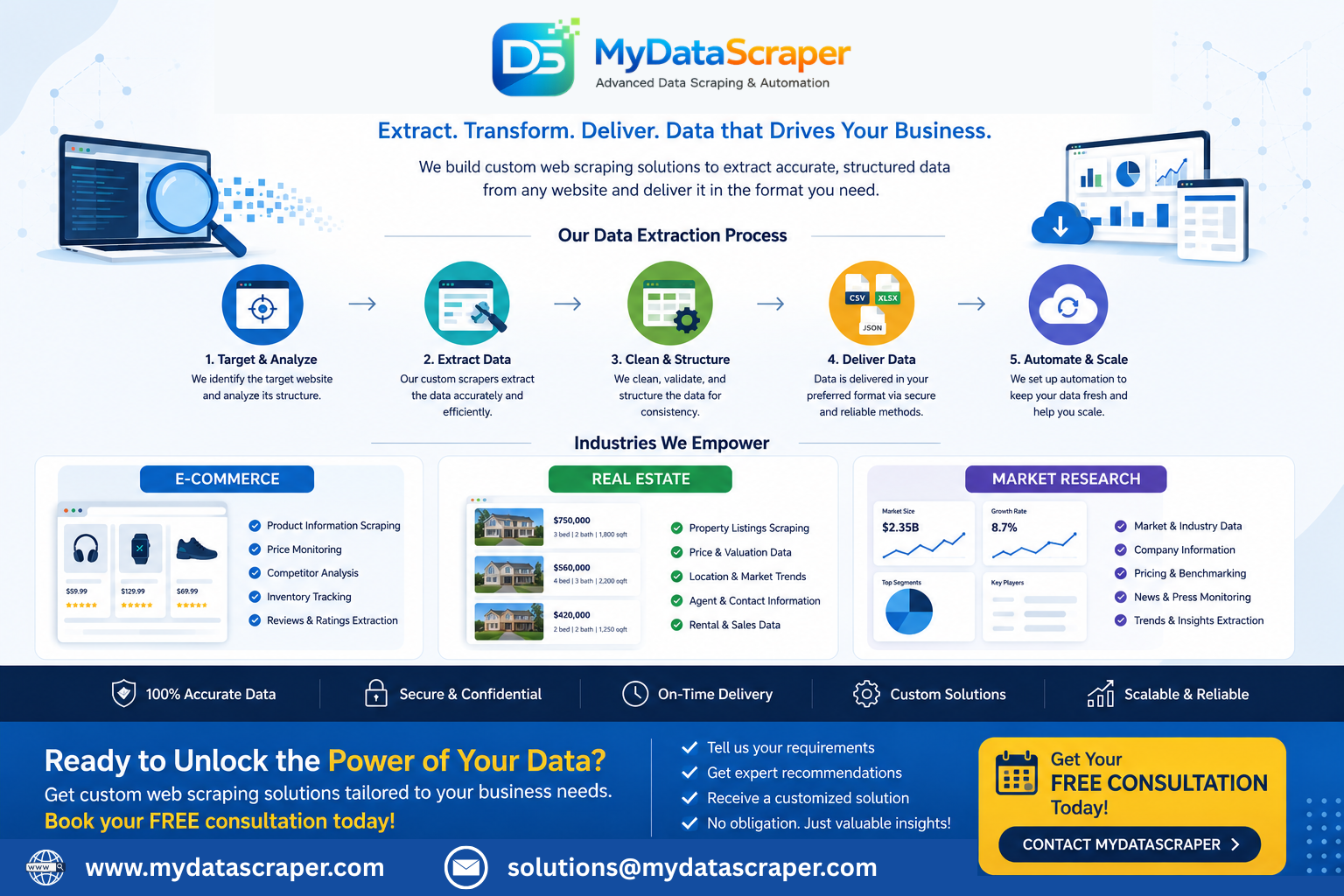
Ready to build your Zomato data advantage? Contact MyDataScraper for a free consultation — or visit mydatascraper.com to explore all our food delivery data scraping services.
Written by the MyDataScraper Team
MyDataScraper is a leading provider of custom web scraping and data extraction solutions for Zomato, Swiggy, and other major food delivery platforms. We help restaurants, cloud kitchen chains, food-tech companies, and investment firms extract the food delivery intelligence that drives smarter menu strategy, better competitive positioning, and stronger revenue growth. Learn more at mydatascraper.com or contact our team today for a free consultation.