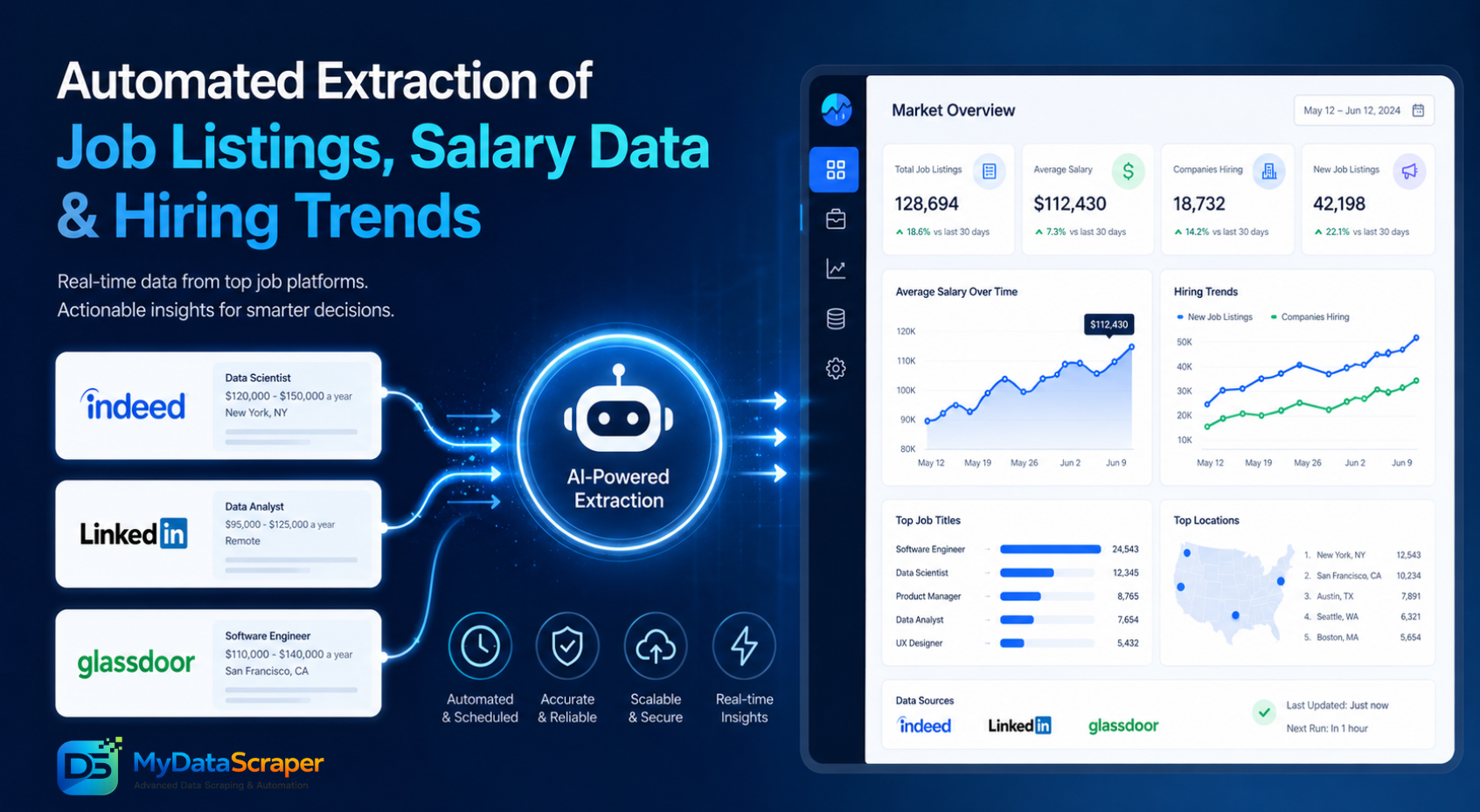
Why Job Market Data Is a Strategic Intelligence Goldmine
Every single day, companies across the globe publish hundreds of thousands of new job listings. Each one is far more than a recruitment advertisement — it’s a strategic signal. A company hiring 50 AI engineers is telling you where their product roadmap is heading. A startup posting its first sales roles is signaling imminent market entry. A competitor scaling customer success hires reveals they’ve hit product-market fit. A wave of CFO postings across an industry signals restructuring or M&A activity.
These signals are publicly available — published on job boards, company career pages, and professional networks for anyone to see. Yet most businesses, recruiters, and analysts access this intelligence manually, one listing at a time, with no systematic way to aggregate, compare, and act on job market data at scale.
In 2026, the organizations gaining the biggest strategic advantages from job market intelligence are those using web scraping for job market data — automated collection of job listings, salary information, hiring trends, skills demand, and workforce composition data from across the entire job market ecosystem. This data powers everything from recruitment pipeline optimization to competitive intelligence, salary benchmarking, workforce planning, and investment signal generation.
In this guide, we’ll show you exactly how job listing data extraction works, who benefits most, which platforms to target, what data can be collected, and how MyDataScraper builds custom job market intelligence solutions that deliver this data in CSV, JSON, or Excel — ready for immediate analysis.
New job postings published daily across global job boards and company websites
Global HR analytics market in 2026 fueled by demand for data-driven talent decisions
Of companies say workforce data is now critical to strategic business planning
ROI reported by staffing agencies using automated job data extraction vs manual sourcing
What Is Web Scraping for Job Market Data?
Web scraping for job market data is the automated extraction of publicly available job posting information — job titles, descriptions, qualifications, salary ranges, company names, locations, posting dates, and application details — from job boards, career pages, professional networks, and recruitment platforms.
Unlike manually searching job boards or subscribing to expensive HR data vendors, web scraping builds a custom intelligence pipeline that automatically collects exactly the job market data you need, from exactly the sources you specify, at whatever frequency your analysis requires — and delivers it in clean, structured formats ready for immediate use.
Beyond Recruiting: While recruiters are the most obvious beneficiaries of job data extraction, the intelligence value extends far beyond hiring. Investors use hiring data as leading economic indicators. Competitive intelligence teams decode competitor strategy through their job postings. Workforce planners use aggregate demand data to forecast talent supply shortages. Market researchers track technology adoption through skills demand trends. The use cases are remarkably diverse.
Job Data Extraction in Action: The Hiring Intelligence Feed
Here’s a visualization of what a job listing data extraction pipeline actually delivers — the structured intelligence MyDataScraper provides from public job sources:
This is just a snapshot. Automated hiring intelligence extraction delivers thousands of structured records daily — complete with job titles, companies, salary ranges, locations, required skills, experience levels, benefits, and posting metadata. Every data point becomes part of a growing intelligence database that powers recruitment, competitive strategy, salary benchmarking, and workforce planning.
Why Job Market Intelligence Matters More Than Ever in 2026
The Talent Market Is the Most Competitive in a Generation
Skills shortages across technology, healthcare, finance, and engineering have made talent acquisition the top strategic challenge for most organizations. Recruiters who can identify opportunities and candidates faster — using data-driven intelligence rather than manual searching — fill roles in half the time at significantly lower cost.
Salary Transparency Is Reshaping Compensation Strategy
New pay transparency laws in California, New York, Colorado, Washington, and the EU are requiring salary ranges in job postings. This creates an unprecedented opportunity for salary data scraping — building comprehensive compensation benchmarks from millions of actual posted salary ranges rather than relying on expensive, outdated salary surveys.
Job Postings Are Leading Economic Indicators
Aggregate hiring activity is one of the most reliable leading indicators of economic health. Increasing job postings signal growth; declining postings signal contraction. Investors, economists, and business strategists who track these signals systematically gain a significant forecasting advantage.
AI & Technology Adoption Is Visible Through Skills Demand
The fastest way to understand which technologies companies are actually adopting — not just talking about — is to look at what skills they’re hiring for. A surge in “LLM Engineer” postings tells you more about actual AI adoption than any press release or analyst report.
“Job posting data is the most underutilized source of competitive intelligence available today. Every company publishes their strategic priorities in plain sight through the roles they hire for — most businesses just never think to systematically collect and analyze this information.”— Workforce Intelligence Strategist, 2026
Top Platforms for Job Market Data Extraction
The job data ecosystem is vast and diverse. Here are the primary platforms from which MyDataScraper extracts hiring intelligence:
Indeed
The world’s largest job site with millions of listings across every industry and geography — job titles, descriptions, salary estimates, company ratings, and reviews.
LinkedIn Jobs
Professional network job listings with company size, industry, applicant counts, seniority levels, and posted salary ranges from millions of employers.
Glassdoor
Job listings combined with company reviews, salary reports, interview questions, and employer ratings — rich context for competitive talent intelligence.
ZipRecruiter
High-volume job board with salary estimates, employer verification, and quick-apply data across diverse industries and experience levels.
Company Career Pages
Direct employer career sites for the most accurate, first-party job posting data — often with salary ranges, benefits, and team information not listed elsewhere.
Niche Job Boards
Specialized platforms like AngelList (startups), Dice (tech), BuiltIn (tech hubs), Healthcare JobFinder, and industry-specific boards for targeted intelligence.
Government Job Databases
USAJobs, EU public sector portals, and government employment databases for public sector hiring trends and wage scale intelligence.
International Job Platforms
StepStone (Europe), Seek (APAC), Naukri (India), and regional job platforms for global workforce intelligence and market entry research.
Freelance & Gig Platforms
Upwork, Fiverr, Toptal, and freelance marketplaces for gig economy trends, freelance rate intelligence, and skills demand in the contingent workforce.
Complete Job Data Dictionary: What Can Be Extracted
| Data Category | Specific Extractable Fields | Intelligence Application |
|---|---|---|
| Job Details | Title, description, department, seniority level, employment type (FT/PT/contract) | Role mapping, skills demand, competitive analysis |
| Compensation Data | Salary range (min/max), bonus structure, equity mentions, benefits listed | Salary benchmarking, compensation strategy, pay equity analysis |
| Company Information | Company name, industry, size, headquarters, Glassdoor rating, funding stage | Employer intelligence, competitive hiring analysis |
| Location & Work Model | City, state, country, remote/hybrid/on-site designation, relocation offered | Geographic talent demand, remote work trends, office expansion signals |
| Skills & Qualifications | Required skills, preferred skills, certifications, education requirements, years of experience | Skills gap analysis, training needs, technology adoption tracking |
| Posting Metadata | Post date, expiration date, days active, number of applicants, easy apply availability | Hiring velocity, market competitiveness, posting effectiveness |
| Benefits & Perks | Healthcare, 401k, PTO, remote flexibility, learning budgets, stock options | Benefits benchmarking, employer branding intelligence |
| Recruiter & Source Data | Recruiter name, agency name, direct vs agency posting, source platform | Recruitment market analysis, agency competitive intelligence |
At MyDataScraper, we extract exactly the data fields your workforce analysis requires — delivered in CSV, JSON, or Excel, ready for your HR analytics platform, BI tool, or research environment.
High-Impact Use Cases for Job Market Data Scraping
Recruitment Pipeline Optimization
Aggregate new job postings from dozens of boards and career pages into a single feed — giving recruiters and staffing agencies instant access to every relevant opening without manually checking 30 websites daily.
Salary Benchmarking & Compensation Intelligence
Build comprehensive salary databases from millions of posted compensation ranges — segmented by role, seniority, location, industry, and company size — for data-driven compensation strategy at a fraction of survey costs.
Competitor Hiring Analysis
Monitor competitor job postings to decode their strategic priorities — which teams are growing, what technologies they’re adopting, where they’re expanding, and which leadership roles signal strategic pivots or M&A activity.
Labor Market Trend Analysis
Track aggregate hiring trends across industries, geographies, and skill categories to identify workforce shifts, emerging talent shortages, and hot job markets — critical intelligence for workforce planning and economic forecasting.
Technology & Skills Demand Tracking
Monitor which programming languages, tools, frameworks, and certifications are appearing most frequently in job postings — providing a real-time map of technology adoption across industries that guides training, curriculum, and product strategy.
Investment Signal Generation
Use aggregate hiring velocity as a leading indicator of company and sector growth. Increasing engineering hires signal product development. Surge in sales hires signals go-to-market acceleration. Declining postings signal contraction — all visible weeks before earnings reports.
Workforce Planning & Supply Analysis
Understand talent supply vs demand dynamics in specific skill categories and geographies — informing decisions about where to locate offices, which roles to outsource, and where talent competition will drive compensation inflation.
HR Tech Product Data Layer
Power HR technology platforms, ATS systems, compensation tools, and workforce analytics products with comprehensive job market data feeds — giving your product a data advantage that competitors building on limited vendor feeds cannot match.
Salary Benchmarking with Scraped Job Data: A Visual Example
With pay transparency laws expanding rapidly, millions of job postings now include explicit salary ranges. Here’s how scraped salary data translates into actionable compensation intelligence:
This is the kind of salary intelligence that traditional compensation surveys charge $20,000–$100,000 per year for — and those surveys are typically 6-12 months outdated by the time you receive them. Scraped salary data from live job postings is current to within 24 hours and covers every role, seniority level, geography, and industry where pay transparency exists — at a fraction of survey costs.
Game-Changing Opportunity: With pay transparency legislation expanding across the US and EU, the volume of publicly available salary data is growing exponentially. Companies that build systematic salary data scraping programs now will have years of proprietary compensation intelligence by the time their competitors start thinking about it. This is a compounding data advantage — and MyDataScraper can help you build it today.
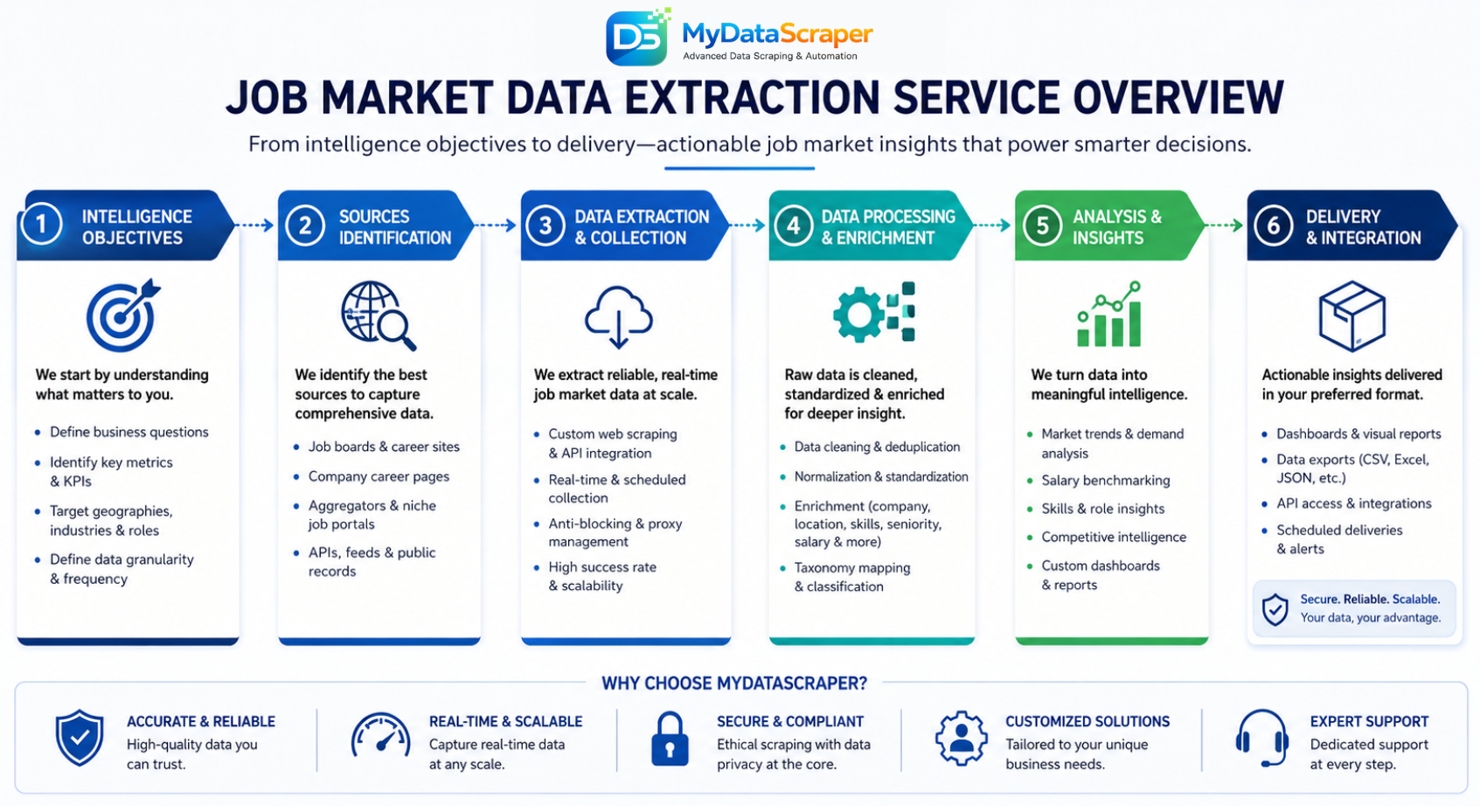
The Job Data Extraction Process: Step by Step
🎯 Intelligence Objectives Definition
We start by understanding your specific job market intelligence needs — recruitment pipeline building, salary benchmarking, competitor monitoring, skills demand tracking, or investment signal generation. Each objective shapes the platforms targeted and data fields extracted.
🗺️ Platform & Source Selection
Based on your objectives, we identify the specific job boards, company career pages, niche platforms, and geographic markets that will yield the most relevant intelligence. Source selection quality directly determines data quality and coverage.
🔑 Keyword & Filter Configuration
We configure precise search parameters — job titles, skills, locations, companies, industries, experience levels, salary ranges — that the scrapers will use to target exactly the postings matching your intelligence requirements.
🔧 Custom Scraper Development
Our engineering team builds platform-specific scrapers that handle each job board’s unique structure, pagination, dynamic content loading, anti-bot measures, and data presentation format. Every scraper is custom-built for maximum data completeness.
🧹 Data Cleaning & Standardization
Raw job data requires specialized cleaning — title normalization, salary range standardization, location geocoding, company name deduplication, skills taxonomy mapping, and posting deduplication across multiple sources that list the same job.
📦 Delivery in Your Preferred Format
Clean, structured job market data is delivered in CSV, JSON, or Excel — or pushed directly to your ATS (Applicant Tracking System), HR analytics platform, BI tool, or database via automated pipeline on your required schedule.
🔄 Continuous Collection & Historical Database
Job market data is perishable — postings appear and expire daily. We configure continuous collection that captures new postings in real time while building a growing historical database for trend analysis, salary benchmarking, and longitudinal workforce intelligence.
How a Staffing Agency Grew Their Placement Pipeline 5x Using Automated Job Data Extraction
A mid-size IT staffing agency with 22 recruiters was stuck in a manual sourcing cycle. Their recruiters spent the first 2 hours of every day manually browsing Indeed, LinkedIn, and client career pages to find new job openings matching their candidate pool. By the time they identified opportunities and made contact, competitors who found the listings first had already submitted candidates. They were consistently late to opportunities and losing market share.
After partnering with MyDataScraper, we built a comprehensive job listing intelligence pipeline:
- Automated daily extraction of all new IT/engineering job postings from 14 major job boards and 200+ target company career pages
- Intelligent matching against their candidate database — flagging postings that matched available candidates’ skills and preferences
- Salary intelligence layer extracting compensation ranges for every role — enabling data-backed rate negotiations with clients
- Competitor staffing agency monitoring — tracking which agencies were advertising which roles and at what rates
- Daily Excel report delivered at 6:00 AM with prioritized opportunity shortlist for each recruiter’s specialty area
Results After 6 Months
Increase in qualified placement pipeline opportunities identified per month
Reduction in recruiter time spent on manual job sourcing (2 hrs to 30 min daily)
Improvement in placement rate from faster opportunity identification
Additional annual revenue from increased placement volume and faster time-to-fill
Contact MyDataScraper today and let’s build your job market intelligence pipeline.
Stop Searching Manually.
Start Extracting Job Market Data at Scale.
MyDataScraper builds custom job market data extraction pipelines that deliver job listings, salary benchmarks, skills demand trends, and competitor hiring intelligence — in CSV, JSON, or Excel. Starting within days.
💼 Get Your Free Consultation Explore all services at www.mydatascraper.comHow MyDataScraper Delivers Hiring Intelligence That Transforms Talent Strategy
At MyDataScraper, we build job market intelligence solutions that go far beyond simple job listing aggregation:
🌐 Complete Market Coverage — Any Board, Any Career Page
We scrape every major job board, niche industry platform, and individual company career page relevant to your intelligence objectives. If a job is posted publicly on the web, we can capture it — giving you market-wide visibility that no single job board provides.
💰 Salary Intelligence Layer
Every scraped job listing with a posted salary range is captured, normalized, and structured into a growing compensation database — segmented by role, seniority, location, industry, and company size. This builds a proprietary salary intelligence asset that becomes more valuable over time.
🧹 Job Data Normalization
Raw job data is messy — the same role is called “Software Engineer”, “SDE”, “Developer”, and “Programmer” across different companies. We apply title normalization, skills taxonomy mapping, location standardization, and company deduplication to deliver clean, comparable, analysis-ready data.
📦 Integrated into Your Workflow
Job intelligence is delivered in CSV, JSON, or Excel — or pushed directly to your ATS (Greenhouse, Lever, Workday), HR analytics platform (Visier, Eightfold), BI tool (Tableau, Power BI), or CRM. Your team gets data where they already work.
Ethical & Legal Framework for Job Market Data Scraping
✅ Ethical Practices We Follow
- Collect only publicly visible job posting information
- Respect platform terms of service and access policies
- Implement proper rate limiting on all collection systems
- Never collect personal applicant data or private profiles
- Use data for legitimate business intelligence only
- Comply with applicable data privacy laws (GDPR, CCPA)
- Maintain data security for all collected information
- Focus on aggregate intelligence, not individual tracking
❌ Practices We Never Engage In
- Scraping personal applicant data or private user profiles
- Collecting data behind login walls without authorization
- Using scraped data for discriminatory hiring practices
- Overwhelming job board servers with excessive requests
- Republishing scraped job listings verbatim as own content
- Circumventing platform security measures deceptively
- Collecting applicant PII for unauthorized marketing
- Violating platform terms through misrepresentation
Legal Context: The legality of scraping publicly available job posting data has been supported by landmark cases including hiQ v. LinkedIn, which affirmed the right to access and collect publicly available data. Job postings are published specifically to be widely seen — they are among the most clearly “public” data on the internet. MyDataScraper builds compliance into every project and recommends consulting legal counsel for jurisdiction-specific questions.
Frequently Asked Questions
Is it legal to scrape public job listings from job boards?
Yes — job postings are published specifically to be widely visible and accessed by the public. Court rulings (including hiQ v. LinkedIn) have affirmed the right to collect publicly accessible data. MyDataScraper focuses exclusively on publicly visible job listing data and builds ethical, compliant collection practices into every project.
What format will job market data be delivered in?
We deliver job data in CSV, JSON, or Excel — and can also integrate directly with your ATS (Greenhouse, Lever, Workday), HR analytics platforms (Visier, Eightfold), CRM systems, or BI tools (Tableau, Power BI). Data arrives structured, clean, and ready for immediate analysis.
How many job postings can be collected per day?
Our infrastructure supports collection volumes ranging from hundreds of targeted postings per day from niche sources to tens of thousands of listings daily from major job boards. Volume is configured to match your intelligence objectives and platform coverage requirements. Contact us for volume estimates specific to your project.
Can salary data be extracted from job postings?
Absolutely — and this is one of the highest-value applications of job data scraping. With expanding pay transparency laws, a growing percentage of job postings now include explicit salary ranges. We extract, normalize, and structure this compensation data into comprehensive salary benchmarking databases segmented by role, seniority, location, and industry.
Can you scrape specific company career pages in addition to job boards?
Yes — we frequently build scrapers for individual company career pages alongside job board coverage. This is particularly valuable for competitive hiring analysis, where monitoring specific competitor career pages provides deeper intelligence than job board listings alone. We can scrape career pages from any company with a public careers section.
How does job posting data differ from what HR data vendors sell?
HR data vendors like Burning Glass, Lightcast, or LinkedIn Talent Insights provide pre-aggregated job market data — but at high cost ($25K-$150K/year), with significant delivery lag, limited customization, and no ability to build proprietary historical databases. Custom web scraping delivers fresh data daily, from any source you specify, at a fraction of vendor costs — and you own the data completely.
How quickly can a job data scraping project be launched?
Most job market data extraction projects are delivering data within 5 to 7 business days of project kick-off. Simpler, single-platform projects can often be launched faster. Contact us today for a timeline estimate specific to your requirements.
Every Job Posting Is a Signal. The Question Is Whether You’re Collecting Them.
The job market is the economy’s most public, most frequently updated, and most strategically rich data source — yet it remains drastically underutilized by most organizations. Millions of job postings are published every day, each one revealing company priorities, technology adoption, compensation trends, geographic expansion, and economic health signals. The intelligence is there, in plain sight, publicly available to anyone with the tools to collect it systematically.
Web scraping for job market data is the technology that transforms this vast, scattered, constantly changing landscape of job postings into structured, actionable business intelligence — for recruiters filling pipelines faster, for HR teams benchmarking salaries accurately, for competitive intelligence analysts decoding competitor strategy, for investors generating economic signals, and for workforce planners forecasting talent markets.
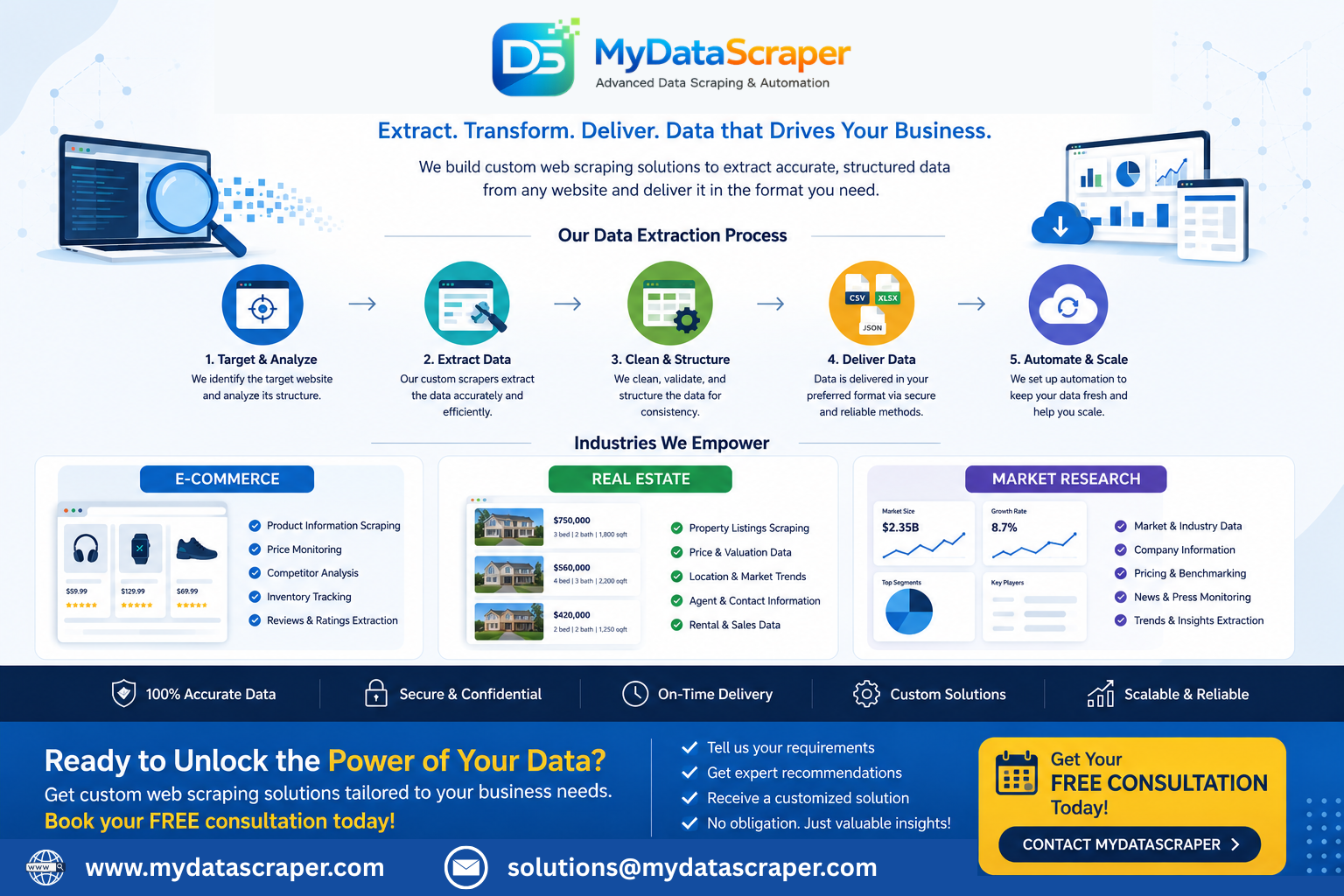
At MyDataScraper, we build custom job listing data extraction solutions tailored to your specific intelligence objectives — delivering clean, normalized, analysis-ready job market data in CSV, JSON, or Excel on any schedule you need. Our solutions cover any job board, any company career page, any geography — with salary intelligence, skills taxonomy mapping, and title normalization built in.
Every competitor posting is a signal about their strategy. Every salary range is a data point for your compensation decisions. Every skills requirement is a clue about technology adoption trends. The only question is whether you’re collecting these signals systematically — or hoping to catch the right ones by chance.
Custom Job Data Extraction
Built for Your Talent Strategy
Free consultation. Fast setup. No technical knowledge required. Tell us what job market intelligence you need — and we’ll build the automated extraction pipeline that delivers it continuously, cleanly, and affordably.
📩 Contact MyDataScraper — Free Consultation Visit www.mydatascraper.com to explore all our data extraction services.