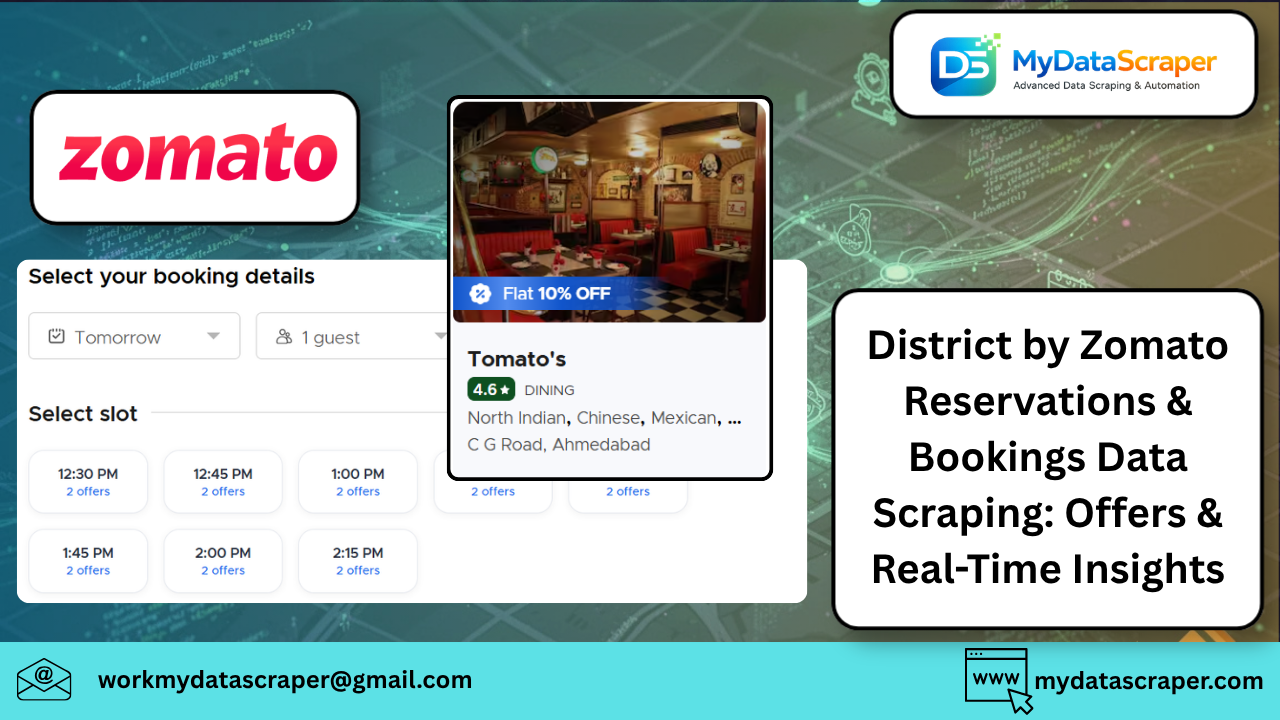
In today’s competitive dining and nightlife ecosystem, data is no longer optional—it’s a strategic asset. Platforms like District by Zomato are redefining how users discover restaurants, book tables, and access exclusive offers.
But for businesses, aggregators, and analytics companies, the real opportunity lies deeper—in reservation patterns, booking behavior, and promotional data.
In this blog, we’ll explore how scraping District by Zomato reservations, bookings, and offers data can help businesses gain powerful insights, optimize pricing, and outperform competitors.
What is District by Zomato?
District by Zomato is an evolution of dining + experiences, combining:
- Restaurant reservations
- Nightlife and event bookings
- Time-sensitive offers and deals
- Curated premium dining experiences
Unlike traditional listing platforms, it focuses heavily on booking-driven engagement and promotional campaigns, making it a high-value data source.
Why Reservations & Offers Data Matters
Let’s start with a simple real-world scenario.
Imagine two restaurants in the same area:
- One is offering 25% off during weekdays
- Another is offering no discount but has limited slots
Now, if you track:
- Which one gets more bookings
- At what time slots
- With what discount levels
You can reverse-engineer demand behavior.
This is exactly why businesses scrape booking + offers data.
According to industry insights, companies use this data to monitor discount strategies, booking density, and demand fluctuations in real time.
What Data Can You Extract?
A robust District by Zomato scraping API typically captures:
🪑 Reservation & Booking Data
- Available time slots
- Table sizes
- Booking status (available / sold out)
- Peak vs off-peak demand
💸 Offers & Discounts Data
- Discount percentages
- Buy-one-get-one deals
- Membership-based offers
- Time-based promotions
📊 Demand & Trend Data
- Booking frequency
- Day-wise demand patterns
- Weekend vs weekday trends
🏪 Restaurant Metadata
- Location
- Cuisine type
- Ratings & reviews
- Price range
A Real Insight Example (From Experience)
While working on a dining analytics project, we tracked bookings across multiple premium restaurants.
What stood out:
- Heavy discounts didn’t always mean higher bookings
- Some premium restaurants performed better with limited offers but better timing
- Weekday offers (Tue–Thu) had higher ROI than weekend discounts
This aligns with findings where businesses optimized campaigns by correlating discount levels with booking behavior and customer type.
Key Use Cases of District Data Scraping
1. Competitor Offer Tracking
Track:
- What discounts competitors are offering
- How frequently offers change
- Which deals drive bookings
This helps avoid:
- Over-discounting
- Losing margin unnecessarily
2. Booking Trend Analysis
Understand:
- Peak dining hours
- Slow time slots
- Seasonal demand
Businesses use this to align promotions with actual demand, not guesswork.
3. Revenue Optimization
With booking + offer data, you can:
- Increase prices during high demand
- Offer discounts only when needed
- Improve profit margins
4. Multi-Location Performance Tracking
For restaurant chains:
- Compare city-wise booking trends
- Identify high-performing outlets
- Optimize marketing spend
5. Customer Behavior Insights
Analyze:
- Discount-driven vs premium diners
- Booking frequency
- Preferred dining times
How District by Zomato Scraping API Works
Let’s simplify the process:
Step 1: Data Collection
Automated systems extract data from:
- Restaurant pages
- Booking widgets
- Offer sections
Step 2: Handling Dynamic Content
District uses dynamic interfaces, meaning:
- Data loads in real time
- Requires browser automation
- Needs advanced scraping logic
Step 3: Data Structuring
Raw data is converted into:
- JSON / CSV
- Structured datasets
- Analytics-ready formats
Step 4: Real-Time Monitoring
Continuous tracking enables:
- Live booking updates
- Instant offer tracking
- Demand forecasting
Challenges in Scraping District by Zomato
1. Dynamic UI & APIs
Booking slots and offers change frequently.
2. Anti-Bot Mechanisms
Includes:
- Rate limits
- Session validation
- CAPTCHA systems
3. Data Standardization
Different restaurants may display:
- Different offer formats
- Different pricing structures
Requires normalization.
4. Compliance Considerations
Always ensure:
- Ethical data usage
- Platform terms compliance
Advanced Insights You Can Unlock
Once you have clean data, the possibilities are huge:
📈 Slot-Level Demand Forecasting
Predict which time slots will fill fastest.
🎯 Offer Effectiveness Analysis
Which discounts actually drive bookings?
💰 Margin Impact Modeling
Identify:
- Profitable offers
- Loss-making campaigns
🧠 Predictive Pricing
Use historical data to:
- Set optimal discounts
- Improve ROI
Real Business Impact
Companies using structured District data scraping have achieved:
- Better control over discount strategies
- Improved booking quality
- Increased high-value customers
- More efficient marketing spend
In one case, businesses reduced unnecessary discounting and improved premium reservations by analyzing booking + offer correlations.
How MyDataScraper Can Help
If you’re looking to extract and analyze District by Zomato data at scale, MyDataScraper offers powerful solutions tailored for hospitality intelligence.
✔ Reservation & Booking Data Extraction
Track real-time slot availability and booking trends.
✔ Offers & Deals Monitoring
Monitor discounts, campaigns, and competitor strategies.
✔ Multi-Platform Data Integration
Combine insights from:
- District
- Zomato
- Swiggy
- Other platforms
✔ Custom Dashboards
Visualize booking trends, offer performance, and demand insights.
✔ Scalable Infrastructure
Handle millions of data points across cities.
Future of Dining Intelligence
The future is moving toward:
- AI-driven pricing models
- Real-time demand forecasting
- Personalized dining offers
- Hyper-dynamic promotions
Businesses that invest in data today will lead tomorrow’s dining ecosystem.
Final Thoughts
Scraping District by Zomato reservations, bookings, and offers data is not just about collecting information—it’s about understanding how the dining market actually works.
With the right data, you can:
- Optimize pricing
- Improve booking conversions
- Reduce unnecessary discounts
- Gain a strong competitive edge
In a world where every table, every time slot, and every offer matters—data is your biggest advantage.
Let’s Hear From You!
Have you ever noticed how restaurant offers change depending on the time or day?
Do you think discounts really influence your booking decisions?
Drop your thoughts in the comments—I’d love to hear your experience!
Need Help with District by Zomato Data Scraping?
If you want to build a powerful reservation intelligence system or track offers at scale, we’re here to help.
👉 Get in touch: https://www.mydatascraper.com/contact-us/
Let’s turn booking data into smarter business decisions 🚀